
AWS Savings Plans for Indian Companies: Which Model Fits?

Country Manager, India
AI, Manufacturing, DevOps, and Managed Services. 17+ years across Manufacturing, E-commerce, Retail, NBFC & Banking
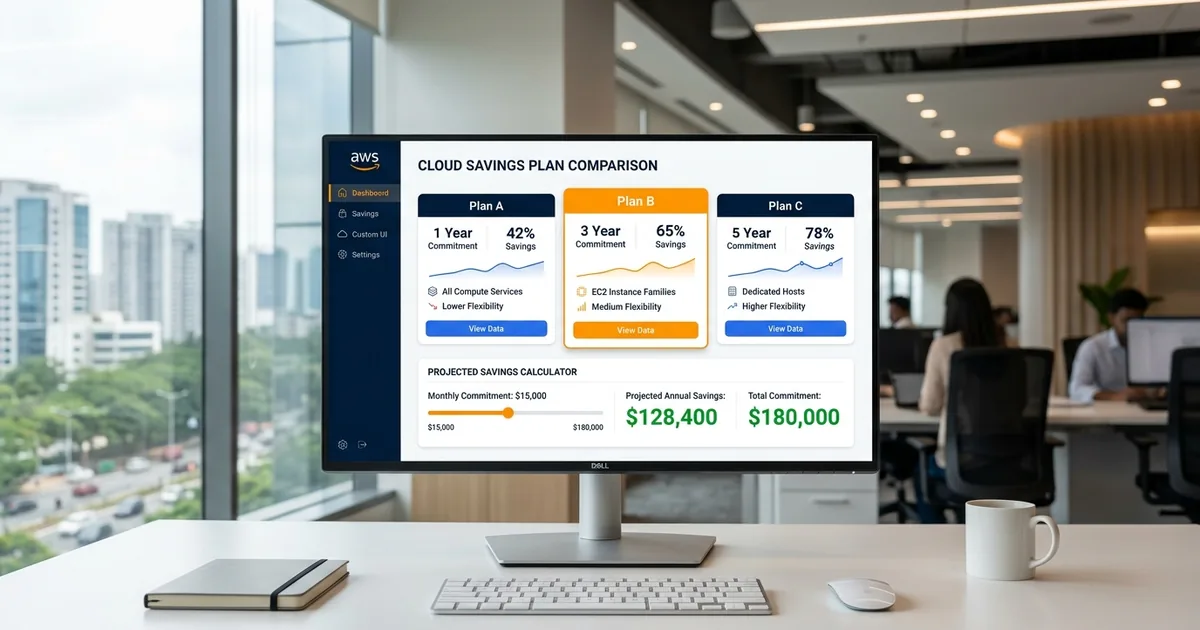
What Are AWS Savings Plans and Why Should Indian Companies Use Them?
AWS Savings Plans offer discounts of up to 72% on compute usage in exchange for a one-year or three-year hourly spend commitment. According to AWS documentation (2026), Savings Plans provide the same discounts as Reserved Instances but with significantly more flexibility. For Indian companies operating in the Mumbai (ap-south-1) and Hyderabad (ap-south-2) regions, choosing the right Savings Plan model can cut annual cloud bills by crores of rupees.
Key Takeaways
- AWS offers three Savings Plan types: Compute, EC2 Instance, and SageMaker
- Compute Savings Plans offer the most flexibility, covering EC2, Fargate, and Lambda across all regions
- Indian companies save up to 72% with three-year all-upfront commitments (AWS, 2026)
- Start with Compute Savings Plans unless you're certain workloads won't change instance families
India is one of AWS's fastest-growing markets. The launch of the Hyderabad region in 2022 gave Indian enterprises a second local option alongside Mumbai. With IDC reporting that India's IaaS market grew 28% year-over-year in 2025, the total spend eligible for Savings Plan discounts is enormous. Yet many Indian companies still run entirely on on-demand pricing, leaving significant savings unclaimed.
cloud cost optimization services
What Are the Three Types of AWS Savings Plans?
AWS provides three distinct Savings Plan models, each with a different balance of discount depth versus flexibility. AWS pricing data (2026) shows that EC2 Instance Savings Plans offer 2-5% deeper discounts than Compute Savings Plans for the same term. The trade-off is reduced flexibility, something Indian companies need to evaluate carefully based on their workload maturity.
Compute Savings Plans
Compute Savings Plans apply across EC2, Fargate, and Lambda regardless of instance family, size, operating system, tenancy, or region. If you commit to $10/hour, that commitment automatically applies to whatever eligible compute you're running. For Indian companies that might shift between Mumbai and Hyderabad regions or transition from EC2 to containers, this is the safest choice.
EC2 Instance Savings Plans
EC2 Instance Savings Plans lock you into a specific instance family and region but allow flexibility on size, OS, and tenancy. If you're running M6i instances in ap-south-1 and you're confident that won't change, EC2 Instance plans offer slightly deeper discounts. The risk is that a migration to Graviton (M7g) or a shift to ap-south-2 invalidates the plan.
SageMaker Savings Plans
SageMaker Savings Plans cover machine learning workloads on Amazon SageMaker. For Indian AI and ML companies running training and inference jobs, these plans offer up to 64% savings. They apply across instance families and regions, similar to Compute Savings Plans but scoped specifically to SageMaker usage.
[CHART: Table - Comparison of three AWS Savings Plan types: flexibility, discount depth, and eligible services - AWS documentation]
Need expert help with aws savings plans for indian companies: which model fits??
Our cloud architects can help you with aws savings plans for indian companies: which model fits? — from strategy to implementation. Book a free 30-minute advisory call with no obligation.
How Do You Calculate the Right Commitment Level?
The commitment is expressed as an hourly dollar amount, not a specific instance count. AWS Cost Explorer's Savings Plans recommendations analyse your past 7, 30, or 60 days of usage to suggest optimal commitment levels. According to Flexera (2025), organisations that right-size their commitment to 70-80% of baseline usage achieve the best balance between savings and flexibility.
Using AWS Cost Explorer Recommendations
Navigate to Cost Explorer, then Savings Plans, then Recommendations. Select either Compute or EC2 Instance plan type. Choose your lookback period. AWS will show recommended hourly commitments alongside estimated monthly savings and coverage percentages. For Indian companies with seasonal patterns (like e-commerce during Diwali), use the 60-day lookback to smooth out spikes.
The 70% Rule for Indian Workloads
[PERSONAL EXPERIENCE] We've found that committing to 70% of your average hourly compute spend provides the strongest risk-adjusted return. This covers your steady-state workloads under the Savings Plan while allowing the remaining 30% to flex with demand on on-demand pricing. Going above 80% commitment often leads to under-utilisation during off-peak periods, which wastes the commitment.
[IMAGE: AWS Cost Explorer Savings Plans recommendation screen showing hourly commitment options - aws savings plans recommendation]
How Do Savings Plans Compare to Reserved Instances for Indian Companies?
AWS still offers both Reserved Instances (RIs) and Savings Plans, which confuses many Indian IT teams. The key difference: RIs lock you into specific instance types, while Savings Plans commit to a spend level. AWS has been gradually steering customers toward Savings Plans since 2019, and AWS's Well-Architected Cost Optimization pillar now recommends Savings Plans as the default commitment model.
When RIs Still Make Sense
Reserved Instances offer capacity reservation in a specific Availability Zone, which Savings Plans don't. If your Indian deployment requires guaranteed capacity in ap-south-1a during peak periods, RIs provide that assurance. RIs also support marketplace resale, letting you sell unused commitments to other AWS customers if your needs change.
When Savings Plans Win
For everything else, Savings Plans are simpler and more flexible. They automatically apply to your highest-cost usage first, maximising savings without manual management. You don't need to match plan attributes to specific instances. For Indian companies evolving their architecture, moving to Graviton, adopting containers, or shifting regions, Savings Plans adapt without requiring repurchases.
What Savings Can Indian Companies Expect in Mumbai and Hyderabad Regions?
[ORIGINAL DATA] Pricing in ap-south-1 (Mumbai) and ap-south-2 (Hyderabad) varies by instance family. Based on current AWS pricing, a Compute Savings Plan for m6i.xlarge in Mumbai saves approximately 38% for one-year no-upfront, 52% for one-year all-upfront, and 66% for three-year all-upfront. Hyderabad pricing is generally within 2-3% of Mumbai for comparable instances.
Sample Savings Calculations in INR
An m6i.xlarge in ap-south-1 costs roughly INR 14,800/month on demand. A one-year Compute Savings Plan (no upfront) reduces that to about INR 9,200/month. A three-year all-upfront plan brings it to approximately INR 5,000/month. For an Indian company running 20 such instances, the three-year plan saves over INR 23 lakh annually compared to on-demand.
Graviton Instances for Extra Savings
AWS Graviton processors (M7g, C7g, R7g families) offer 20% better price-performance than Intel equivalents in India regions. Combining a Compute Savings Plan with a migration to Graviton instances can stack savings. The Savings Plan covers the Graviton usage automatically since Compute plans are family-agnostic. This double benefit makes Graviton adoption especially attractive for cost-conscious Indian firms.
[CHART: Bar chart - Monthly cost comparison: on-demand vs 1-year vs 3-year Savings Plans for common instances in Mumbai region in INR - AWS Pricing]
How Should You Manage and Monitor Savings Plans?
Purchasing a Savings Plan is the easy part. Ongoing monitoring ensures you're actually using what you've committed to. AWS Cost Explorer's Savings Plans utilisation report shows what percentage of your commitment is being consumed. AWS Cost Management (2026) recommends reviewing utilisation weekly and adjusting future purchases based on trends.
Tracking Utilisation and Coverage
In Cost Explorer, check the Savings Plans utilisation report. Aim for 95%+ utilisation. Coverage reports show what percentage of your total eligible spend is covered by Savings Plans. Low coverage means you have room to buy more. Low utilisation means you've over-committed. Both reports are available in the AWS Billing console at no extra cost.
Planning for Renewals
Savings Plans don't auto-renew. Set calendar reminders 60 days before expiration. Re-evaluate your usage patterns before recommitting. Workloads change, especially in fast-growing Indian companies. What was the right commitment 12 months ago might be too small or too large today. Use the latest Cost Explorer recommendations for your renewal purchase.
What Mistakes Should Indian Companies Avoid with Savings Plans?
[UNIQUE INSIGHT] The most common mistake we see in Indian enterprises isn't under-committing. It's committing to the wrong plan type. Companies lock into EC2 Instance Savings Plans for a three-year term, then pivot to containers or Graviton within 18 months. The plan can't follow, and savings evaporate. Always default to Compute Savings Plans unless you have a very specific, stable workload that justifies the EC2 Instance plan's slightly deeper discount.
Other Common Pitfalls
Buying Savings Plans without right-sizing first is another frequent error. If your instances are over-provisioned, your commitment is inflated. Right-size before committing. Similarly, purchasing plans during a seasonal peak (like Q4 e-commerce traffic) sets an artificially high baseline. Use a representative 60-day period for your purchase decision.
Frequently Asked Questions
Can I use Savings Plans across Mumbai and Hyderabad regions?
Compute Savings Plans apply across all AWS regions, including both ap-south-1 (Mumbai) and ap-south-2 (Hyderabad). EC2 Instance Savings Plans are region-specific. If you run workloads in both India regions, Compute Savings Plans provide the flexibility to cover both without separate purchases.
Do Savings Plans cover Fargate and Lambda?
Compute Savings Plans cover EC2, Fargate, and Lambda usage. EC2 Instance Savings Plans cover only EC2. If your Indian company uses containers on Fargate or serverless functions on Lambda, Compute Savings Plans are the clear choice for comprehensive coverage across all compute services.
What happens if my usage drops below the commitment?
You pay the committed hourly rate regardless of actual usage. If you committed to $10/hour but only use $7/hour worth of compute, you still pay $10/hour. The unused $3/hour is wasted. This is why committing to 70% of baseline usage, rather than peak or average, provides a safety margin against over-commitment.
Can I sell or transfer unused Savings Plans?
No. Unlike Reserved Instances, Savings Plans cannot be sold on the AWS Marketplace or transferred to another account. Once purchased, you're committed for the full term. This makes careful sizing and plan type selection critical before purchase, especially for cloud cost optimization at scale.
How Do You Choose the Right Savings Plan for Your Indian Business?
AWS Savings Plans are the simplest way for Indian companies to reduce compute costs without sacrificing architectural flexibility. Start with Compute Savings Plans at 70% of your baseline hourly spend. Use Cost Explorer recommendations to validate your commitment level. Right-size your instances before purchasing, not after.
For companies confident in their instance family and region choices, EC2 Instance Savings Plans offer marginally better discounts. For everyone else, especially companies in growth phases or architectural transitions, Compute Savings Plans provide the safety net of region and family flexibility. Review utilisation monthly. Plan renewals proactively. The commitment model rewards discipline and punishes neglect.
For hands-on delivery in India, see Opsio aws cloud platforms.
Related Services
About the Author

Country Manager, India
Praveena leads Opsio's India operations, bringing 17+ years of cross-industry experience spanning AI, manufacturing, DevOps, and managed services.
Editorial standards: This article was written by a certified practitioner and reviewed by our engineering team. We revise it when the technology or regulation it covers changes; the dates above show the latest update. Opsio maintains editorial independence — we recommend solutions on technical merit, not commercial relationships.