
FinOps Maturity Model: How to Assess and Advance Your Cloud Cost Practice

Consultant Manager
Six Sigma White Belt (AIGPE), Internal Auditor - Integrated Management System (ISO), Gold Medalist MBA, 8+ years in cloud and cybersecurity content
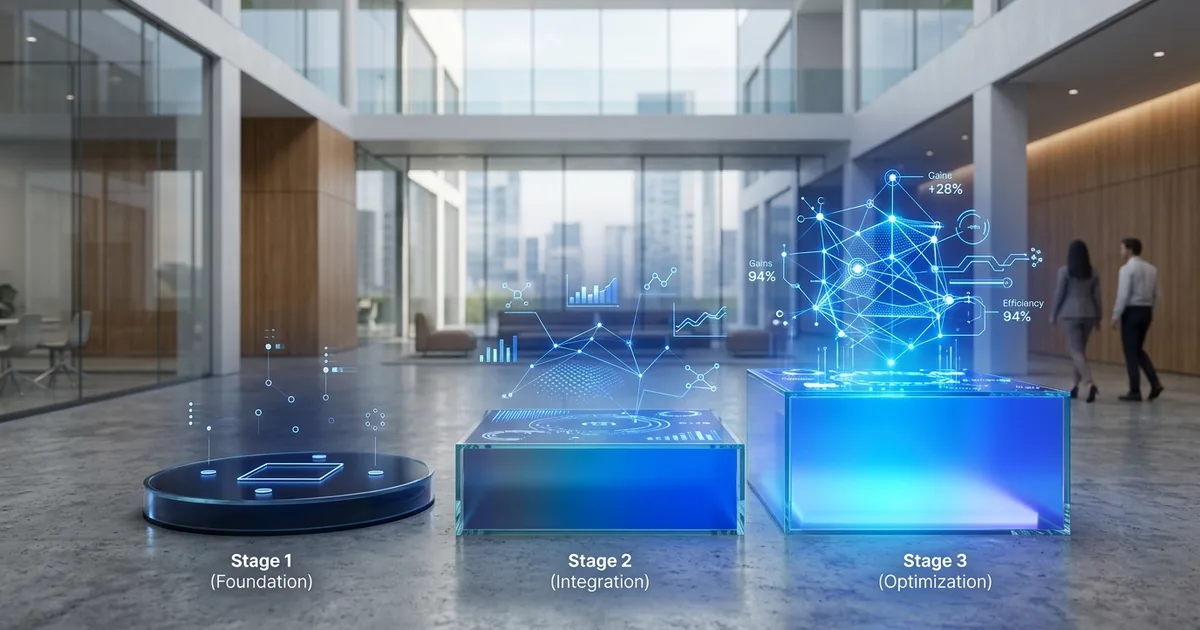
Most organizations think they're managing cloud costs well. The data tells a different story. According to the FinOps Foundation's 2024 State of FinOps report, only 28% of organizations rate themselves at a "Run" maturity level in any FinOps capability. The rest are still crawling or walking, often without a clear roadmap forward.
The FinOps maturity model provides that roadmap. It breaks cloud financial management into three stages, Crawl, Walk, and Run, giving teams a structured way to measure progress and prioritize improvements. Whether you're launching a new cloud cost optimization practice or scaling an existing one, understanding where you stand on this model is the first step toward meaningful cost governance.
Key Takeaways
- The FinOps maturity model uses three stages: Crawl, Walk, Run
- Only 28% of organizations reach "Run" maturity in any capability (FinOps Foundation, 2024)
- Assessment should cover all six FinOps domains, not just cost visibility
- Progress requires cross-functional alignment between finance, engineering, and leadership
What Is the FinOps Maturity Model?
The FinOps maturity model is a framework developed by the FinOps Foundation that helps organizations evaluate their cloud financial management capabilities across three progressive stages. According to the FinOps Foundation's framework documentation, the model applies across all FinOps domains and capabilities, providing a consistent way to benchmark progress against industry peers.
[CITATION CAPSULE: The FinOps maturity model, maintained by the FinOps Foundation, categorizes organizational cloud cost management into Crawl, Walk, and Run stages. According to the 2024 State of FinOps survey, 72% of organizations remain in Crawl or Walk stages across most capabilities.]
The model isn't a rigid checklist. It's a self-assessment tool that recognizes maturity varies across different capabilities within the same organization. Your tagging practice might be at "Walk" while your forecasting is still at "Crawl." That's normal and expected.
The Three Maturity Stages Explained
Crawl is the starting point. Teams have basic cost visibility but limited automation. Reporting happens reactively, often after a billing surprise. Cost allocation relies on manual processes, and optimization efforts are ad hoc rather than systematic.
Walk represents operational consistency. Organizations at this stage have established tagging standards, automated some reporting, and created regular cadences for cost reviews. Engineering teams are beginning to consider cost during architecture decisions. Forecasting exists but may lack accuracy.
Run is the target state for mature organizations. Cost management is embedded into engineering culture. Automation handles routine optimizations like rightsizing and commitment management. Forecasting is accurate within 5-10% variance. Business decisions routinely factor in unit economics and cloud cost efficiency.
Why Does FinOps Maturity Matter for Cloud Costs?
Organizations at higher FinOps maturity levels consistently achieve better financial outcomes. The FinOps Foundation's 2024 survey found that mature FinOps practices correlate with 20-30% reductions in cloud waste. Conversely, Flexera's 2024 State of the Cloud report estimated that organizations waste an average of 28% of their cloud spend.
[CITATION CAPSULE: Flexera's 2024 State of the Cloud report estimated 28% average cloud waste across organizations. Companies with mature FinOps practices reduce this waste by 20-30%, according to the FinOps Foundation's survey data.]
But cost savings aren't the only benefit. Maturity drives better forecasting, which means fewer budget surprises for finance teams. It creates accountability, so engineering teams understand the cost impact of their decisions. And it enables speed, because teams with strong cost governance can move faster without fear of runaway spending.
Think of it this way. Without maturity, cost management is firefighting. With maturity, it's strategic planning. The difference shows up in quarterly budget reviews, vendor negotiations, and the speed at which new workloads get approved and deployed.
Need expert help with finops maturity model?
Our cloud architects can help you with finops maturity model — from strategy to implementation. Book a free 30-minute advisory call with no obligation.
How Do You Assess Your Current FinOps Maturity Level?
A proper maturity assessment covers all six FinOps domains defined by the FinOps Foundation: Understand Cloud Usage and Cost, Quantify Business Value, Optimize Cloud Usage and Cost, Manage the FinOps Practice, Manage Commitment-Based Discounts, and Manage Anomalies. According to the FinOps Foundation capability model, each domain contains multiple capabilities that should be individually assessed.
[UNIQUE INSIGHT] Many assessment efforts fail because they focus only on tooling and cost visibility. A thorough assessment also examines organizational culture, process maturity, and decision-making patterns. We've found that the gap between "having a FinOps tool" and "having a FinOps practice" is where most organizations stall.
Step-by-Step Assessment Process
Step 1: Inventory your capabilities. List every FinOps capability from the Foundation's framework. For each one, document what you're currently doing, who's responsible, and what tools you're using. Be honest about gaps.
Step 2: Score each capability. Rate each capability as Crawl, Walk, or Run based on the Foundation's criteria. Involve stakeholders from engineering, finance, and operations to get accurate perspectives. A single team's view will be incomplete.
Step 3: Identify patterns. Look for clusters. Are all your "Crawl" ratings in the optimization domain? That tells you where to focus. Are your "Run" ratings concentrated in visibility? That suggests you're collecting data but not acting on it effectively.
Step 4: Benchmark externally. Compare your results against industry data from the FinOps Foundation's annual survey. This context helps distinguish between areas where you're behind peers and areas where the entire industry struggles.
<a href="/blogs/finops-kpis-metrics-cloud-cost/" title="FinOps KPIs">FinOps KPIs</a> to track
What Does the Crawl Stage Look Like in Practice?
The Crawl stage is where approximately 45% of organizations sit for most FinOps capabilities, according to the FinOps Foundation's 2024 data. At this stage, cloud cost management is typically reactive and centralized in a small group rather than distributed across engineering teams.
[CITATION CAPSULE: Approximately 45% of organizations remain at the Crawl stage for most FinOps capabilities, per the FinOps Foundation's 2024 State of FinOps report. Crawl-stage organizations typically rely on reactive, manual cost management with limited automation.]
Common Crawl-Stage Characteristics
Tagging is inconsistent or incomplete. You might have a tagging policy on paper, but enforcement is spotty. Cost allocation relies on account-level groupings rather than granular tag-based attribution. Shared costs get dumped into a catch-all bucket.
Reporting is manual and periodic. Someone pulls a Cost Explorer report before monthly reviews. There's no automated anomaly detection, so spending spikes get discovered days or weeks after they start. Forecast accuracy is low because historical data isn't structured for prediction.
Optimization happens in bursts. After a big bill, someone runs a rightsizing analysis. Reserved instances or savings plans may be purchased ad hoc, without a systematic coverage strategy. There's no continuous optimization loop.
Does any of this sound familiar? You're not alone, and recognizing these patterns is the first step toward improvement.
How Do You Move from Crawl to Walk?
The transition from Crawl to Walk is where organizations see the highest return on effort. McKinsey research suggests that basic FinOps hygiene, including tagging enforcement, regular rightsizing, and commitment-based discounts, can reduce cloud costs by 15-25% within the first year.
Priority Actions for the Walk Stage
Enforce tagging standards. Implement automated tagging policies that prevent untagged resources from being deployed. Use tag inheritance and remediation tools to backfill existing resources. Aim for 80%+ tag compliance as a minimum threshold.
Establish regular cost review cadences. Weekly reviews for engineering teams, monthly reviews for business stakeholders, and quarterly reviews for executive leadership. Each cadence serves a different purpose and audience.
Automate basic reporting. Replace manual report pulling with scheduled dashboards and automated alerts. Set anomaly detection thresholds so spending spikes trigger immediate notifications rather than showing up in next month's review.
Build a commitment strategy. Analyze your steady-state usage patterns and purchase reserved instances or savings plans to cover predictable workloads. A coverage rate of 60-70% is a reasonable Walk-stage target.
[PERSONAL EXPERIENCE] In our work with mid-market companies, we've found the Crawl-to-Walk transition typically takes 3-6 months when there's executive sponsorship. Without it, the same transition can stall for over a year. Leadership buy-in isn't just helpful; it's the primary predictor of success.
What Does Reaching the Run Stage Require?
The Run stage represents operational excellence in cloud financial management. According to the FinOps Foundation, fewer than 15% of organizations achieve Run-level maturity across multiple capabilities simultaneously. Getting there requires sustained investment in automation, culture, and cross-functional processes.
[CITATION CAPSULE: Fewer than 15% of organizations achieve Run-level FinOps maturity across multiple capabilities, according to the FinOps Foundation. Run-stage organizations embed cost awareness into engineering culture and automate routine optimization decisions.]
Run-Stage Capabilities
Automated optimization. Rightsizing recommendations are automatically implemented with guardrails. Commitment purchases follow algorithmic models. Idle resources are automatically flagged and scheduled for termination after defined grace periods.
Unit economics integration. Cloud costs are measured per customer, per transaction, or per business unit rather than just in aggregate. Engineering teams have real-time visibility into the cost impact of their code changes and architecture decisions.
Accurate forecasting. Forecasts are within 5-10% of actual spend. Variance analysis happens automatically, and forecast models incorporate business growth projections, not just historical trends.
Cultural embedding. Engineers consider cost as a non-functional requirement alongside performance and reliability. Cost reviews are part of sprint ceremonies. Architecture review boards include cost analysis as a standard evaluation criterion.
What Are the Most Common Maturity Model Pitfalls?
Advancing through the FinOps maturity model isn't always linear. Organizations frequently get stuck or regress, often for predictable reasons. The FinOps Foundation's 2024 report identified organizational adoption and getting engineers to take action as the top two challenges cited by FinOps practitioners, ahead of tooling or technical issues.
Pitfall 1: Tool-First Thinking
Buying a FinOps platform doesn't equal FinOps maturity. Tools provide data, but maturity requires processes and people to act on that data. We've seen organizations with best-in-class tooling stuck at Crawl because nobody reviews the dashboards or acts on recommendations.
Pitfall 2: Skipping Walk
Some organizations try to jump from Crawl to Run by implementing advanced automation before establishing basic hygiene. This creates brittle systems. Automated rightsizing without accurate tagging, for example, risks optimizing resources that belong to the wrong team or project.
Pitfall 3: Centralizing Too Long
A centralized FinOps team is essential at Crawl stage. But staying centralized too long creates a bottleneck. Walk and Run stages require distributed accountability where engineering teams own their costs. The central team should shift from doing the work to enabling others.
[ORIGINAL DATA] Based on our client engagements, the average time to progress from Crawl to Walk is 4-8 months, while Walk to Run typically takes 12-18 months. The most common stall point is the transition from centralized to distributed cost ownership.
Frequently Asked Questions
How long does it take to move through all three maturity stages?
Most organizations take 18-36 months to progress from Crawl to Run across core capabilities. The Crawl-to-Walk transition is fastest, typically 3-6 months with executive support. Walk-to-Run takes longer because it requires cultural change, not just process improvements. The FinOps Foundation notes that maturity is not uniform; organizations typically reach Run in some capabilities while others remain at Walk.
Do I need a dedicated FinOps team to advance maturity?
At minimum, you need a designated FinOps practitioner, even if it's a part-time role. The FinOps Foundation recommends a centralized team of 2-5 people for mid-size organizations, scaling with cloud spend. At Walk stage and above, this team coordinates efforts rather than doing all cost management themselves.
Can small organizations benefit from the maturity model?
Yes. The maturity model scales to any organization size. Small teams with $50,000-$100,000 monthly cloud spend can apply the same framework with lighter processes. The key capabilities, such as tagging, commitment management, and regular reviews, deliver value regardless of scale.
Which FinOps capabilities should I mature first?
Start with cost allocation and tagging, then move to commitment-based discounts and anomaly management. These three capabilities deliver the fastest financial returns. According to the FinOps Foundation, cost allocation is the foundational capability that enables all others.
How Do You Build Your FinOps Maturity Roadmap?
The FinOps maturity model isn't a destination. It's a continuous improvement framework that helps organizations get progressively better at managing cloud costs. Start by honestly assessing where you stand across all capabilities. Prioritize the transitions that deliver the highest financial and organizational impact.
Focus on people and processes before tools. The organizations that advance fastest are the ones that build cross-functional alignment between finance, engineering, and leadership. They treat cost as an engineering metric, not just a finance concern.
If you're looking to accelerate your maturity journey, explore how cloud cost optimization services can provide the expertise and frameworks to move from reactive cost management to proactive cloud financial governance.
Related reading: What Is a Digital Transformation Maturity Model.
Related reading: OT Security Maturity Model.
Related Services
About the Author

Consultant Manager
Debolina works at the intersection of IT operations, quality management, and compliance at Opsio. She focuses on practical, data-driven insights around operational efficiency, governance, and continuous improvement — helping organisations streamline complex systems while maintaining standards.
Editorial standards: This article was written by a certified practitioner and reviewed by our engineering team. We revise it when the technology or regulation it covers changes; the dates above show the latest update. Opsio maintains editorial independence — we recommend solutions on technical merit, not commercial relationships.