
Cloud Governance Framework: How to Control Cloud Usage and Costs

Group COO & CISO
Operational excellence, governance, and information security. Aligns technology, risk, and business outcomes in complex IT environments
Without governance, cloud environments grow into sprawling, expensive ecosystems that nobody fully understands. According to Flexera's 2024 State of the Cloud report, 84% of enterprises report cloud governance as a top initiative, yet most struggle with inconsistent policies across teams and environments.
A cloud governance framework provides the structure to balance innovation speed with cost control, end-to-end cloud security, and operational consistency. It defines who can provision what, where guardrails apply, and how decisions get made. For organizations serious about cloud cost optimization, governance isn't a constraint. It's the foundation that makes sustainable optimization possible.
Key Takeaways
- 84% of enterprises cite cloud governance as a top initiative (Flexera, 2024)
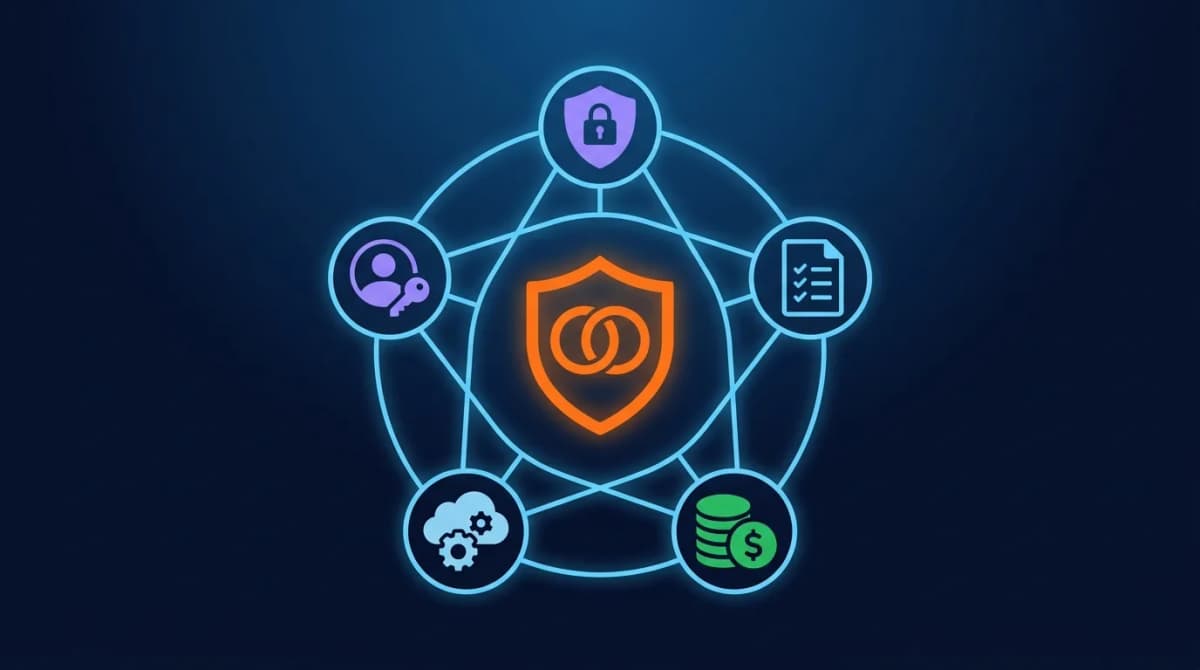
- A governance framework covers five pillars: cost, security, compliance, operations, and architecture
- Automated policy enforcement scales better than manual approval processes
- Start with high-impact policies and expand incrementally
What Is a Cloud Governance Framework?
A cloud governance framework is a structured set of policies, processes, and tools that control how an organization uses cloud resources. According to Gartner, organizations with formal cloud governance frameworks experience 30% fewer security incidents and 20-25% lower cloud waste compared to ungoverned environments.
[CITATION CAPSULE: Gartner research indicates that organizations with formal cloud governance frameworks experience 30% fewer security incidents and 20-25% lower cloud waste. Governance provides the policy structure that enables consistent cost control, security compliance, and operational efficiency across cloud environments.]
The Five Pillars of Cloud Governance
Cost governance controls spending through budgets, alerts, tagging requirements, and approval workflows for high-cost resources. It's the pillar most directly connected to FinOps practices.
Security governance enforces encryption standards, access controls, network segmentation rules, and vulnerability management requirements. It prevents misconfigurations that lead to breaches.
Compliance governance ensures cloud usage meets regulatory requirements (HIPAA, SOC 2, GDPR, PCI-DSS). It covers data residency, audit logging, and retention policies.
Operations governance standardizes how resources are provisioned, monitored, patched, and decommissioned. It includes naming conventions, tagging standards, and lifecycle management policies.
Architecture governance guides technology choices, approved services, and design patterns. It prevents architecture fragmentation and ensures workloads follow organizational standards for reliability and cost efficiency.
Why Does Cloud Governance Matter for Cost Control?
Cost governance prevents waste at the source rather than cleaning it up after the fact. According to McKinsey, proactive cost governance through policies and guardrails reduces cloud waste by 15-25% more than reactive optimization alone. Prevention is cheaper than remediation.
Consider the lifecycle of ungoverned cloud spending. An engineer provisions an oversized instance for a quick test. Nobody enforces tagging, so the resource becomes invisible to cost tracking. The test finishes, but the instance runs for months because there's no decommission process. This pattern, repeated across hundreds of engineers, generates enormous waste.
Governance interrupts this pattern at multiple points: tagging requirements make the resource visible, sizing policies prevent over-provisioning, lifecycle rules flag idle resources, and budget alerts catch spending anomalies early. Each layer of governance reduces the surface area for waste.
Does governance slow down developers? Done right, it shouldn't. The best governance frameworks use automated guardrails that prevent bad outcomes without requiring manual approvals for routine operations. The goal is speed within safe boundaries, not bureaucratic gatekeeping.
Need expert help with cloud governance framework?
Our cloud architects can help you with cloud governance framework — from strategy to implementation. Book a free 30-minute advisory call with no obligation.
How Do You Build a Cloud Governance Framework?
Building a governance framework requires input from IT, finance, security, and business leadership. The FinOps Foundation recommends starting with the policies that deliver the highest impact and expanding incrementally rather than attempting comprehensive governance from day one.
[CITATION CAPSULE: The FinOps Foundation recommends building cloud governance incrementally, starting with high-impact policies. Organizations that implement governance in phases report 3x higher adoption rates than those attempting comprehensive frameworks from the start.]
Phase 1: Foundation (Months 1-3)
Account and subscription structure. Organize cloud accounts by business unit, environment (production, staging, development), or product line. This structure enables account-level cost allocation and policy scoping.
Tagging policy. Define mandatory tags (cost-center, team, environment, application) and enforce them through cloud provider policies and CI/CD pipeline checks. Tagging is the single most important governance policy for cost management.
Budget alerts. Set spending thresholds at the account and team level. Configure alerts at 50%, 80%, and 100% of budget. This provides early warning without requiring approval workflows for every provisioning action.
Phase 2: Expansion (Months 3-6)
Service and region restrictions. Limit which cloud services and regions teams can use. This prevents sprawl into services that are difficult to manage or regions that violate data residency requirements.
Instance type policies. Define approved instance families and maximum sizes for each environment. Development environments don't need production-grade instances. Enforce this automatically through cloud policies.
Lifecycle management. Implement automated policies that identify and flag resources older than defined thresholds. Require confirmation to keep development resources running longer than 30 days. Auto-terminate resources in sandbox accounts after 72 hours.
Phase 3: Maturation (Months 6-12)
Architecture review boards. Require cost analysis as part of architecture reviews for new workloads. This shifts cost considerations left into the design phase.
Automated remediation. Move from alerting to automated action: auto-stop idle development instances, auto-right-size underutilized resources, auto-enforce encryption policies.
Exception management. Create formal exception processes for teams that need to deviate from governance policies. Exceptions should be time-limited, documented, and reviewed quarterly.
[PERSONAL EXPERIENCE] The biggest governance implementation mistake we see is trying to implement everything at once. Organizations that launch with 50 policies on day one face massive resistance. Start with five high-impact policies, prove their value, then expand. Governance adoption is a marathon, not a sprint.
What Tools Support Cloud Governance?
Every major cloud provider offers native governance tooling. According to a Forrester analysis, organizations that combine native governance tools with third-party platforms achieve 40% better policy compliance than those using native tools alone.
AWS Governance Tools
AWS Organizations and SCPs provide account-level policy enforcement. AWS Config monitors compliance with configuration rules. AWS Service Catalog offers pre-approved templates. AWS Budgets handles cost alerts and actions.
Azure Governance Tools
Azure Policy enforces organizational standards across subscriptions. Azure Blueprints packages governance artifacts for consistent deployment. Management Groups enable hierarchical policy application. Azure Cost Management provides budget enforcement.
Multi-Cloud Governance Platforms
For multi-cloud environments, platforms like HashiCorp Terraform Cloud, CloudHealth, and Spot by NetApp provide unified governance across providers. Policy-as-code tools like Open Policy Agent (OPA) and Kyverno enable portable governance that works across clouds and Kubernetes.
<a href="/blogs/finops-tools-comparison-2026/" title="FinOps Tools">FinOps tools</a> comparison
How Do You Balance Governance with Innovation Speed?
The tension between governance and speed is real but manageable. According to the FinOps Foundation's 2024 data, organizations with automated governance report faster, not slower, provisioning because automated guardrails replace slow manual approval workflows.
Guardrails, Not Gates
Design governance as guardrails that prevent dangerous outcomes rather than gates that require approval for every action. An automated policy that blocks unencrypted S3 buckets is a guardrail. A manual approval process for every new S3 bucket is a gate. Guardrails scale; gates don't.
Environment-Based Flexibility
Apply governance proportionally. Production environments deserve strict policies: approved instance types, mandatory encryption, change management processes. Development and sandbox environments can be more permissive: broader service access, relaxed sizing limits, shorter approval chains.
Self-Service with Boundaries
Give teams pre-approved templates and service catalogs that comply with governance requirements. When developers can self-serve from governed templates, they move faster than if they had no governance at all, because they skip the trial-and-error of figuring out compliant configurations on their own.
[UNIQUE INSIGHT] The organizations with the best governance outcomes treat policies as products, not mandates. They gather feedback from engineering teams, iterate on policy design, and communicate the "why" behind every rule. Governance that feels imposed gets circumvented. Governance that feels collaborative gets adopted.
Frequently Asked Questions
Who should own the cloud governance framework?
Typically a Cloud Center of Excellence (CCoE) or Cloud Platform team with representatives from IT, security, finance, and engineering. The framework needs cross-functional input and authority. In smaller organizations, the FinOps practitioner or cloud architect may serve as the governance lead with executive sponsorship.
How do we enforce governance without slowing down teams?
Automate enforcement through cloud provider policies (AWS SCPs, Azure Policy) and CI/CD pipeline checks. Automated guardrails are instant, consistent, and require no manual intervention. Reserve manual approvals for genuinely high-risk actions like production changes or large resource requests.
How many governance policies should we start with?
Start with 5-7 high-impact policies: mandatory tagging, budget alerts, region restrictions, maximum instance sizes, and encryption requirements. Prove their value, build adoption, then expand by 3-5 policies per quarter based on organizational needs and risk assessment.
How does cloud governance relate to FinOps?
Cloud governance and FinOps are complementary practices. Governance provides the structural framework (policies, guardrails, standards) while FinOps provides the financial management processes (allocation, optimization, forecasting). Together they ensure cloud resources are both well-managed and cost-efficient. See our governance best practices for more detail.
How Do You Build Governance That Works?
A cloud governance framework isn't about control for its own sake. It's about creating the structure that enables teams to move fast without creating risk or waste. Start with the five pillars, implement incrementally, and automate everything you can.
The organizations that govern cloud usage most effectively treat governance as an evolving practice, not a one-time project. Policies should be reviewed quarterly, updated as the cloud environment changes, and refined based on feedback from the teams they affect.
For organizations building or strengthening their governance framework, cloud cost optimization services can provide the assessment, design, and implementation support to establish effective governance faster.
Related Services
About the Author

Group COO & CISO
Fredrik is the Group Chief Operating Officer and Chief Information Security Officer at Opsio. He focuses on operational excellence, governance, and information security, working closely with delivery and leadership teams to align technology, risk, and business outcomes in complex IT environments. He leads Opsio's security practice including SOC services, penetration testing, and compliance frameworks.
Editorial standards: This article was written by a certified practitioner and reviewed by our engineering team. We revise it when the technology or regulation it covers changes; the dates above show the latest update. Opsio maintains editorial independence — we recommend solutions on technical merit, not commercial relationships.