
Cloud Security Services for India
Protect your cloud infrastructure end-to-end across Indian regions. Opsio's cloud security services cover network security, identity management, data protection, and compliance — across AWS Mumbai, Azure Central India, and GCP Mumbai.
Trusted by 100+ organisations across 6 countries
24/7
Security Monitoring
3
Cloud Platforms
100%
Compliance
50+
Security Engineers
What's Included
Cloud Security Posture Management
Continuous assessment of your cloud configuration against CIS benchmarks and provider best practices. We detect misconfigurations, overly permissive IAM policies, unencrypted storage, and exposed services — remediating them before exploitation.
Network Security & Segmentation
Security group optimisation, network ACLs, VPC architecture, micro-segmentation, and WAF configuration. We enforce zero-trust network principles across your Indian cloud environment to restrict lateral movement.
Identity & Access Management
Least-privilege policies, MFA enforcement, service account auditing, and federated identity integration with Indian SSO providers. Only authorised users and services access your cloud resources.
Data Protection & Encryption
Encryption at rest and in transit, key management via AWS KMS and Azure Key Vault, data classification aligned with DPDPA categories, and DLP policies safeguarding sensitive Indian customer data.
DDoS Protection & WAF
AWS Shield, Azure DDoS Protection, and Cloud Armor configuration. Custom WAF rules defend applications against OWASP Top 10 vulnerabilities and application-layer attacks targeting Indian e-commerce and fintech platforms.
Security Monitoring & SIEM
Round-the-clock monitoring using cloud-native SIEM — AWS Security Hub, Azure Sentinel, Chronicle — integrated with our SOC. Real-time alerting, threat correlation, and rapid incident response for Indian enterprises.
Our AWS migration has been a journey that started many years ago, resulting in the consolidation of all our products and services in the cloud. Opsio, our AWS Migration Partner, has been instrumental in helping us assess, mobilize, and migrate to the platform, and we're incredibly grateful for their support at every step.

Roxana Diaconescu
CTO · SilverRail Technologies
Two enterprise security platforms. Included free.
Others pay a fortune for continuous vulnerability monitoring and a unified security-and-cost workspace — and then pay again for the people to run them. Every Opsio managed-cloud customer gets both, at no extra cost, with our engineers acting on what they surface.
SeqOps
Continuous vulnerability monitoring across your entire cloud & server estate — always on, never in the way.
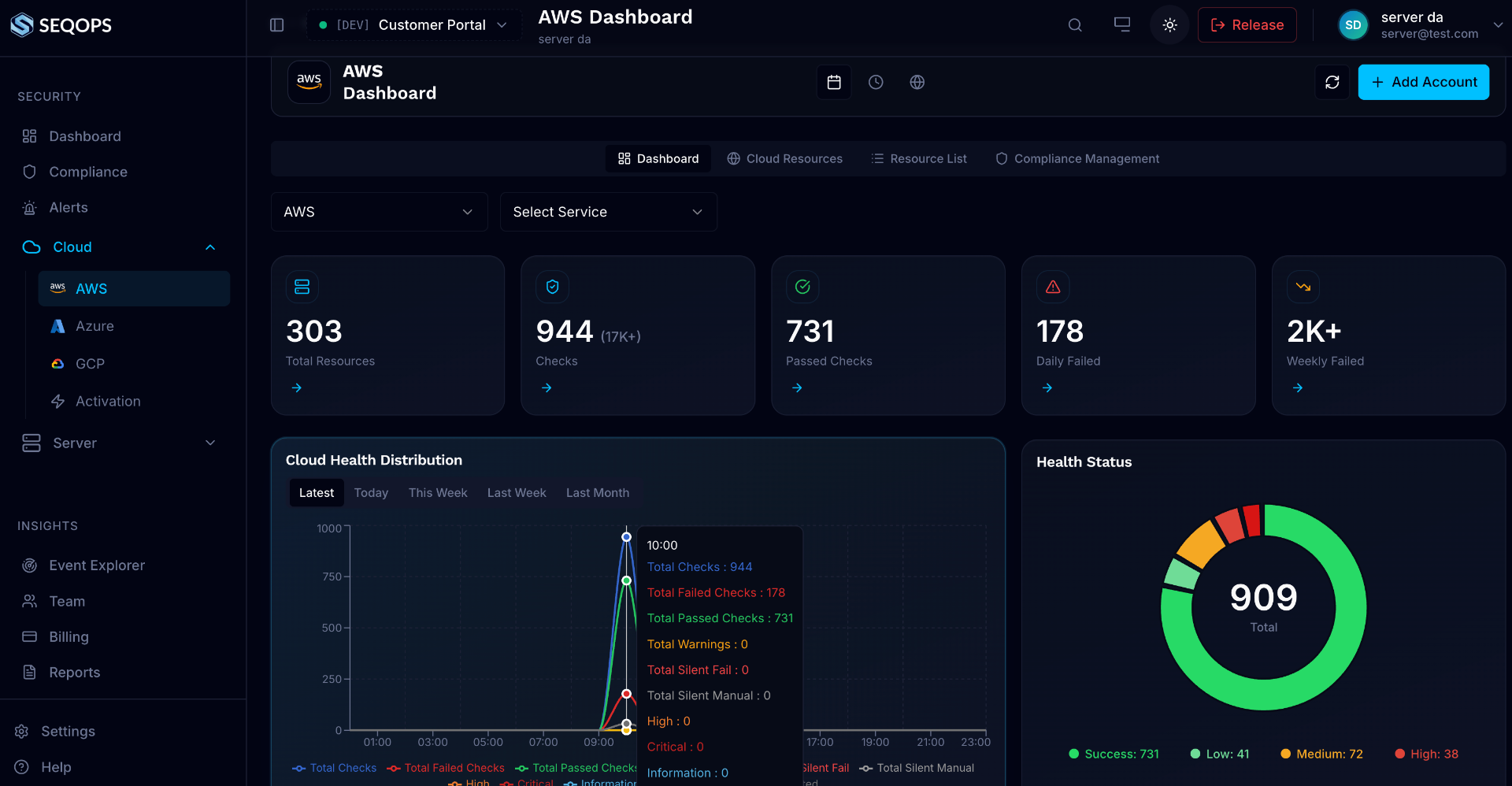
- Every vulnerability, misconfiguration & exposure found continuously across AWS, Azure, GCP, Windows & Linux
- AI ranks findings by real risk, so effort goes where it matters
- Continuous compliance scoring: NIS2 · ISO 27001 · GDPR · PCI · HIPAA
- Read-only — collects security metadata, never your data
Opsio Shield
One intelligent workspace that unifies security posture, compliance scoring and cloud cost — so nothing hides between tools.
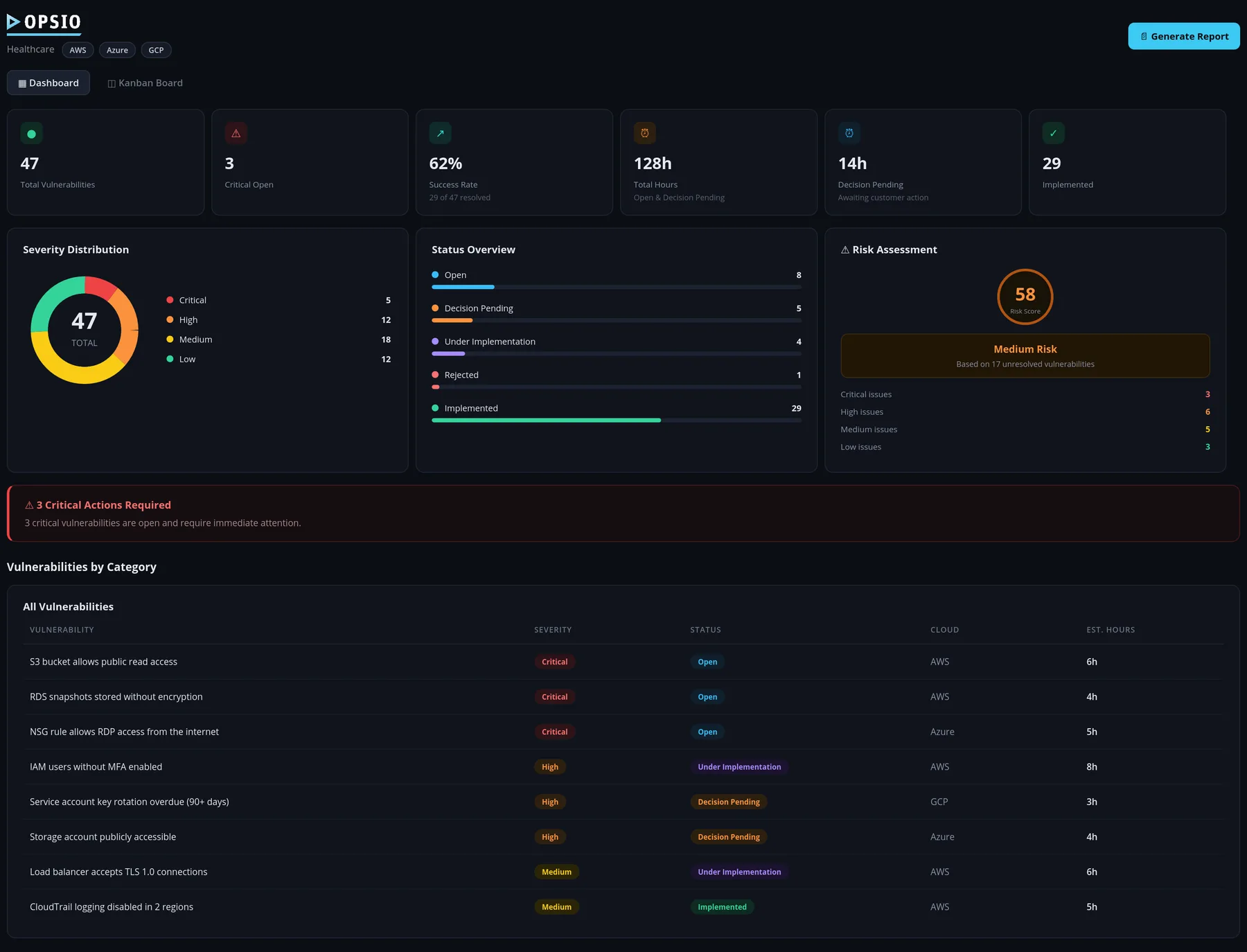
- Security posture, compliance score & multi-cloud spend on one live dashboard
- Cost anomalies & budget overruns caught before the invoice lands
- Auto-generated compliance evidence & vulnerability reports
- Encrypted secrets, mandatory MFA & row-level isolation by design
It's simply part of being an Opsio managed-cloud customer.
Why Your Indian Cloud Needs Dedicated Security Services
Migrating to the cloud does not automatically make your workloads secure. Misconfigurations remain the leading cause of cloud breaches, and India's Digital India push has accelerated adoption faster than security practices have matured. Cloud security demands a fundamentally different approach from traditional perimeter-based defences — the same defence-in-depth principles we apply for global engagements detailed on our cloud security service page for global cloud security pillar, adapted for Indian regulatory and infrastructure realities. Opsio's cloud security services are designed specifically for AWS Mumbai, Azure Central India, and GCP Mumbai regions. We implement defence-in-depth strategies using cloud-native tools — AWS Security Hub, GuardDuty, Azure Sentinel, Defender for Cloud, GCP Security Command Center — combined with our round-the-clock SOC to protect workloads, data, and users. Security telemetry is correlated with the platform health signals captured by our cloud monitoring and support services so anomalies are triaged with full operational context.
Whether you need to secure a single-cloud deployment or manage security across a multi-cloud estate serving the Indian market, our certified security architects design and operate solutions that satisfy both your business requirements and regulatory obligations under DPDPA and RBI guidelines. Teams handling personal data at scale typically pair this engagement with our dedicated DPDPA compliance services to formalise data-principal rights workflows and breach-notification readiness.
India's rapid cloud adoption has created a security skills gap that most enterprises struggle to fill domestically. With AWS Mumbai, Azure Central India, and GCP Mumbai regions hosting increasingly critical workloads — from UPI payment processing to Aadhaar-integrated services — the consequences of misconfigured cloud resources extend beyond data loss into regulatory non-compliance with CERT-In, DPDPA, and sector-specific frameworks like RBI's technology risk guidelines. For a deeper look at how cost-conscious teams sequence these controls, see our analysis on cost-effective cloud compliance, which translates directly to DPDPA-bound Indian workloads.
The Indian threat landscape presents unique challenges that generic global security services often miss. State-sponsored groups targeting Indian defence and government contractors, financially motivated actors exploiting UPI and IMPS payment channels, and hacktivist campaigns during geopolitical tensions all require security operations calibrated to regional patterns. Opsio maintains India-specific threat intelligence feeds and detection rules tuned to these adversary profiles, operationalised through our SOC security services with India-based analysts running 24/7 detection and response.
Multi-cloud environments are becoming the norm for Indian enterprises, with organisations often running production workloads across AWS Mumbai and Azure Central India while leveraging GCP for analytics. This architectural diversity compounds security complexity exponentially. Opsio's unified cloud security platform provides a single pane of glass across all three hyperscalers, eliminating the blind spots that arise when security tools operate in silos. Featured reading from our knowledge base: What Is OT Security? Complete Guide for India 2026, Trusted Cloud Security Services India for Enterprise Security, and Top Cyber Security Companies in India for 2026. Related Opsio services: Security Assessment & Forensics for India, and OT Security Services.
How Opsio Compares
| Capability | DIY Security | Generic Provider | Opsio Cloud Security India |
|---|---|---|---|
| Multi-cloud coverage | Single cloud only | Partial coverage | AWS Mumbai + Azure India + GCP unified |
| CSPM & posture management | Manual audits | Basic scanning | Continuous automated posture monitoring |
| DPDPA data protection | Ad-hoc controls | Generic DLP | Purpose-built DPDPA data flow controls |
| Incident response | Reactive, slow | Alert forwarding | Full containment & remediation under 1hr |
| Zero trust architecture | Not implemented | Partial micro-segmentation | Complete identity-centric zero trust |
| Compliance reporting | Manual quarterly | Semi-automated | Continuous CERT-In, RBI, DPDPA dashboards |
| Typical annual cost | ₹1-2Cr (fragmented tools) | ₹50-80L (gaps remain) | ₹40L-1.2Cr (comprehensive) |
Ready to get started?
What You Get
Pricing & Investment Tiers
Transparent pricing. No hidden fees. Scope-based quotes.
Security Audit
₹4–₹12 lakh
One-time
Implementation
₹12–₹35 lakh
Managed Security
₹2.5–₹10 lakh/mo
Ongoing
Transparent pricing. No hidden fees. Scope-based quotes.
Questions about pricing? Let's discuss your specific requirements.
Cloud Security Services for India
Free consultation