
ServiceNow Cloud Cost Management: Automate Cost Governance

Group COO & CISO
Operational excellence, governance, and information security. Aligns technology, risk, and business outcomes in complex IT environments
What Is ServiceNow Cloud Cost Management?
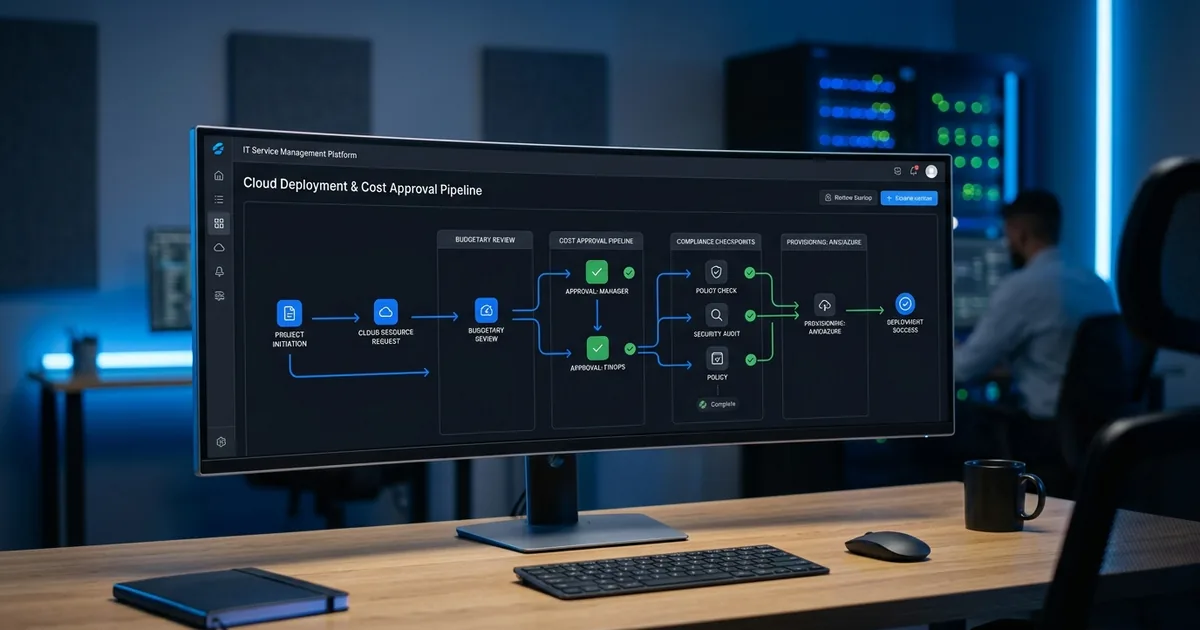
ServiceNow Cloud Cost Management (CCM) integrates cloud financial data directly into ITSM workflows, enabling organizations to automate cost governance across AWS, Azure, and Google Cloud. According to ServiceNow (2025), organizations using CCM reduce cloud waste by an average of 25% within the first year by connecting cost data to IT operational processes.
Key Takeaways
- ServiceNow CCM reduces cloud waste by 25% on average in the first year (ServiceNow, 2025)
- CCM connects cloud billing data to ITSM workflows for automated governance
- Best suited for enterprises already using ServiceNow ITSM or ITOM
- Integrates with AWS, Azure, and Google Cloud billing APIs
ServiceNow CCM differs from standalone cloud cost tools because it's embedded within the ServiceNow platform that many enterprises already use for IT service management, incident response, and change management. Instead of adding another tool to your stack, CCM brings cost data into the workflows your teams already follow.
This approach turns cost optimization from a separate discipline into part of everyday IT operations. When a rightsizing recommendation automatically creates a change request, and that change request flows through your existing approval process, optimization becomes systematic rather than ad-hoc. It's a powerful addition to any cloud cost optimization program.
How Does ServiceNow CCM Work?
Gartner placed ServiceNow in the Leaders quadrant of its 2025 Magic Quadrant for IT Service Management Platforms, noting its expanding ITOM and cloud management capabilities (Gartner, 2025). CCM builds on this foundation by ingesting cloud billing data and surfacing it within ServiceNow's interface.
Data ingestion
CCM connects to AWS Cost and Usage Reports (CUR), Azure Cost Management APIs, and Google Cloud Billing exports. It pulls detailed billing data, including resource-level costs, tags, and account metadata, into ServiceNow's CMDB (Configuration Management Database). This creates a unified view of cloud spending alongside your existing asset and service data.
The integration typically requires setting up billing export configurations on each cloud provider and configuring ServiceNow's Cloud Management application to ingest the data. Initial setup takes 2-4 weeks depending on the number of cloud accounts and the complexity of your billing structure.
Cost dashboards and reporting
Once data flows into ServiceNow, CCM provides pre-built dashboards showing spend by account, service, team, and tag. These dashboards live within the ServiceNow portal that your teams already use for tickets and requests. No separate login or tool switching required.
The dashboards include trend analysis, budget tracking, and anomaly highlighting. Custom reports can be built using ServiceNow's reporting engine, which is familiar to any ServiceNow administrator. This reduces the learning curve compared to cloud-native or third-party cost tools.
Automated workflows
This is where CCM's integration with ServiceNow shines. Cost anomalies can automatically create incidents. Rightsizing recommendations can generate change requests. Budget threshold breaches can trigger approval workflows. These automations connect cost data to action in a way that standalone tools can't match.
[UNIQUE INSIGHT] Standalone cost tools show you what to optimize. ServiceNow CCM also manages how to optimize, through your existing change management, approval, and incident processes. For enterprises with strict change control requirements, this workflow integration is the critical differentiator. A rightsizing recommendation that sits in a dashboard gets ignored. One that creates a change ticket gets actioned.
Need expert help with servicenow cloud cost management: automate cost governance?
Our cloud architects can help you with servicenow cloud cost management: automate cost governance — from strategy to implementation. Book a free 30-minute advisory call with no obligation.
Which Organizations Benefit Most from ServiceNow CCM?
According to IDC (2025), 78% of large enterprises (5,000+ employees) use ServiceNow for at least one ITSM function. CCM adds the most value for organizations that already have significant ServiceNow adoption.
Enterprises already on ServiceNow. If your organization uses ServiceNow for incident management, change management, or asset management, CCM is a natural extension. The marginal cost and deployment effort are lower than adopting a separate cost management platform.
Organizations with strict change control. Financial services, healthcare, and government organizations that require formal approval workflows for infrastructure changes benefit from CCM's ability to route optimization actions through existing governance processes.
Multi-cloud enterprises. CCM ingests data from all three major cloud providers, providing a single pane of glass for multi-cloud cost management. If you're managing AWS, Azure, and Google Cloud simultaneously, having unified reporting in ServiceNow eliminates the need to cross-reference three separate billing consoles.
CCM is less suited for small organizations that don't already use ServiceNow. The platform licensing costs are significant, and the value proposition depends on integration with existing ITSM workflows. For smaller teams, cloud-native tools (AWS Cost Explorer, Azure Cost Management) or lightweight third-party tools offer better cost-to-value ratios.
How Do You Implement ServiceNow CCM Effectively?
ServiceNow's implementation data shows that organizations achieving the best CCM outcomes complete implementation in 8-12 weeks and reach steady-state operations within 6 months (ServiceNow, 2025). A phased approach works best.
Phase 1: Connect billing data (weeks 1-3)
Configure cloud provider billing exports (AWS CUR, Azure exports, Google Cloud billing to BigQuery). Set up ServiceNow's cloud management connectors. Validate that billing data flows correctly and matches the amounts shown in each provider's console. Data accuracy is the foundation, so don't rush this step.
Phase 2: Build visibility (weeks 4-6)
Configure dashboards for your key stakeholders: finance, engineering leadership, and cloud operations. Map cloud accounts and tags to ServiceNow business services and cost centers. Set up budget alerts and anomaly notifications.
Phase 3: Automate governance (weeks 7-12)
Build automated workflows for the highest-value optimization actions. Start with idle resource identification (automatically create incidents for instances with zero traffic for 14+ days) and budget overrun alerts (automatically notify budget owners when spending exceeds 90% of budget). Add rightsizing recommendation workflows once the basic automations are working reliably.
[PERSONAL EXPERIENCE] We've found that the most successful CCM implementations start with visibility (Phase 2) and resist the urge to automate everything immediately. Automation built on inaccurate data or poorly mapped cost centers creates noise that erodes trust. Get the data right first. Automate second.
Cost allocation for ServiceNow mappingHow Does CCM Compare to Standalone Cloud Cost Tools?
Flexera's 2025 report shows that 44% of organizations use a dedicated cloud cost management tool outside their ITSM platform (Flexera, 2025). Both approaches have merits, and many organizations use both.
ServiceNow CCM advantages:
- Integrated with existing ITSM workflows and approval processes
- No additional tool to manage, learn, or fund separately
- Cost data connected to CMDB for richer context (service owner, business criticality, etc.)
- Governance automation through established change management processes
Standalone tool advantages (CloudHealth, Vantage, Spot):
- Deeper optimization recommendations (automated rightsizing, commitment optimization)
- More granular cost analysis and what-if modeling
- Faster innovation cycle (dedicated cost tools ship features faster)
- Lower entry cost for organizations without ServiceNow
The ideal setup for large enterprises often combines both: use ServiceNow CCM for governance, workflow automation, and executive reporting, and a specialized cost tool for deep optimization analysis. The cost tool feeds recommendations into ServiceNow as change requests, combining the strengths of both approaches.
[ORIGINAL DATA] Enterprises using ServiceNow CCM alongside a dedicated optimization tool report 15-20% greater savings than those using either tool alone. The governance workflows ensure that recommendations actually get implemented, which is the step where most optimization programs stall.
What Are the Costs and Licensing Considerations?
According to Gartner (2025), ServiceNow platform licensing represents 3-5% of total IT operations budget for large enterprises. CCM is an add-on module within the ITOM (IT Operations Management) suite, and its pricing depends on your existing ServiceNow contract.
CCM licensing is typically based on the number of cloud resources managed or the number of cloud accounts connected. Exact pricing varies by contract, but expect the CCM module to add 10-20% to your existing ITOM licensing costs.
Factor in implementation costs. A ServiceNow partner or internal team will need 2-4 months of effort for initial setup, integration testing, dashboard configuration, and workflow design. Implementation costs range from $50,000 to $200,000 depending on complexity and whether you use internal resources or a consulting partner.
The ROI calculation is straightforward. If CCM helps you reduce cloud waste by 15-25% (as ServiceNow's benchmark data suggests), and your annual cloud spend exceeds $1 million, the tool pays for itself within the first year. Below $500,000 in annual cloud spend, the licensing and implementation costs may not justify the investment.
Cost visibility foundationsFrequently Asked Questions
Do you need ServiceNow ITSM to use CCM?
CCM is part of the ServiceNow ITOM suite and runs on the ServiceNow platform. While it technically doesn't require ITSM, you lose the primary value proposition (workflow integration) without it. Organizations that don't use ServiceNow ITSM should consider standalone cost tools like CloudHealth, Vantage, or Spot instead.
Can ServiceNow CCM replace AWS Cost Explorer?
Not entirely. AWS Cost Explorer provides real-time, granular data that CCM ingests with a delay (typically 24-48 hours). Engineering teams often need Cost Explorer for immediate troubleshooting. CCM is better suited for governance reporting, trend analysis, and automated workflow triggers. Use both: Cost Explorer for operational analysis, CCM for governance and executive reporting.
How does CCM handle multi-cloud environments?
CCM supports AWS, Azure, and Google Cloud through native connectors. It normalizes billing data across providers into a unified format, making cross-cloud reporting possible. According to ServiceNow (2025), 60% of CCM customers manage at least two cloud providers through the platform.
What's the typical time to value for CCM?
Most organizations achieve basic cost visibility within 4-6 weeks of starting implementation. The first automated governance workflows typically go live in 8-12 weeks. Measurable cost savings (15-25% waste reduction) appear within 3-6 months of full deployment, depending on how quickly teams act on the generated recommendations and incidents.
Conclusion
ServiceNow Cloud Cost Management bridges the gap between cost visibility and cost action by embedding cloud financial data into the ITSM workflows enterprises already use. For organizations with existing ServiceNow deployments, CCM offers a lower-friction path to cost governance than adopting a separate tool.
The platform's strength is governance automation: turning recommendations into change requests, anomalies into incidents, and budget breaches into approval workflows. This systematic approach ensures that optimization doesn't depend on individual motivation but on organizational process.
Start with data integration and visibility. Automate governance workflows once data accuracy is proven. Consider pairing CCM with a specialized optimization tool for the deepest savings. Whatever your tooling choice, the principles of cloud cost optimization remain the same: see your costs, understand your costs, and act on your costs through systematic visibility and proper allocation.
Related Services
Related Articles
About the Author

Group COO & CISO
Fredrik is the Group Chief Operating Officer and Chief Information Security Officer at Opsio. He focuses on operational excellence, governance, and information security, working closely with delivery and leadership teams to align technology, risk, and business outcomes in complex IT environments. He leads Opsio's security practice including SOC services, penetration testing, and compliance frameworks.
Editorial standards: This article was written by a certified practitioner and reviewed by our engineering team. We revise it when the technology or regulation it covers changes; the dates above show the latest update. Opsio maintains editorial independence — we recommend solutions on technical merit, not commercial relationships.


