
Cloud Security Services — Multi-Cloud Protection & 24/7 SOC
Opsio's cloud security services are the umbrella programme for protecting AWS, Azure, and GCP workloads end-to-end: managed CSPM, IAM hardening, WAF, encryption, and a 24/7 SOC operating the controls — backed by point-in-time assessments, advisory engagements, and zero-trust roadmaps when you need them. Cloud misconfigurations caused 82% of cloud breaches last year; we close those gaps with native tools, CIS benchmarks, and continuous human oversight rather than alert-only monitoring.
Trusted by 100+ organisations across 6 countries
24/7
SOC Monitoring
3
Cloud Platforms
82%
Misconfigs Found
CIS
Benchmarked
What's Included
Cloud Security Posture Management (CSPM)
Continuous automated assessment of your cloud configuration against CIS benchmarks, AWS Well-Architected, and cloud provider best practices using AWS Config, Azure Policy, and GCP Organization Policy. We detect and auto-remediate misconfigurations, overly permissive IAM policies, unencrypted storage, and exposed services before they become attack vectors.
Network Security & Zero-Trust Segmentation
Security group optimization, network ACL hardening, VPC design with private subnets, micro-segmentation using AWS Transit Gateway or Azure Virtual WAN, and Web Application Firewall configuration. We implement zero-trust network principles across your cloud environment using native controls to limit lateral movement.
Identity & Access Management Hardening
Least-privilege IAM policy enforcement, MFA on all human accounts, service account key rotation, cross-account role architecture, and federated identity via Okta or Azure AD. We audit and harden IAM configurations — the number one attack vector in cloud breaches — across all three major providers.
Data Protection & Encryption
Encryption at rest (AES-256) and in transit (TLS 1.3), key management via AWS KMS, Azure Key Vault, and Cloud KMS with automatic rotation, data classification tagging, and DLP policies. We protect sensitive data throughout its complete lifecycle from creation to archival.
DDoS Protection & WAF
AWS Shield Advanced, Azure DDoS Protection, Cloud Armor configuration and 24/7 management. Custom WAF rulesets protecting against OWASP Top 10 vulnerabilities, bot mitigation, rate limiting, and application-layer attack patterns — with real-time tuning based on traffic analysis.
Security Monitoring & SIEM Integration
24/7 monitoring using cloud-native SIEM tools — AWS Security Hub, Azure Sentinel, Chronicle — integrated with our SOC. Real-time alerting, cross-cloud threat correlation, automated incident response playbooks, and detailed investigation for every confirmed security event.
Opsio is our partner for IT operations and cyber security – a crucial part of our business. We roast 12 million cups of coffee each day, and therefore have high demands for availability and reliability to deliver the best possible quality for our customers. Our partnership with Opsio is vital for us to succeed with this central function.

Magnus Norman
Head of IT · Löfbergs
Two enterprise security platforms. Included free.
Others pay a fortune for continuous vulnerability monitoring and a unified security-and-cost workspace — and then pay again for the people to run them. Every Opsio managed-cloud customer gets both, at no extra cost, with our engineers acting on what they surface.
SeqOps
Continuous vulnerability monitoring across your entire cloud & server estate — always on, never in the way.
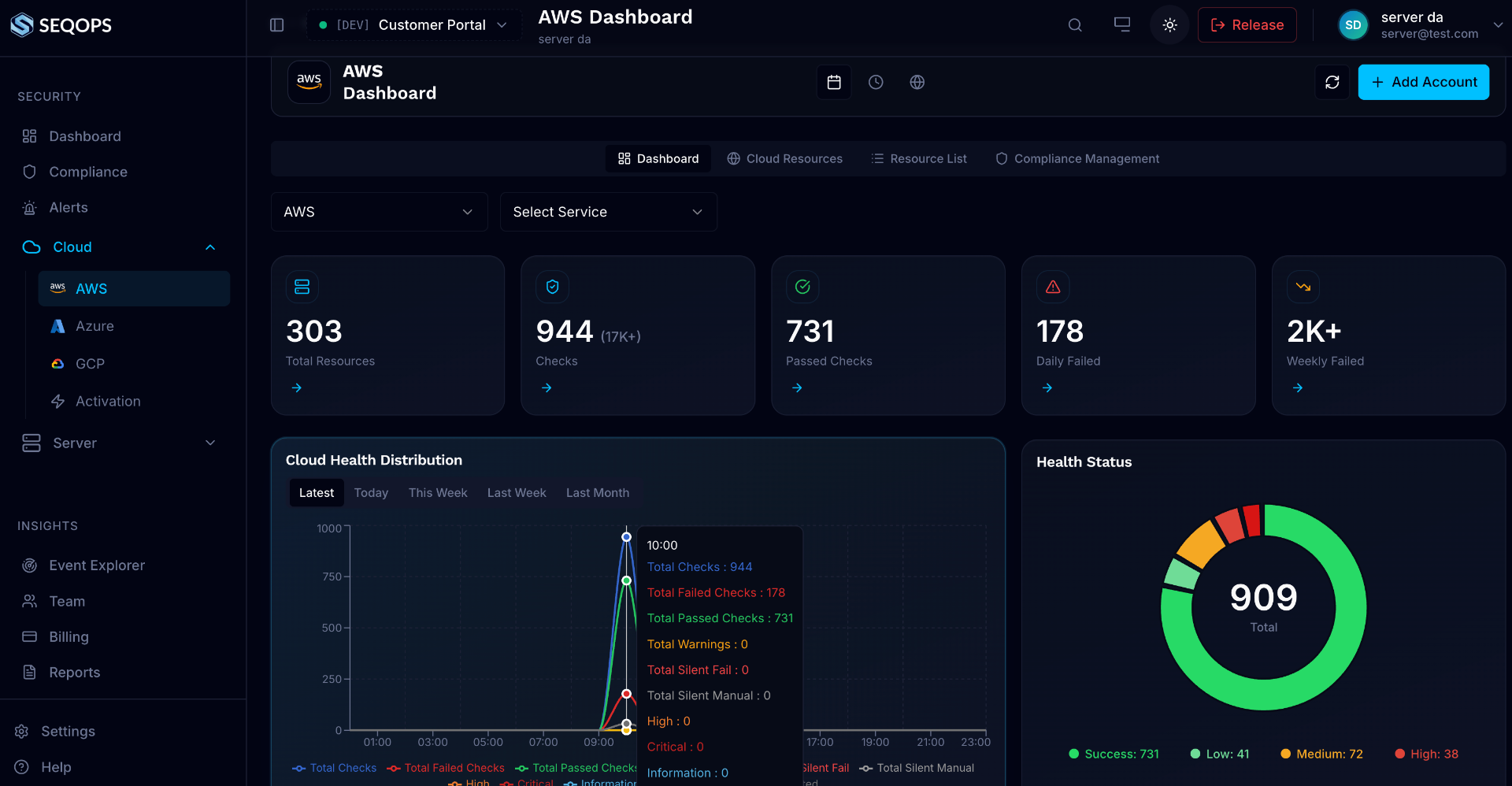
- Every vulnerability, misconfiguration & exposure found continuously across AWS, Azure, GCP, Windows & Linux
- AI ranks findings by real risk, so effort goes where it matters
- Continuous compliance scoring: NIS2 · ISO 27001 · GDPR · PCI · HIPAA
- Read-only — collects security metadata, never your data
Opsio Shield
One intelligent workspace that unifies security posture, compliance scoring and cloud cost — so nothing hides between tools.
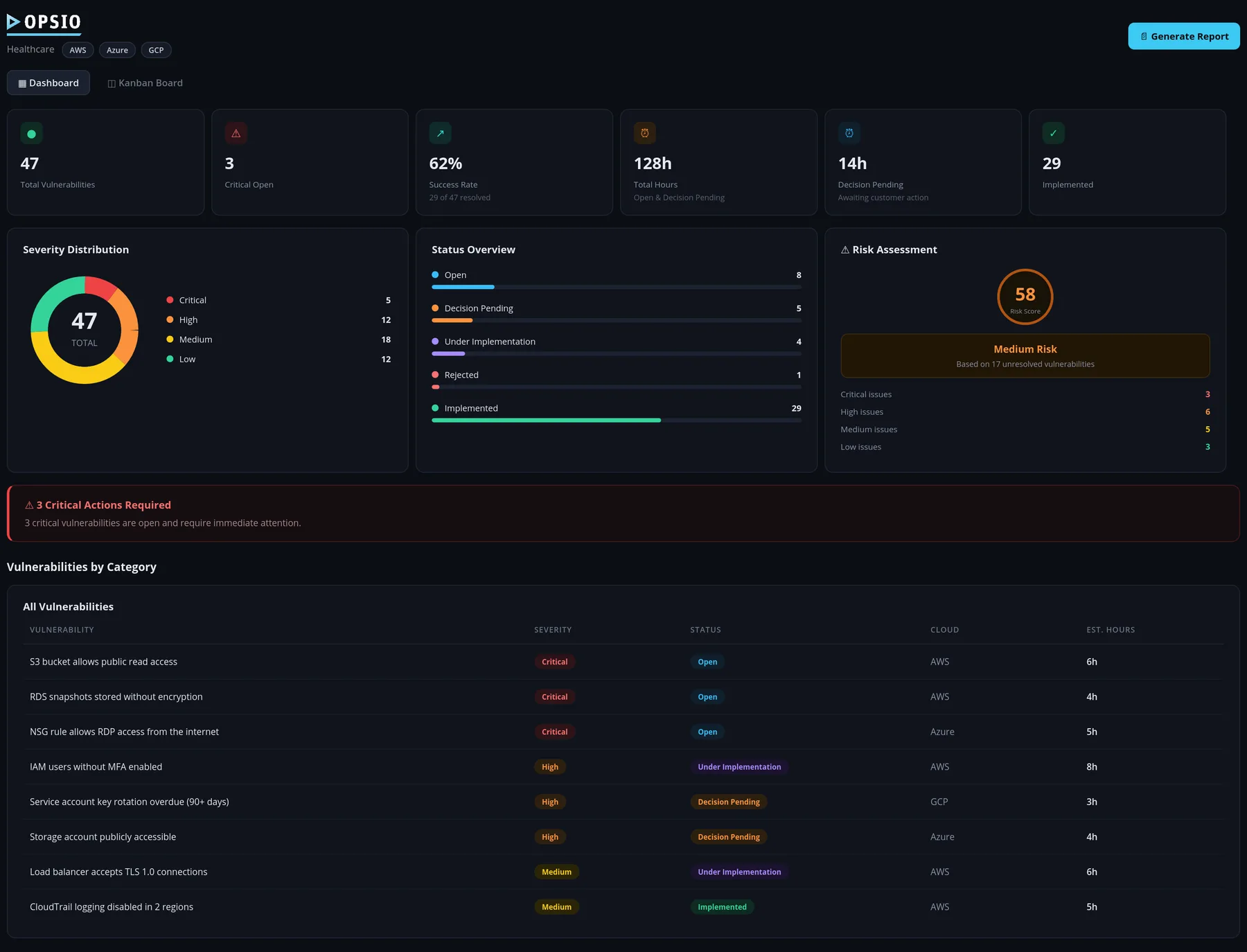
- Security posture, compliance score & multi-cloud spend on one live dashboard
- Cost anomalies & budget overruns caught before the invoice lands
- Auto-generated compliance evidence & vulnerability reports
- Encrypted secrets, mandatory MFA & row-level isolation by design
It's simply part of being an Opsio managed-cloud customer.
Why Your Cloud Needs Dedicated Security Services
Moving to the cloud does not automatically make you secure — in fact, it often makes you less secure. Cloud misconfigurations are the number one cause of cloud data breaches, responsible for 82% of incidents in 2023 (Verizon DBIR), and IBM's Cost of a Data Breach 2025 puts the average cloud breach above $4.9 million. Default settings leave storage buckets publicly accessible, IAM policies grant excessive permissions, and security groups allow unrestricted inbound traffic. Your cloud provider secures the infrastructure, but securing your configuration, data, and access is entirely your responsibility under the shared responsibility model. This is our managed cloud security service — if you need an advisory engagement, see our cloud security consulting practice; if you need a one-off audit deliverable instead of an ongoing programme, start with our cloud security assessment; and if your organisation is on a zero trust journey, we map our control catalogue directly to NIST SP 800-207 components. Opsio's cloud security services are built specifically for AWS, Azure, and GCP environments. We implement defense-in-depth strategies using cloud-native security tools — AWS Security Hub, GuardDuty, and Inspector; Azure Sentinel and Defender for Cloud; GCP Security Command Center and Chronicle — combined with our 24/7 Security Operations Centre monitoring. Our approach prioritises native tools because they integrate better, cost less, and provide deeper visibility than third-party overlays.
Without dedicated cloud security services, organisations accumulate configuration drift, orphaned access keys, unencrypted data stores, and unmonitored network paths that attackers actively scan for. A single misconfigured S3 bucket or overly permissive IAM role can expose millions of records. Our Cloud Security Posture Management (CSPM) continuously detects and remediates these risks before they become headlines.
Every Opsio cloud security engagement includes CSPM continuous scanning against CIS benchmarks, IAM policy review and least-privilege enforcement, network security group and VPC hardening, encryption-at-rest and in-transit verification, WAF and DDoS protection configuration, SIEM integration with 24/7 SOC monitoring, and compliance reporting mapped to your regulatory frameworks.
Common cloud security challenges we solve: over-permissive IAM roles granting admin access to service accounts, publicly exposed storage buckets leaking sensitive data, missing encryption on databases and object stores, security group rules allowing unrestricted SSH or RDP from the internet, lack of logging making incident investigation impossible, and no centralised monitoring across multi-cloud environments.
Following cloud security best practices, our cloud security assessment evaluates your current posture across all three major providers and builds a prioritised remediation roadmap. We use proven cloud security tools — AWS Security Hub, Azure Defender, GCP SCC, Prisma Cloud, Wiz — selected for your specific environment. Whether you are implementing cloud security services for the first time or hardening an existing multi-cloud deployment, Opsio delivers the engineering expertise to close configuration gaps and maintain continuous compliance. For continuous threat detection on top of the platform, layer our SeqOps XDR/EDR product; for cross-framework control automation, integrate with our continuous compliance service; and for the CISO-level controls catalogue we apply across engagements, see our deep-dive on cloud infrastructure security controls for CISOs. Wondering about cloud security cost or whether to hire in-house versus engage cloud security consulting? Our assessment delivers a clear answer with a detailed risk-based implementation plan. Featured reading from our knowledge base: OT Security in Water Utilities: SCADA Protection, Managed IT Services Security: Complete Protection Guide, and OT Security in Healthcare: Medical Device Protection.
How Opsio Compares
| Capability | DIY / In-House | Generic MSSP | Opsio Cloud Security |
|---|---|---|---|
| CSPM continuous scanning | Manual spot checks | Basic config alerts | ✅ CIS automated + remediation |
| Multi-cloud support | Per-cloud expertise gaps | Single cloud focus | ✅ AWS, Azure, GCP native |
| IAM hardening | Periodic review | Not included | ✅ Continuous least-privilege |
| 24/7 SOC monitoring | Business hours only | Alert forwarding | ✅ Full investigation + response |
| Compliance reporting | Manual spreadsheets | Basic logs | ✅ 7+ frameworks automated |
| Incident response | Ad hoc, if staffed | Alert escalation only | ✅ Containment + forensics |
| Typical annual cost | $300K+ (3 FTEs) | $40-80K (alerts only) | $36-144K (fully managed) |
Ready to get started?
What You Get
Pricing & Investment Tiers
Transparent pricing. No hidden fees. Scope-based quotes.
Cloud Security Audit
$5,000–$15,000
One-time assessment
Security Implementation
$15,000–$45,000
Full hardening
Managed Cloud Security
$3,000–$12,000/mo
24/7 SOC included
Transparent pricing. No hidden fees. Scope-based quotes.
Questions about pricing? Let's discuss your specific requirements.
Cloud Security Services — Multi-Cloud Protection & 24/7 SOC
Free consultation