

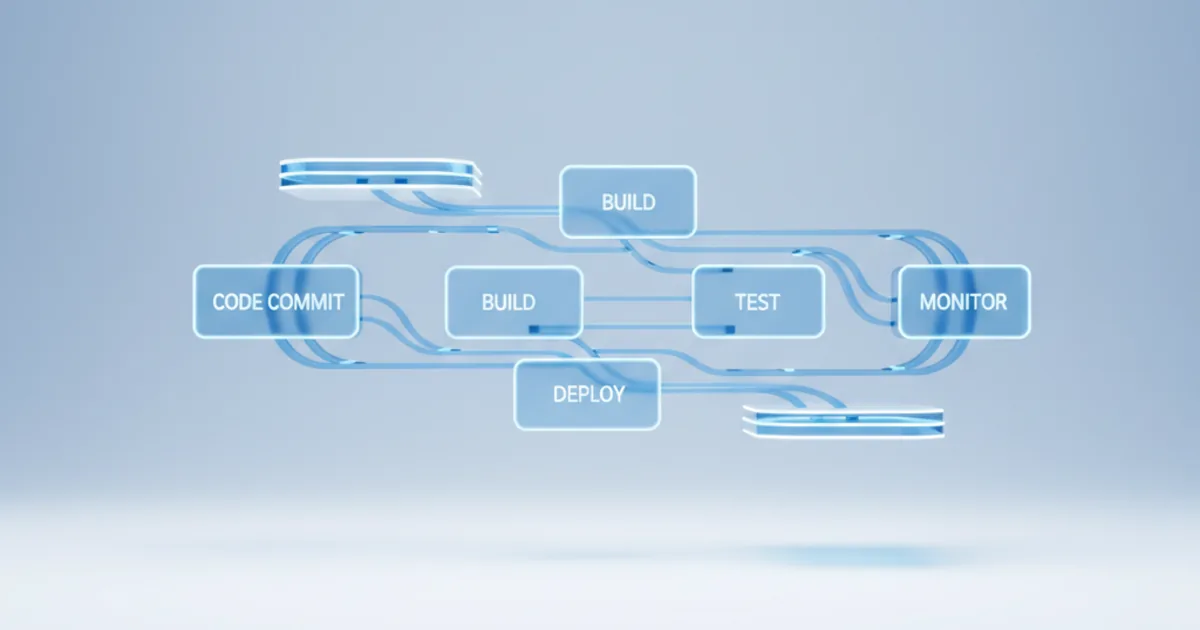
Managed DevOps Services: Outsourcing DevOps Done Right
Managed DevOps services transfer the operational burden of building, running, and securing your CI/CD pipelines, infrastructure-as-code, observability stack, and release processes to a dedicated provider. Done well, this lets your engineering team focus on product code while a specialized team handles platform engineering, on-call rotation, and compliance automation — across AWS, Azure, GCP, or all three simultaneously.
Key Takeaways
- Managed DevOps services hand off pipeline design, infrastructure automation, monitoring, and incident response to a specialized provider — freeing your engineers to ship product features.
- Outsourcing DevOps works well when done with clear service boundaries, shared repositories, and contractual SLAs — not when treated as a black box.
- EU organizations must verify their DevOps provider meets NIS2 incident-reporting timelines, GDPR data-residency requirements, and potentially Schrems II transfer safeguards.
- A strong managed DevOps engagement covers CI/CD, IaC, observability, security pipeline integration, and FinOps — not just "we run your Jenkins."
- Evaluate providers on multi-cloud depth, on-call model, compliance posture, and willingness to work in YOUR repositories rather than proprietary portals.
Need help with DevOps?
Book a free 30-minute meeting with one of our DevOps specialists. We'll analyse your situation and provide actionable recommendations — no obligation, no cost.
What Managed DevOps Services Actually Include
The term "managed DevOps" gets stretched to cover everything from a consultant writing a few Terraform modules to a full platform engineering team operating your infrastructure 24/7. Here is what a substantive engagement covers:
CI/CD Pipeline Design and Operations
This is the core. A managed DevOps provider designs, builds, and maintains your continuous integration and continuous delivery pipelines. That means choosing and configuring the right tooling — GitHub Actions, GitLab CI/CD, Azure DevOps Pipelines, AWS CodePipeline, or Jenkins — and then owning the pipeline's health: fixing broken builds caused by infrastructure drift, updating runner fleets, managing secrets rotation, and tuning build caches so your developers aren't waiting 20 minutes for a container image to compile.
At Opsio, we see a recurring pattern: teams adopt a CI/CD tool in year one, customize it heavily, and by year three nobody understands the pipeline YAML well enough to modify it safely. A managed provider prevents that entropy.
Infrastructure as Code (IaC)
Terraform, Pulumi, OpenTofu, AWS CloudFormation, Azure Bicep — the tooling choice matters less than the discipline. Managed DevOps means your provider writes, reviews, and applies IaC changes through pull-request workflows with automated plan/apply stages. They maintain module libraries, enforce tagging policies for cost visibility, and handle state-file management (remote backends, locking, drift detection).
Observability and Incident Response
Pipelines are useless if nobody notices when production breaks. Managed DevOps includes configuring and operating your monitoring stack — Datadog, Dynatrace, Grafana Cloud, or cloud-native tools like Amazon CloudWatch, Azure Monitor, and Google Cloud Operations Suite. The provider defines SLIs/SLOs, builds dashboards, configures alerting thresholds, and staffs the on-call rotation. When the pager fires at 03:00, it is their engineer who responds first, not yours.
Security Pipeline Integration (DevSecOps)
Modern managed DevOps embeds security scanning into the pipeline: SAST (SonarQube, Semgrep), DAST (OWASP ZAP, Burp Suite), SCA (Snyk, Trivy for container images), and secrets detection (GitLeaks, TruffleHog). The provider triages findings, suppresses false positives, and escalates real vulnerabilities before code reaches production. This directly supports cloud security posture requirements.
Platform Engineering and Developer Experience
The most mature managed DevOps engagements go beyond pipelines. They build internal developer platforms (IDPs) — using Backstage, Port, or custom tooling — that give developers self-service access to environments, databases, and pre-configured service templates. The managed provider maintains the platform itself: the Kubernetes clusters, the service mesh, the GitOps controllers (ArgoCD, Flux).
When Outsourcing DevOps Makes Sense — and When It Doesn't
Not every organization should outsource DevOps. Here is an honest breakdown:
| Scenario | Outsource? | Why |
|---|---|---|
| Startup with < 10 engineers, no dedicated ops hire | Yes | You need pipelines and monitoring but can't justify a full platform team. |
| Mid-market company (50-200 engineers) scaling fast | Yes | Hiring platform engineers takes 3-6 months; a managed provider delivers in weeks. |
| Enterprise with a mature platform team wanting 24/7 coverage | Partially | Outsource NOC/SOC on-call and compliance automation; keep architecture decisions in-house. |
| Regulated industry (finance, healthcare) with strict data controls | Yes, with caveats | Provider must operate within your tenant, your repos, your audit trail. Verify contractually. |
| Organization where DevOps IS the product (e.g., you sell a PaaS) | No | Core competency should stay in-house. |
The honest trade-off: you gain speed and coverage, you lose some direct control. The risk of outsourcing DevOps poorly is vendor lock-in to proprietary portals, loss of institutional knowledge, and misaligned incentives (provider bills by ticket volume, so they don't invest in automation that reduces tickets). Good contracts mitigate these risks.
The EU Compliance Dimension: NIS2, GDPR, and Cloud Sovereignty
European organizations face regulatory requirements that directly affect how managed DevOps services must be structured.
NIS2 Directive
The NIS2 Directive, which EU member states transposed into national law by October 2024, applies to entities in 18 sectors deemed essential or important. It imposes supply-chain security obligations: if your managed DevOps provider has access to your production infrastructure, they are part of your supply chain. You must assess their security practices, ensure they can support your 24-hour early-warning and 72-hour incident-notification obligations, and document this in contracts.
From Opsio's EU headquarters in Karlstad, Sweden, we see customers — particularly in Germany and the Nordics — increasingly requiring that managed service providers demonstrate ISO/IEC 27001 certification, SOC 2 Type II attestation, and contractual commitments to NIS2-aligned incident response timelines.
GDPR and Data Residency
CI/CD pipelines frequently handle PII: database credentials that access personal data, test environments seeded with production-like data, and log streams containing user identifiers. A managed DevOps provider must ensure that pipeline artifacts, logs, and secrets remain within agreed-upon data-residency boundaries. For EU customers, this typically means AWS eu-north-1 (Stockholm), eu-central-1 (Frankfurt), Azure Sweden Central / West Europe, or GCP europe-north1 / europe-west3.
Swedish and German Cloud Sovereignty
Swedish government agencies increasingly reference the Swedish Civil Contingencies Agency (MSB) guidelines for cloud usage. German organizations follow BSI's C5 attestation framework. A managed DevOps provider serving these markets needs to demonstrate that operational access is auditable, that data does not transit non-EU jurisdictions, and that administrative access from non-EU locations (e.g., an Indian support center) is governed by contractual and technical safeguards.
The India Market Perspective: DPDPA 2023 and Regional Growth
India's Digital Personal Data Protection Act (DPDPA) of 2023, with rules expected to be fully notified by 2026, introduces data-fiduciary obligations that affect DevOps practices. Test data management, log retention, and cross-border data transfers to global parent companies all require documented lawful basis.
Organizations running workloads in AWS Mumbai (ap-south-1), Azure Central India, or GCP asia-south1 benefit from a managed DevOps provider with local operational presence. Opsio's Bangalore-based NOC team provides India-timezone coverage and understands the local regulatory landscape, reducing the friction that comes from outsourcing to a provider twelve time zones away.
Practically, Indian enterprises in fintech and healthtech are the fastest-growing segment requesting managed DevOps services. They need rapid pipeline maturity to meet RBI (Reserve Bank of India) technology risk guidelines and CERT-In incident-reporting timelines — both of which map well to DevOps automation.
How to Choose a Managed DevOps Provider: Concrete Criteria
Skip the marketing pages. Ask these questions during evaluation:
1. Where Does the Work Happen?
Does the provider work in YOUR GitHub/GitLab/Azure DevOps organization, or do they insist on their own proprietary portal? If it is the latter, walk away. You should own your pipeline definitions, your IaC modules, and your monitoring configurations. If the engagement ends, you keep everything.
2. What Is the On-Call Model?
Clarify: who holds the pager? What are the response-time SLAs for P1 (production down), P2 (degraded), P3 (non-urgent) incidents? A credible provider offers defined response times — commonly under 15 minutes for P1 — backed by a staffed 24/7 NOC, not an answering service.
3. Multi-Cloud or Single-Cloud?
If your estate spans AWS and Azure (as Flexera's State of the Cloud has consistently found is the norm for mid-to-large enterprises), your provider needs genuine operational depth in both. Ask for specific certifications: AWS DevOps Professional, Azure DevOps Engineer Expert, GCP Professional Cloud DevOps Engineer. Ask how they handle Terraform modules that abstract across clouds versus cloud-native IaC (CloudFormation, Bicep).
4. How Do They Handle Compliance Evidence?
For SOC 2, ISO 27001, or NIS2 evidence collection, a good provider automates compliance-as-code: Open Policy Agent (OPA) rules in the pipeline, automated CIS benchmark scans, and exportable audit logs. If their answer is "we'll fill out your spreadsheet manually," their maturity is insufficient.
5. What Is the Knowledge Transfer Model?
The best managed DevOps engagements include explicit knowledge-transfer milestones: documentation in your wiki, recorded architecture decision records (ADRs), and periodic training sessions for your internal team. The goal is to make you less dependent over time, not more.
Tooling Landscape: What a Managed DevOps Stack Looks Like in 2026
Here is a representative stack we operate for customers across managed cloud services:
| Layer | Tools | Notes |
|---|---|---|
| Source Control | GitHub, GitLab, Azure Repos | GitHub dominates; GitLab strong in EU due to self-hosted option |
| CI/CD | GitHub Actions, GitLab CI, Azure Pipelines, ArgoCD | ArgoCD for GitOps-based Kubernetes deployments |
| IaC | Terraform / OpenTofu, Pulumi, Bicep | OpenTofu gaining traction post-HashiCorp license change |
| Containers & Orchestration | Docker, Amazon EKS, Azure AKS, GKE | CNCF Annual Survey consistently shows Kubernetes as default orchestrator |
| Observability | Datadog, Grafana Cloud, Dynatrace, CloudWatch, Azure Monitor | Choice depends on budget and multi-cloud scope |
| Security Scanning | Snyk, Trivy, Semgrep, Checkov | Checkov for IaC policy; Trivy for container vulnerability scanning |
| Secrets Management | HashiCorp Vault, AWS Secrets Manager, Azure Key Vault | Vault for multi-cloud; native services for single-cloud |
| Incident Management | PagerDuty, Opsgenie, Grafana OnCall | PagerDuty remains the default for serious on-call workflows |
| Cost Management | Kubecost, AWS Cost Explorer, Infracost | Infracost runs in CI to show cost impact of IaC changes before apply |
The tooling matters less than the operational discipline around it. A managed provider's value is in the runbooks, the escalation paths, and the continuous tuning — not in installing Terraform.
The Relationship Between Managed DevOps and Cloud Migration
Many managed DevOps engagements begin during or immediately after a cloud migration. The pattern: a company lifts-and-shifts workloads to AWS or Azure, realizes their legacy Jenkins server does not translate to a cloud-native model, and brings in a managed DevOps provider to build proper pipelines, containerize applications, and implement GitOps workflows.
This sequencing is correct. Attempting to define your DevOps operating model before the migration adds unnecessary abstraction. Migrate first (even imperfectly), then optimize pipelines around the actual infrastructure you landed on.
What Opsio's SOC/NOC Sees: Operational Patterns Worth Knowing
Running a 24/7 NOC across EU and India gives us visibility into patterns that marketing-focused DevOps content misses:
Pipeline failures cluster on Monday mornings and Friday afternoons. Monday because infrastructure drift accumulated over the weekend; Friday because developers push speculative changes before leaving. A managed provider with continuous monitoring catches these before they block the team.
Secrets sprawl is the most common security finding. API keys in environment variables, database passwords in CI logs, cloud credentials in Slack threads. Managed DevOps must include secrets hygiene: vault integration, automated rotation, and CI pipeline scanning that blocks commits containing secrets.
Cost anomalies originate from dev/test environments, not production. Developers spin up oversized instances for testing and forget to tear them down. A managed DevOps provider integrates FinOps practices into the pipeline — ephemeral environments with automatic TTL, Infracost checks in pull requests, and weekly cost-anomaly reviews.
Alert fatigue kills incident response. According to Datadog's State of Cloud research, the volume of monitoring data grows faster than teams' ability to triage it. A managed provider's most underrated job is alert tuning: reducing noise so that the alerts that do fire are actionable.
Pricing Models for Managed DevOps Services
Transparency matters. The common models:
- Fixed monthly retainer: Provider commits a defined number of engineer-hours or a named team allocation. Predictable cost, works well for steady-state operations.
- Per-environment pricing: You pay per managed environment (production, staging, dev). Scales with your footprint.
- Tiered SLA pricing: Base tier covers business-hours support; premium tier adds 24/7 on-call and guaranteed response times.
- Consumption-based: Rare in managed DevOps but emerging — priced by pipeline runs, deployments, or incidents handled.
Expect to pay meaningfully more than a single DevOps engineer's salary but less than building a three-person platform team (which is the realistic minimum for 24/7 coverage with redundancy). The economics favor outsourcing when you factor in hiring timelines, tool licensing, on-call burnout, and the cost of production incidents handled slowly.
Related: Our service: DevOps Managed Service
Frequently Asked Questions
What are MSP examples in the DevOps context?
In DevOps, an MSP (Managed Service Provider) is a company that operates CI/CD pipelines, infrastructure-as-code, monitoring, and incident response on your behalf. Examples include cloud-native MSPs like Opsio that run 24/7 NOC/SOC across AWS, Azure, and GCP, as well as platform-specific providers like CloudBees for Jenkins-centric estates. The differentiator is operational ownership: an MSP holds the pager, not just an advisory role.
What replaced TFS (Team Foundation Server)?
Microsoft replaced TFS with Azure DevOps Server (on-premises) and Azure DevOps Services (cloud-hosted) in 2019. The rebrand brought Boards, Repos, Pipelines, Test Plans, and Artifacts under one umbrella. Most managed DevOps providers now integrate with Azure DevOps Pipelines, GitHub Actions, or both — since Microsoft also acquired GitHub and increasingly positions GitHub Actions as the primary CI/CD layer.
What are the 7 C's of DevOps?
The 7 C's are a pedagogical framework: Continuous Development, Continuous Integration, Continuous Testing, Continuous Deployment, Continuous Monitoring, Continuous Feedback, and Continuous Operations. In practice, a managed DevOps provider operationalizes all seven — owning the pipeline (CI/CD), the observability stack (monitoring/feedback), and the runbooks (operations), so your team focuses on the Development part.
Does DevOps work with outsourced development teams?
Yes, but it requires deliberate design. Outsourced developers need access to the same CI/CD pipelines, branch policies, and test environments as in-house engineers. A managed DevOps provider acts as the neutral infrastructure layer: they own the pipeline, enforce quality gates, and provide a shared inner-loop developer experience regardless of which team commits the code. Time-zone differences are mitigated by asynchronous pipeline execution and automated test feedback.
What are the five types of Managed Services?
The five broad categories are: Managed Infrastructure (compute, networking), Managed Security (SOC, SIEM, vulnerability management), Managed Applications (patching, uptime), Managed Communication (email, unified communications), and Managed DevOps (CI/CD, IaC, observability, release engineering). Managed DevOps is the newest category, emerging as organizations recognized that pipeline and platform engineering require specialized, ongoing operational effort — not just a one-time setup.
Related reading: How to Choose a DevOps Managed Service Provider.
Related reading: We Provide DevOps Managed Services for Enhanced Efficiency.
Written By

Head of Innovation
Jacob leads innovation at Opsio, specialising in digital transformation, AI, IoT, and cloud-driven solutions that turn complex technology into measurable business value. With nearly 15 years of experience, he works closely with customers to design scalable AI and IoT solutions, streamline delivery processes, and create technology strategies that drive sustainable growth and long-term business impact.
Editorial standards: This article was written by cloud practitioners and reviewed by our engineering team. We revise it when the technology or regulation it covers changes; the dates on this page show the latest update. Opsio maintains editorial independence.