

Understanding Cloud Costs and Pricing Models
Cloud cost management starts with understanding what drives spend and how pricing options affect your budget. This section breaks down the main cost drivers and compares pricing models so you can choose the right approach for your workloads.
What drives cloud spend: common cost factors and how to reduce costs
Common cost drivers include:
- Resource usage patterns: CPU, memory, GPU hours and number of instances directly affect compute costs.
- Idle resources: Unused or underutilized virtual machines, orphaned volumes, and idle IP addresses.
- Data transfer and egress: Cross-region or public internet egress charges are often overlooked and can be significant.
- Storage tiers: Using premium SSD for archival data adds unnecessary expense; choosing the right storage class matters.
- Licensing and third-party software: OS licenses (Windows) and commercial software subscriptions add on top of infrastructure costs.
Quick example: a test environment left running 24/7 can cost as much as a production service if not scheduled to shut down — cleaning up such idle resources often yields immediate savings.
Tip: Start by identifying the top 20% of services that account for 80% of your spend — those are your highest-leverage targets for cost reduction.
Cloud pricing models comparison: on-demand, reserved, spot, and committed use
Understanding pricing models is key to reducing cloud service expenses. Here's a concise comparison:
| Pricing Model | Best For | Savings Potential | Commitment |
| On-demand | Variable or short-lived workloads | 0% (baseline) | None |
| Reserved instances | Steady-state production workloads | 30-72% | 1-3 years |
| Spot/preemptible | Batch jobs, stateless workloads | 60-90% | None (can be interrupted) |
| Committed use | Predictable, continuous workloads | 20-65% | 1-3 years |
Cloud pricing models comparison matters because it affects cost predictability and potential savings. For example, AWS Savings Plans and Reserved Instances can save up to 72% versus on-demand for EC2, while spot instances are best for interruptible workloads where cost is the priority.
Interpreting bills and cost allocation through Manage Cloud
To find savings opportunities you must interpret bills effectively:
- Tagging: Apply consistent tags (project, environment, owner, cost-center) to allocate costs and make bills actionable.
- Chargeback vs showback: Decide whether to charge teams directly (chargeback) or simply report costs to promote awareness (showback).
- Parsing provider invoices: Normalize line items, group them by service or team, and use cost allocation reports to identify anomalies.
Example tag best practice (simple key/value strategy):
tags:
- key: Environment
 values: [Production, Staging, Test, Dev]
- key: CostCenter
- key: Owner
- key: Application
Tools like AWS Cost Explorer, Azure Cost Management, and GCP Billing allow filtered views by tags, but consistent tagging policy and enforcement via automation are required for reliable cost allocation.
Core Cloud Cost Management Strategies
This section covers high-impact strategies: rightsizing, automation, and financial governance — the backbone of any plan for optimizing cloud service costs.
Rightsizing and workload optimization for reducing cloud service expenses
Rightsizing means matching resource capacity to actual workload demand.
Steps for rightsizing:
- Inventory resources and baseline utilization (CPU, memory, I/O).
- Identify over-provisioned instances (e.g., VM average CPU
- Resize instances, choose smaller machine series, or move to managed services where appropriate.
- Consider architectural changes: containerization, serverless, or autoscaling groups to better match capacity to load.
Practical example: Converting a fleet of t3.large EC2 instances with 15% average CPU usage to t3.medium or autoscaling group could cut compute costs by ~50% while maintaining performance.
Rightsizing is often the first high-impact move in optimizing cloud service costs and is supported by many cloud cost management tools that provide rightsizing recommendations.
Automation and lifecycle policies to optimize cloud service costs
Automation reduces human error and enforces cost policies:
- Auto-scaling: Scale out/in based on load metrics to avoid over-provisioning.
- Scheduled shut-downs: Stop non-production instances nights and weekends.
- Automated provisioning/decommissioning: CI/CD hooks and infrastructure-as-code (IaC) to create ephemeral resources on demand.
- Lifecycle policies: Automate storage tiering (hot → cool → archive) and snapshot retention.
Example automation: Use scheduled scripts or cloud provider scheduler to shut down dev VMs between 20:00–07:00 local time to capture savings across the company.
{
"alert": "Cost Spike",
"service": "EC2",
"percentage_change": 45,
"action": "create_ticket",
"ticket_queue": "cloud-cost"
}
Financial governance and accountability
Governance ties technical actions to budget discipline:
- Budgets and alerts: Set budgets per project or cost center and configure alerts at 50%, 75%, 90% thresholds.
- Cost policies: Enforce tag requirements, instance type constraints, and spending caps.
- Accountability: Define cost owners and implement chargeback or showback to create financial responsibility.
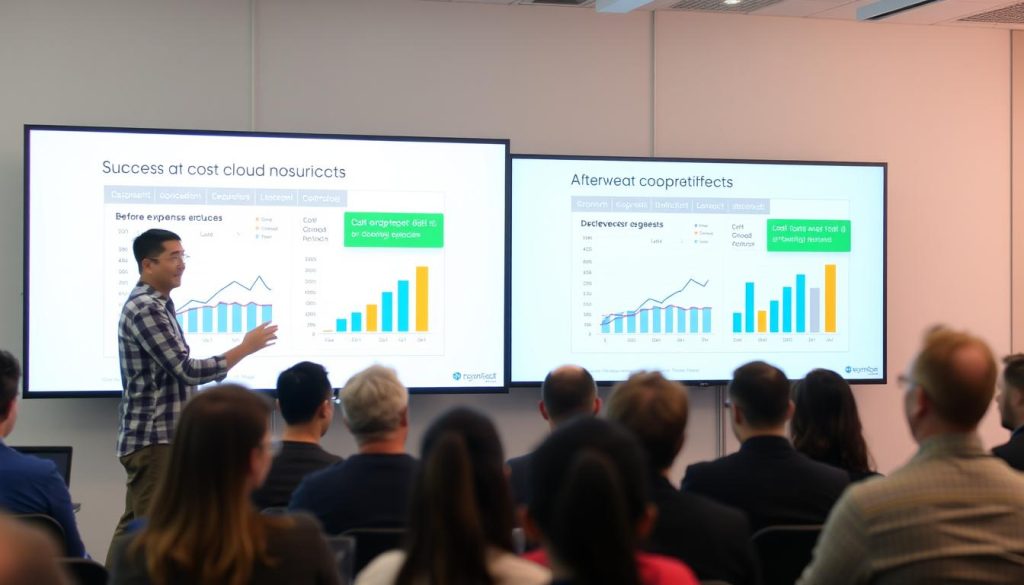
Adopt FinOps practices: cross-functional collaboration among engineering, finance, and product teams produces better decisions and measurable savings. The FinOps Foundation offers frameworks to operationalize this discipline.
 cost optimization" width="750" height="428" srcset="https://opsiocloud.com/wp-content/uploads/2025/08/Cross-functional-team-in-a-FinOps-meeting-discussing-cloud-cost-optimization-1024x585.jpeg 1024w, https://opsiocloud.com/wp-content/uploads/2025/08/Cross-functional-team-in-a-FinOps-meeting-discussing-cloud-cost-optimization-300x171.jpeg 300w, https://opsiocloud.com/wp-content/uploads/2025/08/Cross-functional-team-in-a-FinOps-meeting-discussing-cloud-cost-optimization-768x439.jpeg 768w, https://opsiocloud.com/wp-content/uploads/2025/08/Cross-functional-team-in-a-FinOps-meeting-discussing-cloud-cost-optimization.jpeg 1344w" sizes="(max-width: 750px) 100vw, 750px" />
Tools and Platforms for Cost Optimization
Choosing the right mix of cloud cost management tools and integrations is crucial to reduce cloud service expenses. This section compares native vs third-party options and highlights categories of tools.
Cloud-native cost tools vs third-party cloud cost management tools
Cloud-native tools:
- AWS Cost Explorer, AWS Budgets, AWS Cost Anomaly Detection
- Azure Cost Management + Billing
- Google Cloud Billing + Cost Management tools
Advantages: Deep integration, no extra vendor cost, direct access to billing APIs and marketplace discounts.
Third-party tools:
- CloudHealth by VMware, Apptio Cloudability, Spot by NetApp, CloudZero, Kubecost, Harness
- Often provide unified multi-cloud dashboards, advanced analytics, anomaly detection, and FinOps workflows.
When to use what:
Single-cloud environments
Start with cloud-native cost tools to gain visibility without additional costs.
Multi-cloud environments
Consider third-party tools for cross-cloud normalization and advanced forecasting.
Tools for cloud cost optimization: monitoring, forecasting, and recommendations
Key tool capabilities to look for:
- Cost monitoring: real-time dashboards and drilldowns by tag, team, or workload.
- Anomaly detection: automated alerts on sudden spend spikes.
- Rightsizing recommendations: automated sizing suggestions based on historical utilization.
- Reservation/commitment planners: tools that recommend optimal reserved instance or committed use discounts and calculate amortized savings.
- Forecasting and budgeting: model future spend by trend analysis and growth assumptions.
| Tool Category | Example Tools | Key Benefits |
| Container cost management | Kubecost, CloudHealth | Container-level cost allocation, namespace optimization |
| Enterprise FinOps platforms | Apptio, CloudHealth, Flexera | Comprehensive workflows, chargeback, optimization |
| Spot instance management | Spot by NetApp, AWS Spot Fleet | Automated spot usage, interruption handling |
| Reserved capacity optimization | CloudHealth, AWS Cost Explorer | RI/Savings Plan recommendations, coverage analysis |
Integrations and APIs for automated cost actions
Automate cost-saving actions using integrations:
- Tag enforcement via CI/CD pipelines and IaC tools (Terraform/CloudFormation).
- Use billing APIs to feed a centralized cost platform for anomaly detection and reporting.
- Hook cost events to Slack/Teams or ticketing systems for fast remediation.
- Automate reservation purchases or savings plans via APIs or third-party optimizers.
Integrations enable responsive, automated actions that prevent bill shocks and reduce manual effort. Learn more about Kubernetes cost optimization for containerized workloads.

Best Practices for Cloud Cost Management
Adopt these best practices for cloud cost management to create sustainable savings and alignment across teams.
Establishing cost-aware culture and processes
- Training: Regular FinOps training for engineers, product managers, and finance teams.
- Incentives: Reward teams for cost improvements and efficient architecture.
- SOPs: Standard operating procedures for provisioning, tagging, and decommissioning.
- Governance: Clear policies on who can approve purchases, what instance types are allowed, and when discounts must be applied.
People and process are as important as technology. A cost-aware culture ensures optimization becomes part of daily work.

Continuous optimization lifecycle: measure, act, review
Implement a simple cyclical process:
- Measure: Baseline costs and KPIs (cost per customer, cost per environment).
- Act: Implement rightsizing, automation, or commit purchases.
- Review: Monthly or quarterly reviews to validate savings and adjust.
This continuous optimization lifecycle aligns with FinOps practice and reduces regression into expensive configurations.
Security, performance, and cost trade-offs
Optimization must balance security, performance, and compliance:
- Don't sacrifice required redundancy or SLAs for marginal cost savings.
- Maintain backup and DR if your compliance or uptime needs demand it.
- Evaluate risk vs savings on spot workloads and ensure fallbacks for interrupted instances.
Critical workloads
Prioritize performance and availability for user-facing services.
Non-critical workloads
Maximize cost savings with spot/low-priority resources for batch processing.
Advanced Approaches and Case Studies
Once core practices are in place, advanced analytics, multi-cloud strategies, and real-world examples help deliver further savings.
Using forecasting and analytics to predict future spend
- Use historical trends, business forecasts, and growth assumptions to build monthly and annual spend forecasts.
- Anomaly detection coupled with forecast ranges can highlight unusual cost spikes early.
- Capacity planning informed by forecasting prevents emergency purchases and enables better commitment planning.
According to industry surveys, organizations often report that a significant portion of cloud spend is wasted due to inefficiencies — forecasting and analytics are the tools that reduce that waste.

Hybrid and multi-cloud cost strategies
- Compare cloud pricing models across providers to pick optimal placement (e.g., compute-heavy workloads where provider X has cheaper instances; storage-heavy where provider Y has lower egress/tier costs).
- Employ workload portability for bursty tasks: run steady-state in committed contracts and burst to spot or secondary cloud when needed.
- Beware of multi-cloud complexity: data transfer and operational overhead may offset price benefits.
Hybrid and multi-cloud strategies can optimize costs but require governance and automation to avoid complexity-driven expense. Learn more about AWS reserved instances for optimizing steady workloads.
Real-world examples of reducing cloud service expenses
E-commerce Rightsizing
An e-commerce company reduced EC2 costs by 40% by rightsizing VMs and committing to 1-year Savings Plans for steady-state traffic.
SaaS Spot Utilization
A SaaS analytics vendor moved batch jobs to spot/preemptible instances and cut compute costs by 65% for non-critical processing.
Media Storage Tiering
A media company automated lifecycle policies to move 70% of archival content to low-cost object storage, saving 50% on storage costs.
These examples show that combining architectural change, pricing model optimization, and tooling yields the biggest impact.
Want to achieve similar results?
Schedule a free 30-minute cloud cost assessment to identify your biggest saving opportunities.
Implementation Roadmap and Checklist
This roadmap prioritizes what to do now, next, and over the long term to sustainably reduce cloud service expenses.
Quick wins: immediate actions to lower costs
- Clean up idle resources (orphaned disks, stopped instances, unused load balancers).
- Enforce tag policy and identify top spenders.
- Turn on native cost anomaly detection and set budget alerts.
- Purchase short-term reserved instances or savings plans for clearly steady workloads.
Expected impact: Many teams see 10%–30% immediate cost reduction from quick wins alone.

Mid-term initiatives: tooling and governance
- Deploy or integrate cloud cost management tools (native or third-party) for continuous monitoring.
- Implement automated scheduled shutdowns for dev/test environments.
- Build a tagging and chargeback/showback model and train stakeholders.
- Start a FinOps working group to align engineering and finance.
Expected impact: Establish measurable, recurring savings and accountability.
Long-term optimization: architecture and cultural change
- Invest in platform engineering (internal platforms that enforce cost-effective patterns).
- Adopt FinOps as a discipline with KPIs (cost per product, cost per customer).
- Re-architect monoliths to serverless or containers where appropriate.
- Continuously iterate: measure outcomes, refine policies, and optimize reserved capacity.
Long-term, these changes embed cost efficiency into product design and operations. Explore our guide to FinOps frameworks for structured implementation.
Conclusion of Cloud Spending
Reducing cloud service expenses and optimizing cloud service costs is a multi-dimensional effort: understand pricing models and billing details, implement rightsizing and automation, adopt financial governance, and use the right mix of cloud cost management tools and processes. Start with quick wins like idle resource cleanup and tagging, then build mid- and long-term initiatives — from tooling and policies to platform engineering and FinOps adoption.
Key takeaways:
- Use the right pricing models (on-demand, reserved, spot, committed use) for each workload — a proper cloud pricing models comparison unlocks large savings.
- Combine automation, rightsizing, and lifecycle policies to cut waste.
- Deploy cloud-native and third-party tools for monitoring, forecasting, and recommendations.
- Create a cost-aware culture and iterate using a measure-act-review lifecycle.
Next steps:
- Run a 30-day cost discovery: inventory, enable tagging, set budgets, and identify top three savings opportunities.
- Evaluate one cloud cost management tool and set a rightsizing action plan for your top 5 cost drivers.
- Consider forming a FinOps cross-functional team to institutionalize best practices for cloud cost management.
Ready to start reducing cloud service expenses? Begin with a 30-day audit, enable your cloud provider's cost tools, and pick one automation or rightsizing change to implement this month.