

In today's dynamic digital landscape, organizations are increasingly adopting multi-cloud strategies to enhance resilience, foster innovation, and avoid vendor lock-in. While multi-cloud environments offer significant advantages, they also introduce complex challenges, particularly concerning expenditure. Mastering multi cloud cost optimization is paramount for businesses seeking to maximize their return on investment from diverse cloud platforms.
This comprehensive guide delves into the essential strategies, tools, and best practices required for effective multi cloud cost optimization, ensuring your organization achieves cross-cloud cost efficiency. We will explore the nuances of managing costs across heterogeneous cloud environments and provide actionable insights for success. Understanding and implementing robust multi-cloud FinOps strategies is crucial for sustained profitability.
Understanding the Multi-Cloud Landscape and Its Cost Implications
Multi-cloud refers to the utilization of two or more cloud computing services from different cloud providers, such as AWS, Azure, Google Cloud, and others. This approach enables businesses to leverage the unique strengths of various providers for specific workloads and data requirements. It can also provide enhanced disaster recovery capabilities and greater flexibility.
Organizations adopt multi-cloud for a multitude of reasons. These include leveraging best-of-breed services, meeting regulatory compliance requirements in specific regions, or improving overall application performance by distributing workloads closer to end-users. This distributed approach, however, often leads to fragmented visibility and complex billing structures.
The inherent complexity of multi-cloud environments makes cost management a significant challenge. Each cloud provider has its own pricing models, discount structures, and billing cycles, making it difficult to gain a holistic view of total spend. Without a clear strategy for multi cloud cost optimization, organizations can quickly find their cloud expenditures spiraling out of control.
Core Principles for Effective Multi-Cloud Cost Optimization
Achieving successful multi cloud cost optimization hinges on adopting a structured and proactive approach. This involves more than just reactive cost-cutting; it requires a strategic mindset rooted in transparency, accountability, and continuous improvement. Implementing these core principles lays the groundwork for sustainable savings and efficient resource utilization.
A robust framework for hybrid cloud cost management integrates people, processes, and technology to optimize spend across multiple clouds. It treats cloud resources as a financial asset that must be managed diligently. This holistic perspective is essential for long-term success in dynamic cloud environments.
The fundamental principles include:
- Visibility: Gaining a clear, unified view of all cloud spending across every provider.
- Accountability: Assigning ownership for cloud costs and usage within the organization.
- Optimization: Continuously identifying and implementing opportunities to reduce waste and improve efficiency.
- Governance: Establishing policies and controls to guide cloud usage and spending.
- Automation: Leveraging tools and scripts to automate cost-saving actions and enforce policies.
RECOMMENDED FOR YOU
Connect With Opsio
Tell us about your business requirement and let Opsio take care of the rest.
✓ No commitment required
✓ Trusted by experts
Key Challenges in Multi-Cloud Cost Management
Despite the benefits of a multi-cloud strategy, managing costs effectively can be daunting. The disparate nature of these environments creates several obstacles that organizations must overcome to achieve true cross-cloud cost efficiency. Recognizing these challenges is the first step toward developing effective solutions.
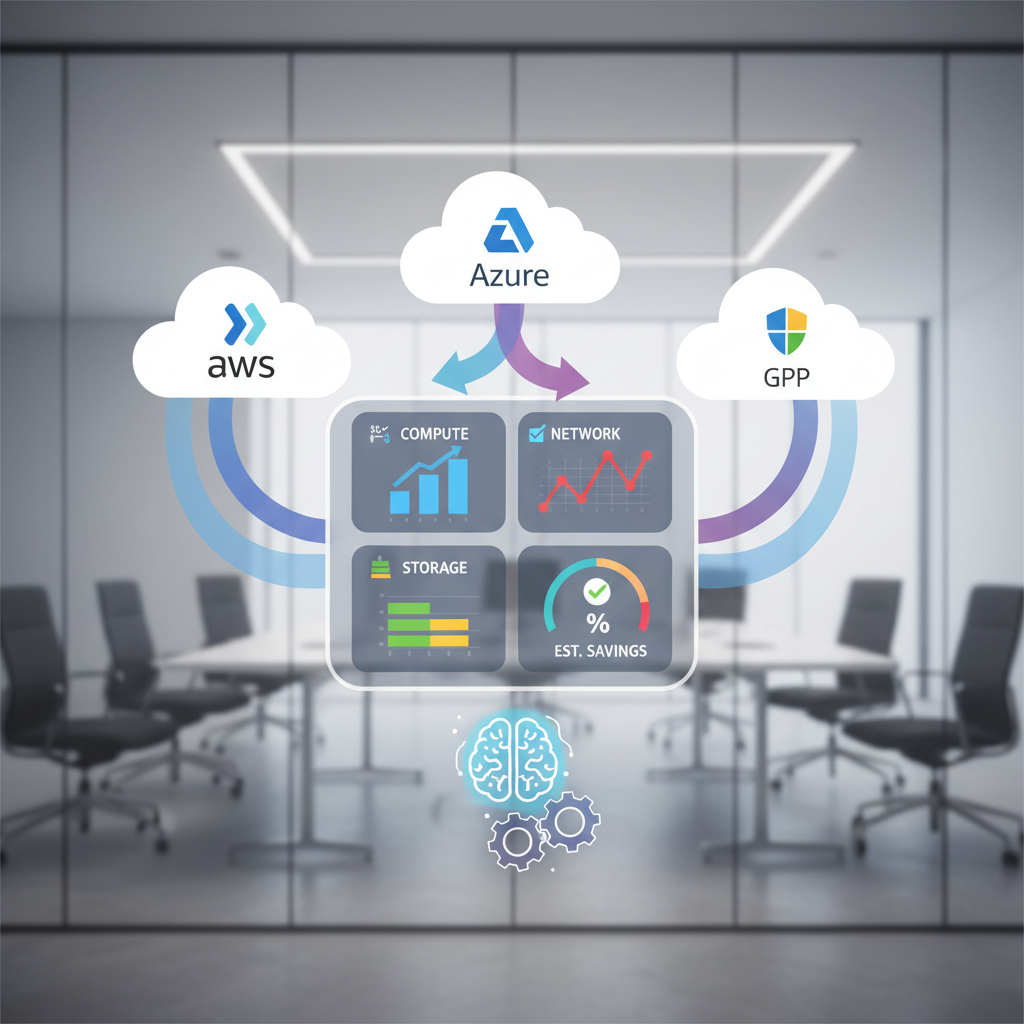
One primary hurdle is the lack of centralized visibility. Different cloud providers offer their own monitoring and billing dashboards, but there is rarely a single pane of glass to view all expenditures. This fragmentation makes it difficult to understand where money is being spent and identify areas for cost reduction.
Diverse pricing models across providers further complicate cost analysis. Services might be priced per second, per minute, or per hour, with varying data transfer fees, storage tiers, and network egress charges. Comparing these disparate models and making informed decisions about resource allocation becomes an intricate task.
Shadow IT and rogue spending also pose a significant threat to budget control. Developers or teams may provision resources without proper oversight, leading to unapproved expenditures that go unnoticed. These unmanaged resources contribute to cloud sprawl and unnecessary costs, making multi cloud cost optimization efforts difficult.
Lastly, skill gaps and the sheer complexity of managing costs in heterogeneous cloud environments often hinder progress. Specialized knowledge is required to navigate the intricacies of each cloud provider's services and pricing. This often necessitates dedicated FinOps teams or external expertise to effectively manage and optimize multi-cloud spend.
Strategies and Techniques for Multi-Cloud Cost Optimization
Implementing effective strategies is crucial for achieving substantial savings and maximizing the value of your multi-cloud investments. A comprehensive approach to multi cloud cost optimization involves a combination of tactical adjustments and strategic cultural shifts. These multi cloud cost optimization tips can guide your journey.
Successful multi-cloud FinOps strategies require continuous effort and cross-functional collaboration. By systematically addressing common areas of waste and inefficiency, organizations can realize significant reductions in their overall cloud expenditure. These methods are designed to bring structure and discipline to your cloud financial management.
Centralized Visibility and Reporting
Gaining a unified perspective on all cloud spending is foundational for any multi cloud cost optimization guide. Without clear insights, identifying waste and making informed decisions becomes impossible. Tools that aggregate billing data from all providers into a single dashboard are invaluable for this purpose.
Implementing robust tagging strategies is also critical for accurate cost allocation and reporting. Consistent tagging allows you to categorize costs by project, department, application, or environment across all your cloud providers. This level of detail supports effective chargeback/showback models and promotes accountability. This contributes directly to hybrid cloud cost management.
Unified cloud billing management solutions provide the necessary infrastructure to collect, normalize, and analyze cost data from multiple sources. These platforms offer dashboards, reports, and alerts that highlight anomalies and optimization opportunities. They transform complex, siloed data into actionable intelligence, improving overall financial governance.
Resource Rightsizing and Optimization
Identifying and eliminating idle or underutilized resources is one of the most immediate ways to start optimizing spend across multiple clouds. Many instances are provisioned with excessive capacity for their actual workload, leading to unnecessary expenses. Regularly reviewing resource utilization metrics is paramount.
Automated scaling and scheduling mechanisms can dynamically adjust resource capacity based on demand. This ensures you only pay for what you need, when you need it. Implementing policies to automatically shut down non-production environments during off-hours or weekends can also generate substantial savings.
Choosing the right instance types for specific workloads also plays a significant role. Cloud providers offer a wide array of instance families optimized for different performance characteristics and cost points. Selecting an instance type that matches your workload's requirements without over-provisioning is a key aspect of cross-cloud cost efficiency.
Leveraging Discount Programs and Pricing Models
Cloud providers offer various discount programs designed to reward commitment and scale. Reserved Instances (RIs) and Savings Plans allow organizations to commit to a certain level of usage over a 1-year or 3-year term in exchange for significant discounts. Strategically utilizing these programs across your multi-cloud environment can lead to considerable savings.
Spot instances, available for fault-tolerant and flexible workloads, offer compute capacity at a much lower price point, sometimes up to 90% off on-demand rates. While these instances can be interrupted, they are ideal for batch processing, rendering, and other stateless applications. Integrating them into your multi-cloud architecture can drastically reduce costs.
Exploring volume discounts and enterprise agreements with cloud providers can also yield substantial financial benefits. As your cloud spend grows, negotiate with providers for custom pricing tiers or favorable terms. This proactive engagement is a key multi cloud cost optimization tip for larger organizations.
Implementing Robust Governance and Policy Enforcement
Establishing clear spending limits and budgets for different teams or projects is fundamental to maintaining financial control. These budgets should be regularly monitored and alerts configured to notify stakeholders when thresholds are approached or exceeded. Strong governance prevents unexpected cost overruns.
Policy-as-code allows organizations to define rules and guardrails for resource provisioning and configuration. These policies can automatically enforce compliance with cost management best practices, such as requiring specific tags or preventing the deployment of overly expensive instance types. This automation ensures consistency and reduces human error.
Implementing chargeback or showback mechanisms promotes accountability by making teams aware of their cloud consumption costs. Chargeback directly bills departments for their usage, while showback simply reports it. Both methods encourage responsible resource utilization and foster a cost-conscious culture, contributing to managing costs in heterogeneous cloud environments.
Automation for Continuous Savings
Automation is a powerful enabler for multi cloud cost optimization. Manual efforts to identify and remediate cost inefficiencies are often time-consuming and prone to oversight. Automated solutions can operate continuously, ensuring optimal resource utilization around the clock.
Scripting for starting and stopping non-production resources, such as development and testing environments, during predefined hours can save a significant amount. Tools can also be configured to automatically delete unattached storage volumes or old snapshots, preventing lingering costs from unused assets.
Leveraging auto-scaling groups based on real-time demand ensures that compute resources scale up only when needed and scale down during periods of low activity. This dynamic adjustment is far more cost-efficient than maintaining a fixed, over-provisioned infrastructure. Automated reports also provide best multi cloud cost optimization insights.
Building a Strong Multi-Cloud FinOps Culture
Ultimately, multi cloud cost optimization is not just a technical challenge; it's a cultural one. Building a strong FinOps culture fosters collaboration between finance, operations, and engineering teams. This ensures that everyone understands their role in managing cloud spend and works towards shared financial goals.
Education and training on multi-cloud cost optimization guide principles are essential. Empowering engineers with the knowledge of how their architectural decisions impact costs, and providing finance teams with insights into cloud consumption patterns, bridges the traditional gap between these departments. This holistic view is crucial for effective multi-cloud cost management.

Tools and Technologies for Multi-Cloud Cost Optimization
The right tools are indispensable for navigating the complexities of multi-cloud environments and implementing effective multi cloud cost optimization strategies. Both native cloud provider offerings and third-party solutions play a vital role in gaining visibility and control over spending. Choosing the appropriate tools is a key multi cloud cost optimization tip.
Native cloud provider tools, such as AWS Cost Explorer, Azure Cost Management, and Google Cloud Billing reports, offer detailed insights into spending within their respective platforms. These tools allow for granular analysis of costs by service, region, and linked accounts, providing initial steps toward optimizing spend across multiple clouds.
However, for a truly unified cloud billing management approach, third-party multi-cloud management platforms are often necessary. These solutions aggregate data from all your cloud providers, offering a single pane of glass for cost visualization, budgeting, and optimization recommendations. Many also provide advanced features like anomaly detection and automated remediation.
AI/ML-driven optimization platforms take cost management a step further by using machine learning algorithms to identify hidden patterns, predict future spending, and recommend optimal resource configurations. These intelligent systems can suggest rightsizing opportunities, identify idle resources, and even automate the purchase of Reserved Instances or Savings Plans, showcasing best multi cloud cost optimization practices.
Real-World Multi Cloud Cost Optimization Examples and Success Stories
Many organizations have successfully navigated the complexities of managing costs in heterogeneous cloud environments, achieving significant savings through strategic multi cloud cost optimization examples. These examples highlight the practical application of the principles discussed and demonstrate their tangible impact.
A global e-commerce company, for instance, struggled with spiraling costs due to a lack of visibility across its AWS and Azure deployments. By implementing a unified cloud billing management platform and enforcing consistent tagging, they gained granular insights into departmental spend. This led to identifying and decommissioning over 20% of underutilized resources within six months, realizing substantial cross-cloud cost efficiency.
Another example involves a SaaS provider that utilized a multi-cloud strategy for resilience but faced challenges with high compute costs. They adopted a multi-cloud FinOps strategies approach, focusing on rightsizing and leveraging spot instances for their stateless batch processing workloads across Google Cloud and AWS. Through automation, they reduced compute expenses by 40% annually, a clear demonstration of effective multi cloud cost optimization.
A financial services firm, operating in a highly regulated hybrid cloud environment, prioritized robust governance for their multi cloud cost optimization. They implemented policy-as-code to ensure all new resource deployments adhered to predefined cost and security policies across their on-premises data centers and public cloud providers. This proactive approach prevented costly misconfigurations and maintained tight budget controls, solidifying their hybrid cloud cost management. These multi cloud cost optimization tips led to impressive results.
The Future of Multi-Cloud Cost Optimization in 2026 and Beyond
As cloud environments continue to evolve, so too will the strategies and technologies for multi cloud cost optimization. Looking ahead to 2026 and beyond, several key trends are expected to shape the future of managing costs in heterogeneous cloud environments. These advancements will further empower organizations to achieve greater cross-cloud cost efficiency.
Increased integration of AI and machine learning will lead to more predictive and proactive optimization. AI will not only identify current waste but also anticipate future spending patterns and recommend preventative actions before costs escalate. This shift towards proactive intelligence will be a hallmark of best multi cloud cost optimization.
There will be a greater focus on sustainability and "green IT" as part of the multi cloud cost optimization guide. Organizations will increasingly consider the environmental impact of their cloud consumption, seeking to optimize not just for cost but also for energy efficiency. Tools will emerge that provide insights into carbon footprint alongside financial metrics.
The role of FinOps will continue to mature and become even more embedded within organizational structures. FinOps practices will move beyond mere cost reduction to encompass strategic value realization, ensuring that every dollar spent in the cloud directly contributes to business objectives. This integrated approach will solidify multi-cloud FinOps strategies as a cornerstone of cloud governance.
RECOMMENDED FOR YOU
Connect With Opsio
Tell us about your business requirement and let Opsio take care of the rest.
✓ No commitment required
✓ Trusted by experts
Conclusion
Mastering multi cloud cost optimization is an ongoing journey that requires continuous vigilance, strategic planning, and a strong collaborative culture. By embracing the principles of visibility, accountability, and continuous optimization, organizations can effectively manage their spending across diverse cloud environments. The multi-cloud landscape offers immense opportunities for innovation, but unlocking its full potential hinges on smart, disciplined financial management.
Adopting a comprehensive approach, leveraging the right tools, and fostering a robust FinOps culture are essential multi cloud cost optimization tips for success. Proactively managing costs in heterogeneous cloud environments ensures that your cloud investments yield maximum value. Begin your journey toward greater cross-cloud cost efficiency today and transform your multi-cloud strategy into a powerful engine for business growth.
Opsio provides cloud consulting and managed services to help organizations implement and manage their technology infrastructure effectively.