
24/7 Cloud Monitoring — Proactive Operations That Prevent Outages
Downtime costs $5,600 per minute on average — yet most teams only discover issues when users complain. Opsio's 24/7 cloud monitoring services provide proactive surveillance, intelligent alerting, and rapid incident response that catches problems before they impact your business.
Trusted by 100+ organisations across 6 countries
24/7/365
Coverage
<5min
Alert Response
99.9%
Uptime SLA
3
Cloud Platforms
What's Included
Infrastructure Monitoring
CPU, memory, disk, network, and process monitoring across servers, containers, and serverless functions. We set intelligent dynamic thresholds based on historical patterns that minimize false positives while catching real issues early — before they cascade into user-facing outages.
Application Performance Monitoring
APM integration with AWS X-Ray, Azure Application Insights, Datadog APM, or New Relic. We track response times, error rates, throughput, dependency mapping, and database query performance to identify application bottlenecks and failures with full distributed tracing.
Log Management & Analysis
Centralized log aggregation with structured parsing and real-time analysis using CloudWatch Logs, Azure Log Analytics, or ELK Stack. We build custom queries for error pattern detection, anomaly alerts on log volumes, and compliance-ready log retention with searchable archives.
Intelligent Alerting & Escalation
Multi-tier alerting with automatic escalation: P1 critical triggers immediate response within 5 minutes, P2 high within 15 minutes, P3 medium during business hours, P4 low at next review cycle. PagerDuty, OpsGenie, or Slack integration with configurable routing rules.
Incident Response & Resolution
When alerts fire, our engineers investigate root cause and resolve — not just acknowledge. We follow documented runbooks, perform systematic root cause analysis, implement permanent fixes to prevent recurrence, and produce post-incident reports for every P1 and P2 event.
Capacity Planning & Reporting
Monthly reports covering resource utilization trends, capacity forecasts based on growth patterns, performance baselines against previous periods, and actionable optimization recommendations. Plan ahead for seasonal peaks instead of reacting to capacity emergencies when traffic spikes arrive.
Opsio is our partner for IT operations and cyber security – a crucial part of our business. We roast 12 million cups of coffee each day, and therefore have high demands for availability and reliability to deliver the best possible quality for our customers. Our partnership with Opsio is vital for us to succeed with this central function.

Magnus Norman
Head of IT · Löfbergs
Two enterprise security platforms. Included free.
Others pay a fortune for continuous vulnerability monitoring and a unified security-and-cost workspace — and then pay again for the people to run them. Every Opsio managed-cloud customer gets both, at no extra cost, with our engineers acting on what they surface.
SeqOps
Continuous vulnerability monitoring across your entire cloud & server estate — always on, never in the way.
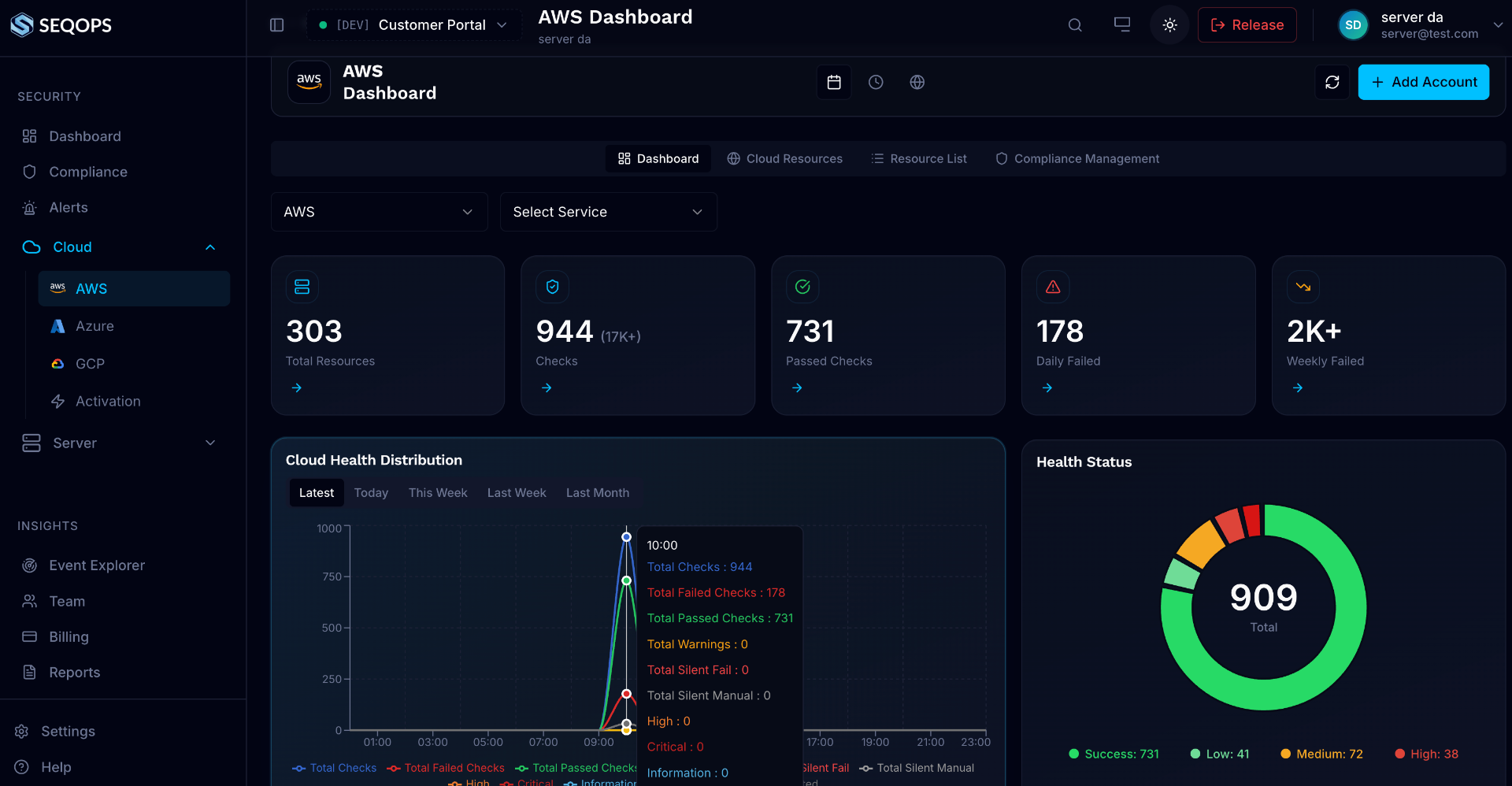
- Every vulnerability, misconfiguration & exposure found continuously across AWS, Azure, GCP, Windows & Linux
- AI ranks findings by real risk, so effort goes where it matters
- Continuous compliance scoring: NIS2 · ISO 27001 · GDPR · PCI · HIPAA
- Read-only — collects security metadata, never your data
Opsio Shield
One intelligent workspace that unifies security posture, compliance scoring and cloud cost — so nothing hides between tools.
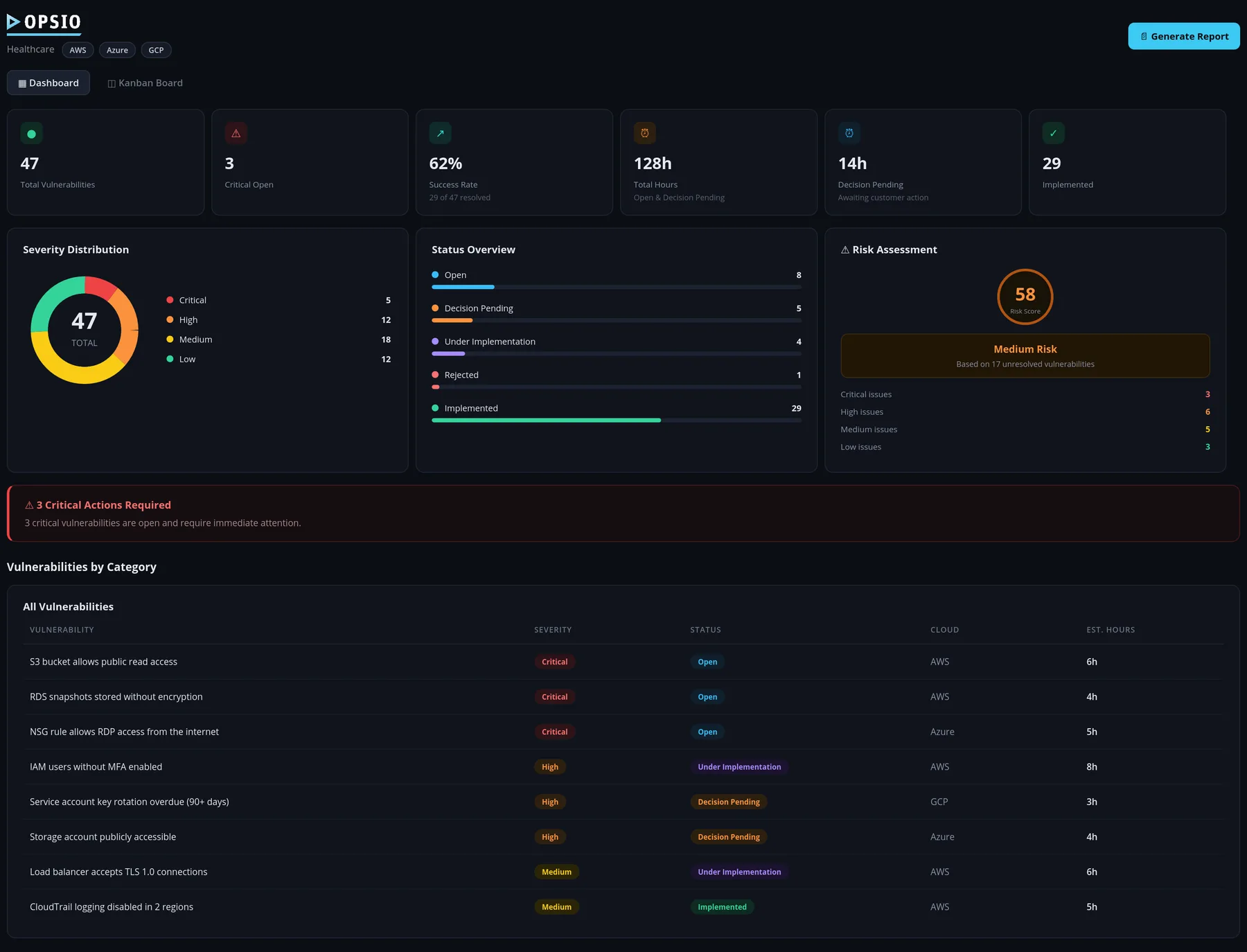
- Security posture, compliance score & multi-cloud spend on one live dashboard
- Cost anomalies & budget overruns caught before the invoice lands
- Auto-generated compliance evidence & vulnerability reports
- Encrypted secrets, mandatory MFA & row-level isolation by design
It's simply part of being an Opsio managed-cloud customer.
Proactive Monitoring That Prevents Outages
Downtime costs enterprise organizations an average of $5,600 per minute. Yet most companies only discover infrastructure issues when customers submit support tickets — reactive monitoring that catches problems after they have already impacted the business, damaged brand reputation, and triggered SLA penalties. The gap between 'we have monitoring' and 'we prevent outages' is enormous, and it is measured in lost revenue. Opsio's cloud monitoring services are proactive, not reactive. We use predictive alerting based on trend analysis and anomaly detection, threshold-based alerts for known failure patterns, and intelligent correlation that reduces alert noise by 70-80%. Opsio's engineers respond to critical alerts within 5 minutes — investigating root cause and resolving most issues before your team or users notice anything unusual.
We monitor across AWS (CloudWatch, X-Ray), Azure (Azure Monitor, Log Analytics), GCP (Cloud Monitoring, Cloud Trace), and third-party platforms (Datadog, Prometheus, Grafana, New Relic). Unified dashboards give you a single pane of glass across all environments. Whether you run a single cloud or multi-cloud infrastructure, our cloud monitoring services provide consistent coverage, alerting, and incident response.
Alert fatigue is the silent killer of monitoring effectiveness. When teams receive hundreds of alerts daily, they stop paying attention — and critical issues get buried in noise. Opsio tunes alerting thresholds continuously based on real incident data, implements multi-tier escalation so the right person gets the right alert at the right time, and correlates related alerts into single actionable incidents.
Our cloud monitoring services go beyond infrastructure metrics. We monitor application performance with APM integration, track business KPIs like transaction success rates and checkout completion, analyze log patterns for error trend detection, and provide capacity planning forecasts so you scale proactively instead of reactively when traffic spikes arrive.
Evaluating cloud monitoring services cost versus building an internal NOC? A 24/7 network operations center requires 4-5 FTEs minimum at $400,000-$600,000 annually. Opsio's cloud monitoring services deliver equivalent or better coverage starting at $2,000/month — with multi-cloud expertise, established runbooks, and proven incident response processes from day one. Featured reading from our knowledge base: 24/7 IT monitoring India: Proactive Support for Your Business Needs, Managed Cloud Operations & Monitoring Services, and Predictive Maintenance Consulting: From Reactive to Proactive Operations. Related Opsio services: AWS Managed Services — 24/7 Operations & Support, Azure Managed Service — 24/7 Cloud Operations, Cloud Managed Services — Your Cloud, Our 24/7 Operations, and IT Managed Service Provider — End-to-End IT Operations.
How Opsio Compares
| Capability | In-House IT | Generic MSP | Opsio |
|---|---|---|---|
| Coverage hours | Business hours only | 8x5 with on-call | True 24/7/365 NOC |
| Alert response time | 30-60 minutes | 15-30 minutes | <5 min P1, <15 min P2 |
| Alert tuning | Set and forget | Annual reviews | Continuous — 70-80% noise reduction |
| Multi-cloud support | Primary cloud only | 1-2 platforms | AWS + Azure + GCP unified |
| APM & observability | Basic metrics | Infrastructure only | Full stack — infra, app, logs, traces |
| Capacity planning | Reactive scaling | Not included | Monthly forecasts with growth modeling |
| Typical annual cost | $400K+ (5 FTE NOC) | $80-150K/yr | $24-168K/yr (SLA-backed) |
Ready to get started?
What You Get
Pricing & Investment Tiers
Transparent pricing. No hidden fees. Scope-based quotes.
Essential Monitoring
$2,000–$5,000/mo
Up to 30 resources
Professional Monitoring
$5,000–$8,000/mo
APM + log management included
Enterprise Monitoring
$8,000–$14,000/mo
Multi-cloud, custom SLAs
Transparent pricing. No hidden fees. Scope-based quotes.
Questions about pricing? Let's discuss your specific requirements.
24/7 Cloud Monitoring — Proactive Operations That Prevent Outages
Free consultation