

E-learning software development services help organizations build digital platforms that deliver training, education, and professional development at scale. Whether you need a custom learning management system, a virtual classroom, or a mobile learning app, these services combine instructional design expertise with modern engineering to create solutions that improve knowledge retention and learner engagement.
The global e-learning market is projected to reach $462 billion by 2027, according to Research and Markets. For businesses investing in workforce training or educational institutions expanding digital reach, partnering with an experienced development team is no longer optional. It is a strategic requirement for staying competitive.

What Are E-Learning Software Development Services?
E-learning software development services encompass the full lifecycle of designing, building, and maintaining digital education platforms tailored to specific organizational goals. These services range from creating custom learning management systems and interactive course builders to developing virtual classrooms and mobile learning applications.
The scope typically includes needs analysis, UX/UI design, backend and frontend development, third-party integrations, quality assurance, deployment, and ongoing maintenance. Providers combine pedagogical understanding with technical skill to ensure platforms are both educationally effective and technically robust.
Organizations that invest in custom e-learning development rather than off-the-shelf solutions gain several advantages: full control over branding, the ability to integrate with existing enterprise systems, and the flexibility to adapt features as learning needs evolve. This approach is particularly valuable for companies with specialized training requirements that generic platforms cannot address.
Core Types of E-Learning Solutions
Modern e-learning development services cover five primary solution categories, each addressing different educational delivery models and organizational needs.
Learning Management System Development
A custom LMS serves as the central hub for administering, tracking, and delivering training programs. Unlike commercial platforms such as Moodle or Canvas, custom LMS development allows organizations to build features specifically aligned with their workflows, including branded interfaces, proprietary assessment engines, and deep integrations with HR or CRM systems.
Key capabilities of a well-built LMS include automated enrollment workflows, SCORM and xAPI compliance for content interoperability, role-based access controls, and detailed analytics dashboards. Custom LMS development is particularly valuable for enterprises managing compliance training across multiple regions, where regulatory requirements demand precise tracking and reporting.
Virtual Classroom Solutions
Virtual classroom development creates real-time, interactive learning environments that replicate the engagement of in-person instruction. These platforms go beyond basic video conferencing by incorporating features like digital whiteboards, breakout rooms, live polling, screen sharing, and session recording.
The technical requirements for virtual classrooms are significant. Low-latency video and audio, WebRTC or similar real-time communication protocols, and scalable server infrastructure are all essential. Development teams must also consider accessibility standards (WCAG 2.1) and cross-device compatibility to ensure all learners can participate regardless of their setup.

Mobile Learning App Development
Mobile learning (m-learning) applications deliver training content directly to smartphones and tablets, enabling learners to study during commutes, between meetings, or whenever they have spare time. Mobile learning app development focuses on creating responsive, offline-capable experiences optimized for smaller screens.
Effective m-learning apps use microlearning principles: short, focused lessons of 3 to 10 minutes, interactive quizzes, and progress notifications that keep learners engaged. Push notifications, offline content caching, and device-native features like camera integration for AR experiences are all design considerations that distinguish mobile-first development from simply making a web app responsive.
Custom Academic Software
Beyond LMS and virtual classrooms, educational software development extends to specialized tools for academic institutions. Student information systems, admissions portals, research collaboration platforms, and automated grading tools all fall under this category. These solutions typically require complex integrations with existing university systems and strict compliance with data privacy regulations like FERPA.
Corporate Training Platforms
Enterprise training platforms differ from academic solutions in their emphasis on business outcomes. Features like skills gap analysis, competency mapping, certification management, and integration with performance review systems help organizations tie learning directly to business metrics. These platforms often include manager dashboards that show team progress and ROI reporting capabilities.
Essential Features for Modern E-Learning Platforms
A successful e-learning platform balances learner engagement with administrative efficiency through a carefully selected feature set.
| Feature Category | Key Capabilities | Business Impact |
|---|---|---|
| User Management | Role-based access, SSO, custom dashboards | Reduced admin overhead, secure access control |
| Content Delivery | Multi-format support, SCORM/xAPI, drag-and-drop builder | Faster course creation, content reuse |
| Assessment Tools | Auto-grading, question banks, proctoring | Consistent evaluation, reduced instructor workload |
| Analytics | Progress tracking, engagement metrics, predictive insights | Data-driven decisions, early intervention |
| Communication | Forums, messaging, live chat, notifications | Community building, improved support |
| Integration | API connectivity, payment gateways, CRM/HRIS sync | Unified ecosystem, streamlined workflows |
Personalization and Adaptive Learning
Modern e-learning platforms increasingly leverage AI-driven personalization. Adaptive learning engines analyze individual performance data to adjust content difficulty, suggest relevant resources, and create personalized learning paths. This approach can improve completion rates by 20 to 30 percent compared to static course structures, according to industry benchmarks from the eLearning Industry.
Content Authoring and Management
Robust content management capabilities allow instructional designers to create, organize, and update course materials without developer assistance. Drag-and-drop course builders, multimedia upload support (video, audio, documents, interactive HTML5 modules), and version control systems ensure content remains current and well-organized.
Assessment and Analytics
Integrated assessment tools should support multiple question formats (multiple choice, free text, drag-and-drop, scenario-based), automated grading, and anti-cheating measures for high-stakes exams. Analytics dashboards provide actionable insights into learner engagement, content effectiveness, and completion trends, enabling continuous improvement of training programs.
The E-Learning Development Process
A structured development process transforms educational requirements into a fully functional platform through five distinct phases.
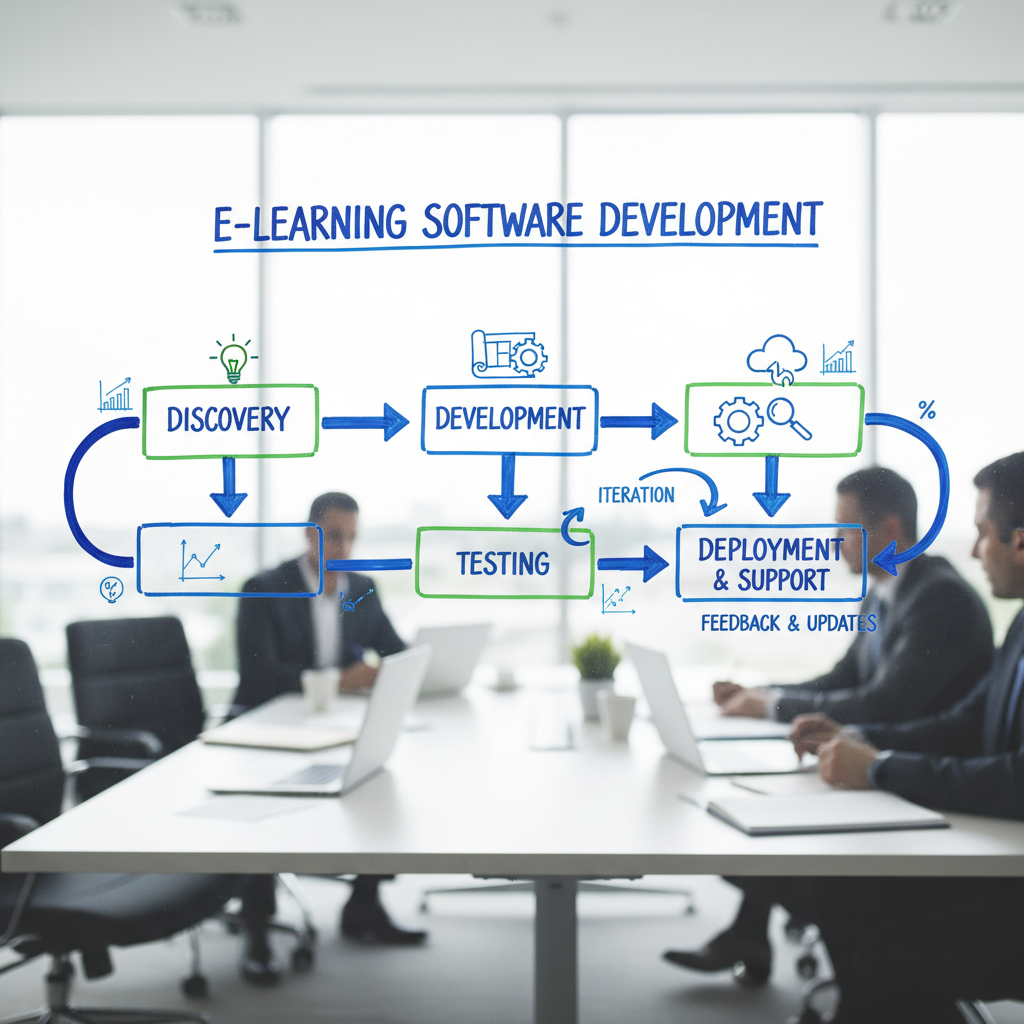
Phase 1: Discovery and Requirements
The discovery phase involves stakeholder interviews, learner persona development, competitive analysis, and detailed requirements documentation. This stage defines the project scope, identifies technical constraints, and establishes success metrics. A thorough discovery phase typically takes two to four weeks and produces a comprehensive project brief that guides all subsequent work.
Phase 2: UX/UI Design and Prototyping
Design begins with wireframes and user flows, progressing to high-fidelity mockups and interactive prototypes. Usability testing with representative learners validates design decisions before development begins. Key priorities include intuitive navigation, accessible design (meeting WCAG 2.1 AA standards), and mobile responsiveness. The design phase also establishes the visual language, component library, and interaction patterns that ensure consistency across the platform.
Phase 3: Development and Integration
Development typically follows agile methodology with two-week sprints, allowing for iterative feedback and course corrections. Backend development covers server architecture, database design, API development, and security implementation. Frontend development focuses on responsive interfaces, interactive components, and performance optimization.
Integration work connects the platform with third-party services: video conferencing APIs, payment processors, email systems, single sign-on providers, and existing enterprise tools like Salesforce or Workday. Each integration point requires careful testing to ensure data flows correctly between systems.
Phase 4: Quality Assurance and Testing
QA covers functional testing, performance load testing, security penetration testing, cross-browser and cross-device compatibility, and accessibility auditing. For e-learning platforms handling sensitive data, security testing is particularly critical, covering authentication mechanisms, data encryption, and compliance with regulations like GDPR or FERPA.
Phase 5: Deployment and Ongoing Support
Deployment includes server provisioning, data migration, user onboarding, and administrator training. Post-launch support covers bug fixes, performance monitoring, security patches, and iterative feature enhancements. A reliable development partner provides Service Level Agreements (SLAs) that define response times and uptime guarantees, ensuring the platform remains stable as usage scales.
How to Choose the Right Development Partner
Selecting an e-learning development partner requires evaluating technical capability, domain expertise, and long-term support commitment.
Look for these critical indicators when evaluating potential partners:
- Portfolio relevance: Review completed e-learning projects similar in scope and complexity to yours. Ask for client references and measurable outcomes achieved.
- Technical depth: Assess proficiency in relevant technologies (React, Angular, Node.js, Python, cloud platforms like AWS or Azure) and experience with e-learning standards (SCORM, xAPI, LTI).
- Instructional design capability: The best development teams include or collaborate with instructional designers who understand adult learning theory and can translate pedagogical goals into technical requirements.
- Scalability planning: Ensure the partner designs for growth, using cloud-native architectures and microservices that can handle increasing user loads without rebuilding the platform.
- Communication practices: Regular sprint demos, dedicated project managers, and transparent progress reporting are essential for maintaining alignment throughout development.
- Post-launch support: Clarify SLA terms, support hours, and the process for requesting enhancements after the initial build is complete.
Opsio brings deep expertise in custom software development and cloud infrastructure, ensuring e-learning platforms are built on scalable, secure foundations. Our team works with organizations across education and enterprise to deliver solutions that drive measurable learning outcomes.
AI and Emerging Trends in E-Learning Development
Artificial intelligence, immersive technologies, and data-driven personalization are reshaping what e-learning platforms can achieve.
AI-Powered Learning Experiences
AI is transforming e-learning through intelligent tutoring systems that provide real-time feedback, natural language processing for automated essay scoring, and recommendation engines that surface the most relevant content for each learner. Chatbot-based learning assistants can answer student questions 24/7, reducing instructor workload while improving response times.
Opsio's Data and AI solutions can be integrated into e-learning platforms to deliver predictive analytics that identify at-risk learners before they disengage, enabling proactive intervention strategies.
Immersive Learning with VR and AR
Virtual reality enables simulation-based training for high-risk scenarios like medical procedures, equipment operation, and emergency response. Augmented reality overlays digital information onto physical environments, creating hands-on learning experiences. While still emerging, these technologies are gaining traction in corporate training where the cost of mistakes in the real world is high.
Microlearning and Just-in-Time Training
The shift toward microlearning reflects how modern professionals prefer to consume information: in short, focused bursts of 3 to 7 minutes. Just-in-time training delivers specific knowledge exactly when and where it is needed, often through mobile apps or embedded learning tools within work applications. This approach dramatically improves knowledge application compared to traditional lengthy training sessions.
Overcoming Common E-Learning Development Challenges
Successful e-learning projects anticipate and address recurring technical and organizational challenges during planning rather than reacting to them after launch.
Security and Data Privacy
E-learning platforms handle personally identifiable information, assessment results, and sometimes financial data. Security must be designed in from the start, including end-to-end encryption, secure authentication (multi-factor where appropriate), regular vulnerability scanning, and compliance with regulations like GDPR, FERPA, or SOC 2. Opsio's security and compliance expertise ensures that learning platforms meet enterprise-grade security standards.
Learner Engagement and Retention
Low completion rates plague many e-learning initiatives. Combat this through thoughtful UX design, gamification mechanics (points, badges, leaderboards), social learning features, and regular content refreshes. Analytics that identify drop-off points help teams continuously optimize the learning experience.
Scalability Under Load
A platform that works smoothly for 100 users may fail at 10,000. Cloud-native architectures using containerization (Docker, Kubernetes) and auto-scaling infrastructure prevent performance degradation during peak usage periods. Load testing should simulate realistic usage patterns, including simultaneous video streaming and assessment submissions.
Investment and Cost Considerations
E-learning development costs vary significantly based on platform complexity, feature requirements, and engagement model, but understanding the key cost drivers helps organizations budget effectively.
Factors That Influence Cost
The primary cost drivers for e-learning software development include:
- Feature complexity: A basic LMS with standard features typically costs less than a platform with AI-driven personalization, VR integration, or custom assessment engines.
- Integration requirements: Each third-party integration (SSO, payment processing, CRM, HRIS) adds development and testing time.
- Content migration: Moving existing courses from legacy systems requires careful data mapping and validation.
- Compliance requirements: Platforms subject to GDPR, FERPA, or accessibility standards require additional development and testing effort.
Engagement Models
Most e-learning development partners offer three engagement models:
- Fixed-price: Best for well-defined projects with clear requirements. Provides cost predictability but limited flexibility for scope changes.
- Time and materials: Ideal for complex or evolving projects where requirements may shift. Offers maximum flexibility but requires active project management.
- Dedicated team: A committed development team working exclusively on your project. Best for long-term initiatives requiring deep domain knowledge and ongoing development.
Frequently Asked Questions
How long does it take to develop a custom e-learning platform?
A minimum viable product (MVP) for a custom LMS typically takes 3 to 6 months. Full-featured platforms with advanced capabilities like AI personalization, virtual classrooms, and extensive integrations usually require 6 to 12 months. Timeline depends heavily on feature complexity, integration requirements, and team size.
What is the difference between custom e-learning development and off-the-shelf platforms?
Off-the-shelf platforms like Moodle or Teachable offer faster setup but limited customization. Custom e-learning development provides complete control over features, branding, integrations, and user experience. Custom solutions are typically more cost-effective long-term for organizations with unique requirements or large user bases.
What technologies are commonly used in e-learning software development?
Modern e-learning platforms commonly use React or Angular for frontend development, Node.js or Python for backend services, and cloud platforms like AWS or Azure for hosting. E-learning standards like SCORM 2004, xAPI (Tin Can API), and LTI ensure content interoperability across systems.
How do you ensure an e-learning platform is accessible?
Accessibility is built into the design and development process by following WCAG 2.1 AA guidelines. This includes keyboard navigation support, screen reader compatibility, sufficient color contrast, alternative text for images, and captioned video content. Regular accessibility audits using automated tools and manual testing verify compliance.
Can existing content be migrated to a new custom platform?
Yes. Content migration is a standard part of e-learning development projects. SCORM and xAPI-compliant content can typically be imported directly. Non-standard content may require reformatting or rebuilding, which the development team handles during the migration phase.