

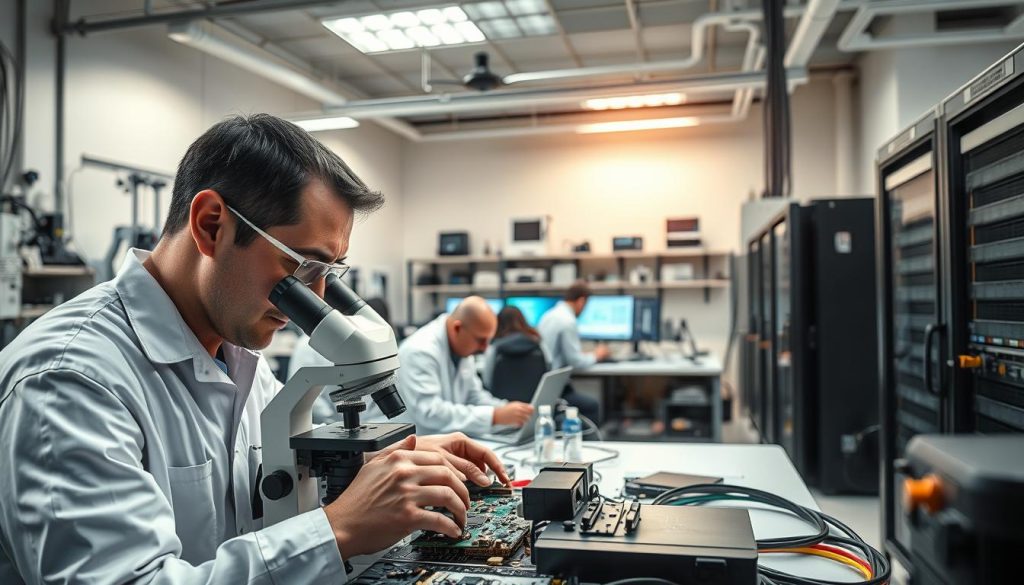
Deep learning models now detect electronic component defects with over 95% accuracy, outperforming manual inspection by 10-25 percentage points while processing thousands of units per minute. For manufacturers running high-volume production lines, this shift from human-dependent quality checks to AI-driven systems directly reduces scrap rates, warranty costs, and time-to-market delays.
 defect detection" width="750" height="428" srcset="https://opsiocloud.com/wp-content/uploads/2025/11/deep-learning-for-electronic-component-defect-detection-1024x585.jpeg 1024w, https://opsiocloud.com/wp-content/uploads/2025/11/deep-learning-for-electronic-component-defect-detection-300x171.jpeg 300w, https://opsiocloud.com/wp-content/uploads/2025/11/deep-learning-for-electronic-component-defect-detection-768x439.jpeg 768w, https://opsiocloud.com/wp-content/uploads/2025/11/deep-learning-for-electronic-component-defect-detection.jpeg 1344w" sizes="(max-width: 750px) 100vw, 750px" />
This guide covers the specific deep learning architectures, training strategies, and deployment considerations that make AI-based inspection viable for real production environments. Whether you are evaluating your first automated optical inspection system or upgrading legacy rule-based equipment, the information here is grounded in published research and practical deployment experience.
Key Takeaways
- Deep learning achieves 95-99% defect detection accuracy versus 70-85% for manual inspection
- YOLO-based object detection models offer the best speed-accuracy trade-off for real-time PCB inspection
- Data augmentation techniques like ConSinGAN solve the chronic shortage of defective sample images
- Cloud-based deployment enables centralized model management across distributed manufacturing facilities
- Successful implementation requires integration with existing SCADA, PLC, and MES infrastructure
- Edge computing and federated learning are expanding what is possible for latency-sensitive inspection
Why Traditional Inspection Falls Short
Manual visual inspection catches only 70-85% of electronic component defects because human inspectors suffer from fatigue, inconsistency, and an inability to keep pace with modern production speeds.
High-volume electronics manufacturing routinely produces millions of components daily. At these volumes, even a 1% miss rate translates to tens of thousands of defective parts reaching downstream assembly or end customers. Manual inspectors typically sustain reliable performance for only 20-30 minutes before attention degrades, according to research published in Nature Scientific Data.
Rule-based automated optical inspection (AOI) systems improved on manual methods by applying fixed thresholds to detect known defect patterns. However, these systems require extensive reconfiguration for each new component type or defect category. They also struggle with lighting variation, surface reflectivity differences, and contamination that changes how defects appear in captured images.
| Inspection Method | Accuracy | Speed | Adaptability | Labor Needs |
|---|---|---|---|---|
| Manual visual inspection | 70-85% | 10-50 units/min | Low | High |
| Rule-based AOI | 85-92% | 100-500 units/min | Low-Medium | Medium |
| Deep learning inspection | 95-99% | 1,000+ units/min | High | Low |
The core limitation of both manual and rule-based approaches is the same: they rely on predefined knowledge of what defects look like. Deep learning flips this model by learning defect patterns directly from labeled image data, adapting automatically to new defect types, component geometries, and environmental conditions. For a broader perspective on this transition, see our guide to AI in quality control implementation.
How Deep Learning Detects Component Defects
Convolutional neural networks (CNNs) process component images through hierarchical feature layers, automatically learning to distinguish defects from normal variation without explicit programming.
At the core of every modern AI defect detection system is a CNN architecture. These networks process raw pixel data through successive convolutional layers, each extracting increasingly abstract features. Early layers detect edges and textures. Intermediate layers identify shapes and patterns. Final layers combine these features to classify whether an image shows a defect and, in some architectures, localize exactly where the defect occurs.
Three primary detection approaches serve different manufacturing scenarios:
- Image classification -- Analyzes cropped regions containing individual components, producing a pass/fail verdict. Works best when component positions are standardized and defect location is less important than presence.
- Semantic segmentation -- Labels every pixel in an image as defective or normal, producing a precise defect map. Ideal for surface inspection where defect shape and area matter.
- Object detection -- Draws bounding boxes around defects within a full image, identifying both defect type and location simultaneously. The most practical approach for PCB-level inspection.
| Detection Approach | Best Use Case | Data Requirements | Output Detail |
|---|---|---|---|
| Image classification | Standardized component positions | Moderate | Pass/fail only |
| Semantic segmentation | Surface defect mapping | High (pixel labels) | Pixel-level mask |
| Object detection (YOLO, Faster R-CNN) | Full-board PCB inspection | Moderate (bounding boxes) | Location + type + confidence |
Object detection models like YOLO (You Only Look Once) have become the dominant choice for electronics inspection because they process an entire image in a single forward pass, delivering both speed and spatial precision. This is critical for production lines where inspection must happen in real time without creating bottlenecks.
PCB Defect Categories and Detection Priorities
Printed circuit board defects fall into four categories -- surface, component, circuit, and assembly errors -- each demanding different detection strategies and tolerances.
PCBs are the interconnection backbone of virtually all modern electronics, from smartphones to automotive control units. A single PCB may contain hundreds of solder joints, passive components, and ICs, any of which can harbor defects that compromise the final product. Understanding defect taxonomy is essential for configuring detection models effectively.
| Defect Category | Common Examples | Detection Priority | Typical Model Approach |
|---|---|---|---|
| Surface defects | Scratches, contamination, solder bridges | High | Segmentation or classification |
| Component defects | Misaligned pins, missing parts, wrong orientation | Critical | Object detection |
| Circuit defects | Open circuits, short circuits, broken traces | Critical | Segmentation |
| Assembly errors | Wrong component values, reversed polarity, cold solder joints | High | Classification + detection |
Component-level defects (missing or misaligned parts) are well-suited to object detection models because each defect manifests as a distinct visual entity with clear boundaries. Surface defects like solder bridging or contamination often require segmentation approaches that can identify irregularly shaped anomalies. Many production systems combine multiple model types in a pipeline to achieve comprehensive coverage.
For more on how automated optical inspection fits into broader quality workflows, see our practical guide.
YOLO Models for Real-Time Component Inspection
Among YOLO variants tested for DIP (dual in-line package) component inspection, YOLOv7 with ConSinGAN data augmentation achieved the best balance at 95.50% accuracy and 285ms per image.
The YOLO family of object detection models is particularly well-suited to electronics inspection because it processes images in a single pass rather than using slower region-proposal methods. Each YOLO generation introduces architectural improvements to the backbone, neck, and detection head that affect real-world performance.
Comparative testing across YOLOv3, YOLOv4, YOLOv7, and YOLOv9 for DIP component quality control revealed that the newest model version does not automatically deliver the best results for a specific industrial application. YOLOv7 combined with synthetic data augmentation achieved 95.50% detection accuracy while completing inference in 285 milliseconds per image -- a reduction of over 900 milliseconds compared to threshold-based methods.
Key findings from YOLO benchmarking:
- YOLOv7 + ConSinGAN delivered the optimal speed-accuracy balance for DIP inspection
- YOLOv9 showed marginal accuracy gains but at higher computational cost, making it less practical for edge deployment
- YOLOv3/v4 remain viable for lower-complexity inspection tasks where computational resources are constrained
- Data augmentation quality had a larger impact on final accuracy than model architecture choice
This last point is critical: the quality and diversity of training data often matters more than selecting the latest model architecture. Manufacturers should prioritize building robust, representative datasets before investing in cutting-edge model complexity.
Solving the Training Data Problem with Augmentation
Synthetic data generation through ConSinGAN addresses the chronic shortage of defective component samples, enabling robust model training from as few as a single defect example per category.
The most common bottleneck in deploying AI defect detection is not model architecture but training data availability. Defective components are inherently rare in well-managed production -- exactly the ratio that makes inspection necessary but training data scarce. A production line with a 0.1% defect rate generates only 1 defective sample for every 999 good ones.
ConSinGAN (Concurrent Single Image GAN) offers a practical solution. Unlike traditional GANs that require thousands of training images, ConSinGAN generates realistic defect variations from a single example image. The model works through progressive multi-stage training, starting at 25x25 pixels and increasing resolution at each stage to produce synthetic defect images that preserve authentic visual characteristics.
| Augmentation Technique | Purpose | Effect on Model Robustness |
|---|---|---|
| Flipping and rotation | Orientation invariance | Handles components at any angle |
| Brightness and contrast adjustment | Lighting variation simulation | Stable across lighting changes |
| Gaussian noise injection | Sensor noise simulation | Reduces false positives from noise |
| ConSinGAN synthesis | Novel defect generation | Expands defect variety from minimal samples |
| Gaussian blur | Focus variation | Tolerates camera focus drift |
Combining geometric augmentation (flips, rotations) with photometric augmentation (brightness, noise) and synthetic generation (ConSinGAN) creates training sets that prepare models for real production variability. This layered approach consistently outperforms models trained on unaugmented data, even when the original dataset is larger.
Deploying AI Inspection on the Factory Floor
Production deployment requires integrating deep learning models with SCADA systems, PLCs, and industrial imaging hardware while meeting real-time processing constraints.
Moving from a trained model to a production-ready inspection station involves hardware selection, software integration, and workflow design. The detection model is only one component of a larger system that must capture images, run inference, communicate results, and trigger sorting or rejection mechanisms.
System Architecture
| Component | Function | Integration |
|---|---|---|
| Industrial cameras | Capture high-resolution component images | GigE Vision or USB3 interface |
| Edge inference device | Run detection model locally | NVIDIA Jetson, Intel NUC, or industrial PC |
| PLC controller | Coordinate mechanical handling and sorting | Ethernet/IP or Modbus TCP |
| SCADA system | Centralized monitoring and logging | OPC-UA or MQTT |
| Cloud platform | Model management, retraining, analytics | REST API, secure VPN |
Handling Hardware Constraints
Production-grade inspection demands lightweight models that run within the computational budget of industrial edge devices. Model optimization techniques such as quantization (reducing weight precision from 32-bit to 8-bit), pruning (removing redundant neurons), and knowledge distillation (training a smaller model to mimic a larger one) reduce inference time without significant accuracy loss.
Multi-camera configurations that capture all six sides of a component require careful synchronization and specialized depth-of-field settings. Multiple automated inspection stations positioned along the production line minimize environmental interference and ensure consistent image quality.
Image Quality and Contamination Challenges
Image contamination from lighting variation, lens fouling, and sensor noise directly degrades detection accuracy, making environmental control and preprocessing essential.
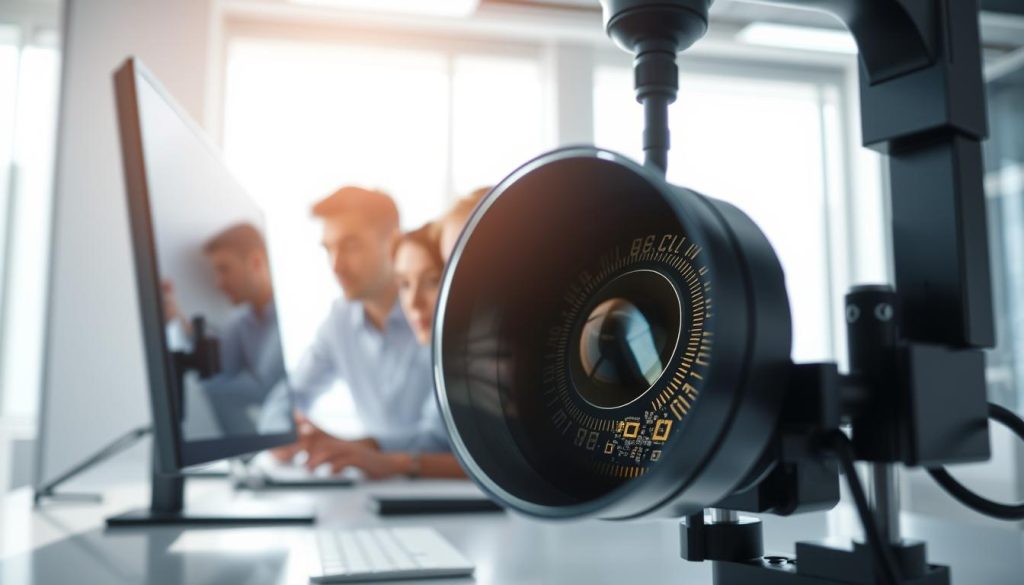
Industrial environments introduce contamination sources that controlled laboratory settings never encounter. Reflections from metallic component surfaces, shadow patterns from overhead fixtures, dust accumulation on camera lenses, and electrical noise in imaging sensors all degrade the quality of captured images.
Practical mitigation strategies include:
- Controlled lighting enclosures that isolate the inspection zone from ambient light variation
- Regular lens cleaning schedules integrated into preventive maintenance routines
- Preprocessing pipelines that normalize brightness, apply noise filtering, and correct for lens distortion before model inference
- Training on contaminated data by augmenting datasets with realistic noise, blur, and lighting artifacts so the model learns to tolerate real-world conditions
Models trained exclusively on clean laboratory images will underperform in production. Including realistic contamination in training data is as important as including the target defect categories themselves.
Cloud Infrastructure for Scalable Inspection
Cloud-based model management eliminates per-facility hardware investment while enabling centralized retraining, version control, and real-time analytics across distributed production sites.
For manufacturers operating multiple production facilities, cloud infrastructure provides significant advantages over purely on-premises deployment. Rather than maintaining separate model training environments at each site, a centralized cloud platform can aggregate inspection data, retrain models on combined datasets, and deploy updated models to all facilities simultaneously.
Key cloud-enabled capabilities:
- Centralized model registry with version control and rollback capability
- Federated data aggregation that combines defect data from multiple sites without transferring raw images
- Automated retraining pipelines triggered when model performance drifts below threshold
- Real-time dashboards showing defect rates, model confidence distributions, and trend analysis across all facilities
The hybrid architecture combining edge inference (for real-time speed) with cloud analytics (for continuous improvement) has emerged as the standard deployment pattern. Edge devices handle the latency-critical detection task, while the cloud handles everything else: model training, performance monitoring, data aggregation, and strategic analytics.
Learn more about how cloud innovation drives quality control transformation in our detailed analysis.
Emerging Technologies Reshaping Inspection
Vision transformers, edge AI accelerators, and federated learning are expanding the accuracy ceiling, reducing latency, and enabling privacy-preserving collaboration across manufacturing networks.

The inspection technology landscape is evolving beyond CNNs toward architectures that offer better generalization with less training data. Vision transformers (ViTs) apply self-attention mechanisms to image patches, capturing long-range dependencies that CNNs can miss. Early results show promise for detecting defects that span large areas or involve subtle spatial relationships between components.
Other developments reshaping the field:
- Edge AI accelerators (dedicated NPUs in industrial hardware) are pushing inference times below 50ms, enabling inspection at even faster production speeds
- Federated learning allows multiple manufacturers to improve shared models without exposing proprietary defect data, addressing both IP and regulatory concerns
- Few-shot learning reduces the number of labeled defect examples needed for training from hundreds to single digits, accelerating deployment for new component types
- Multimodal inspection combining optical imaging with X-ray, thermal, or acoustic data provides defect detection capabilities that no single modality can achieve alone
These technologies are not theoretical. Edge inference hardware is available now from vendors like NVIDIA and Intel. Federated learning frameworks are production-ready. The challenge for most manufacturers is not technology availability but integration planning and workforce readiness.
Planning Your Inspection System Deployment
Successful deployment spans four phases -- assessment, data strategy, pilot integration, and full rollout -- each requiring explicit success criteria before progressing.
| Phase | Activities | Duration | Success Criteria |
|---|---|---|---|
| Assessment | Audit current defect rates, identify target components, evaluate infrastructure | 2-4 weeks | Baseline metrics established |
| Data strategy | Collect defect samples, label images, build augmentation pipeline | 4-8 weeks | Training dataset meets minimum size and balance requirements |
| Pilot integration | Deploy model on single line, validate accuracy against manual inspection | 4-6 weeks | Model accuracy exceeds manual baseline by agreed margin |
| Full rollout | Expand to all lines, integrate with SCADA/MES, establish monitoring | 8-12 weeks | System operates within SLA for accuracy, speed, and uptime |
Common deployment mistakes to avoid:
- Starting with the most complex inspection task instead of a high-volume, well-understood component
- Underinvesting in data labeling quality, which caps model accuracy regardless of architecture choice
- Ignoring change management for operators who will interact with the new system
- Deploying without a retraining pipeline, causing model performance to degrade as production conditions evolve
Opsio helps manufacturers navigate this deployment process from initial assessment through ongoing optimization. Our cloud platform provides the infrastructure for model management, monitoring, and continuous improvement. Contact our team to discuss your specific inspection requirements and production environment.
FAQ
How does deep learning improve defect detection compared to traditional methods?
Deep learning models automatically learn defect patterns from labeled image data, eliminating the need for manual threshold configuration required by rule-based systems. CNNs extract visual features at multiple abstraction levels, achieving 95-99% accuracy compared to 70-85% for manual inspection and 85-92% for traditional automated optical inspection. They also adapt to new defect types through retraining rather than reprogramming.
What types of electronic component defects can AI detect?
AI inspection systems detect surface defects (scratches, contamination, solder bridges), component defects (misaligned pins, missing parts, wrong orientation), circuit defects (open circuits, short circuits, broken traces), and assembly errors (wrong component values, reversed polarity, cold solder joints). Object detection models like YOLO can identify and localize multiple defect types simultaneously in a single image.
How much training data is needed for a defect detection model?
While traditional deep learning approaches require hundreds or thousands of defect examples per category, synthetic data augmentation techniques like ConSinGAN can generate realistic defect images from as few as one real example. A practical starting point is 50-100 labeled defect images per category combined with augmentation, though more data generally improves accuracy. Data quality and labeling consistency matter more than raw volume.
Which YOLO version works best for electronic component inspection?
Benchmarking across YOLOv3, v4, v7, and v9 for DIP component inspection showed YOLOv7 with ConSinGAN augmentation delivering the best speed-accuracy balance at 95.50% accuracy and 285ms inference time. The newest version does not always perform best for a specific application. Selection should be based on your production speed requirements, available compute hardware, and the complexity of defects you need to detect.
Can AI inspection systems integrate with existing manufacturing equipment?
Yes. Modern AI inspection systems are designed to integrate with SCADA systems, PLCs, and MES platforms through standard industrial protocols like OPC-UA, MQTT, Ethernet/IP, and Modbus TCP. Edge inference devices connect to existing camera infrastructure and communicate with production control systems for automated part sorting and rejection. Integration typically requires 4-6 weeks of pilot testing.
What hardware is needed to run deep learning inspection at production speed?
Production-grade inspection typically requires industrial cameras with GigE Vision or USB3 interfaces, an edge inference device with GPU or NPU acceleration (such as NVIDIA Jetson or an industrial PC with dedicated AI accelerator), and a PLC for mechanical coordination. Model optimization techniques like quantization and pruning reduce computational requirements, enabling real-time inference on relatively modest hardware.
How does cloud computing benefit AI defect detection?
Cloud infrastructure centralizes model training, version control, and performance monitoring across distributed manufacturing facilities. It eliminates per-site hardware investment for model development, enables automated retraining when performance drifts, and provides real-time analytics dashboards. The standard architecture pairs edge devices for real-time inference with cloud platforms for model management and continuous improvement.
How do you handle image quality issues in factory environments?
Effective strategies include controlled lighting enclosures to isolate inspection zones, regular lens cleaning schedules, preprocessing pipelines for brightness normalization and noise filtering, and training models on augmented datasets that include realistic contamination patterns. Models trained only on clean laboratory images underperform in production, so including environmental variation in training data is essential.