
AI for Reducing Production Downtime: Expert Strategies for Business Continuity

Country Manager, India
AI, Manufacturing, DevOps, and Managed Services. 17+ years across Manufacturing, E-commerce, Retail, NBFC & Banking
Unplanned downtime costs industrial manufacturers an estimated $50 billion annually, according to Deloitte, 2022. That figure keeps climbing as production lines grow more complex and interconnected. For operations leaders under constant pressure to improve output, the question isn't whether to adopt AI, but how quickly they can get it running.
AI for reducing production downtime works by shifting maintenance from reactive to predictive. Instead of waiting for a machine to fail, algorithms analyze sensor data in real time, flag early warning signs, and trigger interventions before costly breakdowns occur. The result is fewer unplanned stops, higher throughput, and more predictable operating costs. This guide breaks down the core strategies, from predictive maintenance models to computer vision inspection, and walks through a practical implementation roadmap.
Key Takeaways - AI-driven predictive maintenance reduces unplanned downtime by up to 50% (McKinsey, 2023). - Manufacturers using AI for quality control detect defects 90% faster than manual inspection. - A phased implementation, starting with a single production line, lowers risk and accelerates ROI. - Edge computing paired with cloud analytics gives factories real-time insight without bandwidth bottlenecks. - Most organizations recoup their predictive maintenance investment within 12 to 18 months.
How Does AI Reduce Production Downtime?
AI reduces production downtime by detecting equipment anomalies long before they cause failures. A McKinsey (2023) analysis found that AI-enabled predictive maintenance can lower machine downtime by 30-50% and increase machine life by 20-40%. These gains stem from the ability to process vast sensor datasets that human operators simply cannot monitor at scale.
Traditional maintenance follows one of two models: reactive or scheduled. Reactive maintenance waits for a breakdown, then scrambles to fix it. Scheduled maintenance replaces parts at fixed intervals regardless of actual wear. Both approaches waste money. Reactive repairs are expensive emergencies. Scheduled replacements discard components that still have useful life.
AI introduces a third option. Machine learning models ingest vibration data, temperature readings, pressure levels, and power consumption metrics from equipment sensors. They compare current readings against historical baselines and known failure signatures. When patterns shift in ways that precede a breakdown, the system alerts maintenance teams with enough lead time to plan the repair.
What makes this approach powerful is its ability to learn continuously. Every repair, every near-miss, every normal operating cycle feeds back into the model. Over months, prediction accuracy improves. False alarms decrease. Maintenance windows get tighter and more efficient.
The business impact goes beyond maintenance savings. When production lines run more predictably, supply chain planning improves. Delivery commitments become more reliable. Customer satisfaction rises because orders arrive on time.
What Is Predictive Maintenance with AI?
Predictive maintenance with AI uses sensor data and machine learning to forecast equipment failures before they happen. According to Aberdeen Group (2023), best-in-class manufacturers using predictive maintenance achieve 91% uptime compared to 79% for those relying on reactive strategies. That 12-point gap translates directly into revenue and competitive advantage.
The concept is straightforward, but the engineering behind it is layered. Sensors attached to critical equipment collect hundreds of data points per second. That data flows into ML models trained on historical failure records. The models identify subtle patterns, a slight vibration shift, a gradual temperature creep, that human technicians would miss until the problem became obvious.
How Predictive Models Work
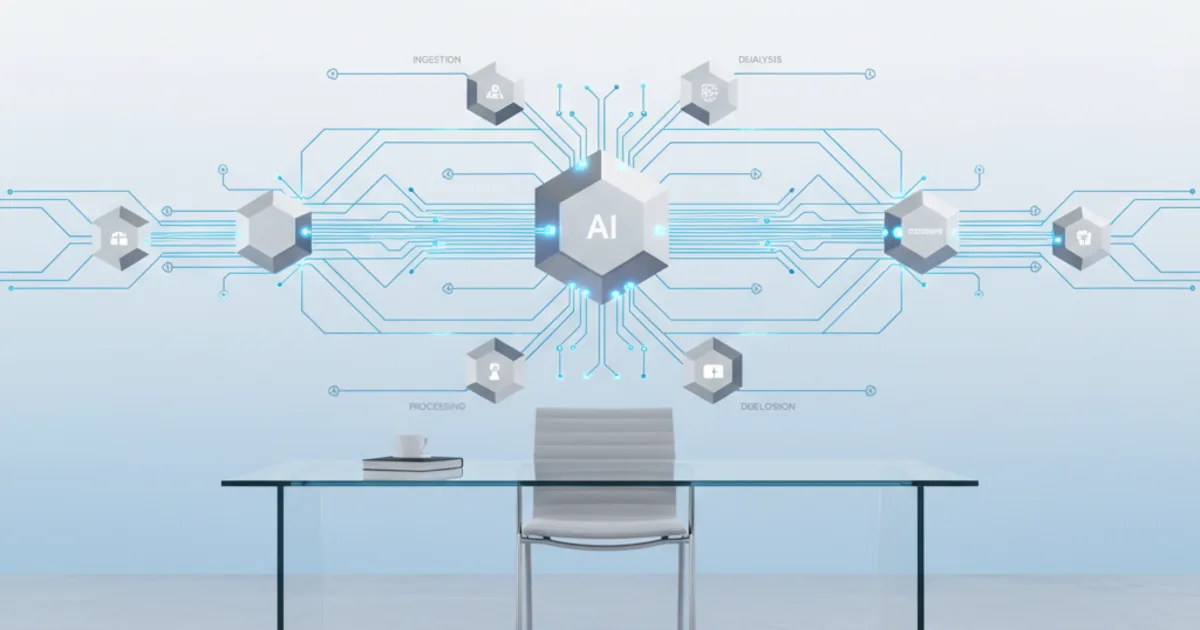
Predictive models typically follow a three-stage pipeline. First, data ingestion collects raw signals from vibration sensors, thermal cameras, acoustic monitors, and power meters. Second, feature engineering transforms those raw signals into meaningful indicators, like the rate of change in bearing temperature or the frequency spectrum of motor vibration. Third, classification or regression algorithms determine whether the equipment is healthy, degrading, or approaching failure.
Common algorithms include random forests for classification tasks, long short-term memory (LSTM) networks for time-series prediction, and autoencoders for anomaly detection. The choice depends on the failure mode being monitored and the volume of historical failure data available.
Is perfect accuracy realistic? Not yet. Even the best models produce some false positives. But the tradeoff is clear: a handful of unnecessary inspections costs far less than a single catastrophic breakdown that halts an entire production line for days.
ROI of Predictive Maintenance
The financial case for predictive maintenance is well documented. Deloitte (2022) reports that predictive maintenance programs deliver a 10-fold return on investment on average, with a 25-30% reduction in maintenance costs and a 70-75% decrease in breakdowns. These numbers reflect mature implementations across heavy industry, automotive, and process manufacturing.
Initial investment varies based on the scope of the deployment. A pilot covering one production line might cost $50,000 to $150,000, including sensors, connectivity, and model development. Scaling across a full facility adds cost, but the marginal expense per additional machine drops significantly because the infrastructure and data pipeline already exist.
Most manufacturers see payback within 12 to 18 months. The fastest returns come from monitoring high-value, failure-prone equipment, think compressors, turbines, CNC machines, and conveyor drive systems. Prioritizing those assets first maximizes early wins and builds internal support for broader rollout.
One factor often overlooked is the reduction in spare parts inventory. When you can predict which component will fail and roughly when, you don't need to stockpile every possible replacement. That frees up working capital and warehouse space.
Need expert help with ai for reducing production downtime?
Our cloud architects can help you with ai for reducing production downtime — from strategy to implementation. Book a free 30-minute advisory call with no obligation.
How Does Computer Vision Improve Quality Control?
Computer vision systems catch defects that human inspectors miss, especially at high line speeds. A McKinsey (2023) study found that AI-based visual inspection improves defect detection rates by up to 90% while reducing false rejection rates by 50%. For manufacturers dealing with tight tolerances, this directly prevents the downstream downtime caused by defective parts reaching assembly.
Traditional quality inspection relies on human eyes and judgment. Inspectors fatigue after a few hours. They miss microscopic surface cracks, subtle color variations, and dimensional deviations that fall just outside acceptable ranges. At high throughput, the problem compounds because each unit gets less attention.
Computer vision flips this equation. Cameras capture images of every unit on the line, often at multiple angles and under controlled lighting. Convolutional neural networks (CNNs) trained on thousands of labeled examples, both defective and good, classify each image in milliseconds. Rejected units get diverted automatically.
Where does this connect to downtime? Defective components that slip past quality control cause problems downstream. A faulty bearing housing that reaches the assembly line might jam equipment, damage tooling, or produce an entire batch of non-conforming products. Catching defects early keeps the rest of the line running smoothly.
Beyond defect detection, computer vision systems generate valuable data about process drift. If defect rates start creeping up on a specific machine, that's an early indicator that something, tooling wear, material inconsistency, or calibration drift, needs attention. The quality system becomes a de facto condition monitoring tool.
How Do You Implement AI-Driven Downtime Prevention?
A structured, four-step implementation gives manufacturers the highest success rate with AI deployments. Deloitte (2023) reports that 93% of companies believe AI will be a pivotal technology for growth, yet only 26% have deployed AI at scale. Closing that gap requires a practical, phased approach rather than a single large-scale transformation.
Step 1: Audit Equipment and Data Readiness
Start by cataloging critical assets and their current sensor coverage. Identify which machines have the highest failure rates, the longest repair times, and the greatest production impact when they go down. Not every machine needs AI monitoring. Focus on the equipment where downtime is most expensive.
Assess your existing data. Do you have historical maintenance records? Are sensors already installed, or will you need to retrofit? Clean, labeled historical data accelerates model training. If records are incomplete, plan for a data collection period of three to six months before expecting accurate predictions.
Step 2: Run a Pilot on High-Impact Equipment
Choose one to three machines for a pilot deployment. Install or connect sensors, set up data pipelines, and train initial models. The goal is to prove value quickly. A focused pilot also gives your maintenance team time to learn the new workflow without overwhelming them.
During the pilot, measure everything: prediction accuracy, false alarm rate, time saved on repairs, and actual downtime avoided. These metrics justify the business case for broader investment.
Step 3: Scale and Integrate
Once the pilot demonstrates results, expand to additional equipment and production lines. Integrate AI alerts into your existing CMMS (computerized maintenance management system) so maintenance technicians receive actionable work orders, not just raw data. Integration matters because tools that sit outside existing workflows get ignored.
Step 4: Optimize Continuously
AI models degrade if they aren't retrained on fresh data. Schedule regular model updates as equipment ages, operating conditions change, or new failure modes emerge. Treat AI maintenance the same way you treat equipment maintenance, as an ongoing process, not a one-time project.
How Do AI and Cloud Infrastructure Work Together in Manufacturing?
Edge computing and cloud analytics form the backbone of scalable AI in manufacturing. According to McKinsey (2024), manufacturers that combine edge processing with cloud-based analytics see 20-30% faster time to insight compared to purely on-premises deployments. The combination solves a core tension: factories need real-time decisions at the machine level, but they also need centralized analytics across multiple sites.
Edge devices, compact industrial computers installed near equipment, handle time-sensitive processing. A vibration anomaly that could indicate imminent bearing failure can't wait for data to travel to a remote data center and back. Edge inference delivers predictions in milliseconds, enabling immediate automated responses like slowing a motor or triggering an alert.
The cloud handles everything that doesn't need millisecond latency. Model training, long-term data storage, cross-plant benchmarking, and dashboard reporting all run more efficiently in a scalable cloud environment. When a model trained on failure data from one factory improves predictions, that updated model can be deployed to edge devices across every facility simultaneously.
What about connectivity challenges in factory environments? Industrial settings are harsh, with electromagnetic interference, dust, and temperature extremes. Modern edge-to-cloud architectures account for intermittent connectivity. Edge devices cache data locally during network outages and sync when the connection restores. No data gets lost, and local predictions continue uninterrupted.
Security is another consideration. Manufacturing data, especially from defense or pharmaceutical plants, can be sensitive. A well-designed architecture encrypts data in transit and at rest, segments networks, and applies role-based access controls both at the edge and in the cloud. Opsio's cloud managed IT services are designed with these security and scalability requirements in mind, supporting manufacturers who need enterprise-grade infrastructure without building it from scratch.
Frequently Asked Questions
What types of manufacturing equipment benefit most from AI monitoring?
High-value rotating equipment benefits the most. Compressors, turbines, pumps, CNC machines, and conveyor systems generate rich sensor data and carry high downtime costs. Aberdeen Group (2023) data shows that monitoring these asset classes first delivers the fastest ROI because their failure modes are well-understood and sensor technology is mature.
How long does it take to implement AI-based predictive maintenance?
A pilot deployment typically takes three to six months from initial sensor installation to validated predictions. Scaling across a full facility usually takes 12 to 18 months. The timeline depends heavily on existing data quality and sensor infrastructure. Manufacturers with modern PLCs and historian databases move faster than those starting from paper-based records.
Does AI for manufacturing require replacing existing equipment?
No. Most AI solutions are retrofit-friendly. Wireless vibration sensors, clip-on thermal monitors, and non-invasive current sensors attach to existing machines without modifications. The AI layer sits on top of your current equipment, analyzing data without requiring new capital machinery purchases.
What's the minimum data needed to train a predictive maintenance model?
Most models need at least three to six months of continuous sensor data, including at least a few documented failure events for supervised learning. Unsupervised approaches like anomaly detection can start with less failure data because they learn what "normal" looks like and flag deviations. In practice, model accuracy improves substantially after 12 months of operational data.
How does AI handle false alarms in production environments?
Modern AI systems use confidence thresholds and multi-signal correlation to reduce false positives. Rather than triggering an alert from a single sensor spike, the model cross-references vibration, temperature, and power data simultaneously. Over time, feedback from maintenance teams, marking alerts as true or false, retrains the model and pushes false alarm rates below 5% in mature deployments.
Moving from Reactive to Predictive
The shift from reactive maintenance to AI-driven prediction isn't a future aspiration. It's happening now across automotive, aerospace, food processing, and pharmaceutical manufacturing. The data is clear: organizations that invest in predictive maintenance, computer vision inspection, and edge-to-cloud infrastructure see measurable reductions in downtime, maintenance costs, and defect rates.
Start small. Pick your most problematic equipment, run a focused pilot, measure results, and scale what works. The technology is mature enough that early adopters are already on their second and third generation of models. Waiting only widens the gap.
The path forward combines the right sensors, the right algorithms, and the right infrastructure. Whether you're exploring IoT-based predictive maintenance, automated visual inspection, or cloud-managed IT services to support your factory's digital backbone, the first step is the same: audit what you have, identify where downtime hurts most, and build from there.
About the Author

Country Manager, India
Praveena leads Opsio's India operations, bringing 17+ years of cross-industry experience spanning AI, manufacturing, DevOps, and managed services.
Editorial standards: This article was written by a certified practitioner and peer-reviewed by our engineering team. We update content quarterly to ensure technical accuracy. Opsio maintains editorial independence — we recommend solutions based on technical merit, not commercial relationships.