



What is Managed Cloud Hosting?
Are you spending too much time on tech instead of growing your business? Many companies struggle with this. They face the challenges of modern IT operations.
Managed cloud hosting is a game-changer. It lets a third-party handle your tech needs. It’s like having a skilled gardener tend to your virtual garden. They take care of your business’s tech, so you can focus on growing.
This way, companies can use top-notch tech without the hassle. They don’t need to have experts for every tech problem. Instead, they work with pros who offer scalability, reliability, and security as their main skills.

With cloud hosting services, your team gets to manage complex tech without losing sight of your business goals. This partnership model changes how companies invest in tech. It cuts down on the need for a huge in-house tech team. It also makes operations more efficient and helps your business grow steadily.
Key Takeaways
- Managed hosting solutions transfer infrastructure responsibilities to specialized providers, freeing your team to concentrate on business priorities
- Third-party experts handle daily operations, maintenance, and monitoring of your technology environment
- Organizations gain access to enterprise-grade capabilities without building extensive internal technical teams
- Scalability and reliability become built-in features rather than ongoing challenges requiring constant attention
- Strategic technology partnerships reduce operational complexity while optimizing your infrastructure investments
- Businesses achieve improved security posture through providers’ dedicated expertise and continuous monitoring
What is Managed Cloud Hosting?
Managed cloud hosting changes how businesses use cloud technology. It removes technical barriers, so you can focus on your business goals. Expert teams handle the technical parts, making it easier for you.
This service model is different from just renting server space. It offers a complete solution where the provider takes care of the technical stuff. This way, you can focus on your business strategy.
Managed cloud hosting is a partnership where the provider and your business work together. They handle the technical side, so you can focus on your business goals.
Defining Managed Cloud Hosting Services
Managed cloud services include features like monitoring, scaling, security, and backups. These are built into the service, making it easy to use. You don’t have to worry about the technical details.
This approach means you get a complete operational framework. It keeps your applications running smoothly. You’re not just buying raw resources, but a complete solution.
A managed cloud environment is a partnership where the provider takes care of everything. They handle tasks like allocating resources, patching vulnerabilities, and monitoring for threats. They also respond quickly to any issues.
This service goes beyond just managing infrastructure. It includes expert attention to every layer of your technology stack. This includes hardware, operating systems, and the environments that power your applications.
Core Components of the Service
Managed cloud services have multiple layers that work together. Each layer has a specific function, but they all work together to deliver a reliable and high-performing environment.
The infrastructure layer is the foundation. It includes compute resources, storage systems, and networking capabilities. This layer powers your applications and enables them to run efficiently.
The management layer orchestrates resource allocation, monitoring, and optimization. It includes automation tools, monitoring systems, and orchestration platforms. This layer ensures resources scale automatically and performance remains consistent.
Security is a critical component that permeates every aspect of the service. It includes firewalls, intrusion detection systems, encryption technologies, and compliance controls. These measures work together to protect your digital assets.
The support layer provides human expertise that complements automated systems. It includes technical specialists, troubleshooting experts, and advisory services. This layer bridges the gap between technology and business outcomes.
These core components work together to create an environment where:
- Technical complexity is abstracted away from your internal teams
- Operational tasks are handled by specialists with deep expertise
- Performance and security receive continuous attention
- Your organization can focus resources on innovation rather than maintenance
- Business continuity is protected through proactive monitoring and rapid response
The Managed Service Model Explained
The managed service model is a partnership approach to cloud technology. It allows you to leverage provider expertise while maintaining control over your environment. This way, you can focus on your business strategy and application functionality.
In this partnership, the provider handles technical operations. They manage server configuration, operating system maintenance, security patch deployment, and more. These responsibilities are outlined in service level agreements that ensure accountability and transparency.
You retain control over business-critical decisions. You decide which applications to deploy, how data flows, who has access, and when to scale operations. The managed service model doesn’t remove your autonomy, but frees your team from maintenance tasks.
This division of responsibilities offers significant advantages. You get enterprise-grade cloud infrastructure and professional management without needing to recruit specialized technical staff. The provider’s team brings experience and best practices to optimize your deployment.
We’ve designed managed cloud services to bridge the gap between technology and business application. By handling the operational complexity, we enable your organization to harness cloud computing without dedicating resources to infrastructure maintenance. This model transforms cloud infrastructure into a strategic business enabler, allowing you to compete effectively in markets where speed, reliability, and innovation determine success.
How Managed Cloud Hosting Works
Managed cloud hosting makes it easier for business leaders to understand how it works. It lets experts handle the technical side, so you can focus on your business. This way, you get top-notch performance without needing to know all the technical details.
Knowing how it works helps you get the most out of your hosting. Your provider works hard to keep your site fast and secure. This lets you focus on making your business grow.
Cloud Infrastructure Management
At the heart of managed cloud hosting is managing the infrastructure. This includes everything from servers to network connections. Your provider sets up and maintains these systems, keeping your business running smoothly.
They also watch over your site to catch any problems early. This means your site stays up and running without any hiccups.
Setting up your servers is the first step. It determines how well your site will run. We make sure everything is set up right, from the operating system to the hardware.
After that, we keep tweaking things to make your site even better. We adjust settings to keep your site fast, even as more people visit.
Resource Allocation and Monitoring
Your provider keeps an eye on your site and makes changes as needed. They track things like CPU and memory use to make sure your site runs smoothly. This means they can fix problems before you even notice them.
They also make sure you’re not wasting money on unused resources. When more people visit, they add more power to handle it. Then, when it’s quiet again, they scale back to save you money.
The Provider’s Responsibilities
Providers do a lot of work behind the scenes to keep your site running well. They handle everything from daily tasks to keeping your site secure. This lets you focus on your business, not the technical stuff.
They take care of all the technical details. This means you don’t need a big IT team to manage your site.
Daily Operational Tasks
Providers do a lot of work every day to keep your site running smoothly. They check everything is working right, look for security threats, and make sure your data is safe. They also fix problems before they cause trouble.
They update your site without interrupting you. They test changes in a safe place first, then apply them to your site. This keeps your site stable and secure.
Performance Optimization
Providers work hard to make your site fast and responsive. They use caching to make your site load quicker. They also make sure your database is running smoothly, even as it grows.
They use load balancing to spread out traffic. This keeps your site running smoothly, even when lots of people are visiting. They also use content delivery networks to make your site faster for everyone, no matter where they are.
What You Maintain as the Client
Even though providers handle the technical stuff, you still have control over your business. You decide on application code, business logic, and data management. This lets you keep your business unique while getting expert help.
You focus on the parts of your business that matter most. You decide what features to add, how users interact with your site, and what data to keep. You also control who can access your site and what they can do.
You make the big decisions about growing your business. You decide when to add new services or upgrade your site. This lets you grow without worrying about the technical details.
This partnership is all about working together. Providers handle the technical stuff, so you can focus on growing your business. This way, you can innovate and improve your customer experience without worrying about the technical side.
Managed Cloud Hosting vs Traditional Hosting Solutions
When choosing a hosting option for your business, it’s key to understand the differences between managed cloud hosting and traditional solutions. These differences affect your business’s efficiency and growth. We’ll help you see how managed cloud hosting compares to traditional hosting options that many businesses have used for years.
Each hosting solution meets different business needs based on budget, performance, and technical skills. Traditional hosting options like shared hosting, VPS hosting, and dedicated servers have their own strengths and weaknesses. These affect scalability, security, and how much management you need.
| Hosting Type | Resource Allocation | Scalability | Management Level | Cost Structure |
|---|---|---|---|---|
| Shared Hosting | Shared among multiple users | Limited or none | Provider-managed basics | Lowest fixed monthly rate |
| VPS Hosting | Dedicated virtual allocation | Manual upgrades required | Partial management available | Medium fixed pricing |
| Dedicated Servers | Exclusive physical hardware | Hardware replacement needed | Minimal or self-managed | High fixed investment |
| Managed Cloud Hosting | Pooled cloud resources | Automatic on-demand scaling | Comprehensive professional management | Flexible pay-as-you-grow |
Comparing with Shared Hosting
Shared hosting is the cheapest way to start online, with many sites on one server. It’s affordable but can be unpredictable as sites compete for resources. Businesses often outgrow shared hosting quickly.
Shared hosting also has security risks. If one site gets hacked, others can be affected too. You can’t customize much since the server has to work for all sites.
Managed cloud hosting solves these problems. It offers isolated environments with dedicated resources and expert management. Your apps run securely and consistently, without worrying about other users.
Differences from VPS Hosting
VPS hosting gives more control and better performance than shared hosting. It has dedicated resources that don’t change with other sites. It’s a good middle ground for cost and performance.
But VPS hosting lacks the automatic scalability and comprehensive management services of cloud hosting. Upgrades need manual requests, and migrations can cause downtime. This can be a problem during busy times.
VPS hosting also requires more technical work. You need to handle setup, security, updates, and maintenance yourself. This takes time and expertise that many businesses don’t have.
Managed cloud hosting offers the benefits of VPS hosting plus more. It includes:
- Multi-server redundancy to avoid single points of failure
- Elastic resource scaling that adjusts automatically
- Professional management for security and updates
- Geographic distribution options for better performance and disaster recovery
How It Differs from Dedicated Servers
Dedicated servers give top performance and security by using your own hardware. They’re great for businesses needing high security, lots of traffic, or special app needs. You have full control over the server.
But dedicated servers cost a lot upfront and need ongoing care. They can be expensive for growing businesses. The investment model is not flexible for changing needs.
Dedicated servers also lack built-in redundancy. A hardware failure means complete downtime until fixed. This is a big risk for business continuity that cloud infrastructure avoids.
Managed cloud hosting offers similar performance and security without the need for a lot of hardware. It scales automatically, has redundancy, and is more affordable. The management is handled for you, so your team can focus on strategy.
Managed vs Unmanaged Cloud Hosting
Understanding the difference between managed and unmanaged cloud hosting helps you choose the right fit for your business. Each model has its own way of handling tasks, depending on your team’s skills and goals. We help you decide which one suits your needs best.
Choosing between managed and unmanaged hosting affects your team and budget. Unmanaged hosting means your team handles everything, from security to performance. Managed hosting, on the other hand, lets a provider team take care of these tasks.
Control and Autonomy Differences
One big difference is control. Unmanaged hosting gives you complete administrative access to your setup. This lets your team customize solutions without limits.
This freedom is great for teams with unique needs or proprietary systems. They can try new technologies and fine-tune their setup. But, they also bear full responsibility for everything.
Managed hosting offers a balance. It gives you control over your apps and data but handles the infrastructure. This way, you get flexibility without the hassle of managing everything.
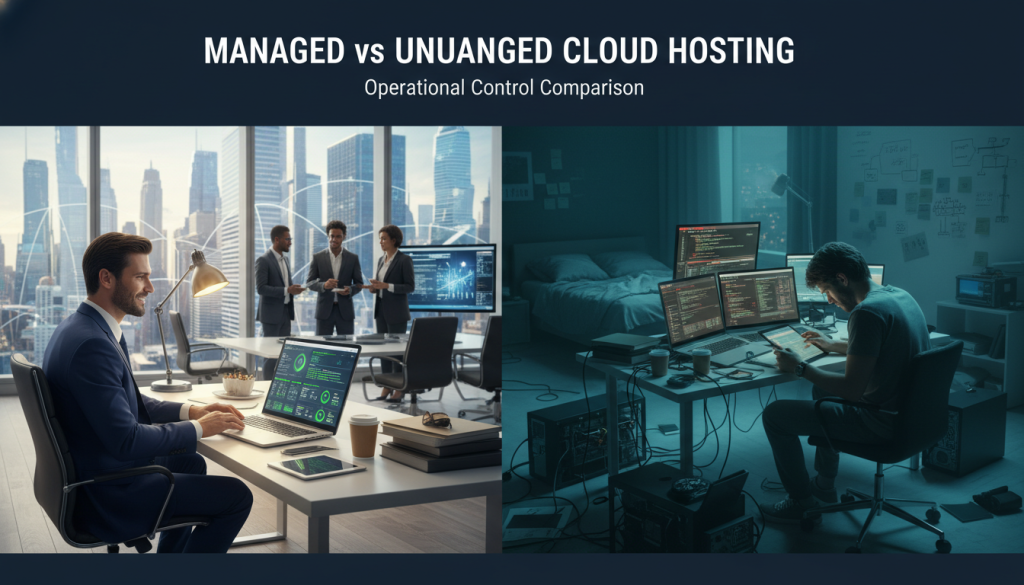
Managed hosting simplifies things by taking care of server and security tasks. It’s perfect for most businesses, offering flexibility without the complexity. Providers set up best practices to avoid common mistakes.
Technical Knowledge Requirements
Managed and unmanaged hosting require different levels of technical skill. Unmanaged hosting needs a team with deep knowledge in many areas. They must know Linux, network setup, security, and more.
Having such a team means hiring skilled DevOps engineers or systems admins. Here’s what you need for unmanaged hosting:
- Operating system mastery: Knowing Linux well, including kernel and system optimization
- Security implementation: Expertise in firewalls, intrusion detection, and patching
- Performance tuning: Skills in database optimization and caching
- Disaster recovery: Knowledge of backup systems and recovery procedures
- Monitoring and diagnostics: Ability to understand complex metrics and solve issues quickly
Building this expertise takes time and money. System administration skills take years to develop. The tech world keeps changing, so ongoing training is essential.
Managed hosting makes things easier. It lets you focus on your business without worrying about the tech. You can use your resources for development and improving your product.
Managed providers also bring their experience to the table. They’ve dealt with many issues before, so they can solve problems quickly. This saves your team time and stress.
Time Investment Comparison
Time is a big factor in choosing hosting. Unmanaged hosting takes a lot of time for maintenance and security. It can take dozens of hours weekly from your team.
Here’s a look at the time needed for common tasks:
| Management Activity | Unmanaged Weekly Hours | Managed Weekly Hours | Time Reclaimed |
|---|---|---|---|
| Security monitoring and updates | 8-12 hours | 0-1 hours | 7-11 hours |
| Performance optimization | 5-8 hours | 0-2 hours | 5-6 hours |
| Backup management and testing | 3-5 hours | 0-1 hours | 3-4 hours |
| Emergency troubleshooting | 4-10 hours | 1-2 hours | 3-8 hours |
These hours cost money in salaries and lost development time. Every hour spent on infrastructure is an hour not spent on features that make money. The cost of not doing something is often higher than the cost of doing it.
Managed hosting saves time by handling tasks for you. This lets your team focus on what matters most. It’s great for growing businesses that need to stay competitive.
Managed hosting also means no surprises. Unmanaged hosting can have emergencies that need quick fixes. Managed providers handle these, keeping your work flowing smoothly.
Essential Features of Managed Cloud Hosting
Managed cloud hosting stands out because of its wide range of features. These features work together to offer top-notch service and keep your business running smoothly. It’s more than just a service; it’s a complete solution.
Managed cloud environments cover all key aspects of running applications today. This includes keeping data safe and making sure everything runs well. Knowing what these features are helps you choose the right provider for your business.
Automated Backup Solutions
We use automated backups to protect your data. These backups happen regularly and capture your entire system state. This way, your business is safe from data loss due to hardware failures or security breaches.
Your provider sets up backup plans that fit your needs and follow the rules you must follow. This automation means you don’t have to remember to do backups. It keeps your whole system safe, including databases and application files.
Backups can happen as often as every hour or as infrequently as once a day. We keep backups for different lengths of time. This lets you recover from problems even if they happened a while ago.
Incremental backups save space and don’t slow down your network. Full backups are good for restoring everything. Differential backups are a mix, balancing space needs with how fast you can recover.
We check backups to make sure they work. This means we can restore your system when you need it. It stops the problem of finding out a backup doesn’t work when you really need it.
Disaster Recovery Planning
We create detailed disaster recovery plans. These plans include backup locations, data replication, and how to recover. They help you get back up and running fast after big problems.
Recovery time objectives are how fast you can get back to normal. Many providers promise to get you back up in hours, not days. This means your business can keep running even when things go wrong.
“The question isn’t whether you’ll experience a disaster, but when—and whether you’ll be prepared to recover quickly enough to survive it.”
Having data in different places helps protect against big disasters. This way, even if something bad happens in one area, your data is safe elsewhere.
Round-the-Clock Monitoring and Support
We watch your system all the time. This means we can see any problems right away. It’s like having a team watching over your system even when you’re not there.
Our monitoring systems collect lots of data every minute. They look for trends and problems. This keeps your system running well and safe from threats.
Proactive Issue Detection
Our systems find problems before they cause trouble. They can fix things automatically or alert our team. This stops small issues from becoming big problems.
We use data to predict when you might run into problems. This lets us fix things before they happen. We do maintenance when it won’t bother you, so your system stays smooth.
Our systems can fix simple problems on their own. This means we can solve issues fast, without waiting for someone to look at them.
We have different levels of support, with fast help for the biggest problems. This means you get help right away, no matter what time it is.
Our team can handle serious issues quickly. This means we can fix big problems fast, without making things worse.
| Severity Level | Response Time | Issue Examples | Support Access |
|---|---|---|---|
| Critical (Severity 1) | 15 minutes | Complete service outages, data loss, security breaches | Direct phone and emergency channels |
| High (Severity 2) | 1 hour | Significant performance degradation, partial outages | Priority ticket queue with callbacks |
| Medium (Severity 3) | 4 hours | Minor performance issues, non-critical bugs | Standard support tickets |
| Low (Severity 4) | 1 business day | General questions, feature requests, documentation | Email and knowledge base |
Software and Security Updates
We handle security updates for you. Our systems apply updates automatically, so you don’t have to worry about it. This keeps your system safe from new threats.
We test updates before applying them to your system. This makes sure they work well and don’t cause problems. It keeps your system stable and secure.
We respond quickly to new security threats. This means we can protect your system fast, before attackers can find a way in.
We update more than just your operating system. We also update databases and other parts of your system. This keeps everything working together smoothly and securely.
Scalability Features
We make sure your system can grow with your business. It can add more resources when needed and reduce them when it’s quiet. This keeps your system running well and saves you money.
Our system can automatically add or remove resources based on how busy it is. This means your system always has what it needs, without wasting resources.
We can add more servers to handle more traffic. This means your system can grow without limits. It’s good for applications that need to handle a lot of users.
“Scalability isn’t just about handling growth—it’s about doing so efficiently, automatically, and without compromising performance or breaking the bank.”
We can also make your servers more powerful. This means you can get more out of your system without having to change how it’s set up. It’s a quick way to boost your system’s performance.
We can also make your system available in different places. This means you can serve users faster and keep your system safe from big problems in one area.
Security Benefits in Managed Cloud Hosting
Security worries keep many business leaders up at night. Managed cloud hosting providers have advanced security measures to protect your infrastructure 24/7. They use a layered approach to cloud security, creating strong defenses against cyber threats.
By partnering with a managed cloud hosting provider, you get access to top-notch security. This would be a big investment and require specialized knowledge if done alone.
These security benefits cover all parts of your cloud environment. Your data stays safe, and your business can grow quickly. Providers keep up with threats, update security, and handle new vulnerabilities fast.
This proactive approach turns your cloud hosting into a strong asset. It helps your business stay competitive.
Advanced Security Protocols
Managed providers use a multi-layered security architecture. This combines automated defenses with human expertise. It protects your infrastructure, applications, and data.
These technologies scan for threats, filter out malicious traffic, and enforce access policies. They prevent unauthorized access to your sensitive resources. This architecture has multiple security zones, making it hard for threats to succeed.
Each layer has a specific role in the security framework. It addresses different attack vectors and threat types. Even as attackers find new ways to attack, your provider adapts defenses without needing your help.
Firewall Management
Network firewalls, web application firewalls, and next-generation firewalls are the first line of defense. They filter traffic based on updated rule sets. This keeps your cloud resources safe.
These firewalls create secure perimeters around your cloud resources. They examine every packet of data trying to enter or leave. The configuration process involves understanding your application needs and legitimate traffic patterns.
Web application firewalls protect your customer-facing applications from common exploits. Next-generation firewalls add deep packet inspection and threat intelligence integration. They identify sophisticated attacks based on behavior, not just known signatures.
Your managed provider handles tuning these systems. They adjust rules as your applications evolve. They also investigate alerts that might indicate security incidents.
Intrusion Detection Systems
Sophisticated monitoring tools analyze network traffic patterns and system logs. They identify potential security breaches and unauthorized access attempts. These tools work continuously to protect your business.
When suspicious activities trigger alerts, your managed provider’s security team investigates. They determine if the alert is a real threat or a false positive. This ensures your data stays protected.
The response protocols that providers maintain contain threats quickly. They isolate affected systems, preserve forensic evidence, and restore normal operations. This rapid response makes a big difference in preventing major breaches.
Compliance and Industry Standards
Meeting regulatory requirements is a challenge for many businesses. Compliance standards are constantly changing. Managed cloud providers help you meet these standards, saving you time and money.
These providers have the knowledge and processes to ensure compliance. This is especially important for businesses in regulated industries like healthcare and finance. Non-compliance can lead to penalties and damage your reputation.
HIPAA Compliance
Healthcare organizations must follow HIPAA rules. This includes encrypting data and implementing strict access controls. Managed providers have HIPAA-compliant environments that meet these requirements.
Encryption protects patient data from unauthorized access. Access controls limit who can view sensitive information. Audit logging captures every access to protected health information, meeting HIPAA audit requirements.
PCI DSS Certification
Businesses that process credit card transactions must meet PCI DSS standards. This includes network segmentation and vulnerability management. Managed providers offer PCI DSS-certified environments that meet these requirements.
These providers have vulnerability management programs that include regular scanning and patch management. They enforce access restrictions and maintain compliance. This enables your e-commerce operations to accept payments securely.
GDPR Readiness
European privacy regulations affect businesses worldwide. GDPR requires data protection principles and consent management. Managed providers help your business comply with GDPR, enabling you to serve European markets.
GDPR mandates data protection principles like purpose limitation and accuracy. Managed providers implement these practices in their infrastructure and processes. They also handle consent management and data subject rights.
| Security Feature | Protection Level | Compliance Support | Business Impact |
|---|---|---|---|
| Firewall Management | Network perimeter defense with continuous rule updates | Required for PCI DSS and HIPAA security controls | Prevents unauthorized access and reduces breach risk |
| Intrusion Detection | Real-time threat identification and response protocols | Supports audit requirements across regulations | Minimizes incident response time and damage scope |
| Encryption Standards | Data protection at rest and in transit using AES-256 | Mandatory for HIPAA, PCI DSS, and GDPR compliance | Protects sensitive information from unauthorized disclosure |
| DDoS Protection | Traffic scrubbing with massive bandwidth absorption | Ensures availability required by service agreements | Maintains operations during distributed attacks |
DDoS Protection and Mitigation
DDoS attacks are a major threat to businesses. They overwhelm your infrastructure with massive traffic volumes. Managed providers offer DDoS protection to absorb these attacks.
They use traffic scrubbing services, rate limiting, and geographic filtering. These capabilities block malicious traffic while allowing normal operations. The bandwidth capacity of major providers can absorb attack volumes that target most businesses.
These mitigation capabilities keep your business available during attacks. They protect your revenue streams and customer relationships. DDoS protection turns potentially catastrophic events into minor incidents, maintaining your business’s reliability.
Top Benefits of Managed Cloud Hosting
Managed cloud hosting offers many benefits. It helps improve financial performance and business growth. It also makes technology operations more efficient.
One big advantage is saving money on infrastructure costs. This lets businesses focus on growing instead of spending on technology.
Managed cloud hosting also boosts website performance. This means better user experience and more sales. It’s a key factor in business success.
By choosing managed cloud hosting, businesses can cut IT costs. They also get better website performance and uptime guarantees. This makes their technology more efficient and reliable.
Managed cloud hosting is a smart choice for businesses. It helps them save money, improve website performance, and ensure their sites are always up and running.
Reduced IT Overhead and Costs
Managed cloud hosting reduces IT costs. It eliminates the need for big upfront investments in hardware and data centers. This saves money and reduces financial risk.
It also saves on personnel costs. Businesses don’t have to hire and train a team to manage their infrastructure. This saves a lot of money.
Managed cloud hosting includes all the necessary software and tools. This reduces costs by 30% to 50% compared to managing everything yourself.
Improved Website Performance
Managed cloud providers optimize websites for better performance. This improves user experience and can increase sales. They use advanced tools and expertise to achieve this.
They continuously monitor and improve website performance. This ensures websites run smoothly and efficiently. It’s a big advantage for businesses.
Faster Load Times
Fast website load times are crucial for user satisfaction and sales. Managed cloud providers use content delivery networks and other techniques to make websites load quickly.
They also optimize databases and images for faster loading. This improves user experience and can increase sales. It’s a key benefit of managed cloud hosting.
They focus on mobile performance too. This ensures websites work well on all devices and networks. It’s important for today’s mobile users.
Higher Uptime Guarantees
Uptime guarantees are important for business success. Managed cloud providers offer high uptime guarantees. This means websites are always available.
They use redundant systems and proactive monitoring to ensure high uptime. This is a big advantage for businesses.
Providers are accountable for uptime. They offer service credits if they don’t meet their guarantees. This ensures high reliability.
Expert Technical Support
Managed cloud hosting provides expert technical support. This means businesses get help from experienced professionals. They can handle complex issues and provide valuable advice.
Support is available 24/7. This means businesses can get help whenever they need it. It helps solve problems quickly.
- Immediate access to specialists with extensive cloud experience and certification credentials
- Proactive guidance on architecture optimization and best practice implementation
- Rapid troubleshooting that leverages provider experience across thousands of client environments
- Strategic consultation on capacity planning, technology selection, and infrastructure evolution
- Documentation and knowledge transfer that builds internal team capabilities over time
The support relationship goes beyond solving problems. It includes proactive advice on security, performance, and cost. This helps improve the infrastructure continuously.
Focus on Core Business Activities
Managed cloud hosting frees up time for businesses to focus on their core activities. This means they can innovate and improve customer experiences. It’s a big advantage.
Internal teams can focus on revenue-generating activities. This is more valuable than managing infrastructure. It helps businesses grow and succeed.
Leaders can also focus on strategic initiatives. This means they can drive business growth and innovation. It’s a key benefit of managed cloud hosting.
Businesses can innovate faster and respond to market opportunities. This is crucial in competitive industries. It helps businesses stay ahead.
Who Should Consider Managed Cloud Hosting
Not every business needs managed cloud hosting. But for those facing challenges and growth, it’s a key solution. It helps address infrastructure needs that might hold back growth.
Understanding your business is key to seeing if managed cloud hosting is right for you. It’s about matching your business needs with what managed cloud hosting offers. This helps make a smart choice for your infrastructure.
Businesses that benefit from managed cloud hosting often face certain challenges. They might have limited resources, unpredictable growth, or need to focus on core activities. Checking if your business fits these profiles can help decide if managed cloud hosting is the best choice.

Growing Small and Medium Businesses
Fast-growing businesses face big infrastructure challenges. As they grow, their needs change quickly. This can slow them down if not handled right.
Managed cloud hosting gives growing businesses the infrastructure they need. It’s like having enterprise-grade tech without the big IT costs. This way, businesses can focus on growing without worrying about their tech.
Trying to manage tech and grow at the same time is tough. Managed cloud hosting lets businesses focus on growing. It takes care of the tech side, making sure it keeps up with the business.
E-commerce and Online Retail
E-commerce businesses need tech that supports their sales. High traffic, sales, and customer expectations create big tech needs. This is different from other businesses.
Managed cloud hosting helps e-commerce businesses a lot. It scales up when needed, keeps sites fast, and handles security. This means more sales and happy customers.
Good tech is crucial for e-commerce. Slow sites can lose sales. Managed cloud hosting helps keep sites running smoothly, protecting revenue.
SaaS and Application Hosting
SaaS companies need reliable tech to keep users happy. This tech is part of their product, making quality important. It’s not just about keeping things running.
Managed cloud hosting gives SaaS companies the tech they need. It supports continuous updates and keeps sites up and running. This lets developers focus on making the product better.
With managed cloud hosting, developers can work faster. They can make the product better and keep up with the market. This is key for success in a competitive market.
Businesses Without In-House IT Teams
Some businesses choose not to have their own IT teams. This might be due to cost, focus on core business, or talent issues. Managed cloud hosting acts as their IT team.
This service model gives businesses the tech support they need. It’s like having a team of experts without the cost of hiring and training. This keeps the business running smoothly.
Managed cloud hosting is often cheaper than building an IT team. It saves money on salaries and training. It also handles the tech needs, so businesses can focus on their work.
Businesses without their own tech team find managed cloud hosting very helpful. It gives them the tech and support they need. This turns tech into a tool for success, not a problem.
| Business Profile | Primary Challenge | Managed Cloud Solution | Key Benefit |
|---|---|---|---|
| Growing SMBs | Unpredictable scaling needs | Automatic infrastructure expansion | Growth without IT constraints |
| E-commerce Operations | Traffic spikes and compliance | Performance optimization and PCI compliance | Revenue protection during peaks |
| SaaS Companies | Infrastructure reliability requirements | High availability and deployment support | Development team focus on product |
| Non-technical Organizations | Lack of internal IT capabilities | Complete infrastructure management | Professional operations without hiring |
Looking at these profiles can help decide if managed cloud hosting is right for your business. It’s for businesses that need strong, scalable, and secure tech but can’t build it themselves.
Understanding Managed Cloud Hosting Costs
Managed cloud hosting is more than just a monthly fee. It offers a full package that includes cost savings and better efficiency. We help you understand the pricing and how it affects your spending. This way, you can make smart choices about your hosting costs.
Managed cloud services might seem pricier at first. But they often save you time and money compared to managing everything yourself. Good providers offer clear pricing and help you use resources wisely, avoiding waste.
Pricing Structure and Models
We guide you through the different ways managed cloud providers charge. Each model fits different business needs. Knowing these options helps you choose what’s best for your budget and growth plans.
Pay-as-You-Go Options
Pay-as-you-go pricing means you only pay for what you use. This model scales with your business, saving you money. It’s great for businesses with changing needs or uncertain growth.
This pricing is flexible and doesn’t require long-term contracts. Your costs match your revenue, making it easier to manage your finances.
Fixed Monthly Plans
Predictable pricing offers set costs for a month. It’s good for businesses that know their needs. These plans include everything you need for a fixed price each month.
Fixed plans are best for stable businesses. They offer budget certainty without sacrificing too much cost savings.
Factors Affecting Your Costs
Many things can change your hosting costs. We help you understand these factors to plan better. This way, you can avoid unnecessary spending and keep your operations running smoothly.
Resource Usage
How much you use resources affects your costs. Knowing your app’s needs helps you plan your budget. We help you analyze your usage to avoid waste and ensure performance.
Resource needs vary by app type. This means different businesses can have different costs, even with the same traffic.
Support Level Tiers
Different support levels cost different amounts. Choosing the right level prevents overpaying. We help you decide based on your needs and risk tolerance.
Businesses with critical apps often need premium support. But, those with less critical needs might find mid-tier support enough.
Comparing Costs with Self-Managed Solutions
Comparing managed hosting to self-managed hosting is more than just looking at prices. We consider all costs, including personnel and training. Managed hosting is often more cost-effective, especially for those without deep technical knowledge.
The table below shows typical costs for both options. It helps leaders understand the full financial picture, not just prices.
| Cost Category | Managed Cloud Hosting | Self-Managed Solutions | Key Difference |
|---|---|---|---|
| Infrastructure Fees | $500-$3,000/month | $300-$2,000/month | Managed includes support services |
| Personnel Costs | Minimal (internal liaison) | $80,000-$150,000/year per admin | Significant savings with managed |
| Monitoring Tools | Included in service | $200-$1,500/month | Bundled vs. separate licensing |
| Training & Certifications | Provider responsibility | $5,000-$15,000/year | Expertise maintained by vendor |
| Opportunity Costs | Focus on core business | Technical resource diversion | Strategic advantage with managed |
This comparison shows managed hosting can be more cost-effective. It saves you money on personnel, tools, and training. Redirecting talent to revenue-generating activities is a big win.
Hidden Fees to Watch For
We warn you about extra charges some providers might have. Knowing these can help you avoid surprises. Look out for fees for data egress, backup storage, support, migration, and early termination.
Ask providers about their pricing to avoid hidden costs. Requesting sample invoices can help you understand their billing practices.
Understanding all aspects of managed cloud hosting helps you make better choices. It ensures your investment supports your business goals.
How to Choose the Right Managed Cloud Hosting Provider
Choosing a managed cloud hosting provider is a big decision. It’s not just about the features. You need to look at infrastructure quality, contracts, and the expertise of the provider. Your chosen provider will affect your business’s growth, security, and efficiency.
Working with a managed cloud hosting provider is a long-term partnership. It impacts your daily operations and future plans. You need to balance technical specs with service quality. Look beyond what providers promise and see what they actually deliver.
Key Selection Criteria
Creating clear criteria helps you compare providers. Look at technical skills, operational practices, and how well they fit your business. Key factors include industry experience, security, financial stability, and cultural fit.
Also, check for transparency in operations and pricing. See if they can customize services for you. Look at their track record of innovation and ability to support your future growth.
References from similar industries can give you real insights. They show how providers perform in real-world scenarios.
Infrastructure Quality
The technology stack, hardware, and network architecture are crucial. Look for the latest technology and redundancy. This ensures high performance and reliability.
Ask about infrastructure updates to see if they keep up with technology. Look for partnerships with leading vendors. Providers with n+1 or n+2 redundancy ensure no single failure affects service.
Providers in multiple locations offer better latency and compliance. They support global operations and expansion. Proximity to data centers affects application speed.
Examine data center locations and expansion plans. Look for certifications like SOC 2 and ISO 27001. This shows their commitment to security and excellence.
Evaluating Service Level Agreements
Service level agreements (SLAs) outline what providers promise. They set performance standards and specify what happens if they fail. It’s important to ensure SLAs meet your needs and offer real protection.
Look at uptime, response times, and performance benchmarks. Also, check for financial remedies in case of service failures. Real-world references can provide valuable insights into provider performance.
Uptime Guarantees
Uptime commitments range from 99.9% to 99.99%. Higher percentages mean less downtime. Understand what downtime means and how it’s measured.
Check how uptime is calculated and if it includes all services. Look for meaningful financial remedies for missed uptime commitments. Remember, service credits don’t fully compensate for downtime.
Response Time Commitments
Response times define how quickly support teams respond. They vary by issue severity. It’s important to understand what each commitment means.
Look at response times for different issues. Check if providers offer aggressive response time commitments for critical issues. This shows their commitment to minimizing downtime impact.
Support Quality Assessment
Support quality is crucial. It determines customer satisfaction more than technical specs. Look for responsive, knowledgeable support teams.
Assess support quality by examining contact methods, team expertise, and escalation procedures. Customer references provide real insights into support quality.
Available Support Channels
Multiple contact methods ensure support is accessible. Look for 24/7 support, especially for global operations. Evaluate the quality of support channels.
Test support channels with pre-sales technical questions. Look for multiple escalation paths for critical issues. This ensures quick resolution by senior staff.
Technical Expertise Level
Evaluate technical expertise beyond marketing claims. Look for team credentials, certifications, and demonstrated knowledge. Use detailed conversations during sales to assess expertise.
Check if providers specialize in your technology stack. Generalist teams may struggle with complex issues. Look for case studies and technical content to assess expertise.
Migration and Onboarding Services
Good transition assistance ensures a smooth move to the new hosting environment. This minimizes disruption and accelerates benefits realization. Migration services are critical but often overlooked.
Look for comprehensive migration services. They should include discovery, planning, data transfer, testing, and training. Strong migration services show provider commitment to customer success.
Examine provider track records with migrations similar to yours. Request detailed migration timelines and understand responsibilities. Quality migration services predict overall provider performance.
Potential Challenges and Important Considerations
We’re experienced in cloud transformation and want to share the whole picture. Managed cloud hosting is great for many organizations, but it’s important to know the potential issues. We help business leaders make informed decisions, considering both immediate needs and future growth.
Every tech decision has its pros and cons. Managed cloud hosting is no different. Success comes from knowing the challenges early and finding the right solutions. Choose a provider that fits your business needs well.
Managing Vendor Lock-in Risks
Managed cloud hosting means relying on your provider’s tools and processes. This vendor lock-in can make it hard to switch providers later. It might also limit your flexibility if you want to manage things yourself again.
There are ways to avoid these risks while still getting the benefits of managed services. Use open-source technologies and standard configurations. This keeps your options open without losing the benefits you need now.
Keeping detailed records of your infrastructure is key. Document everything as code and keep diagrams and records of customizations. This makes it easier to move to a new provider if needed.
Here are more ways to protect yourself:
- Ensure data portability by using formats that are easy to move without restrictions
- Negotiate contract terms that make it easier to leave, including help with moving your data
- Maintain exit strategies as part of your IT planning, reviewing if your provider still meets your needs
- Request multi-cloud architectures to spread your workloads and reduce reliance on one provider
Understanding Service Limitations
Managed cloud hosting has its own rules about what you can and can’t do. These service limitations help most organizations but might not fit every need. Knowing these limits before you start helps set realistic expectations.
Managed services let you customize within their limits, but you give up some control. Some special setups or unique needs might not be covered. Make sure your provider can meet your specific needs.
Good communication is crucial when working within these limits. Choose a provider that is responsive and can meet your specific needs. Poor communication or unclear agreements can cause problems when you need help most.
The service limitations also apply to security. You must trust your provider’s security practices and compliance. While reputable providers have good security, you need to trust them and have clear communication.
Balancing Cost and Performance
Organizations often struggle to balance cost optimization with ensuring performance during busy times. Cloud services offer flexibility, but finding the right balance is key. Too much waste, and you waste money. Too little, and performance suffers.
Many start by over-provisioning to ensure performance, then optimize as they learn more. This cautious approach is good for the early stages but should evolve as you understand your needs better.
The best cloud strategies are always optimizing resource allocation, not just setting it once.
Working with your provider’s account team helps you understand your usage and find ways to save. This approach finds the right balance between cost and performance, avoiding waste or risking performance.
| Cost Factor | Optimization Strategy | Performance Impact |
|---|---|---|
| Compute Resources | Auto-scaling based on demand patterns | Maintains responsiveness during peaks while reducing idle costs |
| Storage Allocation | Tiered storage with automated archiving | Balances access speed with cost efficiency for different data types |
| Bandwidth Usage | Content delivery networks and caching | Improves load times while minimizing data transfer expenses |
| Backup Retention | Scheduled retention policies aligned with compliance | Ensures recovery capability without excessive storage costs |
Planning for Long-Term Scalability
Good infrastructure planning looks ahead to your future needs. Long-term scalability ensures your cloud solution can grow with you without needing big changes. This keeps your business moving smoothly as you expand.
Choose a provider that can grow with you, not just meet your current needs. Ask about their ability to scale and their track record with growing customers. This ensures they can support your growth without disruption.
Long-term scalability also means planning your budget for growth. Negotiate prices that reward growth, not punish it. Make sure you understand how costs will change as you grow.
Consider these key elements for sustainable growth:
- Architecture flexibility that supports adding new services and technologies easily
- Geographic expansion capabilities for serving new regions with good performance and compliance
- Performance headroom to avoid infrastructure limits that slow your growth
- Cost predictability through clear pricing that helps you budget for growth
By tackling these challenges and considerations, you can make the most of managed cloud hosting. This approach minimizes risks and keeps your options open for long-term success.
Conclusion
Your cloud hosting choice can turn infrastructure into a strategic advantage. We’ve seen how managed cloud hosting offers top-level services without needing a lot of in-house knowledge. This lets your team focus on growing the business while experts handle the technical stuff.
Choosing managed cloud hosting depends on your company’s needs. It’s great for growing businesses, e-commerce sites, and those without a big IT team. It speeds up innovation and makes things more reliable.
Working with the right cloud provider is more than just hosting. It’s about building a team that understands and supports your business goals. They grow with you, adapting their services as your needs change.
When looking for a provider, use the guide we’ve given you. Ask them about their skills, what they promise, and their past successes. Choose a partner who is both technically skilled and committed to your success. The right managed cloud hosting helps your business grow by managing infrastructure well.
FAQ
What exactly is managed cloud hosting and how does it differ from regular cloud hosting?
How much does managed cloud hosting typically cost compared to managing my own infrastructure?
What responsibilities does my team still maintain with managed cloud hosting?
Is managed cloud hosting secure enough for handling sensitive customer data and meeting compliance requirements?
How quickly can my business scale with managed cloud hosting during traffic spikes?
What happens if something goes wrong with my managed cloud hosting environment?
Can I migrate my existing applications to managed cloud hosting without significant disruption?
What level of support can I expect from a managed cloud hosting provider?
How does managed cloud hosting compare to hiring an in-house IT team?
What happens if I want to switch managed cloud hosting providers in the future?
Does managed cloud hosting work for small businesses or is it only for large enterprises?
How do automatic backups work in managed cloud hosting and how quickly can data be restored?
Can managed cloud hosting integrate with my existing business systems and third-party services?
What uptime guarantees do managed cloud hosting providers typically offer?
How does managed cloud hosting handle software updates without disrupting my business operations?
What makes managed cloud hosting different from using platforms like Amazon Web Services or Microsoft Azure directly?
Are there specific industries or applications that benefit most from managed cloud hosting?
How do I know if my business has outgrown shared hosting and needs managed cloud hosting?
What questions should I ask when evaluating different managed cloud hosting providers?
Can managed cloud hosting accommodate custom applications with specific technical requirements?