
What is the difference between a vision system and a vision sensor?
Could your manufacturing line be achieving even higher levels of quality and efficiency with a more intelligent inspection solution?
Modern machine vision technologies have revolutionized automation, acting as the precise eyes for industrial systems. They perform tasks like quality control and sorting with unmatched speed and accuracy. This shift moves critical inspection duties away from human operators, who can be inconsistent.
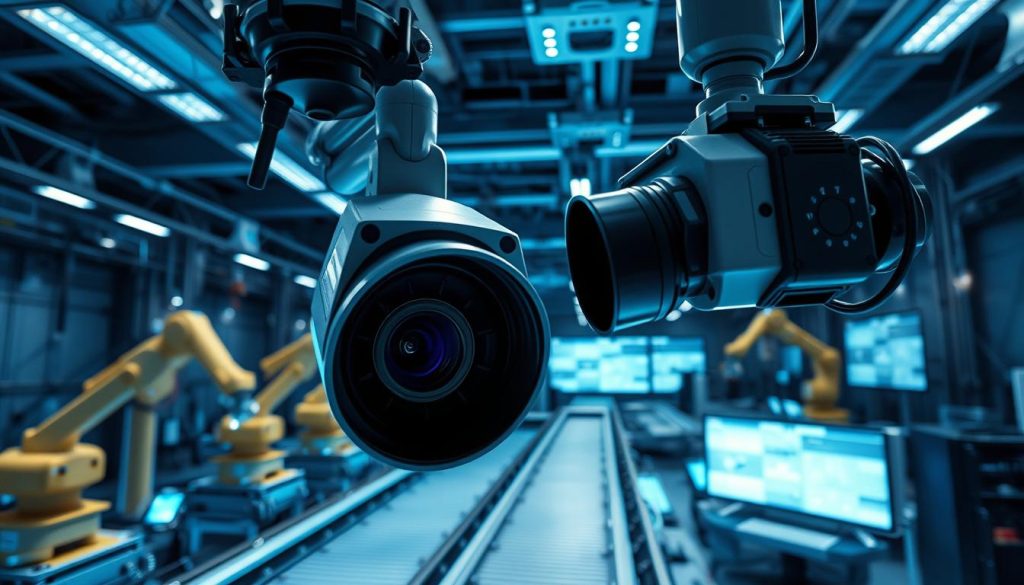
While both vision sensors and more complex vision systems serve this fundamental purpose, they are not the same. They represent different technological approaches designed for specific complexities and business goals.
Understanding this distinction is crucial for leaders evaluating automation investments. Choosing incorrectly can lead to overspending on unnecessary capabilities or an underperforming solution that hampers production.
We recognize that every manufacturing environment presents unique challenges. Our role is to provide clear, tailored guidance, connecting technical capabilities directly to your operational improvements and business outcomes.
This article will provide a comprehensive comparison. We explore the technical fundamentals, operational capabilities, and ideal application scenarios for both technologies. Our goal is to empower you with the knowledge to make a confident, informed decision for your production needs.
Key Takeaways
- Vision technologies are essential for modern, automated quality assurance and inspection tasks.
- Vision sensors and vision systems serve similar purposes but are designed for different levels of complexity.
- Selecting the right technology is critical to avoid overspending or system underperformance.
- Each manufacturing environment requires a tailored solution, not a one-size-fits-all approach.
- These technologies enable machines to perform precise tasks like positioning and verification far beyond human capability.
- Understanding the core difference empowers businesses to make smarter automation investments.
Introduction to Vision Technologies
Today’s manufacturing environments demand unprecedented levels of precision and consistency in quality control processes. We recognize that visual inspection technology serves as the critical bridge between manual operations and fully automated systems.
Overview of Machine Vision
Machine vision represents a fundamental transformation in industrial inspection methodologies. These sophisticated systems process visual data with remarkable speed and accuracy, functioning as the analytical eyes for automated equipment.
The technology enables continuous operation without human limitations, examining hundreds of items per minute across diverse manufacturing applications. From pharmaceutical production to electronics assembly, machine vision ensures perfection through relentless precision.
Historical Perspective and Industry Evolution
The journey of visual inspection technology began with simple presence detection mechanisms. Early vision applications focused primarily on basic sorting and go/no-go decisions within limited operational contexts.
Over decades, computational power and camera technology advancements revolutionized capabilities. Modern machine vision now incorporates artificial intelligence, 3D imaging, and real-time data processing that guides complex robotic systems.
| Era | Primary Capabilities | Industry Impact | Technological Features |
|---|---|---|---|
| 1980s-1990s | Basic presence detection | Initial automation adoption | Simple binary decisions |
| 2000s-2010s | Pattern recognition | Quality standardization | 2D imaging and measurement |
| 2020s-Present | AI-driven analysis | Industry 4.0 integration | 3D imaging and predictive analytics |
This evolution directly responds to increasing demands for traceability and consistency across the global industry landscape. The progression from simple sensors to comprehensive vision solutions reflects manufacturing’s continuous pursuit of operational excellence.
Fundamentals of Vision Sensors
At the core of modern industrial inspection lies the vision sensor, a compact device designed for rapid, repetitive quality checks. We recognize these components as essential tools for maintaining consistent standards throughout manufacturing operations.
Basic Operation and Simple Inspection Tasks
Vision sensors function by capturing light through an integrated camera lens. Photo-sensitive elements convert this optical information into electrical signals that digital processors transform into pixel data.
This signal processing enables straightforward inspection tasks requiring binary decisions. The technology excels at presence detection, basic flaw identification, and optical character recognition.
Role in Production Lines and Quality Checks
Vision sensors provide reliable performance in high-volume manufacturing environments. They verify bottle cap placement, confirm label application, and perform item counting on conveyor systems.
These sensors offer significant advantages through their simplicity and consistency. They operate continuously without fatigue, delivering uniform results across extended production runs.
| Inspection Task | Typical Application | Decision Type | Production Benefit |
|---|---|---|---|
| Presence Detection | Component verification | Binary (yes/no) | Prevents assembly errors |
| Flaw Identification | Surface inspection | Pass/fail | Maintains quality standards |
| Character Recognition | Batch code reading | Match/no match | Ensures traceability |
| Color Verification | Product sorting | Correct/incorrect | Maintains visual consistency |
The straightforward nature of vision sensors translates to practical benefits for manufacturers. They require minimal setup, reduce training needs, and integrate easily into existing infrastructure.
What is the difference between a vision system and a vision sensor?
Industrial automation requires precise matching of inspection capabilities to specific manufacturing challenges. We help businesses navigate this critical distinction by examining technological complexity and operational scope.
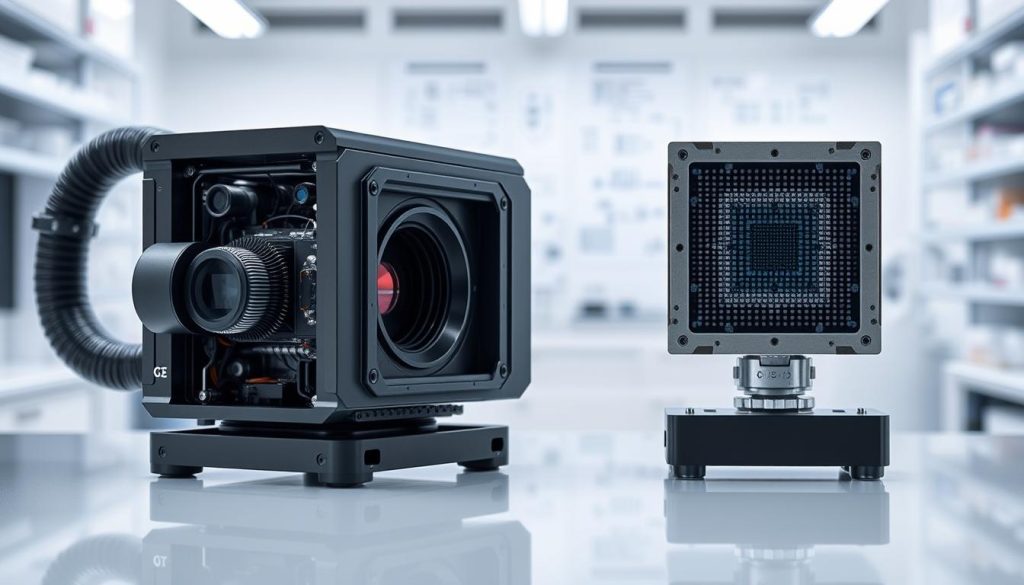
Comparison of Hardware and Software Capabilities
Vision sensors feature integrated components in compact designs optimized for single-purpose tasks. They utilize firmware with limited programmability for rapid binary decisions.
Automated inspection platforms employ separate high-resolution cameras and powerful computing hardware. Their sophisticated software supports custom algorithms, machine learning integration, and multi-sensor coordination.
Exploring Application Scenarios in Manufacturing
Consider a bottling plant where hundreds of containers move along conveyor belts. A basic sensor confirms cap presence through simple yes/no verification.
The same facility might require a comprehensive platform to measure cap alignment angles and verify label positioning accuracy. These advanced applications demand the processing power of complete inspection solutions.
Understanding these distinctions ensures appropriate technology investments. Businesses achieve optimal returns by matching specific requirements with the right inspection tools.
Applications and Benefits on the Production Line
Vision sensors deliver immediate operational benefits when deployed for basic quality control functions. We help manufacturers implement these technologies where they provide maximum value through straightforward inspection tasks.
Presence Detection and Go/No-Go Inspection
These devices excel at presence detection, verifying components are correctly positioned within their field of view. This prevents costly errors that would occur if missing parts progressed through the manufacturing process undetected.
Vision sensors perform reliable go/no-go inspections by comparing captured images against predefined criteria. They automatically route conforming parts forward while diverting non-conforming items to rejection areas.
The operational benefits are substantial for repetitive inspection tasks. These systems work continuously without breaks, maintaining consistent quality standards throughout production runs.
Specific applications include counting items on conveyor systems and verifying label placement. They also confirm component orientation before assembly operations and detect obvious defects like cracks or contamination.
Basic color verification ensures products meet visual specifications. Sensors detect variations that might indicate formulation errors or other quality issues needing attention.
Speed advantages are significant, with sensors evaluating hundreds of parts per minute. This far exceeds manual inspection throughput while generating documentation for quality management systems.
Reliability benefits come from objective, repeatable measurements based on consistent algorithms. This eliminates the subjectivity and variability inherent in human visual inspection processes.
Advanced Features of Automated Vision Inspection Systems
Sophisticated automated inspection platforms bring unprecedented analytical capabilities to modern manufacturing. These comprehensive vision systems leverage powerful hardware and advanced software to perform complex quality control tasks beyond basic detection.
High-Resolution Imaging and 3D Capabilities
Advanced inspection platforms utilize high-resolution industrial cameras that capture extraordinarily detailed images. This enables detection of minute defects and precise measurements at micrometer scales.
Three-dimensional imaging capabilities have revolutionized quality control in precision manufacturing. These systems capture depth information through techniques like laser triangulation and structured light projection.
Code Reading, Measurement, and Data Processing
Sophisticated code reading capabilities allow reliable decoding of barcodes and matrix codes under challenging conditions. This provides essential traceability for modern supply chain management.
Precision measurement applications perform dimensional verification tasks previously requiring contact-based tools. The systems evaluate multiple quality parameters simultaneously through complex algorithms.
These platforms calculate exact position and orientation of components in three-dimensional space. This enables precise guidance for robotic systems executing assembly tasks with millimeter accuracy.
Selecting the Right Vision Technology for Your Business
Choosing appropriate vision technology requires careful evaluation of operational needs and strategic goals. We help businesses navigate this critical decision by analyzing inspection complexity against available resources.
Key Considerations for Integration and Scalability
Vision sensors deliver rapid implementation with minimal technical expertise. Their plug-and-play design allows factory teams to handle installation and basic configuration independently.
Comprehensive vision systems demand specialized knowledge for optimal performance. These advanced solutions typically require partnership with experienced integration specialists.
Budget analysis reveals distinct investment profiles for each approach. Simpler sensors offer faster returns for straightforward applications, while sophisticated systems provide long-term scalability.
We assess your production environment, including space constraints and existing equipment. This ensures recommended solutions align with both immediate needs and future expansion plans.
Contact us today for expert advice at https://opsiocloud.com/contact-us/
Our team provides personalized consultation to match vision technology with your specific quality control requirements. We help implement solutions that deliver measurable improvements in efficiency and competitive advantage.
Conclusion
Selecting the optimal vision solution represents a strategic decision that directly impacts manufacturing efficiency and product quality. Both vision sensors and comprehensive vision systems deliver substantial benefits over manual inspection, but they serve distinct operational requirements.
We help businesses navigate this critical choice by matching technical capabilities with specific production needs. Our expertise ensures you avoid overspending on unnecessary features while achieving reliable automation results.
Contact us today at https://opsiocloud.com/contact-us/ for personalized guidance on implementing the right machine vision technology for your unique manufacturing challenges.
FAQ
What is the primary function of a vision sensor?
A vision sensor performs simple inspection tasks like presence detection, part alignment, and basic quality control. It acts as a self-contained unit that provides a pass/fail signal based on pre-set parameters, making it ideal for straightforward go/no-go decisions on the production line.
When should I consider a full machine vision system instead of a vision sensor?
You should upgrade to a machine vision system when your application requires complex image processing, such as precise measurement, code reading, or detailed defect analysis. These systems offer greater flexibility with powerful software to handle intricate tasks that involve multiple components and data analysis.
Can a vision sensor handle 3D imaging or high-resolution measurement?
No, vision sensors are generally limited to 2D imaging and simpler contrast-based checks. For applications demanding 3D capabilities, high-resolution pixel data, or precise dimensional analysis, a full vision system with advanced cameras and processing software is necessary.
How does the integration process differ between these two technologies?
Vision sensors are designed for easy setup and integration, often connecting directly to a PLC for immediate process control. A machine vision system requires more extensive configuration, including lighting, lens selection, and software programming, but offers superior scalability for future automation needs.
Which option provides better value for high-volume manufacturing?
For high-volume environments with consistent products, vision sensors deliver excellent value through speed and reliability. For lines with frequent changeovers or complex products requiring detailed inspection, the advanced data processing of a full system provides greater long-term value and quality assurance.