

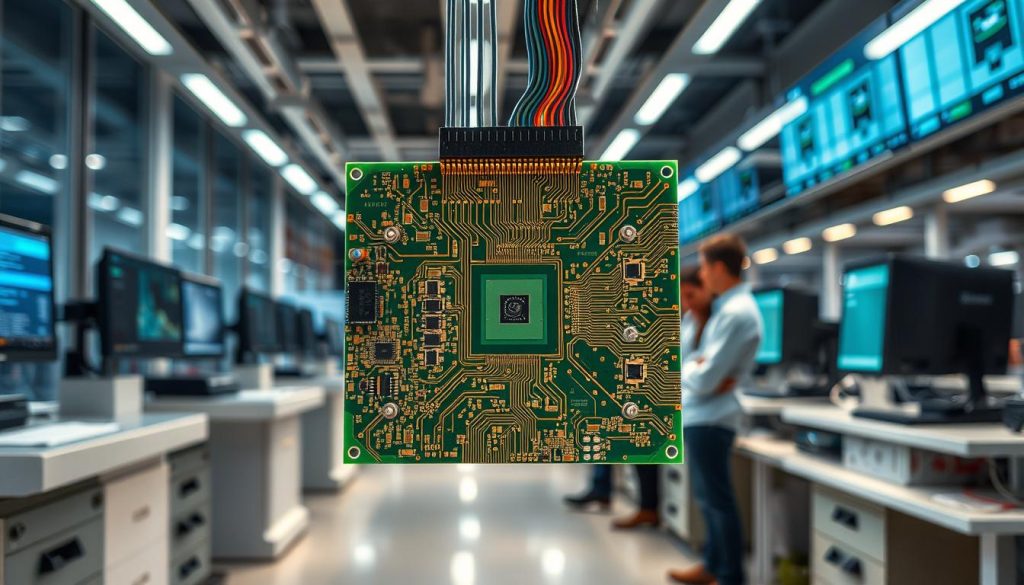
A single microscopic flaw in a printed circuit board can lead to catastrophic failure in a final product. This reality places immense pressure on manufacturing quality control.
As electronic devices become more complex, the demand for flawless circuit boards intensifies. Traditional inspection methods often struggle to keep pace. They can miss subtle errors or flag false positives, slowing down production.
We see a transformative opportunity in modern technology. Advanced computational methods offer a new path forward for quality assurance. These systems analyze production lines with incredible speed and accuracy.
This approach moves beyond simple rule-based checks. It enables proactive identification of potential issues before they impact yield. The goal is to build reliability directly into the manufacturing process.
Our expertise lies in implementing these sophisticated solutions. We partner with manufacturers to integrate intelligent inspection systems. This partnership helps achieve higher standards of product performance and reliability.
Key Takeaways
- Even tiny flaws in circuit boards can cause major product failures.
- Modern electronics require a new level of manufacturing precision.
- Traditional inspection methods are often inadequate for today's standards.
- Advanced technology enables faster and more accurate quality checks.
- Proactive defect identification helps improve overall product reliability.
- Strategic implementation is key to leveraging these new tools effectively.
Overview of PCB Defect Detection Methods
The journey of quality assurance in electronics manufacturing has seen remarkable transformations. We have witnessed significant advances in how production lines verify component integrity and surface quality.
Traditional Manual vs. Automated Inspection
Early manufacturing oversight relied heavily on human operators with magnifying tools. This manual inspection process depended entirely on individual expertise and attention to detail.
While offering flexibility, this approach suffered from subjective judgments and fatigue-related errors. The limitations became apparent as production volumes increased exponentially.
We recognized that human-based methods couldn't scale effectively. The industry needed more reliable solutions for consistent quality control.
Evolution from AOI to Deep Learning Approaches
Automated Optical Inspection (AOI) emerged as a revolutionary step forward. This technology used cameras and image processing to scan components systematically.
However, AOI systems faced challenges with lighting conditions and false positives. These limitations prompted further innovation in manufacturing verification.
The progression toward more advanced computational methods addressed fundamental constraints. Modern approaches now leverage sophisticated pattern recognition for superior accuracy.
Fundamentals of Deep Learning in PCB Quality Inspection
The shift toward intelligent visual inspection is largely powered by sophisticated neural network architectures. These systems learn directly from data, moving beyond rigid, pre-programmed rules.
We see this as a fundamental change in manufacturing quality control. It allows for adaptive systems that improve over time.
The Role of Convolutional Neural Networks in Defect Analysis
Convolutional Neural Networks, or CNNs, excel at analyzing visual information. Their design is inspired by the human visual cortex. This makes them exceptionally good at pattern recognition.
A key strength is hierarchical feature extraction. The network first identifies simple elements like edges and corners. Deeper layers then combine these into complex shapes and textures.
This process happens automatically through deep learning. It eliminates the need for manual feature engineering. The model learns the most relevant features directly from the examples it is given.
Key Algorithms and Architectures Influencing Modern Methods
Several core architectures have shaped modern artificial intelligence for inspection. VGG networks demonstrated the power of stacking many layers. ResNet introduced skip connections to train even deeper networks effectively.
These algorithm advances address critical challenges in image processing. They enable robust performance despite variations in lighting or angle. This convolutional neural approach is detailed in recent comprehensive studies.
We leverage these architectures to build reliable inspection systems. The right neural network design is chosen based on specific production line requirements.
Innovations in pcb defect detection using deep learning
Architectural breakthroughs in visual inspection systems are redefining manufacturing quality control standards. We see particular promise in frameworks that combine real-time processing with sophisticated feature analysis.
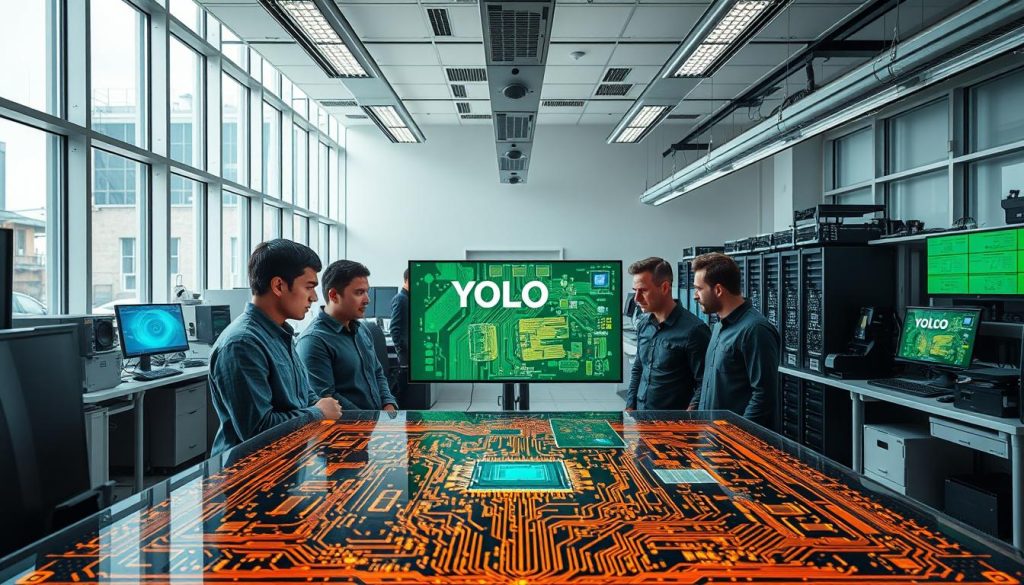
Integration of YOLO and Multiscale Modules
The YOLO architecture provides exceptional speed for production environments. Its single-pass approach enables immediate analysis without sacrificing throughput.
Modern implementations enhance this foundation with specialized multiscale modules. These components extract features across different dimensions simultaneously. This capability proves crucial for identifying both minute imperfections and larger anomalies.
We appreciate the plug-and-play nature of these advancements. Manufacturers can upgrade existing systems incrementally, preserving previous infrastructure investments.
Recent Breakthroughs and Experimental Comparisons
Recent research presented at international conferences demonstrates remarkable progress. The YOLOv11 framework achieves 98.9% precision while processing 121 frames per second.
This represents significant improvement over earlier versions. The system shows perfect accuracy for critical flaw categories like copper irregularities.
These innovations address historical limitations in manufacturing adaptation. They provide the robustness needed for high-volume production environments.
Our analysis confirms these methods offer balanced performance across accuracy, speed, and computational efficiency. This makes them particularly suitable for industrial implementation.
Comparative Analysis: Deep Learning Methods vs. Traditional Techniques
The evolution from conventional inspection frameworks to contemporary computational systems reveals significant advantages across key operational metrics. We observe substantial improvements when comparing modern approaches with traditional quality assurance methods.
Assessing Accuracy, Speed, and Reliability
Our comprehensive evaluation demonstrates that modern computational approaches consistently outperform traditional techniques. They achieve precision rates exceeding 98%, with some implementations reaching 99.74% accuracy.
Speed considerations reveal important distinctions between different frameworks. Single-stage detectors like the YOLO series achieve real-time processing rates of 121 FPS or higher. This represents significant throughput advantages over two-stage frameworks.
We recognize that reliability encompasses more than raw detection performance. It includes consistency across diverse operating conditions and robustness to image quality variations. Modern systems show superior generalization capability when encountering new patterns.
The trade-offs between accuracy and speed require careful consideration based on specific manufacturing requirements. YOLOv11 represents an optimal balance point for many industrial applications. It combines high precision with real-time processing capabilities.
Our analysis confirms that selecting appropriate methods requires holistic evaluation. This includes implementation complexity, training data requirements, and integration compatibility. The right choice depends on balancing performance metrics with practical operational factors.
Methodology and Experimental Setup in Research
Comprehensive experimental setups provide the validation necessary for manufacturing deployment. We approach research methodology with careful attention to reproducibility and industrial applicability.
Data Preprocessing, Augmentation, and Noise Reduction
Raw image data requires significant preparation before analysis. We implement normalization to standardize pixel value distributions across different lighting conditions.
Data augmentation techniques expand training diversity through rotation and scaling. This approach helps models generalize to manufacturing variations not present in original samples.
Noise reduction methodologies target specific challenges in industrial imagery. Our filtering algorithms preserve critical features while suppressing irrelevant artifacts.
Model Architecture, Training Protocols, and Evaluation Metrics
Strategic network design balances computational efficiency with performance. We select backbone architectures based on specific production requirements.
Training protocols incorporate learning rate scheduling and batch normalization. These practices ensure stable optimization and prevent overfitting to training data.
Evaluation extends beyond simple accuracy to include precision and recall metrics. We measure performance at various thresholds to assess real-world applicability.
Our comprehensive assessment includes inference speed measurements. This ensures solutions meet practical industrial deployment requirements.
Integration of Multimodal Data and Domain Adaptation Strategies
Adapting intelligent inspection technologies to work effectively across different factory settings requires sophisticated data integration approaches. We recognize that production environments vary significantly, creating challenges for consistent performance.
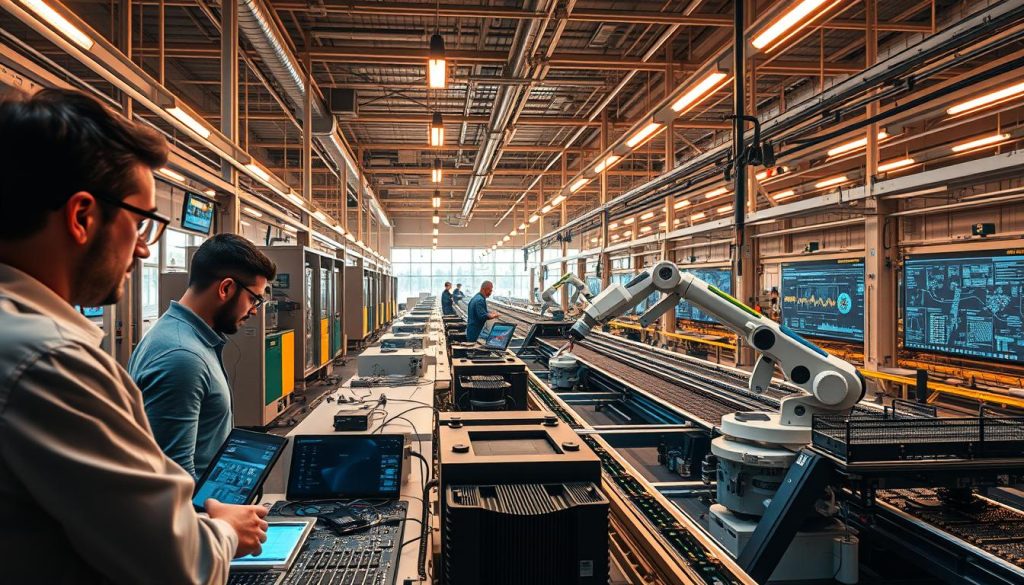
Adapting to Variability in Manufacturing Conditions
Manufacturing conditions present substantial variability across facilities and production lines. Lighting changes, camera positioning differences, and component supplier variations collectively challenge system robustness.
Effective domain adaptation strategies enable models to maintain accuracy when transferred across different contexts. These approaches reduce the need for extensive retraining and new data collection.
Leveraging Visual, Thermal, and X-ray Imaging
Multimodal integration combines traditional visual inspection with thermal analysis and X-ray examination. Thermal imaging identifies temperature anomalies related to electrical conductivity issues.
X-ray technology reveals internal structural problems in multilayer boards that surface inspection cannot detect. This comprehensive approach captures complementary information unavailable through any single method.
Organizations seeking to implement advanced domain adaptation strategies can explore tailored solutions through expert consultation. Specialized partners help optimize manufacturing quality across diverse operational conditions.
Impact on Manufacturing Quality and Real-Time Inspection
The true measure of any quality control system lies in its direct impact on production outcomes and operational efficiency. We see advanced visual analysis creating a new standard for manufacturing excellence. This approach moves beyond simple fault finding to build reliability directly into the production process.
These sophisticated systems deliver profound benefits across two critical areas. They enhance overall production efficiency and establish robust quality control. They also enable the implementation of scalable, real-time solutions tailored for modern industry demands.
Enhancing Production Efficiency and Quality Control
We have observed that implementing advanced visual analysis systems delivers a transformative impact on manufacturing quality. These solutions dramatically reduce the rate of defects escaping the production line. This minimizes costly rework and scrap, leading to significant cost savings.
The achievement of real-time inspection capabilities fundamentally changes quality control economics. Processing speeds of 121 frames per second enable 100% inline inspection without creating bottlenecks. This contrasts sharply with traditional sampling methods that check only a small percentage of units.
Production efficiency gains are substantial. They include reduced manual labor, lower false rejection rates, and accelerated production cycles through immediate feedback. This enhances overall equipment effectiveness across all manufacturing operations.
Implementing Scalable, Real-Time Solutions in Industry
Implementing scalable solutions requires careful architectural planning. We consider edge computing for distributed inspection stations and cloud integration for centralized analytics. Modular system designs accommodate facility expansion without complete redesign.
Industrial applications span diverse contexts, from high-volume consumer devices to low-volume aerospace electronics. Each presents unique requirements for detection sensitivity and processing speed. Successful real-time implementation demands optimization across the entire inspection pipeline.
This includes high-speed image acquisition hardware and efficient data transfer. Optimized neural network inference using specialized processors ensures speed. Streamlined integration with manufacturing execution systems allows for automated quality disposition.
| Inspection Approach | Defect Escape Rate | Inspection Coverage | Impact on Production Speed |
|---|---|---|---|
| Manual Sampling | High | Significant Bottleneck | |
| Basic Automated | Moderate | 100% | Minor Slowdown |
| Advanced Real-Time | Very Low | 100% | No Impact |
YOLOv11's processing speed of 121 FPS with 98.9% precision showcases performance suitable for demanding industrial applications. This paves the way for robust automated quality inspection systems in smart manufacturing. Manufacturers seeking to implement scalable, real-time solutions can contact us today to discuss customized strategies.
Insights from International Research and Innovation Conferences
Global research forums consistently serve as critical platforms for validating and advancing manufacturing inspection technologies. We find that presentations at these events provide indispensable benchmarks for real-world performance.
Comparative Performance: YOLOv11 vs. YOLOv10 and YOLOv8
Recent analysis from a prominent international conference detailed a comprehensive comparison of modern architectures. The work evaluated YOLOv11, YOLOv10, and YOLOv8 for visual inspection applications.
The results clearly demonstrated architectural trade-offs. YOLOv10 achieved the highest speed due to its NMS-free design. YOLOv8 provided a solid baseline for performance.
YOLOv11 emerged as the optimal balance, achieving 98.9% precision with a processing speed of 121 FPS. This makes it exceptionally suitable for demanding industrial applications.
| Model | Precision | Speed (FPS) | Key Strength |
|---|---|---|---|
| YOLOv8 | Solid Baseline | High | Proven Reliability |
| YOLOv10 | High | Maximum | NMS-Free Architecture |
| YOLOv11 | 98.9% | 121 | Optimal Balance |
Notably, YOLOv11 achieved perfect precision for identifying copper irregularities. This highlights its reliability for safety-critical electronics manufacturing.
Contributions from Global Research Institutions and Case Studies
This important research featured contributions from leading global institutions. Collaborations included the University of Southampton and the University of Chinese Academy of Sciences.
Such international partnerships enrich methodological innovation and validation rigor. Case studies from these institutions reveal practical implementation considerations beyond pure algorithmic performance.
We understand that this collaborative work ensures reported metrics reflect realistic industrial scenarios. This advances the practical viability of modern inspection systems for manufacturing quality.
Conclusion
As we conclude this exploration, the strategic implementation of advanced visual analysis emerges as a cornerstone for competitive manufacturing. This comprehensive journey from traditional methods to sophisticated computational approaches demonstrates a fundamental shift in quality assurance paradigms.
The evidence clearly shows that modern systems deliver unprecedented precision and speed. They address critical challenges in production variability while maintaining real-time processing capabilities. This represents a significant advancement for industrial applications.
We recognize that successful adoption requires careful planning and expert guidance. Our team stands ready to help organizations navigate this transformative landscape. We provide tailored solutions that align with specific operational requirements and quality objectives.
Contact us today at opsiocloud.com/contact-us/ to explore how these advanced solutions can enhance your manufacturing systems and drive operational excellence.
FAQ
How does deep learning improve the accuracy of identifying issues on printed circuit boards?
Our technology leverages convolutional neural networks to analyze images with exceptional precision. These advanced algorithms detect minute anomalies that traditional methods often miss, significantly enhancing quality control in electronics manufacturing.
What advantages do automated systems offer over manual inspection processes?
Automated solutions provide consistent analysis at high speeds, eliminating human fatigue and subjectivity. They ensure reliable performance across large production volumes while reducing operational costs and improving overall efficiency.
Can these systems adapt to different manufacturing environments and component types?
Yes, our models incorporate domain adaptation strategies to handle various production conditions. They effectively process multimodal data from visual, thermal, and X-ray sources, ensuring robust performance across diverse industrial applications.
What role do international research conferences play in advancing this technology?
Global innovation summits facilitate knowledge exchange between academia and industry. They accelerate the development of cutting-edge architectures like YOLOv11, driving continuous improvement in detection capabilities and system reliability.
How does real-time implementation impact production line efficiency?
Real-time processing enables immediate feedback during manufacturing, allowing for swift corrective actions. This proactive approach minimizes downtime, reduces waste, and maintains consistent product quality throughout the production cycle.