Imagine cutting mobile solution costs by 70% and getting top-notch tech help. This is real for businesses that team up with outside experts for digital changes. Many companies find that making mobile apps in-house isn't always the best choice.
We show companies how to outsource app development to grow faster. If you're short on time, resources, or need specific tech skills, we connect you with global experts. They turn your challenges into chances for success.
There's more to it than just saving money. Projects that cost $200,000-$400,000 internally can be done for $25,000-$50,000 with the right partner. You get predictable budgets, faster app release, and flexible team sizes without the hassle of hiring and training staff.
Even tech-savvy companies use outside help to stay ahead. We see this partnership as a strategic boost. It lets you focus on what you do best while experts handle the tech work.
Key Takeaways
- Strategic partnerships can reduce mobile solution costs by up to 70% compared to internal development teams
- External collaboration provides immediate access to specialized expertise in iOS, Android, and cross-platform technologies
- Businesses achieve faster time-to-market by leveraging global talent pools and established development methodologies
- Predictable project costs eliminate budget overruns common with internal capacity expansion
- Dynamic resource scaling allows companies to adjust team size as project requirements evolve
- Organizations maintain focus on core competencies while technical professionals handle digital transformation
Understanding Outsource App Development
In today's fast-paced business world, outsource mobile app development is more than saving money. It's a way to speed up innovation and use resources wisely. It has grown from a simple deal to a deep partnership. This partnership brings in experts with new methods, cutting-edge tech, and efficient ways to turn ideas into real apps.
This method helps solve a big problem for businesses today. It's how to make great mobile apps without using too many resources, staying within tight budgets, and meeting tight deadlines.
For leaders in India's fast-growing digital economy, knowing about outsourcing is key. It's about making smart choices on how to develop apps. The next parts will explain what outsourcing is and its many benefits, not just saving money.
What Outsourcing Really Means
Outsourcing app development means working with outside experts for your app project. They handle everything from the start to the end. This includes finding out what you need, designing the app, planning the tech, coding, testing, deploying, and keeping it updated.
This is more than just hiring programmers. It's a full solution where teams use proven ways to make apps ready for use.
Looking at today's business world, it's clear why this approach is important. Companies need to make digital experiences that meet high customer expectations. They must compete with big companies and quick startups. Building a team to do this takes a lot of money and time, taking away from what the company really does.
Working with outside teams gives you quick access to new skills, established tech setups, and tested ways of working. This is very helpful for custom app development outsourcing. It lets you do things your own way, not just follow a standard plan.
Outsourcing changes how companies make apps. It turns a big challenge into a chance to grow and innovate. Companies stay efficient while exploring new digital ideas. They use tools for working together from afar, manage projects quickly, and check the quality of their apps. For those looking to outsource app development well, knowing all this is key to success.
Strategic Advantages for Your Business
Outsourcing mobile app development brings many benefits to your business. It creates value that grows over time. Here are some key advantages that help our partners a lot:
| Business Impact Area |
In-House Development |
Outsourced Development |
Advantage |
| Development Timeline |
9-12 months average |
3-6 months average |
50-60% faster market entry |
| Total Project Cost |
$150,000-$300,000 |
$45,000-$90,000 |
Up to 70% cost reduction |
| Specialized Skill Access |
Limited to current staff |
Global talent pool |
Immediate expertise availability |
| Ongoing Maintenance |
Requires dedicated team |
Included in service model |
Predictable support costs |
Cost efficiency is the most obvious benefit. Businesses can save up to 70% by not building their own app teams. This is because they avoid hiring costs, don't need to invest in infrastructure, and save on overheads. They also get to use talent from places where it's cheaper without losing quality.
Accelerated time-to-market is another big plus. Outsourcing teams are ready to start work right away. They use proven methods and parts they've used before to make apps faster. This means businesses can make money sooner and grab market chances before others do.
Having specialized technical expertise is crucial for making new apps. Outsourcing gives you access to experts in new tech like AI and AR. This is something that would take a lot of time and money to learn internally. It means your app uses the best tech for what you need.
We see that resource optimization is the biggest long-term gain. Outsourcing saves you from the hassle of finding, training, and keeping tech experts. This lets your team focus on what matters most to your business. It helps companies stay lean while still going after big digital goals.
Predictable budgeting is great for planning your finances. Outsourcing means you know exactly how much you'll spend. This makes it easier to plan your budget and reduces financial risks. It's very helpful for growing businesses.
Lastly, ongoing maintenance and support keep your app running smoothly. Outsourcing partners watch over your app, update it, make it better, and fix problems fast. This is something that would take a lot of work to do yourself. It makes your outsourcing partner a long-term partner, not just a one-time helper.
The Outsourcing Process Explained
We start every outsourcing partnership with a deep dive into what you need. This stage is followed by clear steps that match development with your business goals. It's a journey from idea to active partnership, filled with transparency and teamwork.
Many are unsure about what to expect from outsourcing. We clear up these doubts with a clear plan. This plan outlines each step, who does what, and where to check in. It ensures your project stays on track and meets your goals.
Starting with Strategic Discovery
Our journey begins with deep discovery sessions. We look beyond just what you want to build. We explore why it matters to your business. This includes your users, competitors, tech setup, and success metrics.
We see ourselves as both tech advisors and strategic partners. We ask tough questions to uncover potential issues early. This includes how your app will fit with your current systems and grow with your users.
We also set up how we'll work together. This includes who's involved, how we'll make decisions, and how to handle any issues. This early work helps prevent misunderstandings and ensures we can solve problems quickly.
Documenting Requirements and Boundaries
Defining the project scope is a big step. We use a detailed approach to document everything. This includes what the app will do, how it will work, and how it will meet your standards.
We involve both tech and business teams to make sure nothing is missed. We write user stories, outline the tech architecture, and set clear quality standards. This shared understanding helps manage changes during development.
Setting scope is a balance between being clear and flexible. We focus on the initial release while keeping room for future enhancements. This approach protects your project's timeline and budget while allowing for valuable changes.
| Engagement Model |
Best Suited For |
Payment Structure |
Flexibility Level |
| Fixed Price |
Well-defined projects with stable requirements and clear deliverables |
Predetermined total cost based on scope documentation |
Low – changes require formal change orders |
| Managed Team |
Long-term projects requiring dedicated resources and ongoing development |
Monthly retainer for dedicated team members |
High – priorities adjusted within sprint cycles |
| Staff Augmentation |
Organizations with internal teams needing specialized skills or capacity |
Hourly or monthly rates for individual resources |
Very High – resources integrated into client processes |
| Milestone-Based |
Phased projects with distinct deliverables and evaluation points |
Payment upon achievement of predefined milestones |
Moderate – scope defined per phase |
Evaluating and Selecting Development Partners
Choosing the right app development service is crucial. It affects your project's success, timeline, and support. We help you evaluate vendors by looking at their past work, technical skills, and how they communicate.
Technical skills are key, but so is understanding your business needs. We look at their experience with your technology and how they ensure quality. This helps you find a partner that fits your needs.
It's not just about technical skills. We also check if they understand your business and communicate well. This is important for working together, whether you're in India or globally.
Legal and financial stability are also important. We check their business setup, insurance, and contracts. This ensures they can support your project and be there for ongoing needs.
- Portfolio Analysis: Review completed projects similar in complexity, technology stack, and industry vertical to your requirements
- Technical Certification: Verify relevant platform certifications, security compliance attestations, and quality management system credentials
- Reference Checks: Conduct direct interviews with previous clients about communication, problem-solving, and overall satisfaction
- Communication Assessment: Evaluate responsiveness, clarity, and proactive communication during the selection process itself
- Security Practices: Review data handling procedures, access controls, and security incident response capabilities
- Support Capabilities: Confirm availability of post-launch support, maintenance services, and enhancement resources
- Legal Review: Examine standard contract terms, intellectual property provisions, and liability limitations with legal counsel
After selecting a vendor, we draft detailed agreements. These agreements protect your interests and set clear expectations. We focus on making the contract a collaborative effort, not a battle. A good contract sets the stage for a successful partnership.
Choosing the Right Outsourcing Partner
Choosing an outsourcing partner is a big decision for your business. It's not just about finding someone who can do the job for less money. The right partner will help shape your app from start to finish. They should bring technical skills, strategic thinking, and a real commitment to your success.
Look for a partner with technical know-how, business sense, and a good fit for your company culture. They should also be efficient and reliable. This ensures your project will run smoothly and meet your goals.
Assessing Technical Depth and Industry Knowledge
When evaluating a partner, look beyond their credentials. Check if they have the technical skills needed for your project. They should know the platforms, frameworks, and technologies you need.
The team's experience is crucial. Having senior developers who can guide the project can make a big difference. They should have solved similar technical challenges before.
Industry experience is also key, but it's not the only thing. A partner with experience in your field can help avoid common pitfalls. They'll know the regulations and user needs specific to your industry.
It's important for your partner to stay up-to-date with the latest technologies. This ensures they can offer the best solutions for your project. Look for a partner who invests in learning and keeps their skills sharp.
Verifying Track Records Through References and Portfolio Review
Checking references and portfolios is essential. It helps you see if a partner can deliver on their promises. Look for case studies that match your project's complexity and requirements.
Talking to previous clients can give you valuable insights. Ask about how the partner handled challenges and how they communicated. This will help you understand their problem-solving skills and partnership approach.
Reviewing a partner's portfolio should include live apps. This lets you see how well they perform in real-world scenarios. Test the apps yourself to check their quality and user experience.
Don't forget to check the partner's business basics. Make sure they are legally registered, insured, and financially stable. This ensures they can handle your project and stay in business.
Establishing Effective Communication and Support Systems
Good communication and support are key to a successful project. A dedicated project manager can help avoid misunderstandings. They act as a single point of contact for all questions and concerns.
Clear communication from the start is crucial. It prevents delays and budget overruns. Set up regular updates and reviews to keep everyone informed without slowing down the project.
The quality of communication is just as important as its frequency. Your partner should understand your goals and ask questions to clarify any doubts. They should also be proactive in identifying and solving problems.
Support after the project launch is important. Your app will need updates and maintenance. Look for a partner who offers ongoing support and strategic guidance.
Use collaborative tools to keep track of project progress. This allows for real-time feedback and ensures everyone is on the same page. A partner who adapts to your workflow shows they value your input and are focused on your success.
Cost Considerations in Outsourced App Development
Outsourcing app development can save businesses money while keeping quality high. It's all about making smart financial choices. We help leaders understand costs to make decisions that fit their budget and goals.
Understanding how different factors affect costs is key. We break down costs to show the benefits of investing in app development. This way, costs become a strategic advantage for growth.
Budgeting for Quality
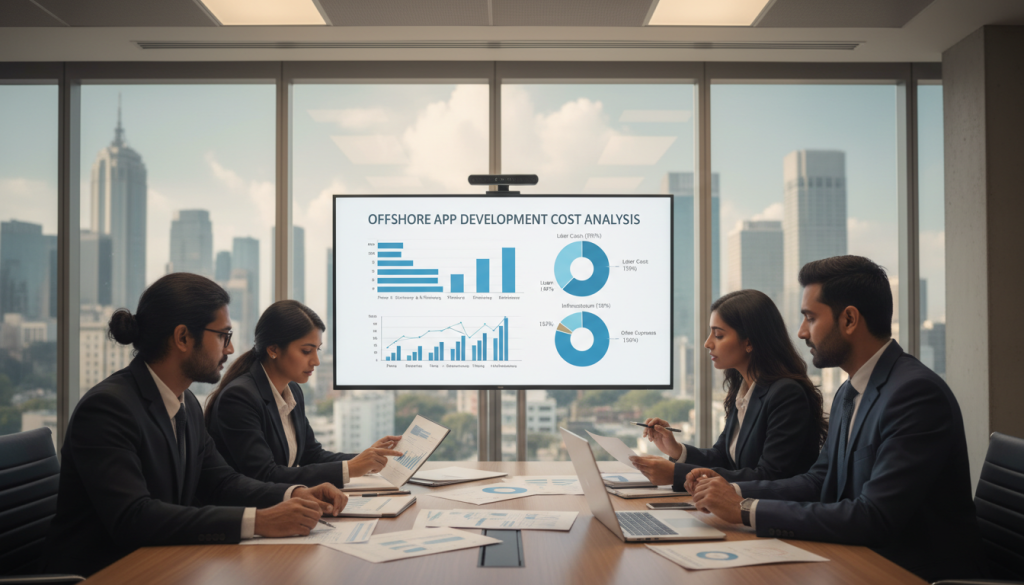
Lower costs don't always mean lower quality. Offshore app development offers great value through talented developers in lower-cost areas. They work efficiently, spreading costs across more clients.
Specialized firms focus on what they do best. They use efficient processes and code libraries to deliver quality fast.
Knowing typical costs is important. Simple apps cost $25,000 to $40,000. More complex apps can cost $50,000 to $100,000. Enterprise apps can cost over $100,000.
Quality partners give clear estimates. Budgeting for quality means having enough for discovery, testing, and security. Cutting corners leads to higher costs later.
Understanding Hidden Costs
Being open about all costs helps avoid surprises. Hosting and infrastructure costs range from $500 to $2,000 monthly. These costs grow with user numbers and features.
App store fees are another ongoing cost. Apple and Google Play charge fees on sales. These fees affect how much money apps make.
Subscriptions for services like push notifications and analytics add to costs. SSL certificates and security tools protect data. Costs for internal time spent on feedback and testing should also be considered.
We provide detailed cost breakdowns to avoid surprises. This helps clients plan for the full cost of apps. Being open about costs helps make informed decisions and avoid budget problems.
| Development Approach |
Initial Development Cost |
Annual Maintenance Cost |
12-Month Total Investment |
| In-House Development |
$300,000 – $400,000 |
$40,000+ |
$340,000 – $440,000 |
| Nearshore Outsourcing |
$200,000 – $275,000 |
$15,000 – $20,000 |
$215,000 – $295,000 |
| Offshore App Development |
$125,000 – $200,000 |
$5,000 – $10,000 |
$130,000 – $210,000 |
| Simple Project (In-House) |
$200,000 |
$25,000 |
$225,000 |
| Simple Project (Outsourced) |
$25,000 – $40,000 |
$3,000 – $5,000 |
$28,000 – $45,000 |
Cost-Benefit Analysis
Cost savings from offshore app development are huge. Outsourced projects can save 70-80% compared to in-house. This frees up money for other important business areas.
Using internal resources for development means less time for other important tasks. Partnering with experienced developers keeps internal teams focused on key business areas.
Being agile is a big advantage. Outsourcing allows for quick responses to market changes. It also reduces the risk of costly project failures.
Outsourcing offers flexibility. Businesses can scale up or down as needed. This flexibility improves financial efficiency and strategic planning.
Technology Stack and Development Tools
Choosing the right technology at the start is crucial for your app's success. It affects its performance, cost, and ability to grow. The best app development services pick the right mix of programming languages, frameworks, and tools. They balance time, budget, scalability, and maintenance needs.
Working with experienced partners means you get a solid development environment. They have tools and frameworks that work well, thanks to many successful projects. This leads to faster development, fewer problems, and a solid foundation for your app.
Popular Technologies for App Development
Mobile app development requires choosing between native and cross-platform options. Native development uses Swift for iOS and Kotlin for Android. It offers top performance but requires more work and expertise.
Cross-platform frameworks like React Native and Flutter use one codebase for both platforms. They save costs and speed up development. These frameworks are now used by big brands and offer good performance.
When you Outsource App Development, your partner will choose based on your needs. Native is best for apps needing top performance or deep device integration. Cross-platform is great for most apps, saving money and time.
Choosing a backend technology is also a big decision. Custom backend solutions give full control over your app's data and logic. They're best for complex apps or unique needs.
Backend-as-a-Service platforms like Firebase speed up development with pre-built features. They're cost-effective for simple apps and startups.
Database choice is critical for your app's future. Traditional databases like PostgreSQL are great for complex data and financial apps. NoSQL databases like MongoDB are flexible and scalable for content and social apps.
| Technology Category |
Option A |
Option B |
Best Use Case |
Primary Advantage |
| Mobile Platform |
Native (Swift/Kotlin) |
Cross-Platform (React Native/Flutter) |
Native for performance-critical; Cross-platform for business apps |
Native: Maximum performance; Cross-platform: Cost efficiency |
| Backend Framework |
Custom API (Node.js/Django) |
BaaS (Firebase/AWS Amplify) |
Custom for complex logic; BaaS for standard features |
Custom: Full control; BaaS: Faster development |
| Database Type |
Relational (PostgreSQL/MySQL) |
NoSQL (MongoDB/Redis) |
Relational for transactions; NoSQL for flexibility |
Relational: Data integrity; NoSQL: Scalability |
| Development Approach |
Waterfall Methodology |
Agile/Scrum Framework |
Waterfall for fixed requirements; Agile for evolving needs |
Waterfall: Predictability; Agile: Flexibility |
Tools for Project Management
Good project management tools are key for distributed teams. They provide real-time updates, help communicate, and keep records. The best app development services use advanced tools that are easy to understand.
Sprint planning and issue tracking often use Jira. It organizes work, tracks tasks, and shows progress. It makes sure everyone knows what to do and keeps a record of all work.
Version control systems like GitHub help teams work together. They prevent conflicts and keep a record of all changes. This ensures quality and makes it easy to find who made what changes.
Tools like Confluence keep all project information in one place. It's easy to find and helps everyone stay on the same page. This prevents important info from being lost.
Platforms like Slack help teams talk in real-time. They keep conversations organized and bring updates from other tools right to your chat. This makes solving problems fast and easy.
Design tools like Figma make it easy to work on user interfaces together. Everyone can see and comment on designs before they're made. This saves time and money by avoiding costly changes later.
Tools like TestFlight help test apps before they're released. They make it easy to get feedback from users. This helps make sure your app is ready for everyone.
Importance of Up-to-Date Technologies
Technology changes fast, and keeping up is important. We choose current, well-supported technology stacks for your app. This ensures your app stays competitive and easy to maintain.
Bleeding-edge technologies might seem exciting but can be risky. They often lack good documentation and can change a lot. This can make your app hard to update or even require a complete rewrite.
Outdated technologies can also cause problems. They might be stable, but they're not supported anymore. This makes it hard to keep your app running smoothly and can be expensive to fix.
Our goal is to find the right balance. We choose technologies that are proven but still modern. This way, your app stays up-to-date and easy to maintain.
When you Outsource App Development to us, your app will stay current. We make sure it's easy to update and grow. This means your app will always be ready for the future.
We regularly review your app's technology stack. This keeps your app from becoming outdated. We make updates as needed to keep your app running smoothly and efficiently.
Quality Assurance and Testing
We follow strict quality assurance steps in every app development stage. This ensures apps meet high standards for function, performance, and user happiness. Quality assurance is more than just a final check before launch. It's a key part of the development process, starting from the first code line and continuing after launch.
Our QA processes make apps stand out from amateur ones. They turn technical plans into reliable solutions that work well on different devices and systems.
We focus on preventing problems rather than just finding them. This approach helps avoid issues that could harm your brand and goals. Quality is built into every development choice, not just tested later.
We use continuous testing and automated checks to keep development on track. This ensures apps meet your business needs and user expectations.
Quality assurance in outsourced development needs clear communication and shared goals. This is harder when teams are far apart. We use structured testing and clear reports to show app reliability and readiness.
Comprehensive Testing Methodology
We have a detailed testing plan with different stages. Each stage checks different parts of the app and finds specific problems. We start with unit testing to check individual code parts.
Then, we do integration testing to see how different parts work together. This includes checking third-party services and data storage. Next, we do functional testing to make sure all features work as planned.
Performance testing checks how the app runs under different loads. Security testing looks for vulnerabilities and protects user data. The final step is user acceptance testing where clients check if the app meets their needs.
| Testing Phase |
Primary Focus |
Methods Applied |
Defects Identified |
| Unit Testing |
Individual code components |
Automated test suites, code coverage analysis |
Logic errors, edge case failures, calculation mistakes |
| Integration Testing |
Component interactions |
API testing, database queries, service mocking |
Interface mismatches, data transformation errors, timing issues |
| Functional Testing |
User-facing features |
Manual exploration, automated UI testing |
Specification deviations, workflow breaks, usability problems |
| Performance Testing |
Speed and scalability |
Load simulation, stress testing, profiling |
Response delays, memory leaks, database bottlenecks |
| Security Testing |
Vulnerability assessment |
Penetration testing, code scanning, compliance audits |
Authentication weaknesses, data exposure, injection vulnerabilities |
Testing is a key part of app development, not just a final step. We use automated tests and manual checks to find problems early. This ensures apps work well on different devices and systems.
Collaborative Feedback Integration
We involve clients throughout development to get their feedback. This helps us make sure the app meets their needs. We deliver working versions regularly for stakeholders to test.
Good app development is a team effort. Client feedback shapes the app's direction. We use feedback to improve the app and make sure it meets business needs.
User feedback is important, not just from clients. We test the app with real users to see if it solves problems. This helps us make the app better for everyone.
Structured Defect Communication
We help clients report problems clearly. Good bug reports include steps to reproduce the issue. This helps developers fix problems fast.
We also provide templates for bug reports. This makes it easier to share important information. Clear communication is key to fixing problems quickly.
"Quality is not an act, it is a habit. In software development, systematic testing and continuous feedback transform good applications into exceptional solutions that users trust and businesses depend upon."
Our focus on quality assurance goes beyond just testing. It includes clear communication and working together to solve problems. This ensures apps are reliable, meet requirements, and are easy to use. These steps protect your investment and help your app succeed.
Managing Remote Development Teams
Managing remote teams well means clear communication and accountability. This keeps projects moving and respects team freedom. When you outsource mobile app development, managing teams from afar can be tough. It can mess up timelines, increase costs, and lower quality if not done right.
We focus on clear communication, smart time zone use, and open accountability. These strategies turn challenges into advantages. They make sure the development team works well with your business goals and keeps delivering value.
Good remote teamwork starts with clear goals, regular talks, and seeing how projects are going. We've learned this from managing teams all over the world. Our methods balance checking in without slowing down the team's work.
Communication Strategies
Good communication is key for remote teams. It means picking the right channels, talking often, and knowing who to talk to. We set up communication systems at the start of projects. This makes sure everyone knows what's going on without getting too much information.
We use different ways to talk, like instant messages, emails, and video calls. This helps everyone understand each other better. It makes sure quick answers and important decisions are clear.
Having a single point of contact helps avoid confusion. This person makes sure everyone knows what's going on. They help translate business ideas into technical plans and keep messages clear between your team and the developers.
We have regular updates to keep everyone in the loop without wasting time. Daily meetings help teams work together and solve problems fast. Weekly reviews show what's done and get feedback for the next steps. Monthly checks make sure projects are on track and make any needed changes early.
| Communication Type |
Recommended Channel |
Response Timeframe |
Primary Purpose |
| Quick Clarifications |
Instant Messaging (Slack, Teams) |
Within 2 hours during business overlap |
Resolve minor blockers and answer simple questions |
| Formal Decisions |
Email with Documentation |
Within 24 business hours |
Create permanent records of approvals and direction changes |
| Technical Discussions |
Video Conference with Screen Share |
Scheduled within 48 hours of request |
Address complex issues requiring real-time collaboration |
| Progress Updates |
Project Management Platform |
Daily automated updates, weekly reviews |
Maintain visibility into task completion and timeline adherence |
When you hire app developers through us, we set up these systems right away. We make sure they fit your needs and keep the team working well.
Time Zone Management
Time zones can be a challenge or an advantage, depending on how you manage them. Nearshore partnerships in similar time zones help teams work together better. They can answer questions quickly and make decisions fast.
Nearshore teams work during your business hours. This makes it easier to talk and work together. It keeps projects moving without the delays of different time zones.
Offshore partnerships with big time zone differences work differently. They can help with projects that need work done at all hours. But, they need clear plans and good communication to work well.
We make the most of time zones while avoiding problems. We use hours when teams can talk, document work for others, and have plans for urgent issues. Our tools let teams work together, no matter when they're working.
Ensuring Accountability
Keeping projects on track and teams responsible is key. We use systems that show progress but don't micromanage. This lets teams work freely while keeping everyone informed.
We use sprints to plan and work on projects. Teams commit to what they can do in two weeks. They plan together, work daily, and review their work to improve.
Regular checks help teams get better and solve problems. They look at what works and what doesn't. This way, everyone works together towards common goals.
Our system shows how projects are doing and if they're on track. When you hire app developers through us, you get these systems ready to go. They help you keep an eye on projects without doing it all yourself.
We trust teams but also check their work. This keeps everyone happy and working well. It also makes sure projects are done right without too much watching.
Intellectual Property and Legal Considerations
Legal protections and intellectual property rights are key to successful partnerships with offshore app development teams. They create secure, beneficial collaborations built on trust and clear rights. When you share your business ideas, customer data, and strategies with external partners, strong legal frameworks are crucial. They protect your investments and ensure you own the digital products made for you.
Legal protections help enable, not hinder, collaboration. We design frameworks that balance your need for security with the flexibility needed for successful projects. Our experience with app development outsourcing companies across various jurisdictions shows that proactive legal planning prevents most disputes. It also clarifies expectations and sets up ways to resolve issues if needed.

Protecting Your Ideas
Before sharing your business concepts, technical details, or competitive strategies, we implement strong intellectual property protections. These protections require all parties to keep information confidential and use it only for the contracted project. Non-disclosure agreements are the first line of defense, with legal consequences for breaches, including financial damages and injunctions.
We start with NDAs before detailed discussions to protect sensitive information from the start. These agreements outline what's confidential, how long confidentiality lasts, and what happens if there's a breach.
Additional protective measures are also recommended:
- Limiting information sharing to only what's necessary for project execution
- Watermarking design assets and documentation before formal agreements
- Conducting due diligence on security practices and personnel
- Structuring phased engagements with initial proofs-of-concept under NDA
- Implementing technical controls like secure file-sharing platforms
Offshore app development requires special attention to IP protections due to different laws in various jurisdictions. We partner with US-registered entities to access global talent while maintaining US legal protections. This ensures familiar legal frameworks govern your IP rights, regardless of where development happens.
Contracts and Agreements
Comprehensive contracts are essential for defining expectations, allocating responsibilities, and establishing payment terms. They transform verbal agreements into legally binding commitments that protect both parties. When evaluating app development outsourcing companies, we focus on contract terms that provide adequate protections while supporting collaborative relationships.
Key contract components include:
- Precisely defined scopes of work that outline deliverables and project boundaries
- Milestone-based payment terms tied to verified deliverables
- Intellectual property assignment clauses that transfer all rights to clients upon payment
- Quality warranties regarding code functionality and performance
- Indemnification provisions protecting clients from third-party claims
- Limitation of liability clauses defining maximum financial exposure
- Termination provisions outlining exit procedures and asset handling
The intellectual property assignment clause is crucial, as unclear ownership terms can lead to disputes. We ensure contracts specify that all work products become your exclusive property upon final payment, with no rights for development partners to reuse or modify.
Indemnity provisions protect your organization from financial exposure if development work infringes on third-party rights. We recommend that reputable app development outsourcing companies maintain Errors and Omissions insurance for additional financial protection.
| Contract Element |
Protection Provided |
Risk Mitigated |
| IP Assignment Clause |
Complete ownership transfer |
Disputes over code ownership and usage rights |
| Indemnification Terms |
Financial protection from third-party claims |
Copyright infringement and patent violation exposure |
| Termination Provisions |
Defined exit procedures and asset handling |
Incomplete projects and payment disputes |
| Confidentiality Obligations |
Information security requirements |
Competitive exposure and data breaches |
Compliance with Local Laws
Regulatory compliance is critical for businesses in regulated industries or handling sensitive customer data. It requires development partners to implement security frameworks and data protection practices that meet legal requirements in the jurisdictions where your applications will operate. We ensure that offshore app development engagements address compliance requirements from the start, avoiding costly redesigns later.
Key compliance areas include:
- Data protection regulations like GDPR for European users or CCPA for California residents
- Industry-specific security standards such as HIPAA for healthcare applications
- Cross-border data transfer restrictions that may prohibit storing certain data types outside specific jurisdictions
- Accessibility requirements mandating applications meet standards like WCAG for users with disabilities
- Age verification and parental consent for applications serving users under 13 years old under COPPA regulations
Our expertise in regulated industries helps prevent costly compliance failures. We work with development partners who demonstrate compliance capabilities, including security certifications and regular audits.
For businesses in India targeting global markets, understanding compliance requirements in destination markets is essential. We help you navigate this complexity by identifying applicable regulations, implementing technical and procedural controls, and documenting compliance efforts.
Contract terms should explicitly allocate compliance responsibilities. They should specify whether development partners must implement specific security controls, undergo compliance audits, or provide documentation supporting regulatory requirements. We recommend including compliance warranties where app development outsourcing companies certify their work meets specified regulatory standards and agree to remediate any compliance deficiencies at their expense.
Ensuring Seamless Integration
Integration is key to linking software development with business change. It's not just about creating a good app. It must also fit well with your current systems and processes. The real success comes from how well the new app works with your business.
Many businesses don't realize how hard integration can be until it's too late. This can stop projects that seemed good in testing. We start planning integration early, making sure we know your tech landscape before we start coding.
Connecting New Applications with Current Infrastructure
Your business likely uses many systems for things like customer data and money. We start by checking out your current tech, looking at data flows, and finding where new apps need to connect. This way, we avoid big changes that cost a lot later on.
We handle things like linking mobile apps with big systems like SAP or Oracle. We also connect apps with customer management systems like Salesforce. And we make sure apps work with identity providers like Active Directory or Okta for better security and easier access.
Top app development companies know how to handle these connections. We work with marketing tools to improve user engagement. And we make sure data flows well to analytics platforms for better insights.
Early on, we focus on the integration architecture. We've seen big problems found in testing that need major changes. We set aside time just for integration work, making sure it's a priority.
| Integration Type |
Common Challenges |
Our Solution Approach |
Timeline Impact |
| Legacy System APIs |
Outdated protocols, limited documentation, synchronous-only communication |
Custom middleware layers, API modernization, asynchronous wrappers |
2-4 weeks additional development |
| Cloud Platform Integration |
Authentication complexity, rate limiting, service dependencies |
OAuth implementation, request queuing, fallback mechanisms |
1-3 weeks for robust setup |
| Database Synchronization |
Data consistency, conflict resolution, performance bottlenecks |
Event-driven sync, conflict detection algorithms, optimized queries |
2-5 weeks depending on volume |
| Third-Party Services |
Vendor API changes, service reliability, cost management |
Abstraction layers, monitoring systems, usage optimization |
1-2 weeks for proper abstraction |
We get your IT teams involved early in planning. They know your systems, security, and how to make changes. Their input helps us design solutions that fit your business.
Building Productive Partnerships with Your Internal Teams
Good app development outsourcing needs teamwork. We work closely with your IT, analysts, department heads, and executives. This ensures everyone is on the same page.
We have joint sessions for design, integration, and testing. This way, knowledge flows throughout the project. We avoid problems that come from not knowing the business well.
We make sure everyone knows their role. This avoids delays and misunderstandings. Good teamwork means respecting each other's strengths.
We have regular meetings to keep everyone updated. We use tools that show what's happening without overwhelming people. Our project managers help translate tech talk into business terms.
Navigating Complex Data Migration Requirements
Data migration is often overlooked but is very complex. Moving data from old systems to new ones requires careful planning. It's about keeping data safe, accurate, and without disrupting business.
We start by checking the data quality and finding what needs fixing. Legacy systems often have problems like duplicates and missing info. We plan how to fix these issues.
We then map old data to new systems. This can reveal differences in how data is handled. We work with experts to make sure the data is used correctly in the new system.
We test data moves in small steps before doing the big move. This lets us find and fix problems early. It's safer than trying to do everything at once.
Having both systems run at the same time is a safety net. This lets users get used to the new system while keeping the old one as a backup. It's a way to be sure everything works right before switching.
Data migration needs its own plan and time. We help clients see that rushing this part is risky. Top app development companies take this seriously, knowing data is very important.
We plan migrations carefully, considering when to switch and how to go back if needed. We document every step to meet rules and solve problems later.
Post-Launch Support and Maintenance
Launching an app is just the start. It's crucial to keep supporting it to keep it relevant. Your app needs ongoing care to stay competitive and meet user needs. This includes updates, security checks, and new feature additions.
Our post-launch services keep your app up to date and secure. We focus on making sure your app meets your business goals. This way, your investment in technology keeps growing over time.
Maintaining Application Health Through Ongoing Support
Keeping your app running smoothly is key. Corrective maintenance fixes bugs and issues found in real use. We act fast to solve problems that affect your users or business.
Adaptive maintenance keeps your app working with new operating system updates. We stay ahead of these changes to avoid any disruptions. This ensures your app works well with the latest technology.
Preventive maintenance updates your app to keep it secure and fast. We regularly check your app to find ways to improve it. This helps avoid costly problems later on.
Outsourcing app development and maintenance can save you money. It costs $5,000-$10,000 a year for professional services. This is much less than keeping a team in-house, which can cost $40,000 or more annually.
We offer different maintenance services to fit your app's needs. This way, you can choose the right level of support for your business.
| Service Tier |
Coverage Scope |
Annual Cost Range |
Ideal Business Scenario |
Response Time |
| Basic Reactive |
Critical bug fixes, security patches, OS compatibility updates |
$5,000 – $7,000 |
Simple apps with stable feature sets and small user bases |
48-72 hours |
| Proactive Standard |
All basic services plus performance optimization, dependency updates, minor enhancements |
$8,000 – $12,000 |
Business-critical apps requiring consistent reliability and gradual improvements |
24-48 hours |
| Comprehensive Premium |
All standard services plus feature development, user support, analytics review, strategic consultation |
$15,000 – $25,000 |
Revenue-generating apps or customer-facing platforms requiring continuous evolution |
4-24 hours |
| Enterprise Dedicated |
Dedicated team resources, unlimited support hours, priority development, quarterly roadmap planning |
$30,000+ |
Large-scale applications with complex integrations and rapidly changing business requirements |
1-4 hours |
Each app needs a different level of support. Our flexible services let you adjust as your app grows. This ensures you're always investing wisely.
Evolving Your Application Through Updates and Feature Enhancement
Your app should grow and change over time. We add new features and fix issues based on user feedback. This keeps your app fresh and relevant.
We work closely with you to understand your app and business. This knowledge helps us improve your app faster. We document everything to make future updates easier.
Deciding what features to add first depends on your business goals. We help you choose based on market trends and your resources. We suggest adding key features first and then enhancing them based on user feedback.
When enhancing your app, we consider several things:
- User feedback analysis: We review app store comments and support tickets to find common issues and feature requests.
- Analytics-driven prioritization: We use data to see which features are most popular and allocate resources wisely.
- Platform capability adoption: We use new OS features to improve your app's performance and user experience.
- Competitive differentiation: We keep an eye on competitors to find areas where your app can stand out.
- Business objective alignment: We make sure updates support your business goals, like increasing sales or user retention.
We plan your app's future together every quarter. We discuss performance, business goals, and technical opportunities. This ensures your app stays aligned with your business goals.
Tracking Success Through Application Performance Measurement
Measuring your app's performance is essential. We use analytics to track technical health and business outcomes. This includes crash rates, loading times, and user engagement.
We set up dashboards to show how your app is doing in real-time. These dashboards combine data from various sources. This helps us understand your app's performance better.
We review your app's performance regularly. We analyze trends, find ways to improve, and show how your app is helping your business. This approach helps us make your app better over time.
Good app development services set clear goals before launching. We track progress and adjust as needed. This way, your app becomes a valuable asset for your business.
Post-launch support turns your app into a lasting business asset. Our services keep your app competitive and aligned with your business goals. This ensures your app remains a valuable asset for your business.
Case Studies: Success Stories
We've seen many businesses change for the better by outsourcing. These stories show how smart choices can lead to success. They highlight the good and the bad of working with outside partners.
These examples are not just inspiring. They also teach us how to make smart choices. They show what makes a partnership work well.
Real-World Triumphs in Strategic Partnerships
A healthcare provider needed a new app to help patients. They didn't have the skills in-house. So, they teamed up with experts who knew how to make a compliant app.
This partnership led to a great app in just six months. It cost $75,000. The app helped patients show up more and saved money for the provider.
An enterprise company needed a mobile app for field workers. They chose to outsource to experts in IoT and offline apps. This choice saved them time and money.
The app they got was a web app that worked offline. It made service calls faster and cut down on paperwork. This saved the company a lot of money.
A startup needed to test a new idea quickly. They outsourced to build a minimum viable product (MVP) fast and cheap. This helped them get funding later.
The MVP attracted 5,000 users, proving the idea was good. This success led to more funding to grow the app further.
Companies like Langate have helped many businesses succeed. They have over 20 years of experience. Their focus on security and compliance is key to their success.
BuildFire offers a wide range of services. They work with different budgets and needs. Their success shows that good partnerships lead to great results.
Valuable Insights from Challenging Experiences
Looking at failed projects can teach us a lot. One common mistake is not defining requirements well. This can lead to apps that don't meet needs.
This mistake costs a lot of time and money. It shows the importance of clear planning before coding starts.
Choosing the cheapest vendor can also go wrong. Many companies have learned this the hard way. Cheap vendors often lead to quality issues and more costs later.
It's important to choose vendors based on experience and fit, not just price. This ensures you get the best value for your money.
Not being involved enough in the development process is another mistake. Many projects fail because stakeholders don't give enough feedback. This leads to apps that don't meet expectations.
Being active in the development process is key. Regular feedback and reviews help avoid costly mistakes. This ensures the app meets the business's needs.
Not protecting intellectual property can also cause problems. Many companies have faced disputes over who owns the app. This can lead to expensive legal battles.
Having clear contracts that protect IP is crucial. It prevents legal issues that can harm a project's success.
| Success Factor |
Successful Projects |
Failed Projects |
Business Impact |
| Requirements Definition |
Comprehensive discovery phase with documented specifications |
Vague descriptions with assumption-based development |
Successful projects launched 40% faster with fewer revisions |
| Vendor Selection |
Experience and cultural fit prioritized over cost alone |
Lowest-cost proposals selected without reference checks |
Quality vendors delivered 60% fewer post-launch defects |
| Client Engagement |
Weekly reviews with iterative feedback throughout development |
Minimal involvement between kickoff and delivery |
Engaged clients achieved 85% first-time acceptance rates |
| Legal Protection |
Comprehensive contracts with clear IP assignment terms |
Ambiguous agreements creating ownership disputes |
Proper contracts eliminated costly legal complications |
Proven Practices for Future Success
By learning from successes and failures, we can find what works. These practices help any business succeed with outsourcing.
Investing in planning and requirements is key. It saves time and money later. It also makes sure the app meets needs.
When hiring developers, look at their experience and fit. The cheapest option is not always the best. Experts in your field will do better.
Stay involved in the development process. Regular feedback and reviews keep the app on track. This avoids costly mistakes.
Clear contracts protect everyone involved. They prevent legal issues that can harm a project. This ensures success.
Set goals and track progress before launching. This helps measure success. It shows if the app is meeting expectations.
Plan for updates and maintenance. This ensures the app stays useful over time. It shows a commitment to long-term success.
Key practices for success include:
- Thorough discovery processes that document requirements comprehensively before development begins
- Vendor evaluation frameworks that assess experience, references, and cultural alignment beyond cost
- Regular communication rhythms with scheduled reviews and iterative feedback cycles
- Comprehensive legal agreements addressing IP ownership, warranties, and termination terms
- Defined success metrics established during planning to enable objective performance measurement
- Long-term partnership perspectives that plan for maintenance and enhancement beyond initial launch
- Risk mitigation strategies including escrow arrangements and knowledge transfer protocols
By following these practices, businesses can achieve great things. Outsourcing can lead to success if done right.
Success in outsourcing comes from careful planning and the right partner. By learning from successes and failures, businesses can make smart choices. This leads to digital transformation and growth.
Future Trends in App Development Outsourcing
The world of app development is always changing. New tech, work models, and global talent are opening up new chances for businesses. We're at the forefront, adapting to meet your needs while keeping our focus on delivering great value through partnerships.
Accessible Development Platforms
No-code platforms make it easier to create apps, but complex needs still require expert help. We use these tools where they help, speeding up common parts. But for unique features, we bring in our custom skills to set you apart.
Choosing to outsource app development means you get both speed and skill. This combo is hard to find with just any platform.
The Next Generation of Development
New tech hubs are popping up worldwide, thanks to investments in education and digital infrastructure. AI helps with routine coding, but humans are key for creativity and solving tough problems. Security is more important than ever, with new threats and rules everywhere.
Cross-platform tools are becoming more popular. They help businesses work efficiently across different devices. This makes offshore app development a smart choice for accessing the latest tech, like AR, IoT, blockchain, and voice interfaces.
Distributed Team Dynamics
Remote work has changed how we see distributed teams. It's shown that virtual teams can be just as productive. Thanks to new tech, AI, and smart project tools, working together from afar is getting easier.
We're all about building strong, lasting partnerships. We invest in the best tools and practices to support your tech goals, not just for one project.
FAQ
What exactly does it mean to outsource app development, and how is it different from hiring freelancers?
Outsourcing app development means working with a team from a development firm. They handle everything from start to finish. This is different from freelancers, who work alone without a team.
We offer complete services with dedicated project management and quality assurance. This ensures your app meets your needs. Freelancers leave you to handle coordination and quality checks.
Our approach offers predictable results and legal protections. It's a strategic partnership, not just hiring temporary help.
How much does it typically cost to outsource mobile app development, and what factors influence the final price?
The cost varies based on complexity, features, and platforms. Simple apps cost ,000 to ,000. More complex apps can cost ,000 to 0,000 or more.
Factors like native vs. cross-platform development and feature complexity affect costs. We provide detailed cost breakdowns to help you understand where your money goes.
Quality outsourcing saves money compared to in-house development. In-house costs can be 0,000 to 0,000 in the first year.
How long does the typical app development outsourcing project take from initial contact to app store launch?
The timeline depends on the project's scope and complexity. We structure projects in phases for better management.
Initial discovery takes 1-2 weeks. Design and prototyping take 2-4 weeks. Development sprints last 8-16 weeks.
Testing and quality assurance take 2-3 weeks. App store submission adds 1-2 weeks. Simple apps can launch in 3-4 months.
More complex apps may take 4-6 months or longer. We focus on quality over speed to ensure successful outcomes.
What are the main risks of outsourcing app development, and how can businesses mitigate them effectively?
Risks include communication challenges, quality concerns, and intellectual property vulnerabilities. Hidden costs and vendor dependency are also risks.
We mitigate these risks through detailed vendor evaluation and structured communication. We ensure proper documentation and knowledge transfer.
Our approach includes dedicated project managers and regular progress reviews. This ensures quality and transparency throughout the project.
Should we choose native development for iOS and Android separately, or use cross-platform frameworks like React Native or Flutter?
The choice depends on your project's needs, budget, and timeline. Native development offers maximum performance but requires maintaining two codebases.
Cross-platform frameworks like React Native reduce costs and accelerate delivery. They are suitable for business applications and MVPs.
We guide clients based on their specific requirements. Our expertise in both native and cross-platform development helps us make the best recommendation.
How do you protect our intellectual property and confidential business information during the outsourcing process?
We implement comprehensive intellectual property protections from the start. We execute detailed non-disclosure agreements and establish clear contracts.
Our contracts include intellectual property assignment clauses. We maintain rigorous internal security practices and conduct regular security audits.
We accommodate additional security measures for sensitive projects. Our legal agreements and security measures protect your valuable assets.
What happens after our app launches—do we need ongoing maintenance, and what does that typically involve?
Ongoing maintenance is crucial for app longevity. We offer different maintenance tiers, including basic reactive maintenance and comprehensive support.
Maintenance costs are about 15-20% of the initial development investment annually. We recommend planning for enhancement releases to improve the app over time.
We maintain deep familiarity with your application architecture. Our monitoring systems track technical and business metrics for continuous improvement.
How do we effectively manage communication and collaboration with a remote development team in different time zones?
We establish clear communication protocols and structured workflows. Our project managers coordinate all development resources internally.
We use collaborative tools for continuous visibility into development progress. We maintain overlapping hours for real-time collaboration when needed.
Our approach ensures effective communication and collaboration, even with remote teams.
What should we do to prepare before starting an app development outsourcing project?
Effective preparation clarifies requirements and aligns stakeholders. It establishes realistic expectations to prevent misunderstandings.
We recommend documenting your vision and business objectives. Conduct stakeholder alignment sessions to surface divergent expectations early.
Research existing system landscapes and prepare realistic budget allocations. Identify comparable applications to communicate your vision effectively.
Review legal and compliance requirements applicable to your industry. Plan for internal resource allocation to ensure meaningful client engagement.