Did you know that government price guarantees protect over 100 million farming families across the nation? This helps feed more than a billion people. It shows why knowing about the minimum support price system is key in India's agriculture.
The Minimum Support Price acts as a safety net. It makes sure farmers get fair pay even when prices drop. This policy started in 1966-67 to help during food shortages. Now, it supports rural life and meets the country's food needs.
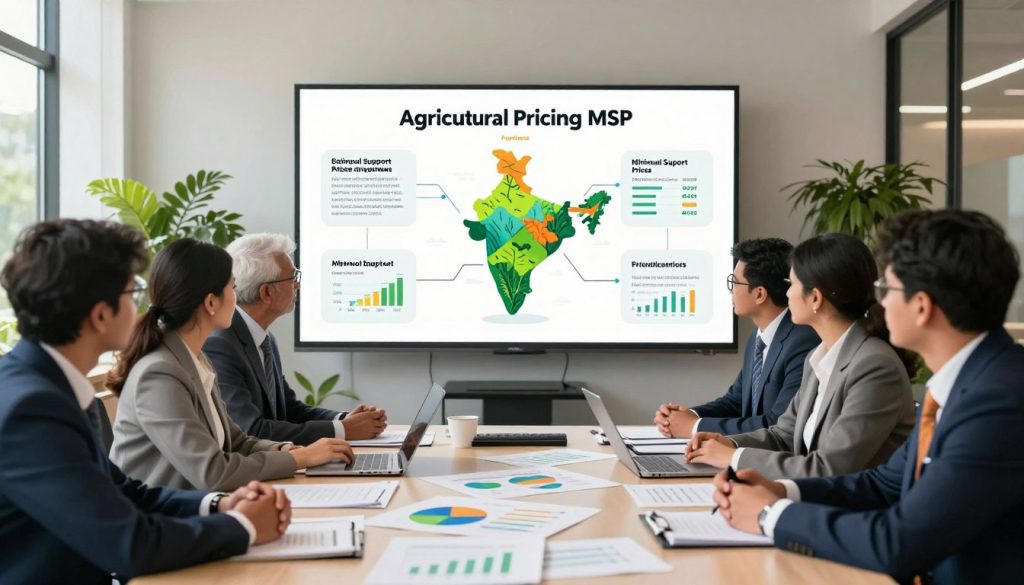
Understanding this complex policy is crucial. This guide will show how farmer income support schemes work. We'll look at how they affect crop choices, markets, and rural economies. We'll also talk about sustainable development goals for farming's future.
Key Takeaways
- Minimum Support Price serves as a guaranteed floor price mechanism protecting farmers from market volatility and production losses
- The system originated in 1966-67 to address food scarcity and boost domestic grain production through Green Revolution technologies
- Government intervention through price guarantees directly impacts crop selection decisions across millions of agricultural households
- This policy framework balances dual objectives of producer protection and national food security management
- Understanding price support mechanisms enables better decision-making for agricultural professionals and policy stakeholders
- The system influences production patterns, market dynamics, and rural economic development across the agricultural sector
What is Minimum Support Price (MSP)?
Agricultural market intervention in India uses a key policy tool. It changes how farmers deal with crop prices. The Minimum Support Price is crucial for the nation's farming policy, helping millions of farmers.
Every year, the government sets these prices for major crops. This helps farmers plan their crops and investments. The timing and amount of these announcements are very important for the next farming season.
Core Concept and Official Framework
The minimum support price is a government-set price. It ensures farmers get at least a certain price for their crops. This protects farmers from low market prices.
The Commission for Agricultural Costs and Prices (CACP) sets these prices. They look at production costs and market trends. Their advice helps the government decide on MSP for different crops.
The prices are set to cover costs and give farmers a fair profit. This helps farmers earn enough from their work and investments. It makes farming more stable.
The MSP does more than just protect prices. It helps farmers and the market in many ways:
- Price Floor Establishment: It sets a minimum price to prevent prices from falling too low.
- Income Security: It ensures farmers get good prices for their crops, even when prices drop.
- Production Incentives: It encourages farmers to grow important crops for the country.
- Market Stabilization: It helps keep prices stable, reducing uncertainty for farmers and buyers.
- Investment Encouragement: It lets farmers invest in better farming with more confidence.
Strategic Significance in Agricultural Development
MSP is vital for farming in many ways. It acts as a safety net for farmers during harvest times. It helps farmers get a fair price for their crops.
It also helps keep food prices stable. By encouraging farmers to grow key crops, it supports the country's food needs. This benefits both farmers and consumers.
The following table shows how MSP works in different market situations:
| Market Condition |
MSP Function |
Farmer Benefit |
System Impact |
| Prices Below MSP |
Government procurement activates |
Guaranteed minimum income protection |
Prevents market collapse and distress sales |
| Prices Above MSP |
Market forces determine prices |
Farmers earn higher market returns |
MSP serves as psychological floor |
| Normal Market Conditions |
Reference price for negotiations |
Improved bargaining position with buyers |
Stabilizes price expectations |
| Supply Surplus |
Buffer stock creation through purchases |
Absorption of excess production |
Manages supply-demand imbalances |
This pricing system also helps farmers deal with unfair prices from traders. It gives farmers a better chance to negotiate prices. This is important for farmers' cash flow after harvest.
It also helps farmers make better choices about what to grow. They consider prices, costs, and local conditions when planning. This is a big step forward from old farming practices.
Historical Background of MSP in India
India's shift from food scarcity to self-reliance in agriculture is thanks to MSP. The MSP history in India is more than an economic policy. It shows the nation's effort to improve its agriculture through government help, technology, and support for farmers. This effort started during a tough time after independence, when food for a growing population was a big challenge.
The past 50 years show how MSP has changed India's agriculture. Knowing this history helps us see how MSP supports farmers today.
Origins and Early Implementation of MSP
The government started MSP in 1966-67 to tackle food shortages. India was heavily reliant on foreign aid, making it vulnerable to supply and political issues. This needed bold policies to boost domestic farming and reduce foreign aid.
MSP came at the right time for the Green Revolution. This revolution changed farming in India. Farmers needed economic support to use new, high-tech farming methods.
The Green Revolution helped farmers invest in better seeds, fertilizers, and tools. The government first focused on wheat and rice for MSP. These crops were key for food security and could be grown more efficiently with modern methods.
This mix of guaranteed prices and new farming methods was a big push for farmers. It made them more confident to invest in better farming. This reduced their risk and encouraged them to use new, productive methods.
Evolution and Major Policy Developments
The CACP was set up in 1965 to help set MSP prices. The Commission for Agricultural Costs and Prices (CACP) is part of the Ministry of Agriculture. It uses data to decide MSP prices.
Over the years, MSP has grown and changed a lot. It now covers 23 crops, including food grains and commercial crops. This has helped farmers and improved the agricultural sector.
- Gradual crop coverage expansion from initially just a few commodities to the current portfolio of 23 crops spanning food grains, pulses, oilseeds, and commercial crops
- Enhanced procurement infrastructure development to ensure farmers could actually sell their produce at MSP rates, not merely receive theoretical price guarantees
- Regional extension efforts aimed at reducing geographical disparities in MSP benefits and procurement access
- 2018 policy commitment to maintain MSP at a minimum of 1.5 times the cost of production, following recommendations aimed at doubling farmer incomes
- Integration with market development initiatives to strengthen agricultural marketing systems and farmer bargaining power
Each step in MSP's history shows how it has adapted to changing times. It has balanced many goals, like helping farmers and keeping food prices stable. It has also encouraged modern farming while helping all farmers, big and small.
| Period |
Key Development |
Impact on Agricultural Sector |
| 1965-1967 |
CACP establishment and first MSP announcement |
Created systematic price support framework and technical analysis capacity |
| 1970s-1980s |
Expansion to additional crops and procurement strengthening |
Broadened farmer coverage and improved implementation effectiveness |
| 1990s-2000s |
Market reforms and MSP refinements amid liberalization |
Balanced government intervention with emerging market mechanisms |
| 2018-Present |
Cost-plus formula commitment and enhanced farmer income focus |
Strengthened profitability assurance while addressing income concerns |
Today, MSP is still evolving. Debates focus on improving infrastructure, covering more areas, and balancing farmer support with keeping food prices low. These talks show how agricultural policy is always changing to meet new challenges and goals.
MSP has been key in transforming India's agriculture, ensuring food security, and boosting rural economies for over 50 years. It has played a big role in India's agricultural success.
MSP and Its Role in Agricultural Economics
In India's complex agricultural scene, MSP acts as a shield for farmers and a tool to shape production and market behavior. The MSP economic impact affects many areas of agricultural economics. It influences how resources are allocated, credit is accessed, and markets are balanced. This has both immediate and long-term effects.
MSP is crucial for rural economies. It makes agricultural investments more predictable and sustainable. This predictability helps farmers make better decisions about what to grow, how much to invest, and which technologies to adopt.
Impact on Farmer Income
The main goal of MSP is to secure farmer incomes. It does this through several channels that reduce the financial risks of farming. MSP sets price floors that ensure farmers get a minimum return on their investments. This creates a safety net that prevents huge losses during market downturns.
The link between MSP and credit is also key. Financial institutions see MSP-covered crops as safer investments. This makes it easier for farmers to get loans, which they can use to improve their farms and increase their income.
Recent data shows MSP's positive impact on farmer incomes. Between 2021-22 and 2023-24, MSP increases ranged from 4% to over 18%. These increases helped farmers earn more, benefiting not just them but also the entire rural economy.
But MSP's impact varies by region and farm size. In states like Punjab and Haryana, farmers get close to MSP prices. But in eastern and southern regions, prices are often lower. This shows how important good procurement infrastructure is.
Role in Price Stabilization
MSP also helps stabilize agricultural prices. It sends signals to the market that affect production and consumption decisions. Knowing there's a price floor helps prevent panic selling and hoarding.
Government procurement at MSP absorbs surplus production during good harvests. Without this, prices would crash, hurting farmers and discouraging future production. By managing stocks, authorities can control prices and ensure food security.
The stabilization mechanism works in two ways. Directly, government buys crops at MSP, removing excess supply. Indirectly, private traders adjust their behavior, keeping prices above MSP. This helps more farmers benefit from MSP, even if they don't sell to the government.
But MSP has its costs. Procurement and storage can be expensive, straining budgets. High MSP levels can also lead to inefficient use of resources, harming the environment, and wasting water.
| Economic Dimension |
MSP Mechanism |
Farmer Benefit |
Market Effect |
| Income Security |
Guaranteed price floor |
Protected against price crashes |
Reduces volatility in agricultural markets |
| Credit Access |
Collateral value enhancement |
Improved loan availability at lower rates |
Increased capital flow to rural areas |
| Production Incentive |
Assured return signals |
Encourages cultivation of essential crops |
Influences cropping pattern decisions |
| Price Stability |
Buffer stock operations |
Prevents catastrophic income losses |
Moderates both producer and consumer prices |
| Regional Development |
Procurement infrastructure |
Varies by state capacity (4-18% income gain) |
Creates spatial disparities in effectiveness |
The MSP economic impact is complex. It balances farmer welfare, fiscal sustainability, and market efficiency. MSP is crucial for income protection and price stability. But, it needs ongoing improvements in infrastructure and policy to address regional disparities and challenges.
Government Policies Related to MSP
India's MSP policy is complex, involving many layers. It ensures farmers' incomes are stable. The MSP policy India goes beyond just setting prices. It includes detailed plans for crop selection, cost analysis, and distribution.
This system aims to help farmers and ensure the country has enough food. It also considers the different needs of various regions.
The policy has a feedback loop between central ministries, state governments, and technical agencies. This ensures prices reflect real conditions while keeping costs under control. Understanding this helps everyone involved in India's agriculture.
Current MSP Policy Framework
The government sets MSP for 23 agricultural commodities. This includes 14 kharif crops, 6 rabi crops, and 2 commercial crops. Sugarcane has its own pricing system.
This wide coverage shows the government's commitment to supporting all types of farming.
CACP recommendations are key to MSP decisions. The Commission studies costs, market trends, and international prices. It uses state data and evaluates input costs before suggesting prices.
The Cabinet then reviews these suggestions and sets the MSP before the main sowing seasons.
The 2018 Union Budget set a rule: MSP should be at least one and a half times the production cost. This rule helps farmers make a profit and invest in farming. But, there's debate on what costs should be included in the calculation.
The Food Corporation of India and state agencies buy wheat and paddy for the Public Distribution System. They set up centers in farming areas during harvest time. This gives farmers a chance to sell at MSP rates.
The PM-AASHA scheme helps with crops like pulses and oilseeds. It's designed to work with different crops and markets. This flexibility lets the government adapt to various needs.
PM-AASHA has three ways to help farmers. The Price Support Scheme buys crops at MSP. The Price Deficiency Payment Scheme gives cash for price gaps. The Private Procurement Scheme encourages private companies to buy crops.
| Procurement Mechanism |
Implementation Method |
Target Commodities |
Key Advantage |
| Price Support Scheme |
Direct government purchase at MSP |
Pulses, oilseeds, copra |
Guaranteed physical procurement |
| Price Deficiency Payment |
Cash compensation for price gap |
All notified crops |
Eliminates storage requirements |
| Private Procurement Scheme |
Private agencies buy on government behalf |
Specified oilseeds and pulses |
Leverages private sector efficiency |
| FCI Direct Procurement |
Central agency purchases for PDS |
Wheat and paddy mainly |
Ensures food security buffer stocks |
Despite MSP announcements, non-cereal crops face challenges. Awareness, logistics, and infrastructure issues prevent farmers from getting MSP benefits. Some states have better access to MSP than others.
Future Policy Directions
Policy discussions aim to make MSP a legally guaranteed right. Farmer groups want laws to enforce MSP. This change would affect government spending and infrastructure needs.
There's a focus on better cost calculations, including family labor and land. The Swaminathan Commission suggested using C2 costs plus 50 percent. This would likely increase MSP and help farmers more.
Future policies might use direct benefit transfers instead of physical procurement. This could simplify support without needing large storage and inventory systems. Some states are testing this idea by paying farmers directly into their bank accounts.
Crop diversification is getting more attention. Policies aim to encourage more pulses, oilseeds, and coarse cereals. This could reduce imports and help the environment.
Environmental concerns are becoming part of MSP policy. There are ideas for higher prices for sustainable farming and penalties for water-intensive crops. These ideas are still being discussed.
Technology is also a focus for future policies. Digital platforms could make registering, assessing, and paying farmers easier. Blockchain could improve transparency and reduce middlemen.
The future of MSP policy looks more inclusive and environmentally friendly. It will balance farmer income, food security, and environmental concerns. This will shape India's agricultural support system in the years to come.
Key Crops Covered under MSP
India's MSP system supports 23 crops, divided into four main categories. This approach helps ensure food security and protect farmer incomes. The MSP crops list India includes 14 kharif and 6 rabi crops, plus 2 commercial crops. This shows the government's effort to support diverse farming across different areas.
The MSP system has four main categories for different national needs. These are food grains, oilseeds, pulses, and commercial crops. Each category helps farmers deal with different market challenges.
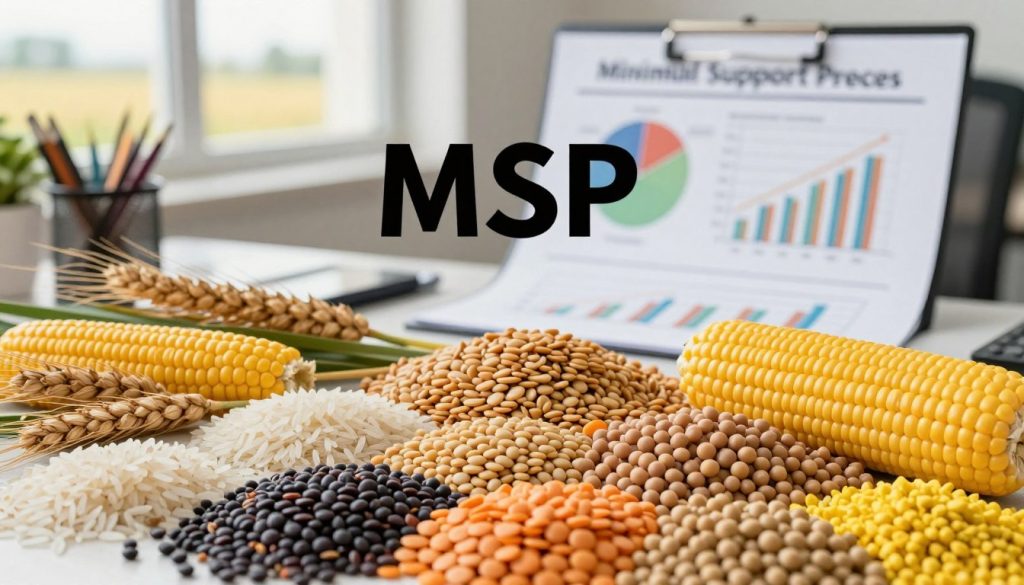
Sugarcane has its own pricing system, not MSP. The government sets a Fair and Remunerative Price (FRP) for it. This is because sugarcane's market and processing needs are unique.
The MSP for these crops changes each year. Inflation, input costs, demand, and supply all play a role in setting prices. This flexibility helps the government adjust to economic changes while keeping farmers safe.
| Crop Category |
Number of Crops |
Primary Season |
Strategic Objective |
| Food Grains |
7 crops |
Kharif & Rabi |
Food security and PDS support |
| Oilseeds |
8 crops |
Both seasons |
Import reduction and self-sufficiency |
| Pulses |
5 crops |
Both seasons |
Protein nutrition and deficit reduction |
| Commercial Crops |
3 crops |
Kharif mainly |
Industry support and farmer livelihoods |
Food Grains
Food grains are at the heart of India's MSP policy. They are crucial for national food security. The MSP for food grains includes paddy, wheat, and other staples. These crops are key to India's Public Distribution System, making food affordable for millions.
Coarse grains like maize, bajra, and jowar are also important. They are valued for their nutritional benefits and are promoted during the International Year of Millets 2023. MSP helps prevent farmers from abandoning these crops for water-intensive rice and wheat.
The MSP for food grains supports diverse farming. It encourages crop diversification, climate resilience, and nutritional security. This is crucial for farming communities.
The government focuses on food grains for national food security. Rice and wheat are the main crops procured. But, there's a growing recognition of the importance of coarse cereals for nutritional diversity and sustainable farming.
Oilseeds
Oilseeds are a key priority due to India's large edible oil imports. The MSP for oilseeds covers seven major crops. India imports about 70% of its edible oil, making domestic production crucial for economic stability.
Groundnut is a major kharif oilseed in Gujarat, Andhra Pradesh, and Tamil Nadu. Soybean is dominant in Madhya Pradesh, Maharashtra, and Rajasthan. Sunflower is grown in Karnataka, Maharashtra, and Andhra Pradesh, providing seasonal income for farmers.
Rapeseed and mustard are the main rabi oilseeds, mainly in Rajasthan and Haryana. Minor oilseeds like sesamum, safflower, and nigerseed also get MSP support. These efforts aim to reduce reliance on imported oils.
The oilseeds support price policy tackles market challenges in this sector. Price swings in international markets affect domestic consumers. By supporting domestic oilseed production through MSP, the government aims to boost self-sufficiency and protect farmers and consumers from global price shocks.
Pulses
Pulses are vital in MSP policy for their protein value, crucial for vegetarian diets. The MSP for pulses covers five major crops, addressing chronic deficits. India has long relied on pulse imports to meet demand.
Gram or chickpea is the largest pulse crop, mainly in Madhya Pradesh, Rajasthan, and Maharashtra. Arhar or tur is another key pulse, known for its long duration. These crops are essential for protein and support farmer incomes in challenging areas.
Short-duration pulses like moong and urad fit into various cropping systems, enabling multiple harvests. Masur, grown in the rabi season, completes the pulse MSP coverage. These crops grow in marginal lands without irrigation, facing higher risks.
The MSP policy for pulses aims to boost production for better nutrition. It ensures price stability for farmers, reducing market uncertainty. Improved incomes for pulse farmers are key benefits of effective MSP implementation.
Commercial crops under MSP include cotton and jute. Cotton supports the textile industry and farmer livelihoods in several states. Copra, mainly in Kerala, Karnataka, and Tamil Nadu, provides price support to coconut farmers.
How MSP is Determined
To understand MSP, we look at how economists and policymakers calculate these prices. They use detailed cost analysis and collect lots of data. The Commission for Agricultural Costs and Prices (CACP) leads this effort every year.
This process balances what farmers need with what the economy can handle. It makes sure prices are good for farmers but don't cause too much inflation. The CACP looks at data from farms all over the country to make these decisions.
Understanding the Cost-Based Calculation Framework
Calculating MSP starts with figuring out the cost of production agriculture. This involves looking at all the money farmers spend and the value of their time. There are three main ways to see the cost of farming.
The first way, A2 costs, includes all the money farmers pay out. This includes things like seeds, fertilizers, and labor. It also includes the interest on money farmers use for farming.
The second way, A2+FL costs, adds the value of unpaid family labor to A2 costs. This shows that family time is also valuable in farming. The MSP calculation formula uses this to help farmers get paid fairly.
The third way, C2 costs, includes everything in A2+FL plus the value of land and capital. This gives a full picture of farming costs. The Swaminathan Commission suggested using C2 costs for MSP to help farmers more.
The government has promised to keep MSP at least 1.5 times the A2+FL cost since 2018. This helps farmers make a profit. But, some argue it doesn't cover all costs, like land value.
| Cost Component |
Included Elements |
Purpose |
Policy Application |
| A2 Costs |
Seeds, fertilizers, pesticides, hired labor, machinery, irrigation, fuel, transportation, interest on working capital |
Captures all paid-out expenses |
Basic cost foundation for analysis |
| A2+FL Costs |
A2 costs plus imputed value of family labor |
Recognizes household labor opportunity cost |
Current MSP calculation baseline (1.5x markup) |
| C2 Costs |
A2+FL plus imputed rent on owned land and interest on fixed capital |
Provides comprehensive economic cost |
Recommended by Swaminathan Commission |
| MSP Formula |
A2+FL costs multiplied by 1.5 |
Ensures minimum 50% profit margin |
Government commitment since 2018 budget |
Multiple Dimensions Shaping Price Decisions
Many things affect MSP, not just costs. We look at economic and policy factors too. The CACP methodology helps make balanced decisions.
Looking at demand and supply is key. The CACP checks production and consumption trends. This helps decide if prices should go up or down.
Keeping prices fair between crops is also important. Farmers choose what to grow based on prices. We make sure prices don't favor one crop too much.
Prices also affect the whole economy. Policymakers consider how MSPs impact inflation and wages. This is crucial for staple foods that many people buy.
International prices and trade also matter. MSPs for crops India exports must be competitive. For crops India imports, prices need to support local farmers.
Other factors include:
- Terms of trade between farming and non-farming sectors, keeping incomes fair
- Environmental sustainability in farming practices
- Regional production patterns and different costs in different areas
- Technological adoption and its impact on farming costs
These factors make setting MSPs a complex task. It's about balancing costs with policy goals and economic realities. The cost of production agriculture is the base, but MSPs reflect broader policy decisions. This approach tries to meet many goals in India's changing economy.
Challenges in the MSP System
While MSP is key to supporting farmers, real-world challenges make it hard to meet promises. The gap between what's promised and what's done limits MSP's help to farmers. This gap makes it hard to trust MSP for many crops and areas.
The main issue is that MSP implementation challenges hit farmers in different ways. The government sets prices for over 23 crops each year. But, most of the buying is for wheat and paddy. This leaves some farmers without real support.
Implementation Issues
The biggest problem is the lack of agricultural procurement infrastructure. Government agencies don't have enough places to buy crops, store them, or check their quality. Farmers of other crops often can't sell at MSP prices.
Most buying happens in a few places. The Food Corporation of India and state agencies have many centers for wheat and paddy. But, other crops often don't get bought, even with announced prices.
Quality issues and grading disputes make things harder. Farmers often have their crops rejected. This can be because of moisture, foreign matter, or other reasons. Sometimes, the rules are applied unfairly to avoid buying crops.
Payment delays are another big problem. Government agencies take a long time to pay for crops. This causes severe cash flow problems for farmers. They need money to pay loans, cover expenses, and plan for the next season.
Many farmers, mainly small ones, don't know about MSP. They don't know the prices, how to sell, or where to sell. This lets middlemen take advantage of them by buying low and selling high.
Regional Disparities in MSP Impact
There are big differences in how MSP helps farmers in different places. In Punjab, Haryana, and western Uttar Pradesh, MSP works well for wheat and paddy. But, in eastern and southern states, regional MSP disparities mean big differences for farmers.
Farmers in Bihar, Odisha, West Bengal, and the northeast often sell at lower prices. This is because there's little buying infrastructure in these areas. It seems like MSP is more of a regional subsidy program than a national support system.
| Region |
Procurement Coverage |
Primary Beneficiary Crops |
Infrastructure Status |
| Punjab & Haryana |
85-95% of production |
Wheat, Paddy |
Extensive network of centers |
| Western Uttar Pradesh |
70-80% of production |
Wheat, Paddy, Sugarcane |
Well-developed facilities |
| Eastern States |
15-30% of production |
Limited to paddy only |
Inadequate infrastructure |
| Southern States |
25-40% of production |
Paddy, limited cotton |
Moderate but inconsistent |
There are big barriers to MSP working well in all areas. These include lack of state help, few central agency centers, bad roads, and not enough storage. Despite having many farmers, these areas are left behind.
The main issue is the gap between MSP promises and what happens in reality. To fix this, we need more places to buy crops, better storage, quality checks, and fast payments. We think more private help, direct payments, or laws that make MSP real could help.
Recent Developments in MSP
The MSP rates have changed a lot from 2021 to 2024. The government made these changes to help farmers more. They wanted to make sure farmers got the support they needed, even with the challenges of the pandemic.
These changes show the government's effort to help farmers. They increased the prices for many crops. This was to help farmers deal with the rising costs of farming.
Current MSP Rates
The MSP rates 2024 show big increases for many crops. This is to help farmers who face challenges in growing certain crops. For example, common paddy went up to ₹2,183 per quintal, a 12.52% increase.
Oilseeds saw big growth, showing the government's focus on reducing imports. Sesamum, for example, went up by 18.17%. Groundnut and niger seed also saw big increases.
Pulses also got a lot of support. This is important for protein and reducing imports. Moong, masur, and urad all saw increases.
| Crop Category |
2021-22 MSP (₹/Quintal) |
2023-24 MSP (₹/Quintal) |
Total Increase (%) |
| Common Paddy |
1,940 |
2,183 |
12.52% |
| Wheat |
2,015 |
2,275 |
12.91% |
| Sesamum |
7,307 |
8,635 |
18.17% |
| Moong |
7,275 |
8,558 |
17.63% |
| Long Staple Cotton |
6,025 |
7,020 |
16.52% |
Cotton got a lot of attention too. Long staple cotton went up by 16.52%. This helps farmers in states like Gujarat and Maharashtra.
Many crops saw bigger increases in 2023-24 than before. Sesamum and long staple cotton saw big jumps. This shows the government's commitment to helping farmers.
Changes During COVID-19 Pandemic
The COVID-19 agriculture India experience was tough. Lockdowns hurt farmers' ability to sell their crops. The government had to find ways to keep support going.
The government made sure farming and procurement were allowed during lockdowns. They also set up more places to buy crops and used digital payments to reduce contact. This helped farmers a lot.
These actions helped farmers a lot during the pandemic. They also made the system better for the future. MSP helped keep farmers' income stable when other jobs were lost.
Post-pandemic MSP trends show prices kept going up. This helped farmers deal with higher costs. But, there's still debate about if prices are enough to help farmers.
Now, there are new ideas for MSP. These include making MSP law, buying crops from private companies, and supporting crops that are better for the environment. The goal is to make MSP work better for all farmers.
- Legal guarantee considerations: Ongoing examination of establishing statutory backing for MSP following sustained farmer movement demands for enforceable price commitments
- Procurement diversification: Exploration of mechanisms beyond physical government purchases, including private procurement schemes and direct benefit transfer models
- Sustainability integration: Using MSP policy to encourage crop diversification toward pulses and oilseeds rather than perpetuating resource-intensive wheat-paddy monocultures
- Implementation infrastructure: Recognition that MSP effectiveness depends critically on addressing gaps that prevent many farmers from realizing announced support prices
- Regional equity focus: Efforts to transform MSP from a selective benefit concentrated in certain states into a genuinely universal agricultural support mechanism
The post-pandemic MSP trends show both good and bad. Prices have gone up, but there's still work to do. The goal is to make sure MSP helps all farmers, not just some.
Stakeholder Perspectives on MSP
Agricultural policy debates in India show how different groups view MSP. These debates touch on economic justice, fiscal responsibility, and farming's future. Farmer protests in 2020-2021 highlighted long-standing disagreements about government's role in agriculture.
Groups like farmers, government officials, and economists have different views on MSP. Farmers want MSP to ensure their income. Government officials worry about costs and challenges. Economists add more complexity, making policy-making a complex task.
Government's Approach to Price Support Policy
The government sees MSP as key for farmer welfare. It aims to secure farmers' income and support strategic crops. MSP also helps maintain food stocks for the public.
But, the government faces big budget challenges. Costs for buying, storing, and managing these stocks are high. These costs compete with other important development needs.
Government officials say MSP works well where it's implemented. They point to high wheat and paddy purchases. But, they face challenges in buying other crops due to infrastructure issues.
They worry about MSP's cost. They say it could lead to overproduction and market distortions. This could also cause trade problems.
The government wants to improve MSP. They're investing in marketing and digital platforms. They see MSP as a safety net, not the main way to sell crops.
Farmer Organizations' Demands and Concerns
The 2020-2021 farmer protests made MSP a national issue. Farmer unions want MSP to be a legal right. They want the government to buy crops at MSP prices.
Farmer groups see MSP as a way to protect against market failures. They say MSP is not followed on the ground. They fear new laws will hurt MSP.
Farmer unions want MSP for all crops and farmers. They say MSP is not just for wheat and paddy. They want a fair system for all farmers.
They face many challenges in MSP's implementation. Issues like lack of buying centers and delayed payments are big problems. Small farmers often don't know their MSP rights.
Farmer unions argue that MSP is fair. They say other industries get more support. They see MSP as a matter of economic justice.
They want MSP for all crops and better infrastructure. They want MSP to keep up with costs and include land rental. They want MSP to be a legal right, not just a promise.
| Stakeholder Group |
Primary Concerns |
Policy Recommendations |
Implementation Priority |
| Government Officials |
Fiscal sustainability, buffer stock management, food security balance |
MSP as safety net, alternative mechanisms like price deficiency payments |
Targeted procurement for strategic crops in viable regions |
| Farmer Organizations |
Income security, market exploitation, implementation gaps |
Legal guarantee of MSP, comprehensive procurement infrastructure |
Universal access across all crops and regions with statutory backing |
| Agricultural Economists |
Market efficiency, resource allocation, long-term productivity |
Direct income transfers, crop insurance reforms, productivity investments |
Evidence-based policy design balancing welfare and efficiency |
| Environmental Advocates |
Resource sustainability, groundwater depletion, crop diversity |
MSP adjustments favoring sustainable practices and diverse crops |
Environmental criteria integration in support price calculations |
Other groups also have important views on MSP. Economists question if MSP is the best way to help farmers. They suggest other ways like direct income transfers or investments in productivity.
Environmental groups worry about MSP's impact on the environment. MSP might encourage unsustainable farming practices. They suggest MSP should consider environmental factors.
Consumer groups look at MSP's impact on food prices. They want policies that help farmers but also keep food affordable. They aim to balance farmer and consumer interests.
These diverse views show MSP policy is complex. It involves balancing many important goals. Policymakers must find ways to address these competing needs.
The future of MSP policy requires careful thought. It must improve farmer welfare and address regional and crop diversity issues. Sustainable farming and long-term sector growth are key. Finding a balance is a major challenge for policymakers in India.
Future of MSP in India
India's agriculture is at a turning point. MSP reforms must meet new farming needs while protecting farmers. The next years will show if price support can handle today's farming challenges.
Exploring Reform Pathways
One big reform idea is legal MSP guarantees. This would make price support a law, giving farmers real rights. They would have enforceable rights to sell at MSP.
Direct benefit transfer is another idea. If market prices drop below MSP, farmers could get digital payments. This cuts costs and eases the load on storage and infrastructure. States like Madhya Pradesh and Haryana have tested this.
Future pricing must cover more than just grains. Vegetables, fruits, and dairy need stable prices too. They require special handling due to their short shelf life.
Building Environmental Stewardship
MSP can also support the environment. By pricing organic farming and water conservation, MSP becomes more than just income support. The rice-wheat cycle in Punjab and Haryana shows why we need sustainability.
Higher prices for natural farming could boost biodiversity. Recognizing the value of less chemicals and crop variety is key. Technology helps verify these practices through blockchain and mobile apps.
Prices could also reflect local water conditions. Areas with less water need different incentives than those with plenty. Balancing farmer income with environmental care needs creative solutions and teamwork from all sides.
FAQ
What exactly is the Minimum Support Price in India's agricultural system?
The Minimum Support Price (MSP) is a key government policy. It sets a floor price for agricultural products. This ensures farmers get a fair price for their crops.
It helps farmers by providing a safety net during price drops. This is due to oversupply, demand changes, or economic shocks. MSP also supports the country's food security by encouraging the growth of important crops.
It helps farmers by stabilizing their income. This is crucial in a market that can be unpredictable. MSP also helps prevent farmers from selling their crops too cheaply.
It ensures there are enough food grains for the government's distribution programs. This is vital for managing food availability in the country.
How many crops are currently covered under the MSP framework and what are they?
Right now, MSP covers 23 crops. This includes 14 kharif crops like paddy and jowar. It also includes 6 rabi crops like wheat and barley.
There are also 2 commercial crops, copra and jute. Sugarcane gets its own price support. This wide coverage helps balance food security and economic goals.
When was MSP first introduced in India and what prompted its establishment?
MSP was introduced in 1966-67. This was during a time when India faced severe food shortages. The country relied heavily on imported food grains.
The government needed to encourage domestic farming. MSP was a key policy to achieve this. It coincided with the Green Revolution, which brought new farming technologies.
Wheat and rice were given priority. This was because they were crucial for the country's food security.
How is the Minimum Support Price actually calculated for different crops?
Calculating MSP starts with the Cost of Production. The Commission for Agricultural Costs and Prices does this through detailed analysis.
There are three cost concepts: A2, A2+FL, and C2. A2 includes all actual expenses. A2+FL adds the value of unpaid family labor. C2 includes all these plus imputed rent and interest.
The government aims to keep MSP at 1.5 times A2+FL cost. This ensures farmers get fair compensation for their work and expenses.
What is the Commission for Agricultural Costs and Prices and what role does it play in MSP determination?
The Commission for Agricultural Costs and Prices is a key body. It was set up in 1965. It studies costs, demand, and supply to recommend MSP.
The Cabinet Committee on Economic Affairs usually approves these recommendations. The CACP uses data from state universities to make these recommendations. It considers many factors, not just costs.
Why do farmers in Punjab and Haryana benefit more from MSP compared to farmers in other states?
Farmers in Punjab and Haryana get more from MSP. This is because of strong procurement systems. But, farmers in other states face challenges.
They often sell at lower prices. This is due to weak procurement systems. MSP seems to favor some regions more than others.
What are the main challenges in implementing MSP effectively across all covered crops?
Implementing MSP is tough. There's a lack of procurement infrastructure. This is true for crops other than wheat and paddy.
Quality standards and grading disputes also cause problems. Delayed payments affect farmers' cash flow. Small farmers may not know about MSP rates.
Regional disparities also hinder MSP implementation. This is why MSP is not effective everywhere.
What is the PM-AASHA scheme and how does it relate to MSP implementation?
The PM-AASHA scheme is a new initiative. It aims to make MSP more effective. It covers pulses, oilseeds, and copra.
It has three mechanisms: Price Support Scheme, Price Deficiency Payment Scheme, and Private Procurement and Stockist Scheme. This helps expand MSP beyond wheat and paddy.
What were the recent MSP rates announced for major crops and how much have they increased?
MSP rates have gone up for 2023-24. Paddy now gets ₹2,183 per quintal, a 12.52% increase. Wheat is at ₹2,275 per quintal, a 12.91% rise.
Oilseeds and pulses have seen big increases. This shows the government's focus on these crops. It aims to boost production and reduce imports.
How did the COVID-19 pandemic affect MSP operations and agricultural procurement?
The pandemic changed things. Lockdowns disrupted supply chains. They made it hard for farmers to get their produce to markets.
There were concerns about procurement. But, the government kept buying crops. This helped farmers during tough times.
What are farmer organizations demanding regarding MSP reforms and legal guarantees?
Farmer groups want MSP to be legally guaranteed. They want it to be a law, not just a promise. This would make MSP more reliable.
They also want MSP to cover more crops. And they want it to be adjusted automatically. This would help farmers more.
What is the difference between A2, A2+FL, and C2 costs in MSP calculation?
MSP uses three cost concepts: A2, A2+FL, and C2. A2 includes all actual expenses. A2+FL adds unpaid family labor. C2 includes all these plus imputed rent and interest.
The government aims to keep MSP at 1.5 times A2+FL cost. This ensures fair compensation for farmers.
Why is MSP considered more effective for wheat and paddy compared to other crops?
MSP works better for wheat and paddy. This is because of strong procurement systems. But, other crops face challenges.
They often don't get bought at MSP. This is due to weak procurement systems. MSP seems to favor some crops more than others.
What role does MSP play in India's food security strategy?
MSP is key for food security. It helps manage surplus production. This prevents price crashes.
It also helps maintain buffer stocks. This is important for the Public Distribution System. MSP ensures there's enough food for everyone.
How does MSP influence farmers' crop selection decisions?
MSP affects farmers' choices. It sets price expectations. This influences market prices and farmer decisions.
It provides economic security. This helps farmers make better choices. But, MSP can encourage unsustainable farming practices.
What are the main criticisms of the current MSP system from an economic perspective?
Critics say MSP has problems. It can be costly. It may distort markets and encourage overproduction.
It can also harm the environment. MSP may encourage unsustainable farming. Some say it's not the best way to help farmers.
What reforms are being discussed for the future of MSP policy in India?
Reforms are being talked about. One idea is to make MSP a legal guarantee. This would make it more reliable.
Direct benefit transfers are also being considered. This could help farmers without needing physical procurement. MSP coverage could also be expanded to include more crops.
How can MSP policy be aligned with environmental sustainability objectives?
MSP can support sustainable farming. It can encourage organic farming and water-saving crops. This helps protect the environment.
It can also help preserve biodiversity. MSP can be adjusted to support sustainable practices. This would make farming more environmentally friendly.
What is the government's fiscal concern regarding expanding MSP procurement?
The government is worried about the cost of MSP. Expanding it could be expensive. It could strain the budget.
It could also distort markets. MSP could encourage overproduction. This could lead to surplus stocks and trade problems.
Why is there special emphasis on pulses and oilseeds in recent MSP policy?
Pulses and oilseeds are getting more attention. They are important for nutrition and reducing imports. MSP rates for these crops have increased.
This shows the government's focus on these crops. It aims to boost production and reduce imports.