Did you know that over 78% of businesses worldwide now rely on external technology partnerships to handle their critical IT operations? This shift represents a fundamental change in how organizations approach their technical infrastructure and resource allocation.
We understand that navigating the landscape of IT outsourcing India can be complex for businesses seeking to optimize their operations while maintaining focus on core competencies. The decision to partner with external technology experts requires careful consideration of multiple factors, from technical capabilities to cultural alignment.
Choosing the right technology partnership can transform your business operations and accelerate digital transformation initiatives. That’s why we have created this comprehensive guide to help decision-makers understand the full spectrum of solutions available in the Indian market.

Throughout this guide, we will examine the strategic advantages of engaging with specialized providers, the various solutions available, and the critical factors that determine successful partnerships. You will gain the knowledge necessary to select a partner that not only meets your immediate technical needs but also supports your long-term business growth.
Key Takeaways
- India has emerged as a leading destination for technology outsourcing due to its combination of technical expertise, cost efficiency, and mature delivery frameworks
- Strategic partnerships with specialized providers enable businesses to focus on core competencies while optimizing IT infrastructure management
- Successful technology partnerships require alignment of business objectives, cultural compatibility, and clear communication channels
- The Indian market offers diverse solutions ranging from infrastructure management to cloud innovation and security operations
- Cost savings of 40-60% are typically achieved without compromising quality when partnering with Indian technology experts
- Selection criteria should include technical capabilities, industry experience, security certifications, and scalability potential
- Long-term success depends on establishing collaborative relationships that support ongoing digital transformation initiatives
What is a Managed Service Provider?
We understand that navigating the complexities of modern IT infrastructure requires specialized expertise, which is why managed service providers have become essential technology partners for businesses worldwide. As organizations face increasing pressure to maintain secure, efficient, and scalable technology environments, the MSP definition has evolved from simple technical support to comprehensive strategic partnership. These technology outsourcing companies deliver end-to-end IT management that transforms how businesses operate in the digital age.
The shift toward managed services represents a fundamental change in business operations. Rather than maintaining expensive internal IT departments, companies now access enterprise-level capabilities through external partnerships that provide predictable costs and superior expertise.
Strategic Partnership and Operational Excellence
A managed service provider operates as your dedicated technology partner, assuming full responsibility for maintaining, monitoring, and optimizing your IT infrastructure on an ongoing basis. Unlike traditional break-fix arrangements where technicians respond only when problems occur, we provide proactive management that prevents issues before they disrupt your operations. This subscription-based model delivers continuous oversight of networks, security systems, cloud computing platforms, and business applications.
The role extends far beyond simple technical troubleshooting. We serve as strategic advisors who align technology investments with your business objectives, developing comprehensive roadmaps that support growth and competitive advantage. Through remote IT support services, our teams monitor your systems 24/7 using advanced automation platforms and sophisticated monitoring tools.
This approach eliminates the need for extensive on-site presence while ensuring immediate response to potential threats or performance degradation. Technology outsourcing companies like ours provide single-point accountability for your entire technology ecosystem, allowing your leadership team to focus on core business initiatives rather than technical challenges.
Comprehensive IT Service Management Functions
Modern IT service management through managed service providers encompasses a wide array of critical functions that work together to create a resilient, secure, and high-performing technology environment. We deliver integrated services that address every aspect of your IT operations, from infrastructure to end-user support.
The comprehensive scope of managed services includes:
- Continuous Infrastructure Monitoring: Real-time alerting systems detect anomalies and performance issues before they impact business operations, with automated remediation for common problems
- Proactive Patch Management: Systematic application of security updates and system patches maintains stability while protecting against emerging vulnerabilities
- Helpdesk and End-User Support: Dedicated technical teams provide responsive assistance for employee technology issues and service requests through multiple channels
- Cybersecurity Management: Advanced threat detection, response protocols, and security policy enforcement protect sensitive data and maintain regulatory compliance
- Backup and Disaster Recovery: Comprehensive data protection solutions ensure business continuity through automated backups and tested recovery procedures
- Strategic IT Consulting: Technology planning services align infrastructure investments with long-term business goals and industry best practices
We also manage cloud environments with specialized expertise in multi-cloud architectures, application performance optimization, and vendor coordination. This creates a unified technology management approach that reduces complexity while improving outcomes.
| Service Aspect |
Traditional IT Approach |
Managed Service Provider Model |
Business Impact |
| Cost Structure |
Unpredictable break-fix expenses |
Fixed monthly subscription fees |
Improved budget predictability and financial planning |
| Support Model |
Reactive response after failures |
Proactive monitoring and prevention |
Reduced downtime and increased productivity |
| Expertise Access |
Limited to internal staff capabilities |
Enterprise-level specialists across disciplines |
Advanced technology implementation without hiring costs |
| Security Posture |
Periodic updates and manual monitoring |
Continuous threat detection and automated response |
Enhanced protection against cyber threats and data breaches |
Through this comprehensive IT service management framework, we enable businesses to achieve technological excellence without the overhead and complexity of building internal capabilities. The result is a technology environment that actively supports business growth, innovation, and competitive differentiation in increasingly digital markets.
Benefits of Hiring a Managed Service Provider
The decision to work with a managed service provider delivers measurable value across financial, operational, and strategic dimensions. Organizations that engage these specialized partners gain access to capabilities that would otherwise require substantial investment and years of development. We have witnessed countless businesses transform their technology operations while simultaneously reducing overhead and improving service quality.
Beyond immediate operational improvements, managed service providers enable companies to adapt quickly to market changes and technological advances. This flexibility becomes increasingly critical as digital transformation accelerates across industries. The right partnership creates a foundation for sustainable growth and competitive advantage.
Cost Efficiency
Partnering with a managed service provider in India delivers substantial cost reduction through the transformation of unpredictable capital expenditures into manageable operational expenses. This shift eliminates the need for significant upfront investments in IT infrastructure, software licenses, and internal staffing. Businesses gain access to enterprise-grade technology at a fraction of the cost of building equivalent capabilities internally.
The offshore managed services model leverages India’s favorable cost structure and deep talent pool. Companies can access skilled IT professionals, certified engineers, and specialized experts across various technology domains. This approach proves particularly valuable for small and medium-sized enterprises that require sophisticated solutions but lack the budget for full-scale IT departments.
We have identified several key financial advantages that organizations realize through managed service partnerships:
- Predictable monthly expenses replace variable costs and emergency spending on IT issues
- Reduced infrastructure investment through shared resources and cloud-based solutions
- Lower staffing costs by eliminating recruitment, training, and retention expenses for specialized roles
- Optimized technology spending through strategic planning and vendor management expertise
- Minimized downtime costs via proactive monitoring and rapid issue resolution
Beyond direct cost savings, managed service providers deliver value through improved operational efficiency. Experienced technical teams resolve issues faster and implement preventive measures that reduce recurring problems. Strategic technology planning ensures that businesses invest in solutions that align with growth objectives rather than maintaining outdated systems.
| Cost Component |
In-House IT Management |
Managed Service Provider |
Potential Savings |
| Annual Staffing Costs |
$180,000 – $300,000 |
$60,000 – $120,000 |
40-60% |
| Infrastructure Investment |
$50,000 – $150,000 |
$10,000 – $30,000 |
70-80% |
| Software Licensing |
$25,000 – $75,000 |
$8,000 – $20,000 |
60-73% |
| Downtime Impact |
$100,000 – $500,000 |
$20,000 – $80,000 |
75-84% |
Access to Expertise
Access to specialized expertise represents another compelling benefit of engaging managed service providers. These organizations maintain teams of specialists across diverse technology areas including cloud architecture, cybersecurity, network engineering, and database administration. Businesses benefit from current best practices and cutting-edge solutions without the challenge of keeping internal staff trained on rapidly evolving technologies.
The enterprise IT solutions India market offers particularly robust expertise across emerging technologies. Managed service providers invest continuously in certifications, training programs, and knowledge development to maintain competitive advantages. This commitment ensures that client organizations receive guidance from professionals who understand both technical implementation and business strategy.
We observe that companies leveraging managed service providers gain access to:
- Multi-disciplinary technical teams with certifications across major technology platforms and frameworks
- Industry-specific knowledge developed through working with diverse clients in similar sectors
- Advanced security expertise including threat intelligence, compliance frameworks, and incident response capabilities
- Strategic technology advisors who provide guidance on digital transformation and innovation initiatives
- 24/7 monitoring and support from experienced professionals across multiple time zones
This depth of expertise proves especially valuable when implementing complex enterprise IT solutions India providers offer. Organizations can confidently pursue sophisticated technology initiatives knowing they have qualified specialists managing critical aspects. The knowledge transfer that occurs through these partnerships also strengthens internal capabilities over time.
Focus on Core Business Activities
Perhaps the most significant advantage involves redirecting organizational focus toward core business activities that drive competitive advantage and revenue growth. When technology infrastructure concerns, system outages, and security incidents consume leadership attention, strategic initiatives suffer. Managed service providers handle these operational details, freeing business leaders to concentrate on what matters most.
We have observed that business efficiency improves dramatically when organizations delegate IT management to specialized partners. Internal teams can dedicate their energy to innovation, customer service, product development, and market expansion. This focus creates tangible improvements in business performance and market positioning.
The operational benefits extend throughout the organization:
- Leadership bandwidth redirected from technical problem-solving to strategic planning and execution
- Employee productivity enhanced through reliable technology infrastructure and rapid issue resolution
- Innovation capacity increased as resources shift toward competitive differentiation initiatives
- Customer satisfaction improved through better service delivery enabled by stable technology platforms
- Market responsiveness accelerated by eliminating technology constraints on business agility
Organizations that successfully implement managed service partnerships report significant improvements in overall business efficiency metrics. Projects complete faster, customer complaints decrease, and employee satisfaction increases. These operational improvements translate directly into financial performance and competitive strength in the marketplace.
The strategic value of this focus shift cannot be overstated. Companies competing in dynamic markets need every advantage they can secure. By partnering with managed service providers, businesses ensure that technology enables rather than constrains their ambitions, creating sustainable pathways for growth and innovation.
Types of Managed Services Offered in India
We deliver an extensive array of managed service capabilities that span the complete technology ecosystem, ensuring organizations receive comprehensive support for their evolving IT requirements. Our approach to IT infrastructure management encompasses specialized service categories designed to address specific operational challenges while maintaining seamless integration across your entire technology environment. Each service type leverages sophisticated automation platforms and experienced technical teams to provide consistent, reliable support that aligns with your business objectives.
Comprehensive IT Support Solutions
Our IT support services form the foundation of reliable technology operations, providing multi-layered assistance that keeps your systems running smoothly. We implement Remote Monitoring and Management (RMM) platforms that continuously observe your infrastructure, detecting potential issues before they impact productivity. This proactive approach ensures problems are resolved quickly, often before end users even notice a disruption.
The scope of our IT infrastructure management support includes several critical components:
- Helpdesk Support: Responsive assistance for end-user issues through multiple channels including phone, email, and chat
- Technical Troubleshooting: Expert resolution of hardware and software problems across diverse platforms
- System Administration: Professional management of servers, workstations, and enterprise applications
- Incident Management: Structured processes ensuring rapid response according to defined service level agreements
- Professional Services Automation (PSA): Efficient ticketing and scheduling systems that streamline service delivery
Advanced Cloud Management Capabilities
As organizations increasingly migrate to cloud environments, cloud service providers India offer specialized expertise in managing complex multi-cloud architectures. We guide businesses through every stage of their cloud journey, from initial strategy development through ongoing optimization. Our team understands that successful cloud adoption requires more than simple migration—it demands continuous refinement to maximize value while controlling costs.
When partnering with cloud service providers India, businesses gain access to comprehensive cloud management that includes infrastructure provisioning, application modernization for cloud-native architectures, and seamless integration between cloud services and existing on-premises systems. We focus particularly on cloud cost optimization, implementing monitoring and governance practices that prevent wasteful spending while ensuring performance meets business requirements. Our managed cloud services encompass both public cloud platforms like AWS and Azure, as well as private and hybrid cloud configurations tailored to specific security and compliance needs.
Strategic Network Management Services
Reliable connectivity forms the backbone of modern business operations, making network management services essential for organizations of all sizes. We provide end-to-end network support that begins with thoughtful architecture planning and extends through continuous monitoring and optimization. Our approach ensures that your network infrastructure supports current operations while remaining scalable for future growth.
Our network management services encompass design and deployment of networking equipment such as routers, switches, and firewalls, combined with 24/7 monitoring to detect performance degradation or connectivity issues. We specialize in bandwidth optimization to ensure efficient resource utilization, wireless network management for mobile workforce support, and WAN optimization for distributed organizations operating across multiple locations. These capabilities are delivered through sophisticated monitoring platforms that provide real-time visibility into network health and performance metrics.
Robust Security Services and Protection
In today’s escalating threat landscape, cybersecurity services India represent a critical investment for protecting business assets and maintaining operational continuity. We implement layered security strategies that combine advanced technology solutions with human expertise and ongoing vigilance. Our security team stays current with emerging threats, ensuring your defenses adapt to evolving attack vectors.
Organizations working with cybersecurity services India benefit from comprehensive protection that includes vulnerability assessments and penetration testing to identify weaknesses before attackers exploit them. We deploy Security Information and Event Management (SIEM) solutions that aggregate and analyze security logs across your entire infrastructure, providing centralized visibility into potential threats. Our security automation tools enhance response capabilities while reducing the burden on internal teams.
| Security Service Category |
Key Technologies |
Primary Benefits |
Delivery Model |
| Endpoint Protection |
Antivirus, EDR, Application Control |
Prevents malware infections and unauthorized software |
24/7 Managed Service |
| Network Security |
Firewalls, IDS/IPS, VPN Management |
Controls traffic and blocks intrusion attempts |
Continuous Monitoring |
| Identity Management |
SSO, MFA, Privileged Access |
Ensures appropriate user permissions and access control |
Policy-Based Automation |
| Incident Response |
SIEM, Forensics, Threat Intelligence |
Contains and remediates security breaches rapidly |
On-Demand + Proactive |
Our security services extend to security patch management that addresses known vulnerabilities across operating systems and applications, security awareness training that transforms employees into the first line of defense, and dedicated incident response services that contain and remediate breaches when they occur. This comprehensive approach creates multiple defensive layers, ensuring that even if one control fails, others remain in place to protect your organization’s critical data and systems.
How to Choose the Right Managed Service Provider
We understand that choosing among managed service providers can feel overwhelming, given the abundance of options and varying capabilities in today’s market. The selection process requires a methodical approach that examines both technical qualifications and strategic alignment with your organizational goals. Your decision will impact not only your IT operations but also your ability to innovate, scale, and compete effectively in your industry.
The foundation of any successful technology partnership rests on clear understanding of what you need, rigorous evaluation of what providers offer, and honest assessment of how well potential partners align with your business culture and objectives. We recommend approaching this decision with the same diligence you would apply to hiring a senior executive, as your managed service provider will become an integral extension of your technology leadership.
Understanding Your Technology Requirements
Before evaluating any managed service provider, we advise conducting a comprehensive internal assessment of your current IT infrastructure management capabilities and future requirements. This foundation ensures you approach provider conversations with clarity rather than relying on vendors to define your needs. Start by documenting your existing technology landscape, including hardware, software, cloud services, and the personnel currently supporting these systems.
Identify specific pain points that prompted your search for external support. Are you experiencing frequent downtime that disrupts operations? Do you lack expertise in emerging technologies like cloud platforms or cybersecurity? Is your internal team overwhelmed by routine maintenance, preventing them from focusing on strategic initiatives?
Define concrete outcomes you expect from the partnership. These might include improving system uptime to 99.9% or higher, reducing IT-related costs by a specific percentage, accelerating deployment of new applications, or achieving compliance with industry regulations. Clear objectives allow you to evaluate providers against measurable criteria rather than vague promises.
Consider your growth trajectory and how technology requirements will evolve. A provider suitable for your current state may lack the capabilities or scalability needed as you expand. We emphasize the importance of selecting partners who can grow alongside your business, offering flexible solutions that adapt to changing demands without requiring disruptive provider changes.
Determine which functions should remain internal versus those better suited for outsourcing. Core competencies that differentiate your business may warrant keeping in-house, while commodity services like help desk support or infrastructure monitoring often benefit from external management. This strategic division ensures you maintain control over critical capabilities while leveraging external expertise where it provides greatest value.
Analyzing Service Commitments and Performance Standards
Service level agreements represent the contractual foundation of your technology partnership, defining performance expectations, accountability mechanisms, and remedies when providers fail to meet commitments. We recommend scrutinizing these documents carefully, as they determine the quality of service you’ll receive and your recourse when issues arise. Too many organizations accept standard SLA templates without negotiating terms that reflect their specific business requirements.

Evaluate SLAs across multiple dimensions that directly impact your operations. System uptime guarantees should align with your business tolerance for downtime, typically ranging from 99.5% to 99.99% depending on how critical systems are to revenue generation. Incident response times should be tiered by severity, with critical issues addressed within minutes rather than hours.
Examine resolution timeframes for different issue categories. A comprehensive SLA specifies not just when the provider will respond, but when they commit to resolving problems. Escalation procedures should outline clear paths when initial response proves inadequate, ensuring issues don’t languish unresolved.
Review reporting requirements that provide visibility into service delivery. Regular reports should document system performance, incident history, resolution times, and trends that inform strategic planning. We value transparency in these relationships, and comprehensive reporting demonstrates provider accountability.
| SLA Component |
Industry Standard |
Premium Service Level |
Business Impact |
| System Uptime Guarantee |
99.5% (3.6 hours monthly downtime) |
99.95% (22 minutes monthly downtime) |
Revenue protection and operational continuity |
| Critical Incident Response |
Within 30 minutes |
Within 15 minutes |
Minimizes business disruption duration |
| Issue Resolution Time |
4 hours for critical issues |
2 hours for critical issues |
Reduces productivity loss and customer impact |
| Reporting Frequency |
Monthly performance reports |
Weekly reports with real-time dashboards |
Enables proactive decision-making |
Understand consequences when providers fail to meet SLA commitments. Service credits offer financial compensation, but verify these actually offset business losses from downtime. The most valuable SLAs include meaningful penalties that incentivize consistent performance rather than token gestures.
Evaluating Expertise and Cultural Alignment
Industry experience distinguishes providers who truly understand your operational context from those offering generic solutions. We emphasize selecting managed service providers with demonstrated expertise in your sector, as they bring relevant knowledge of regulatory requirements, compliance frameworks, and technology challenges specific to your industry. A provider experienced in healthcare understands HIPAA requirements and patient data protection, while one specializing in financial services navigates stringent security mandates and audit requirements.
Review the provider’s technical capabilities and vendor certifications. Partnerships with major technology platforms like Microsoft, AWS, or Cisco demonstrate expertise with systems you likely depend on. Industry certifications such as ISO 27001 for security management validate systematic approaches to protecting your data and systems.
Examine certifications held by the provider’s technical staff. Credentials like CISSP, CEH, or vendor-specific certifications indicate individual expertise that translates to higher quality service delivery. We look for providers who invest in continuous training, ensuring their teams remain current with evolving technologies.
Request references from current clients in similar industries or with comparable IT infrastructure management challenges. Direct conversations with these references reveal insights about the provider’s responsiveness, problem-solving capabilities, and ability to deliver on commitments that marketing materials never capture.
Assess cultural fit and communication approaches to ensure alignment with your organizational preferences. Some providers operate with formal, structured communication protocols, while others embrace more flexible, collaborative styles. The MSP selection criteria should include evaluating whether the provider’s working style complements your team’s expectations, as misalignment here creates friction that undermines even technically sound partnerships.
Consider the provider’s approach to innovation and continuous improvement. The technology landscape evolves rapidly, and your provider should proactively introduce new capabilities, optimize existing services, and help you leverage emerging technologies for competitive advantage. Partners who simply maintain the status quo limit your ability to innovate and grow.
Top Managed Service Providers in India
We recognize that navigating the managed service provider landscape in India involves understanding provider tiers, service specializations, and delivery models to identify the right technology partner for your organization. The Indian managed services market features numerous established companies with varying capabilities, from global enterprise-focused firms to specialized boutique providers. Each category brings distinct advantages that align with different business requirements and operational scales.
Understanding these provider categories helps businesses match their specific needs with appropriate service capabilities. The diversity within India’s managed services ecosystem ensures that organizations of all sizes can find suitable technology partners. This knowledge enables more informed decision-making when evaluating potential managed service relationships.
Enterprise-Grade Service Providers
Large, enterprise-focused managed service providers dominate the upper tier of India’s IT services market, bringing global delivery capabilities and extensive industry certifications to their client relationships. These providers maintain comprehensive service portfolios spanning infrastructure management, application support, cloud services, and cybersecurity solutions. Their operational frameworks support Fortune 500 companies and large enterprises with complex, multi-location IT environments.
We observe that these enterprise IT providers deliver sophisticated service frameworks backed by dedicated account teams and proven methodologies. Their technical bench strength provides access to specialists across multiple technology domains. The scale of these organizations enables 24/7 support across global time zones with redundant service delivery centers.
Integration capabilities represent a significant advantage of enterprise-grade providers, as they seamlessly connect with existing enterprise systems and established IT governance frameworks. Their experience managing large-scale transformations and complex migrations reduces risk for organizations undertaking significant technology initiatives. However, this enterprise positioning typically comes with premium pricing structures that reflect comprehensive capabilities and extensive customization options.
The value proposition centers on reliability, scalability, and proven track records with similar enterprise clients. These leading MSPs invest heavily in compliance certifications, security frameworks, and quality management systems. Their structured approach to service delivery provides predictability and consistency across large, distributed organizations.
Mid-Market Focused Partners
Mid-market managed service providers represent a sweet spot for many growing businesses, balancing sophistication with accessibility in their service delivery models. These technology partners provide robust managed services including continuous monitoring, cloud migration expertise, security services, and comprehensive helpdesk support. Their operational efficiency often translates into excellent value propositions for organizations requiring professional IT management without enterprise-level complexity.
We find that these providers excel at delivering responsive customer support while maintaining flexibility to customize solutions for specific client requirements. Their adoption of modern automation tools enhances service efficiency and reduces response times. The personal attention and relationship-focused approach often surpasses what larger providers can offer.
These managed service providers typically serve organizations with 100 to 2,000 employees, where IT requirements demand professional management but may not necessitate the extensive infrastructure of enterprise-tier solutions. Their service delivery models accommodate industry-specific needs while maintaining cost efficiency. The agility of mid-sized providers enables faster decision-making and service adjustments compared to larger competitors.
Technology partnerships with mid-market providers often feature transparent pricing models and straightforward contract terms. Their growth orientation aligns with expanding businesses, creating partnerships that scale alongside client needs. The combination of professional capabilities and personalized service makes them particularly attractive to companies transitioning from basic IT support to comprehensive managed services.
Specialized Domain Experts
Specialized managed service providers focus on specific technology domains or industry verticals, bringing deep expertise and tailored solutions to their chosen focus areas. These providers concentrate on niches such as cloud-native services, cybersecurity-focused offerings, or industry-specific solutions for healthcare, financial services, or manufacturing sectors. Their concentrated expertise often delivers innovation and cutting-edge capabilities that generalist providers may not match.
We recognize that specialized providers invest heavily in their domain of focus, maintaining certifications, partnerships, and technical knowledge that position them as subject matter experts. This specialization enables them to address complex challenges within their area of expertise more effectively than broader providers. Their solutions incorporate best practices and lessons learned from extensive experience within their specialty.
Organizations benefit from this focused approach when dealing with critical technology areas where specialized expertise provides significant competitive advantage. Cloud migration specialists, for example, bring depth of experience with specific platforms and migration methodologies. Cybersecurity-focused providers maintain current knowledge of emerging threats and advanced security technologies.
The trade-off involves potentially working with multiple specialized providers to address comprehensive IT needs, which can introduce coordination complexity across different service relationships. However, for organizations with specific critical requirements in areas like data security, regulatory compliance, or advanced analytics, the superior capabilities of specialized providers often justify this additional coordination effort. Their innovation in focused areas frequently leads industry trends and delivers competitive differentiation for their clients.
Cost Factors for Managed Services in India
When evaluating managed services pricing, we find that organizations benefit from understanding both pricing models and underlying cost drivers. Transparent cost structures enable better budgeting and help business leaders align their technology investment with expected returns. We believe that informed financial decisions stem from clarity about what drives pricing in the managed services marketplace, particularly when considering IT outsourcing India options that offer competitive advantages.
The pricing landscape for managed services encompasses several distinct approaches, each with unique characteristics and implications for your budget. Selecting the right pricing structure requires careful consideration of your organization’s size, growth trajectory, and service requirements. We guide our clients through these options to ensure their managed services pricing aligns with both current needs and future scalability.
Understanding Different Pricing Structures
We observe several common pricing models that managed service providers utilize across the industry. Each model offers different benefits depending on your operational environment and cost optimization goals. Understanding these structures helps you compare proposals effectively and identify the best fit for your organization.
The per-user or per-device model calculates costs based on the number of users or devices under management. This approach provides predictability and scales naturally with business growth. Organizations with stable or expanding employee counts find this model straightforward, as costs adjust proportionally with headcount changes.
A tiered service model offers different service levels such as basic, standard, and premium packages with corresponding features and support commitments. This structure allows businesses to select packages that match their requirements and budget constraints. The flexibility to upgrade tiers as needs evolve makes this approach appealing, though careful evaluation ensures that essential services are included rather than positioned as expensive add-ons.
Some providers implement a monitoring-only model with separate charges for remediation and project work. While this appears cost-effective initially, it may result in unpredictable expenses when issues require resolution. We typically recommend comprehensive all-inclusive models for organizations seeking cost certainty and proactive management rather than reactive problem-solving.
Custom or hybrid pricing combines elements from different models, tailored to specific organizational requirements or complex environments. This approach provides maximum flexibility but requires detailed negotiation and ongoing management to ensure pricing remains aligned with delivered value. Organizations with unique service combinations or specialized compliance needs often benefit from this personalized approach.
| Pricing Model |
Best Suited For |
Predictability |
Scalability |
| Per-User/Device |
Growing companies with clear headcount projections |
High – fixed per-unit costs |
Excellent – adjusts automatically |
| Tiered Service |
Businesses needing flexibility in service levels |
Medium – depends on tier selection |
Good – can upgrade tiers |
| Monitoring-Only |
Stable environments with minimal issues |
Low – variable remediation costs |
Limited – may need restructuring |
| Custom/Hybrid |
Complex environments or unique requirements |
Medium – requires active management |
Highly flexible – fully customizable |
Key Elements That Impact Your Investment
Beyond the pricing model itself, we identify several critical factors that influence the total technology investment required for managed services. Understanding these variables helps you anticipate costs accurately and negotiate effectively with potential providers. Each factor contributes differently depending on your specific environment and requirements.
Environment complexity and size significantly affect pricing, as larger infrastructures require more monitoring, management, and support resources. Organizations with distributed systems, multiple locations, or diverse technology stacks typically see higher costs reflecting the additional management overhead.
The scope of services included in your engagement ranges from basic monitoring to comprehensive management across all IT domains. More extensive service portfolios naturally command higher pricing but often deliver superior cost optimization through consolidated vendor relationships and integrated management approaches.
Service level commitments such as response times, resolution targets, and availability guarantees directly impact pricing structures. More stringent SLAs with faster response times and higher uptime commitments command premium pricing due to the additional resources required to meet these obligations consistently.
Geographic distribution and timezone coverage requirements influence costs, particularly for organizations needing follow-the-sun support across multiple regions. Global coverage requires coordinated teams across different locations, adding complexity and cost to service delivery.
The current state of IT infrastructure affects initial engagement costs, as significant remediation or standardization may be needed before effective ongoing management can commence. Providers assess existing environments to determine the baseline work required to bring systems under proper management.
Compliance and regulatory requirements specific to your industry necessitate additional controls, specialized reporting, and domain expertise. Healthcare, financial services, and other regulated industries require providers with specific certifications and experience, which influences pricing structures.
The balance between onshore and offshore resources represents a significant cost variable, with IT outsourcing India providing advantages through offshore delivery models while maintaining quality through mature processes and experienced teams. We help clients optimize this balance to achieve cost optimization without compromising service quality or responsiveness.
Challenges of Working with Managed Service Providers
Understanding the potential difficulties inherent in managed service provider relationships empowers organizations to establish stronger partnerships built on realistic expectations and comprehensive risk mitigation strategies. We recognize that while these partnerships deliver substantial value, they also introduce complexities that require proactive management and clear communication frameworks.
Every successful technology partnership demands attention to potential obstacles that can undermine effectiveness if left unaddressed. The communication challenges, dependency concerns, and security considerations we explore in this section reflect real-world scenarios that organizations face when engaging external providers for critical IT functions.
By acknowledging these difficulties upfront and implementing structured approaches to overcome them, we help our clients build resilient partnerships that deliver consistent results while minimizing disruption and risk exposure.
Navigating Communication Complexities
Communication challenges represent one of the most significant obstacles in offshore managed services relationships, particularly when teams operate across different time zones, cultural contexts, and organizational structures. These barriers can lead to misunderstandings about technical requirements, delays in issue escalation, or misalignment between what gets implemented and what the business actually needs.
Time zone differences create natural friction in collaboration, as urgent issues arising during your business hours may fall outside the provider’s standard working schedule. Cultural differences in communication styles can compound these challenges, with some cultures preferring direct communication while others use more indirect approaches that may seem ambiguous to American business professionals.
We address these communication barriers through several proven strategies that create clarity and maintain alignment:
- Establishing clear communication protocols that define how different types of issues get escalated, which channels to use for various communication needs, and expected response timeframes for different priority levels
- Designating specific points of contact on both sides who serve as primary liaisons, reducing confusion about whom to approach for different matters and creating accountability for information flow
- Scheduling regular meetings that accommodate both time zones reasonably, using rotating schedules when necessary to share the burden of inconvenient meeting times fairly between teams
- Implementing documentation standards that ensure all important decisions, requirements, and technical specifications get captured in written form, reducing reliance on verbal communication that may be subject to misinterpretation
- Investing in relationship building that creates mutual understanding beyond transactional interactions, including occasional in-person meetings when feasible and team-building activities that bridge cultural differences
Much like the common mistakes organizations make when adopting automation—such as rushing setup without clear plans or choosing tools based on feature count rather than solving specific problems—communication failures often stem from insufficient upfront planning and unrealistic expectations about how information flows across organizational boundaries.
Managing Dependency on External Partners
Dependence on external providers represents a legitimate concern that organizations must address through careful vendor management and strategic planning. As your managed service provider assumes responsibility for critical IT functions, your organization naturally becomes reliant on their performance, availability, and continued viability as a business partner.
This dependency creates potential vulnerabilities if the provider experiences service disruptions, financial difficulties, or performance degradation that affects your operations. The situation becomes more complex when the provider holds concentrated knowledge about your infrastructure, configurations, and custom implementations that may not be easily transferable to another vendor.
Limited organizational agility can result when your provider cannot adapt quickly to changing business requirements or when you discover that transitioning to a different provider would involve significant disruption and expense. We help clients mitigate these vendor management challenges through comprehensive protective measures:
- Comprehensive service level agreements that establish clear performance standards, define remedies for failures to meet those standards, and create financial incentives aligned with consistent delivery
- Documentation requirements that ensure your organization maintains current records of infrastructure configurations, custom procedures, and technical dependencies, reducing knowledge concentration with the provider
- Escrow arrangements for critical intellectual property, custom code, or unique configurations that would be essential for continuity if the relationship ended unexpectedly
- Periodic relationship reviews that assess whether the partnership continues delivering expected value and meeting evolving needs, identifying issues before they become critical problems
- Exit planning that considers how you would transition services to another provider or bring functions in-house if necessary, even if you have no immediate plans to make such changes
These strategies balance the operational efficiency gained through outsourcing against the need to maintain control over your technology destiny and business continuity.
Addressing Security and Data Protection Concerns
The risk of data breaches and security incidents increases when external parties access organizational systems and sensitive information, as the attack surface expands beyond your direct control. Security risks in managed service relationships require careful attention because your security posture now depends on both your own practices and those of your provider.
Every additional organization with access to your systems represents a potential entry point for attackers, and high-profile breaches have demonstrated that compromising a managed service provider can give attackers access to multiple client organizations simultaneously. The provider’s security controls, employee vetting processes, and incident response capabilities become as important as your own in protecting your data and systems.
| Security Risk Category |
Specific Concerns |
Mitigation Controls |
| Unauthorized Access |
Provider employees accessing systems beyond their assigned responsibilities or former employees retaining access after termination |
Least-privilege access policies, regular access reviews, immediate deprovisioning protocols, multi-factor authentication requirements |
| Data Exposure |
Sensitive information transmitted or stored without adequate protection, potentially intercepted or accessed by unauthorized parties |
Encryption for data in transit and at rest, secure file transfer protocols, data classification requirements, geographic storage restrictions |
| Compliance Violations |
Provider practices that violate regulatory requirements applicable to your industry or data types, creating liability |
Contractual compliance obligations, regular audit rights, certification requirements, incident notification procedures with defined timeframes |
| Inadequate Monitoring |
Inability to detect anomalous provider activities that might indicate security incidents or policy violations |
Continuous monitoring systems, activity logging requirements, anomaly detection capabilities, regular security reporting |
We emphasize that security risks require comprehensive due diligence before engaging a managed service provider, examining their security certifications, track record with previous incidents, and specific practices for protecting client data. Contractual provisions must clearly define security responsibilities, establish liability for security failures, and create notification requirements that ensure you learn about incidents promptly.
Technical controls complement contractual protections by limiting what the provider can access, monitoring how they use that access, and ensuring that sensitive data remains protected even if the provider’s environment gets compromised. When implemented thoughtfully, these measures ensure that partnering with a specialized provider actually enhances your security posture through their dedicated expertise and resources rather than creating new vulnerabilities.
The challenges inherent in managed service provider relationships demand respect and preparation, but they should not deter organizations from pursuing partnerships that deliver genuine business value. By acknowledging these difficulties and implementing structured approaches to address them, we help clients build resilient, productive relationships that overcome obstacles and deliver consistent results over the long term.
Case Studies: Successful Partnerships
Examining actual case studies reveals the substantial benefits organizations achieve through well-executed managed service partnerships. We have witnessed numerous businesses across different sectors accomplish remarkable business transformation by engaging with the right managed service providers in India. These real-world examples demonstrate how strategic collaboration delivers measurable improvements in operational efficiency, cost management, and technology ROI.
The following case studies illustrate specific scenarios where organizations overcame significant challenges and achieved their business objectives. Each example provides concrete metrics and outcomes that showcase the tangible value of these partnerships.
Transforming Operations Through Enhanced Efficiency
A mid-sized financial services company based in the United States faced persistent operational challenges that hindered their growth trajectory. Their internal IT team struggled with frequent system outages that disrupted customer service and internal operations. Help desk response times stretched to several hours, creating frustration among employees who depended on technology to serve clients effectively.
The company’s IT staff spent most of their time addressing immediate problems rather than supporting strategic initiatives. This reactive approach prevented them from implementing new technologies that could drive competitive advantage. Management recognized that continuing with the existing model would limit their ability to scale operations and meet increasing customer demands.
After partnering with an enterprise IT solutions India provider specializing in financial services, they implemented a comprehensive transformation strategy. The managed service provider deployed advanced monitoring tools across their entire infrastructure, enabling proactive identification of potential issues before they impacted operations. They established tiered support with clearly defined escalation paths, ensuring that routine requests received immediate attention while complex issues reached specialized experts quickly.
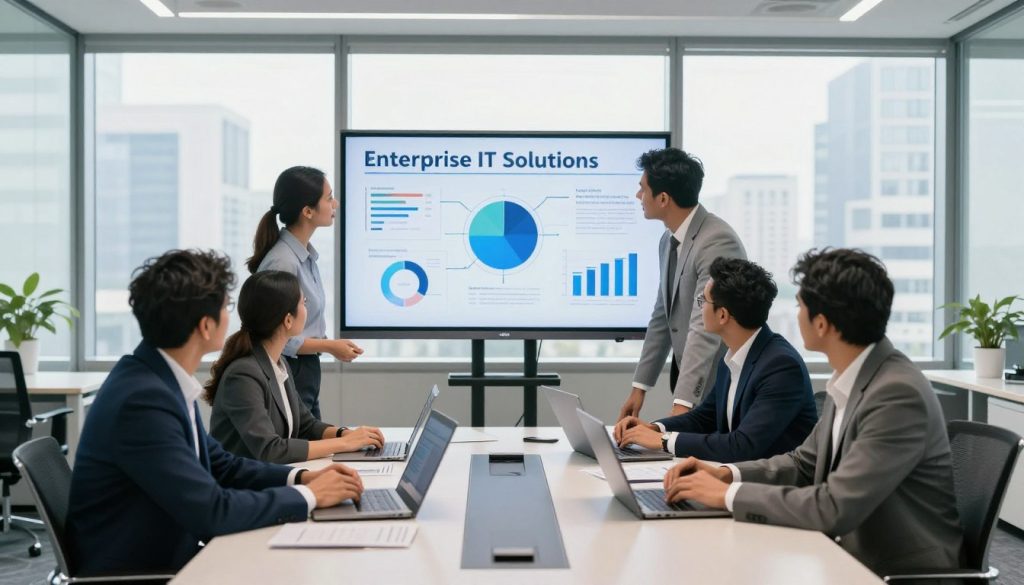
The provider also introduced automation for routine maintenance tasks, freeing up resources for more strategic activities. The internal IT team gained access to specialized expertise for complex challenges, allowing them to tackle projects they previously couldn’t manage independently. This approach facilitated significant IT optimization across the organization.
The results exceeded expectations within six months. Unplanned downtime decreased by 65%, dramatically improving system reliability and customer satisfaction. Average help desk response times dropped from hours to minutes, enabling employees to resolve client issues more efficiently. The internal IT team shifted their focus to business-enabling projects, including implementing a new customer portal and modernizing their application portfolio.
This transformation changed IT from a cost center and source of frustration into a strategic enabler. The company gained competitive differentiation through improved service delivery and the ability to launch new digital offerings faster than competitors. The technology ROI extended beyond cost savings to include revenue growth and enhanced market position.
Achieving Significant Savings Through Strategic Consolidation
A manufacturing company with operations across multiple locations maintained separate IT staff at each facility, creating substantial inefficiencies. This distributed model resulted in redundant infrastructure, inconsistent security practices, and high overhead costs. Each location operated independently, using different tools and following varying procedures that complicated collaboration and created compliance risks.
The company’s leadership recognized that this fragmented approach was unsustainable as they planned expansion into new markets. They needed a scalable IT model that could support growth without proportionally increasing costs. After evaluating their options, they engaged a managed service provider to consolidate their IT operations.
The provider implemented a comprehensive business transformation strategy that unified IT operations under a single service delivery framework. They standardized tools and processes across all locations, creating consistency and improving collaboration between facilities. The provider migrated redundant infrastructure to cloud-based solutions, eliminating unnecessary hardware costs and improving scalability.
The new model replaced distributed IT staff with a centralized managed services approach. On-site technicians remained only where physical presence was essential for equipment maintenance. This structure provided better coverage at lower cost while improving service quality and response times.
The financial impact was substantial. The company achieved a 40% reduction in total IT costs while simultaneously improving multiple aspects of their technology operations. Security posture strengthened through consistent policy enforcement and specialized expertise. System reliability improved as the provider’s monitoring and maintenance protocols prevented issues that previously caused production disruptions.
Management reinvested the cost savings in manufacturing automation and product development initiatives that directly supported revenue growth. This strategic reallocation of resources demonstrates how effective IT optimization enables organizations to focus investment on core competencies rather than maintaining undifferentiated infrastructure.
The company gained additional benefits beyond direct cost reduction. Standardized processes simplified compliance with industry regulations across all facilities. Cloud migration provided flexibility to scale operations quickly in response to market opportunities. The partnership enabled them to enter new markets faster than would have been possible with their previous IT model.
| Performance Metric |
Financial Services Case |
Manufacturing Case |
Key Success Factor |
| Primary Challenge |
Frequent outages and slow response times |
Redundant infrastructure and high costs |
Accurate needs assessment |
| Implementation Timeline |
6 months to full deployment |
9 months including cloud migration |
Phased approach minimized disruption |
| Cost Impact |
15% reduction in IT operating costs |
40% reduction in total IT expenses |
Elimination of redundant resources |
| Efficiency Improvement |
65% decrease in unplanned downtime |
30% improvement in system reliability |
Proactive monitoring and maintenance |
| Strategic Outcome |
IT team focused on innovation projects |
Reinvestment in core business growth |
Alignment with business objectives |
Both case studies demonstrate how partnerships with enterprise IT solutions India providers deliver measurable value across different business contexts. The financial services company prioritized operational efficiency and service quality, while the manufacturing company focused on cost reduction and scalability. Despite different objectives, both achieved substantial technology ROI through strategic engagement with the right managed service provider.
These examples illustrate several critical success factors. First, organizations must clearly identify their specific challenges and objectives before selecting a provider. Second, implementation requires careful planning and phased execution to minimize disruption. Third, success depends on strong collaboration between the provider and internal teams, with clear communication channels and well-defined responsibilities.
The transformative outcomes in both cases extended beyond immediate operational improvements. Each organization gained capabilities that positioned them for future growth and competitive advantage. They achieved this by partnering with providers who understood their industry context and aligned service delivery with strategic business goals rather than simply providing technical support.
Regulatory Compliance and Managed Services
The landscape of regulatory compliance continues to evolve at an unprecedented pace, creating new challenges for organizations that must balance innovation with adherence to data protection laws, security frameworks, and industry-specific requirements. We understand that partnering with managed service providers introduces additional complexity to your compliance obligations, as you remain ultimately responsible for regulatory adherence even when technology operations are delivered by external partners. This reality makes it essential to select providers who treat compliance as a core competency rather than an afterthought.
Why Compliance Cannot Be Compromised
Organizations face substantial consequences when regulatory requirements are not met, ranging from financial penalties that can reach millions of dollars to legal liability, operational restrictions, and severe damage to brand reputation. We emphasize that compliance management represents a critical dimension of risk mitigation, protecting your organization from exposures that threaten financial stability and competitive position. The cost of non-compliance far exceeds the investment required to maintain appropriate controls and documentation.
When you engage cybersecurity services India or other managed service providers, we ensure that compliance is embedded in service delivery through documented processes, regular audits, continuous monitoring, and clear accountability for maintaining required standards. This approach transforms compliance from a burden into a competitive advantage, demonstrating to customers, partners, and regulators that your organization takes data protection seriously. Our commitment extends beyond basic requirement fulfillment to implementing industry best practices that exceed minimum standards.
We work collaboratively with your internal teams to understand existing compliance obligations, identify gaps in current controls, and implement solutions that address vulnerabilities while supporting business objectives. This partnership approach ensures that compliance becomes integrated into operational workflows rather than creating friction or hindering innovation. Our managed services delivery incorporates compliance checkpoints, automated reporting, and evidence collection that simplifies audit preparation and ongoing governance activities.
Navigating Essential Regulations and Standards
The regulatory frameworks governing IT services vary based on your industry, geographic operations, and the types of data you process, but several key regulations affect organizations across multiple sectors. We maintain deep expertise in these requirements, ensuring that our services support rather than complicate your compliance journey. Understanding which regulations apply to your specific circumstances represents the first step in developing an effective compliance strategy.
The General Data Protection Regulation (GDPR) establishes comprehensive requirements for organizations that process personal data of European Union residents, regardless of where your business is located. This regulation mandates specific technical and organizational measures for data protection, requires explicit consent for data processing activities, grants individuals extensive rights regarding their information, and imposes strict breach notification timelines. Penalties for violations can reach 4% of global annual revenue or €20 million, whichever is greater.
Healthcare organizations must comply with the Health Insurance Portability and Accountability Act (HIPAA), which protects sensitive patient health information through administrative, physical, and technical safeguards. We ensure that business associate agreements are properly executed, access controls limit information exposure to authorized personnel only, and audit trails document all interactions with protected health data. Similar attention applies to the Payment Card Industry Data Security Standard (PCI DSS) for organizations processing credit card transactions, which requires network segmentation, encryption, vulnerability management, and regular security testing.
Financial services and publicly traded companies face additional obligations under regulations like the Sarbanes-Oxley Act (SOX), which includes IT controls affecting system access, change management procedures, and data integrity verification. State-level laws such as the California Consumer Privacy Act (CCPA) create consumer data rights that require transparent privacy practices, data inventory capabilities, and processes for fulfilling access and deletion requests. We track evolving requirements across jurisdictions, ensuring that services adapt as new obligations emerge.
| Regulation |
Primary Focus |
Key Requirements |
Penalty Range |
| GDPR |
Personal data of EU residents |
Consent management, breach notification within 72 hours, data subject rights, privacy by design |
Up to €20M or 4% global revenue |
| HIPAA |
Protected health information |
Access controls, encryption, audit logs, business associate agreements, risk assessments |
$100 to $50,000 per violation |
| PCI DSS |
Payment card data security |
Network segmentation, encryption, vulnerability scans, penetration testing, access restrictions |
$5,000 to $100,000 per month |
| SOX |
Financial reporting integrity |
IT general controls, change management documentation, access reviews, system monitoring |
Up to $5M and 20 years imprisonment |
Beyond regulatory requirements, we implement established security frameworks such as ISO 27001 for information security management systems, the NIST Cybersecurity Framework for comprehensive security controls, and SOC 2 attestations that demonstrate appropriate safeguards exist for service organizations. These frameworks provide structured approaches to security governance, risk management, and continuous improvement. Industry-specific standards like Essential Eight add additional layers of protection tailored to particular threat landscapes and operational contexts.
Our managed security services protect businesses with advanced threat detection, ensure compliance with industry regulations through continuous monitoring, and conduct regular security assessments that identify vulnerabilities before they can be exploited. We provide detailed documentation, activity logs, and compliance reports that support your own audit requirements and regulatory filings. This comprehensive approach creates transparency and accountability, giving you confidence that technology operations meet all applicable standards while supporting business innovation and growth objectives.
Future Trends in Managed Services in India
We observe profound shifts occurring across the managed services industry in India, driven by technological breakthroughs that redefine what organizations can achieve through strategic partnerships. The landscape continues to evolve rapidly as technology innovation accelerates and client expectations rise alongside competitive pressures. These changes reward efficiency and value delivery in ways that transform traditional service models.
Managed service providers face mounting pressure to deliver more with existing resources. The economics of service delivery are being fundamentally reshaped by emerging capabilities. We see providers adapting their operational models to meet demands that were impossible to satisfy just a few years ago.
Intelligent Automation Reshapes Service Delivery
Artificial intelligence and AI automation represent transformative forces that fundamentally change how managed service providers operate and support their clients. What was once considered optional has become essential for competitive survival. Providers must now increase output and service quality without proportionally expanding their teams.
We observe AI technologies being deployed across multiple dimensions of managed services. These applications create tangible value for both providers and their clients. The shift from reactive to predictive service models marks a significant evolution in the industry.
- Predictive analytics that identify potential infrastructure failures before they occur, enabling proactive intervention
- Automated ticket classification and routing that accelerates issue resolution and reduces response times
- Chatbots and virtual agents that handle routine support requests without human intervention
- Security threat detection using machine learning algorithms that identify anomalous patterns indicating potential breaches
- Intelligent orchestration that coordinates complex workflows across multiple systems and tools
These automation capabilities enable managed service providers to support larger client bases with consistent quality. Manual effort for routine monitoring, maintenance, and support activities decreases substantially. The India managed services market reflects these technological shifts through increased adoption rates and evolving service offerings.
Cloud Platforms Drive Organizational Agility
The growth of cloud-based solutions continues to accelerate as organizations recognize advantages in agility, scalability, and innovation capabilities. Cloud service providers India are expanding their offerings to support increasingly sophisticated deployment strategies. We see a clear movement beyond simple infrastructure migration toward comprehensive cloud transformation.
Organizations now embrace multi-cloud strategies that utilize services from multiple vendors. Hybrid architectures integrate on-premises infrastructure with public cloud resources. This complexity requires specialized expertise that managed service providers are uniquely positioned to deliver.
Cloud computing enables digital transformation initiatives that were previously unattainable for many organizations. Containerization and microservices architectures provide application portability and scalability. Serverless computing models eliminate infrastructure management entirely for certain workloads.
Managed service providers evolve from traditional infrastructure managers to become cloud transformation partners. They guide strategy, execute migrations, optimize costs, and ensure organizations fully realize cloud benefits. This partnership approach creates value beyond simple technical implementation.
Cloud service providers India address unique challenges of distributed, dynamic cloud environments through cloud-native security approaches. They help organizations navigate compliance requirements while maintaining operational flexibility. The provider role expands to encompass strategic advisory functions alongside technical delivery.
| Service Dimension |
Traditional Approach |
Future Trend |
Business Impact |
| Service Delivery |
Reactive manual monitoring and response |
Predictive AI-driven automation |
Reduced downtime and faster issue resolution |
| Infrastructure Management |
On-premises hardware maintenance |
Multi-cloud and hybrid orchestration |
Enhanced scalability and operational flexibility |
| Pricing Models |
Fixed monthly subscriptions |
Consumption-based usage pricing |
Cost alignment with actual business needs |
| Performance Metrics |
Technical uptime and response times |
Outcome-based business results |
Provider incentives aligned with client success |
We anticipate continued evolution toward outcome-based service models where providers are measured and compensated based on business results. This shift moves beyond simple technical metrics to focus on tangible business value. Partnerships align provider incentives with client success and organizational objectives.
Additional trends include increased emphasis on cybersecurity services as threat landscapes grow more sophisticated. Regulatory requirements expand across industries and geographies. Integration of managed services with business process outsourcing delivers comprehensive operational support beyond IT infrastructure alone.
The future of managed services in India combines technology innovation with evolving business models that emphasize partnership over vendor relationships. Providers who successfully navigate these trends position themselves and their clients for sustained competitive advantage in an increasingly digital business environment.
How to Measure the Success of Your Managed Services
The true effectiveness of your managed service provider relationship becomes clear only when you implement systematic measurement approaches that capture both operational performance and tangible business outcomes. We understand that establishing objective evaluation criteria transforms your partnership from a subjective arrangement into a data-driven collaboration built on accountability and continuous improvement. Regular reporting included in managed services engagements highlights service performance, risk areas, and forward-looking recommendations that keep your business aligned with technology goals.
Every managed engagement operates under clearly defined service-level agreements that govern response times, resolution targets, and escalation paths. These SLAs create accountability and provide measurable benchmarks that both parties can reference when evaluating service quality. Moving beyond subjective assessments requires a balanced framework that addresses technical performance, operational efficiency, and strategic business value simultaneously.
Tracking Technical and Operational Performance Indicators
We believe that comprehensive performance management begins with establishing key performance indicators that reflect multiple dimensions of service delivery. Availability metrics form the foundation of any remote IT support services evaluation, providing immediate insight into how well your technology infrastructure supports daily operations. System uptime percentages, mean time between failures for critical systems, and the frequency of unplanned outages directly impact user productivity and business continuity.
Response and resolution metrics provide equally important visibility into your provider’s efficiency and responsiveness. Average time to acknowledge incidents, mean time to resolve issues by priority level, and the percentage of tickets resolved within SLA targets demonstrate how effectively your managed service provider addresses problems when they arise.
Operational efficiency indicators reveal deeper patterns in service delivery quality. The number of incidents per user or device can uncover underlying infrastructure issues that require proactive remediation rather than reactive responses. We track the ratio of proactive to reactive work performed by your provider, with higher proactive percentages indicating more mature service delivery that prevents problems before they impact operations.
Automation adoption rates show how your managed service provider leverages technology to improve consistency and efficiency. Security metrics deserve special attention, including the number of detected threats, time to detect and contain security incidents, patch compliance rates, and results from vulnerability assessments and penetration tests, ensuring that your remote IT support services provider actively protects your environment rather than simply maintaining availability.
| Performance Category |
Key Indicators |
Business Impact |
Measurement Frequency |
| Availability |
System uptime percentage, MTBF, unplanned outages |
Operational continuity and user productivity |
Real-time monitoring with monthly reporting |
| Response Efficiency |
Time to acknowledge, mean time to resolve, SLA compliance rate |
Problem resolution speed and service quality |
Per-incident tracking with weekly summaries |
| Security Posture |
Threat detection count, containment time, patch compliance, vulnerability scores |
Risk mitigation and regulatory compliance |
Continuous monitoring with quarterly assessments |
| Operational Maturity |
Proactive vs. reactive work ratio, automation adoption, incident density |
Infrastructure stability and cost efficiency |
Monthly trend analysis |
Evaluating User Experience and Strategic Alignment
Client satisfaction metrics provide essential qualitative feedback that complements quantitative performance data, capturing the human experience behind the numbers. Regular satisfaction surveys with end users regarding help desk interactions, response quality, and communication effectiveness reveal how well your managed service provider connects with the people who depend on technology daily. These surveys transform abstract service quality concepts into concrete feedback that drives improvement.
Stakeholder interviews with business leaders and IT staff assess strategic alignment and value delivery beyond technical metrics. We conduct these conversations to understand whether the managed services partnership enables your organization to pursue strategic initiatives rather than getting bogged down in operational firefighting. Net promoter scores indicate likelihood to recommend the provider to others, serving as a reliable proxy for overall satisfaction that accounts for factors beyond what formal metrics capture.
Formal quarterly business reviews create a structured forum where performance trends, achievements, challenges, and improvement opportunities receive transparent discussion. These sessions address concerns before they escalate and continuously refine the partnership to better serve evolving business needs. The dialogue during business reviews often uncovers insights that quantitative data alone cannot reveal, strengthening the collaborative nature of the relationship.
We emphasize that the most meaningful success measures ultimately connect to business outcomes rather than purely technical metrics. Ask whether the managed services partnership enables faster time to market for new products and services, supports business growth and scaling without proportional increases in IT costs, and reduces business risk through improved security and compliance posture. Determine whether the relationship frees internal resources to focus on strategic initiatives that drive competitive advantage, ensuring that remote IT support services deliver tangible business value rather than simply maintaining technical infrastructure.
Performance management becomes most effective when you establish a balanced scorecard approach that weighs technical excellence, operational efficiency, user satisfaction, and strategic business impact equally. This comprehensive framework transforms service quality measurement from a compliance exercise into a strategic tool that drives continuous improvement and ensures your managed service provider consistently delivers value aligned with your organization’s goals and priorities.
Conclusion: Is a Managed Service Provider Right for You?
The choice to partner with a managed service provider India represents a strategic decision that impacts your operations for years to come. We believe the answer depends entirely on your current situation and future objectives. Your business stands at a crossroads where technology needs intersect with resource limitations and growth ambitions.
Weighing the Advantages and Challenges
Consider the tangible benefits we have explored: cost predictability, specialized expertise, enhanced security capabilities, and the freedom to concentrate on revenue-generating activities. These advantages often outweigh internal IT maintenance for companies facing talent shortages or rapid expansion. The challenges exist as well. Dependency on external teams requires trust. Communication needs structure. Data security demands careful vetting.
Making Your Choice
Ask yourself these critical questions. Does your current IT infrastructure limit business growth? Can you attract and retain qualified technical professionals? Would redirecting internal resources toward core competencies create competitive advantages? Your answers reveal whether a technology partnership makes sense. Organizations experiencing scaling challenges, compliance pressures, or skills gaps typically find the greatest value in managed services. The path forward becomes clear when you align your technology needs with business objectives. A managed service provider India delivers the capabilities, scalability, and support structure that transforms IT from an operational burden into a catalyst for business growth.
FAQ
What exactly does a managed service provider in India do for my business?
We serve as your strategic technology partner, assuming comprehensive responsibility for the ongoing management, monitoring, and maintenance of your IT infrastructure and end-user systems through a subscription-based model that delivers predictable costs and proactive support. Our role extends far beyond simple technical support to encompass continuous infrastructure monitoring with real-time alerting, proactive patch management and system updates, helpdesk services for end users, cybersecurity management including threat detection and response, backup and disaster recovery solutions, and strategic IT consulting to align technology investments with your business goals. Through advanced monitoring tools, automation platforms, and dedicated technical teams, we deliver enterprise-level IT capabilities remotely without requiring extensive on-site presence, enabling you to access sophisticated technology management without the overhead of building and maintaining internal IT departments, while we handle the complexities of cloud environments, application performance optimization, and vendor management to create a single point of accountability for your technology operations.
How much does it typically cost to hire a managed service provider in India?
We recognize that pricing varies significantly based on several factors, with common models including per-user or per-device pricing that provides predictability and scales naturally with business growth, tiered service packages offering basic, standard, and premium levels with corresponding feature sets, and custom hybrid pricing tailored to specific organizational requirements and complex environments. Factors influencing costs include the complexity and size of your IT environment, the scope of services included in the engagement ranging from basic monitoring to comprehensive management across all IT domains, service level commitments such as response times and availability guarantees, geographic distribution and timezone coverage requirements, the current state of your infrastructure and whether significant remediation is needed before ongoing management can commence effectively, and compliance or regulatory requirements specific to your industry. The offshore managed services model through IT outsourcing India provides significant cost advantages compared to maintaining equivalent internal capabilities or engaging domestic providers, typically delivering 40-60% cost reductions while maintaining quality through mature service delivery processes, experienced technical teams, and enterprise-grade tools and methodologies that ensure reliable service delivery.
What are the main benefits of outsourcing IT infrastructure management to India?
We deliver substantial cost efficiency by transforming unpredictable capital expenditures into manageable operational expenses, eliminating significant upfront investments in infrastructure, software licenses, and internal staffing while providing access to enterprise-grade technology at a fraction of the cost of building equivalent capabilities internally. Beyond direct cost savings, you gain access to our teams of specialists across diverse technology areas including cloud architecture, cybersecurity services India, network engineering, database administration, and emerging technologies, ensuring that your business benefits from current best practices and cutting-edge solutions without the challenge of keeping internal staff trained on rapidly evolving technologies. Perhaps most importantly, engaging with enterprise IT solutions India allows your business leaders and internal teams to focus on core business activities that drive competitive advantage and revenue growth rather than being distracted by IT infrastructure concerns, system outages, and technical details, while we deliver improved operational efficiency, reduced downtime through proactive monitoring, faster issue resolution through experienced technical teams, and optimized technology spending through strategic planning and vendor management expertise.
How do I choose the right managed service provider for my business needs?
We advise beginning with a thorough assessment of your business needs through conducting an internal audit of current IT capabilities and pain points, identifying gaps in technical expertise or resource availability, defining specific outcomes you expect such as improved uptime or enhanced security, understanding your growth trajectory and how IT requirements will evolve, and determining which services should be outsourced versus retained internally. Evaluating service-level agreements represents a critical step, as SLAs define the performance standards, response times, resolution timeframes, and accountability measures that govern the relationship, and we recommend scrutinizing SLAs for specific metrics such as system uptime guarantees, incident response times with different priority levels, escalation procedures, reporting requirements, and consequences when the provider fails to meet commitments. Industry experience should factor prominently in your evaluation, as technology outsourcing companies with experience in your sector understand unique regulatory requirements, compliance frameworks, and operational patterns specific to your industry, and we emphasize evaluating the provider’s technical capabilities and certifications including partnerships with major technology vendors, industry certifications such as ISO 27001, and references from current clients who can speak to reliability, responsiveness, and ability to deliver on commitments.
What types of managed services are available from providers in India?
We provide a comprehensive range of managed services designed to address every aspect of IT operations, beginning with IT support services that encompass helpdesk support for end-user issues, technical troubleshooting across hardware and software platforms, system administration, remote monitoring and management tools providing real-time visibility into infrastructure health, and incident management processes ensuring rapid response according to defined service level agreements. Cloud management services through cloud service providers India offer expertise in multi-cloud strategy development, cloud infrastructure provisioning and optimization, migration planning and execution, ongoing cloud cost optimization, application modernization, and integration between cloud services and existing systems. Network management services include network design and architecture planning, configuration and deployment of networking equipment, continuous monitoring to detect performance issues, bandwidth optimization, wireless network management, and WAN optimization for distributed organizations. Security services represent a critical component, with cybersecurity services India encompassing vulnerability assessments, security information and event management solutions, endpoint protection, firewall management, security patch management, identity and access management, security awareness training, and incident response services that contain and remediate security breaches when they occur.
What challenges should I expect when working with a managed service provider in India?
We acknowledge that communication barriers can emerge in offshore managed services relationships, particularly when working across different time zones, cultural contexts, and communication styles, potentially leading to misunderstandings about requirements or delays in issue escalation, which we address through establishing clear communication protocols, designated points of contact, regular scheduled meetings, documentation standards that ensure clarity, and investment in relationship building that creates mutual understanding beyond transactional interactions. Dependence on external providers represents a legitimate concern, as organizations naturally become reliant on their remote IT support services provider for critical IT functions, creating potential vulnerabilities if the provider experiences service disruptions or performance degradation, which we mitigate through comprehensive service level agreements with clear performance standards, maintaining documentation of infrastructure configurations, establishing escrow arrangements for critical intellectual property, and conducting periodic relationship reviews to ensure the partnership continues to deliver value. The risk of data breaches and security incidents requires careful due diligence regarding the provider’s security posture, certifications, and track record, along with contractual provisions that clearly define security responsibilities, compliance obligations, incident notification requirements, and technical controls such as least-privilege access, multi-factor authentication, and encryption of data in transit and at rest.
How can managed service providers help with regulatory compliance requirements?
We emphasize that regulatory compliance represents a critical dimension of managed services partnerships, and we ensure that compliance is embedded in service delivery through documented processes, regular audits, continuous monitoring, and clear accountability for maintaining required standards across key regulations affecting IT services. These include the General Data Protection Regulation (GDPR) for organizations handling European Union resident data with strict requirements on data processing and breach notification, the Health Insurance Portability and Accountability Act (HIPAA) for healthcare organizations requiring specific safeguards for protected health information and business associate agreements, the Payment Card Industry Data Security Standard (PCI DSS) for organizations processing credit card transactions, the Sarbanes-Oxley Act (SOX) for publicly traded companies with IT controls and documentation requirements, and various state and national data protection laws creating additional obligations regarding consumer data rights and privacy practices. We work within established frameworks such as ISO 27001 for information security management, NIST Cybersecurity Framework for comprehensive security controls, and SOC 2 for service organization controls, ensuring that our managed services delivery incorporates these standards, provides documentation and evidence required for compliance audits, supports your compliance reporting obligations through detailed logs and activity records, and maintains current knowledge of evolving regulatory requirements so that services adapt as obligations change.
What are the current trends shaping managed services in India?
We observe that artificial intelligence and automation represent transformative forces in managed services, as providers deploy AI technologies for predictive analytics that identify potential infrastructure failures before they occur, automated ticket classification and routing that accelerates issue resolution, chatbots and virtual agents that handle routine support requests, security threat detection using machine learning algorithms that identify anomalous patterns, and intelligent orchestration that coordinates complex workflows across multiple systems, fundamentally changing the economics of service delivery. The growth of cloud-based solutions continues to accelerate, and cloud service providers India are expanding capabilities to support multi-cloud strategies where organizations utilize services from multiple cloud vendors, hybrid cloud architectures that integrate on-premises infrastructure with public cloud resources, containerization and microservices enabling application portability, serverless computing models that eliminate infrastructure management for certain workloads, and cloud-native security approaches addressing unique challenges of distributed environments. We also anticipate increased emphasis on cybersecurity services as threat landscapes grow more sophisticated, greater adoption of consumption-based pricing models that align costs more directly with actual usage, integration of managed services with business process outsourcing, and continued evolution toward outcome-based service models where providers are measured and compensated based on business results rather than simply technical metrics.
How do I measure whether my managed service provider is delivering value?
We believe measuring success requires establishing clear, objective metrics that reflect both technical performance and business value, encompassing multiple dimensions including availability metrics such as system uptime percentages, mean time between failures for critical systems, and frequency of unplanned outages, alongside response and resolution metrics including average time to acknowledge incidents, mean time to resolve issues by priority level, and percentage of tickets resolved within service level agreement targets. We also track operational efficiency indicators such as the number of incidents per user or device revealing underlying infrastructure issues, the ratio of proactive to reactive work performed with higher proactive percentages indicating more mature service delivery, automation adoption rates showing how the provider leverages technology to improve efficiency, and security metrics including number of detected threats, time to detect and contain security incidents, patch compliance rates, and results of vulnerability assessments. Client satisfaction metrics provide essential qualitative feedback through regular satisfaction surveys with end users, stakeholder interviews with business leaders to assess strategic alignment, net promoter scores indicating likelihood to recommend the provider, and formal quarterly business reviews where performance trends and improvement opportunities are discussed transparently, while the most meaningful success measures ultimately connect to business outcomes such as whether the partnership enables faster time to market, supports business growth without proportional increases in IT costs, and frees internal resources to focus on strategic initiatives.
What security measures do managed service providers implement to protect my data?
We implement comprehensive security measures as part of our cybersecurity services India offerings, creating layered defense mechanisms that protect business assets, customer data, and operational continuity through vulnerability assessments and penetration testing to identify security weaknesses, security information and event management solutions that aggregate and analyze security logs for threat detection, endpoint protection and antivirus management across all devices, firewall management and intrusion detection systems that monitor network traffic for malicious activity, security patch management to address known vulnerabilities promptly, identity and access management to control user permissions based on least-privilege principles, security awareness training for employees to reduce human-factor risks, and incident response services that contain and remediate security breaches when they occur. We enforce technical controls such as multi-factor authentication for all administrative access, encryption of data in transit using industry-standard protocols and data at rest through encrypted storage solutions, continuous monitoring of provider access to detect anomalous activities, regular security audits and compliance assessments to verify control effectiveness, documented security policies and procedures that define standards and responsibilities, and contractual provisions that clearly define security responsibilities, compliance obligations, incident notification requirements within specified timeframes, and liability for security failures, ensuring that the partnership enhances rather than compromises your security posture through specialized expertise and dedicated security resources.
Can a managed service provider scale services as my business grows?
We design our managed services specifically to provide the scalability that growing businesses require, operating on flexible service delivery models that adjust naturally with your business expansion without requiring significant renegotiation or service disruption, which represents one of the fundamental advantages of the managed services approach compared to fixed internal IT capabilities that often struggle to keep pace with organizational growth. Through our network management services and cloud service providers India capabilities, we support scaling across multiple dimensions including adding new users, devices, or locations to the managed environment seamlessly through standardized onboarding processes and automated provisioning, expanding service scope to encompass additional IT domains or more sophisticated capabilities as your requirements evolve, increasing support capacity during periods of rapid growth or seasonal demand fluctuations through our resource pools and follow-the-sun delivery models, scaling infrastructure resources dynamically through cloud platforms that provide elasticity without capital investments or long procurement cycles, and adapting service levels to match changing business criticality as certain systems or applications become more central to operations. This scalability extends to our technical expertise, as we maintain teams of specialists across diverse technology areas ensuring that as your business adopts new technologies, platforms, or solutions, you immediately gain access to relevant expertise without the delay and expense of recruiting, hiring, and training internal staff, enabling technology capabilities to function as a growth enabler rather than a constraint on business expansion.
What is the typical implementation timeline for managed services?
We recognize that implementation timelines vary based on the complexity of your IT environment, the scope of services being implemented, the current state of your infrastructure and documentation, and whether significant remediation or standardization is needed before ongoing management can commence effectively, with typical engagements following a phased approach that balances speed with thoroughness to ensure successful service delivery. The initial discovery and assessment phase typically requires two to four weeks, during which we conduct comprehensive inventory of your IT assets, applications, and infrastructure, document current configurations and architectures, identify immediate risks or critical issues requiring remediation, establish baseline performance and security metrics, and develop a detailed transition plan with milestones and responsibilities clearly defined. The transition and onboarding phase generally spans four to eight weeks for standard environments or longer for complex, multi-location infrastructures, encompassing deployment of remote monitoring and management tools across your environment, migration of documentation and knowledge to our service delivery teams, establishment of communication channels and escalation procedures, configuration of backup and security systems according to defined standards, initial remediation of critical issues identified during assessment, and training of your staff on new processes and how to engage with our support services. Full operational capability with all services functioning according to service level agreements typically occurs within three months of engagement commencement, though basic monitoring and support services become available much earlier in the process, and we emphasize that successful implementations require active collaboration and access to your systems, personnel, and information throughout the transition period to ensure knowledge transfer and alignment on expectations.
Do I need to have a certain company size to benefit from managed services?
We find that managed service providers deliver value across a wide spectrum of organization sizes, from small businesses with limited IT resources to large enterprises with complex, distributed infrastructures, though the specific benefits and service models vary based on organizational scale and requirements. Small businesses with 10-50 employees particularly benefit from enterprise IT solutions India that would otherwise be completely inaccessible due to cost and complexity, gaining access to enterprise-grade monitoring, security, backup, and support capabilities that protect business operations and enable growth without the expense of hiring even a single full-time IT professional, transforming technology from a constant source of frustration and vulnerability into a reliable foundation for business activities. Mid-sized organizations with 50-500 employees often find the greatest value proposition, as they require sophisticated IT capabilities to support business operations and compete effectively but lack the scale to justify comprehensive internal IT departments with specialists across all technology domains, making IT outsourcing India an optimal approach that provides breadth and depth of expertise, mature service delivery processes, and cost efficiency that dramatically improves their technology posture compared to small internal teams supplemented by break-fix support from local providers. Even large enterprises increasingly engage managed service providers for specific functions such as network management services, cybersecurity services India, or cloud management while retaining strategic technology leadership internally, leveraging specialized provider expertise and efficiency for operational functions while focusing internal resources on innovation and competitive differentiation, demonstrating that the managed services model adapts to organizations of virtually any size when services are appropriately scoped to complement rather than replace strategic internal capabilities.
Author
Jacob Stålbro - Head of Innovation
Jacob Stålbro is a seasoned digitalization and transformation leader with over 20 years of experience, specializing in AI-driven innovation. As Head of Innovation and Co-Founder at Opsio, he drives the development of advanced AI, ML, and IoT solutions. Jacob is a sought-after speaker and webinar host known for translating emerging technologies into real business value and future-ready strategies.