What if your technology infrastructure could not only run smoothly but also anticipate and prevent problems before they impact your business? This is the powerful promise of integrating advanced data science with modern operational practices.

We see a critical evolution underway. Many organizations now use sophisticated models to make crucial decisions. However, simply building a model is not enough. The real challenge lies in managing its entire lifecycle within a production environment.
This emerging discipline, often called MLOps, is far more than a single tool. It represents a comprehensive set of practices and systems. It fosters essential collaboration between data scientists, engineers, and operational teams. The goal is to streamline the entire process from development to deployment and continuous monitoring.
For forward-thinking businesses, this approach is becoming a strategic imperative. It ensures that investments in data-driven technology deliver consistent value, peak performance, and sustainable efficiency over time.
Key Takeaways
- MLOps is a holistic discipline that manages the entire lifecycle of data-driven models in production.
- Successful implementation requires breaking down silos between data scientists, engineers, and IT teams.
- It goes beyond deployment to include continuous monitoring, retraining, and governance.
- Adopting these practices is a strategic necessity for maintaining a competitive advantage.
- Focus on creating frameworks that ensure models remain accurate, fair, and compliant.
- The ultimate goal is to achieve operational excellence and measurable business returns.
Understanding Machine Learning Operations (MLOps)
Successful implementation of data-driven solutions requires more than just advanced algorithms—it demands robust operational frameworks. We define MLOps as the comprehensive discipline that bridges development, IT operations, and analytical modeling.
This approach spans the entire lifecycle from initial planning through production deployment and continuous monitoring. It establishes practices that ensure models deliver consistent business value over time.
Defining MLOps and Its Role in IT
MLOps represents a fundamental shift in how organizations manage analytical systems. Rather than treating model development and operational deployment as separate phases, it creates integrated workflows.
The role of MLOps in IT extends beyond simple deployment to encompass comprehensive lifecycle management. This includes automated testing, performance monitoring, and governance mechanisms that maintain predictive accuracy.
| Traditional Approach |
MLOps Approach |
Business Impact |
| Siloed teams working independently |
Cross-functional collaboration |
Faster time-to-value |
| Manual deployment processes |
Automated pipelines |
Reduced operational errors |
| Limited monitoring capabilities |
Continuous performance tracking |
Proactive issue identification |
| Static model management |
Adaptive system improvements |
Sustained competitive advantage |
Cross-Functional Collaboration Between Teams
Effective MLOps implementation requires breaking down organizational barriers between data scientists, engineers, and operational teams. We emphasize that clear role definitions create shared accountability for system performance.
This collaboration ensures that technical solutions align with business requirements while maintaining production reliability. The result is a unified approach where each stakeholder contributes their specialized expertise.
Through our consulting work, we’ve observed that organizations viewing MLOps as a strategic framework achieve the greatest success. This perspective facilitates the seamless integration of changes and continuous improvement of analytical systems.
Machine Learning for IT Operations
The true potential of analytical models is realized not in isolation, but when they are seamlessly woven into the fabric of daily operational activities. This integration represents a fundamental evolution from manual, reactive tasks to proactive, intelligent automation. Systems can now anticipate issues and optimize performance before they impact core business functions.
We enable organizations to process immense volumes of operational data from various sources. This allows for the identification of subtle patterns and anomalies that human monitoring would likely miss. The result is a significant reduction in resolution times and the prevention of costly disruptions.
Without a structured MLOps framework, however, significant challenges emerge. Manual deployment processes introduce errors, while growing datasets and model complexity hinder scalability. Efficiency suffers from constant manual intervention, and collaboration between teams becomes strained.
The applications of this approach are diverse and powerful. They include:
- Predictive maintenance that forecasts hardware failures.
- Intelligent alerting that prioritizes critical issues.
- Automated root cause analysis to accelerate troubleshooting.
Successful implementation therefore hinges on robust practices that ensure model accuracy as environments change. The resulting business value is clear: reduced costs, improved reliability, and the ability to scale operations efficiently. We advocate for a holistic strategy where intelligent automation augments human expertise, creating a powerful synergy for managing critical infrastructure.
Implementation Levels of MLOps
As companies adopt MLOps practices, they evolve through sequential maturity levels that transform how they manage analytical systems. We guide organizations through three distinct implementation stages, each representing increased automation and operational sophistication.
Level 0: Manual Workflows and Data Scientist Driven Processes
At this initial stage, every step remains manual. Data scientists handle preparation, training, and validation independently. The process separates creation from deployment, with infrequent model updates.
This approach creates significant challenges. Manual transitions introduce errors and delays. There is no systematic monitoring or automated retraining as business needs evolve.
Level 1: Continuous Training and Automated Pipelines
Level 1 introduces pipeline automation for continuous training with fresh data. Organizations deploy entire training workflows rather than individual models. This enables rapid experimentation and consistent performance across environments.
Engineering teams collaborate with data scientists on modular, reusable code components. Centralized feature stores standardize access, while metadata tracking ensures reproducibility.
Level 2: Orchestration and Scalable Experimentation
The most advanced level supports frequent model updates across thousands of servers. Sophisticated orchestration manages multiple concurrent pipelines. Comprehensive registries track versions, lineage, and performance metrics.
This level suits organizations requiring hourly or daily model refreshes. It represents the pinnacle of automated, scalable MLOps implementation.
Progressing through these levels requires both technical investment and organizational change. Each stage builds upon the previous, creating increasingly efficient and reliable analytical operations.
Bridging the Gap Between Data Science and IT Operations
Organizations frequently encounter significant friction when moving data science innovations into operational environments. This transition point, where analytical models move from development to production, often determines whether projects deliver lasting business value or become abandoned experiments.
Establishing Smooth Handoffs and Collaboration
We recognize that successful collaboration requires more than simply transferring completed models between teams. It demands creating shared understanding from project inception, where data scientists and operations engineers jointly define success metrics and architectural requirements.
This approach prevents the common “throw it over the wall” mentality that leads to project failures. Instead, we foster environments where both teams share accountability for system performance throughout the entire lifecycle.
Integrating CI/CD with ML Models
Our approach extends continuous integration and deployment practices specifically for analytical systems. This means automating not just code deployment but also data validation, model testing, and performance benchmarking.
These automated steps create reliable pipelines that minimize risk when introducing changes. They ensure models meet operational standards before reaching production environments.
We help organizations implement feedback mechanisms where operational insights continuously improve development practices. This creates a virtuous cycle of enhancement rather than a linear handoff process.
Key Components of the MLOps Lifecycle
The effectiveness of any analytical system depends on how well its foundational components work together throughout the development and operational phases. We structure our approach around three critical areas that ensure sustainable, high-performing solutions.
Data Preparation and Exploratory Data Analysis
We begin with comprehensive data exploration and preparation. This foundational step involves cleaning raw information, handling missing values, and transforming features to enhance predictive capability.
Quality data preparation establishes the groundwork for reliable model performance. It ensures consistency between development environments and production systems when processing new data.
Model Training, Tuning, and Validation
The training phase represents the core technical work within the MLOps process. We focus on selecting appropriate algorithms and optimizing hyperparameters to balance complexity with generalization.
Rigorous validation protocols assess performance across multiple metrics. This systematic approach ensures models meet quality standards before deployment.
Governance, Security, and Ethical Considerations
We emphasize governance frameworks that address fairness, interpretability, and security concerns. These considerations are essential for responsible operations and align with core MLOps principles.
Continuous monitoring and validation maintain model integrity throughout the lifecycle. This comprehensive management approach protects against bias while ensuring ethical deployment.
Automating ML Pipelines: Deployment, Monitoring, and Retraining
Beyond initial model creation lies the ongoing challenge of maintaining predictive accuracy in dynamic operational environments. We focus on automating three critical activities that sustain model value over time.
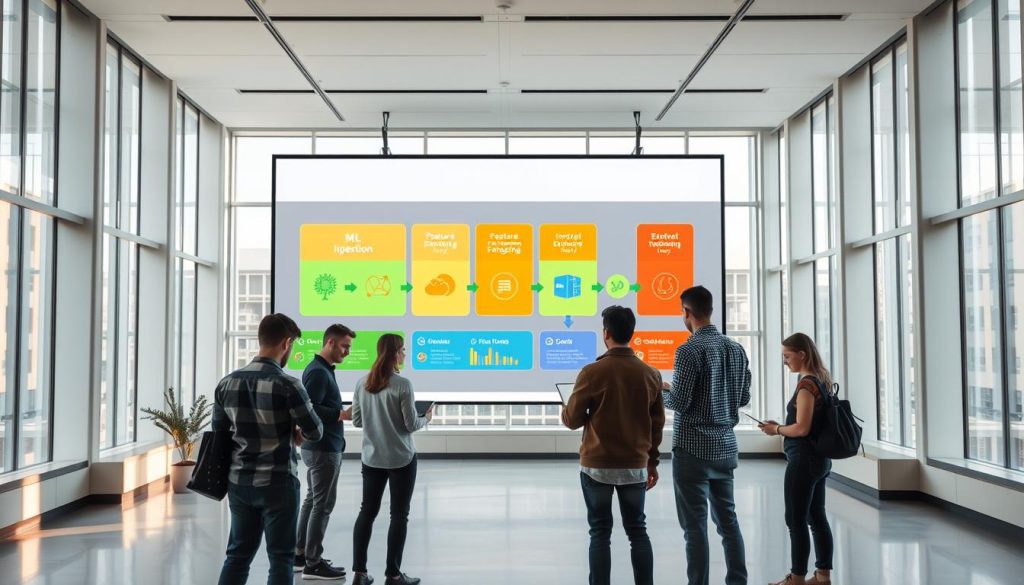
Our deployment expertise establishes robust serving infrastructure that makes trained models accessible to production applications. This includes creating scalable APIs and endpoints for seamless integration across business systems.
Continuous performance monitoring constitutes an essential component of production operations. We implement systematic tracking of key metrics and alerting mechanisms that notify teams when thresholds are breached.
A significant challenge we address is model drift detection, where performance degrades due to changing data patterns. Our approach uses sophisticated statistical techniques to identify drift early, before it impacts business outcomes.
Automated retraining pipelines respond to specific triggers like performance degradation or new data availability. We ensure retrained models meet quality standards through controlled deployment processes.
Effective automation requires more than technical infrastructure. It demands clear processes, governance frameworks, and comprehensive logging. These elements create sustainable systems that adapt to evolving business needs, as detailed in Microsoft’s guide to automating model training.
Benefits of Adopting MLOps for Business Efficiency
Business leaders increasingly recognize MLOps as a critical enabler for sustainable competitive advantage. We observe organizations achieving measurable improvements across multiple dimensions when implementing these practices.
Reducing Errors and Increasing Scalability
Automated MLOps pipelines significantly minimize human errors during model deployment. This enhances overall system reliability while maintaining consistent performance.
The framework enables seamless handling of expanding data volumes. Organizations can scale their analytical operations without proportional increases in resource allocation.
Improving Collaboration and Reducing Costs
Cross-functional collaboration between teams becomes more effective with standardized MLOps practices. Shared tools and processes eliminate communication barriers.
Automation reduces manual intervention requirements, leading to substantial costs savings. Companies optimize resource utilization throughout the entire development to production lifecycle.
| Traditional Approach |
MLOps Implementation |
Business Impact |
| Manual model deployment processes |
Automated pipeline deployment |
90% reduction in deployment errors |
| Separate development and operations teams |
Integrated cross-functional collaboration |
40% faster issue resolution |
| Limited scalability with growing data |
Elastic infrastructure scaling |
3x increase in model handling capacity |
| High operational maintenance costs |
Optimized resource utilization |
35% reduction in total ownership costs |
These benefits demonstrate why forward-thinking organizations prioritize MLOps adoption. The approach transforms machine learning initiatives from experimental projects into reliable business assets.
Optimizing Model Performance and Scalability
The journey from a functional model to a high-performing production system involves deliberate tuning and scalability planning. We focus on systematic approaches that transform theoretical concepts into reliable operational assets.
Practical Techniques for Hyperparameter Tuning
We guide organizations through algorithm selection based on specific problem characteristics and data properties. This ensures technical capabilities align with practical requirements like inference latency and interpretability needs.
Hyperparameter tuning significantly impacts model performance. We employ structured experimentation approaches including grid search and Bayesian optimization. Automated tracking identifies optimal configurations while validation prevents overfitting.
Scalability optimization extends beyond accuracy alone. We design serving architectures that handle increasing inference volumes without performance degradation. Efficient data processing pipelines minimize latency while distributed training accommodates complex models.
Our practical techniques deliver measurable improvements in production environments. Feature selection methods reduce dimensionality while ensemble approaches combine multiple models for better performance. Transfer learning strategies leverage pre-trained models to accelerate development.
Sustainable optimization requires systematic processes for experiment tracking and version control. Organizations can replicate successful experiments and compare performance across different model versions. This enables informed decisions about which configurations to promote to production.
We help balance competing objectives like maximizing performance while minimizing computational costs. Our strategies deliver practical value within each organization’s specific constraints and priorities.
Best Practices for MLOps in the United States
American organizations face unique challenges when implementing MLOps frameworks, requiring thoughtful adaptation of global standards to local regulatory and business contexts. We guide enterprises through this nuanced landscape, ensuring their analytical systems achieve both technical excellence and market relevance.

Adapting Global Standards to Local Business Environments
Successful implementation hinges on understanding specific American compliance requirements. These include data privacy regulations and industry-specific standards in sectors like healthcare and finance.
We help organizations tailor their governance and management processes. This ensures models meet both performance benchmarks and legal obligations.
Our approach emphasizes robust documentation practices. This is crucial in environments with higher employee mobility, preserving institutional knowledge about data pipelines and model behavior.
| Global MLOps Practice |
U.S. Adaptation Consideration |
Business Benefit |
| Generic governance frameworks |
HIPAA, FINRA compliance integration |
Reduced regulatory risk |
| Standard deployment cycles |
Alignment with agile development expectations |
Faster time-to-value |
| Centralized team collaboration |
Tools for distributed workforce coordination |
Improved cross-functional efficiency |
| Universal model monitoring |
Sector-specific performance metrics |
Enhanced model quality and relevance |
We prioritize establishing clear accountability structures across development and production teams. This creates sustainable systems that deliver consistent business value while maintaining necessary compliance.
Tools and Technologies in MLOps
Selecting the right technological foundation determines how effectively organizations can implement and scale their MLOps practices. We guide clients through this complex landscape, considering existing infrastructure, team skills, and specific use cases.
Leading cloud platforms like Google Cloud offer comprehensive suites that address the entire lifecycle. Their managed services reduce operational overhead while accelerating time-to-value.
Leveraging Google Cloud and Other Leading Platforms
Google Cloud’s Vertex AI provides end-to-end capabilities for model development and deployment. Integrated monitoring tools give visibility into performance across production environments.
Other platforms like AWS and Azure offer similar comprehensive solutions. The choice depends on organizational preferences and existing technology investments.
Automating Experiment Tracking and Model Registry
Robust experiment tracking systems automatically log parameters, metrics, and code versions. This enables systematic comparison and reliable reproduction of successful results.
Centralized model registries manage lifecycle tracking and version control. They provide transparency into which models are deployed and how they perform.
| Platform |
Key MLOps Tools |
Primary Strengths |
| Google Cloud |
Vertex AI, Kubeflow |
Integrated AI services |
| AWS |
SageMaker, Step Functions |
Enterprise scalability |
| Azure |
Machine Learning, MLflow |
Microsoft ecosystem integration |
Essential complementary tools include feature stores for consistent computation and data versioning systems. These create reliable workflows that support sustainable business value.
Conclusion
Effective MLOps implementation transforms analytical potential into tangible business value through systematic lifecycle management. This comprehensive guide has demonstrated how robust frameworks bridge experimental development with reliable production systems, ensuring models deliver consistent returns.
We recognize that each organization’s journey toward MLOps maturity is unique, requiring tailored approaches that align with specific capabilities and objectives. Our partnership methodology addresses both technical requirements and organizational dynamics, creating sustainable practices that enhance efficiency and scalability.
The benefits extend across multiple dimensions—from automated workflows that handle growing data volumes to improved collaboration that leverages diverse expertise. For American enterprises, we adapt global standards to local regulatory contexts, ensuring practical value in competitive markets.
We invite you to contact us today to discover how our expertise can help your organization unlock the full potential of your data assets. Together, we can build MLOps capabilities that drive measurable results and sustainable advantages in today’s evolving digital landscape.
FAQ
What is the primary goal of implementing MLOps?
The primary goal is to streamline and automate the end-to-end machine learning lifecycle, bridging the gap between data science and IT operations. This enhances efficiency, accelerates model deployment, and ensures consistent model performance and governance in production environments.
How does MLOps improve collaboration between data scientists and engineers?
MLOps fosters collaboration by establishing clear workflows and set practices for handoffs. It integrates tools for version control, continuous integration, and deployment (CI/CD), enabling both teams to work cohesively on model development, deployment, and monitoring, thereby reducing friction and improving software quality.
What are the key differences between MLOps Level 1 and Level 2?
Level 1 focuses on automating the model training pipeline and enabling continuous training with new data. Level 2 introduces advanced orchestration, scalable experimentation, and automated triggers for retraining, offering greater agility and management of complex workflows across different environments.
Why is continuous monitoring crucial after model deployment?
Continuous monitoring is vital to detect model performance degradation, data drift, and concept drift over time. It allows organizations to maintain model accuracy, ensure business applications run smoothly, and trigger automatic retraining processes to adapt to changes in incoming data.
Which tools are essential for building a robust MLOps framework?
Essential tools include platforms like Google Cloud AI Platform for model training and deployment, MLflow for experiment tracking, and Kubeflow for orchestrating workflows. These technologies support automation, model registry management, and scalable infrastructure, which are critical for operational success.
How can businesses ensure governance and security within their MLOps practices?
Businesses can ensure governance by implementing strict version control for code and models, maintaining detailed audit trails, and embedding ethical considerations into the development process. Security is upheld through access controls, data encryption, and compliance checks integrated into the automation pipelines.
Author
Praveena Shenoy
-
Country Manager
Praveena Shenoy is the Country Manager for Opsio India and a recognized expert in DevOps, Managed Cloud Services, and AI/ML solutions. With deep experience in 24/7 cloud operations, digital transformation, and intelligent automation, he leads high-performing teams that deliver resilience, scalability, and operational excellence. Praveena is dedicated to helping enterprises modernize their technology landscape and accelerate growth through cloud-native methodologies and AI-driven innovations, enabling smarter decision-making and enhanced business agility.