

Key Takeaways
- Managed cloud alternatives give organizations more control over infrastructure, security, and long-term costs than fully managed services.
- Options range from self-managed cloud and private cloud solutions to hybrid deployments, co-location, bare metal servers, and VPS hosting.
- Choosing the right alternative depends on workload performance needs, compliance requirements, budget constraints, and internal IT expertise.
- A structured migration plan with phased rollouts, thorough testing, and continuous monitoring reduces risk when transitioning away from managed services.
- The rise of edge computing, FinOps practices, and multi-cloud strategies is expanding the range of viable managed cloud alternatives in 2026.
Why Organizations Seek Managed Cloud Alternatives
Cloud computing powers nearly every modern enterprise, yet fully managed cloud services are not the right fit for every workload, budget, or compliance requirement. According to Flexera's 2025 State of the Cloud Report, 82% of enterprises now pursue a multi-cloud strategy, with many actively evaluating managed cloud alternatives to reduce costs and regain infrastructure control.
Managed cloud providers handle patching, monitoring, scaling, and security on your behalf, which simplifies operations but introduces trade-offs. Recurring subscription costs can climb unpredictably as usage grows. Vendor lock-in limits portability. And for organizations operating under strict regulatory frameworks such as HIPAA, GDPR, or PCI DSS, handing infrastructure oversight to a third party may not satisfy compliance auditors.
This guide examines every major managed cloud alternative available in 2026, explains how to evaluate them against your specific requirements, and provides a step-by-step implementation framework. Whether you need the raw performance of bare metal, the isolation of a private cloud, or the flexibility of a hybrid deployment, you will find a path forward here.
Understanding Managed Cloud Services and Their Limitations
Managed cloud services involve a provider operating and maintaining cloud infrastructure on behalf of a client. The provider typically handles server provisioning, operating system updates, security patching, backup management, and 24/7 monitoring. This model appeals to businesses that want to focus on application development rather than infrastructure management.
However, the convenience comes at a price. Gartner estimates that organizations overspend on cloud services by 20-30% on average due to idle resources and unoptimized configurations. Beyond cost, managed services introduce several constraints that drive businesses toward alternatives:
- Escalating costs: Pay-as-you-go pricing becomes expensive at scale, and egress fees add up when moving data between services or regions.
- Vendor lock-in: Proprietary APIs, data formats, and service integrations make migration to another provider complex and costly.
- Limited customization: Managed environments restrict access to underlying hardware configurations, kernel parameters, and networking layers.
- Compliance gaps: Some industries require data residency guarantees, physical access controls, or audit trails that managed providers cannot always satisfy.
Evaluating managed cloud alternatives allows organizations to reclaim control, optimize spending, and build infrastructure that matches their exact performance and compliance requirements.
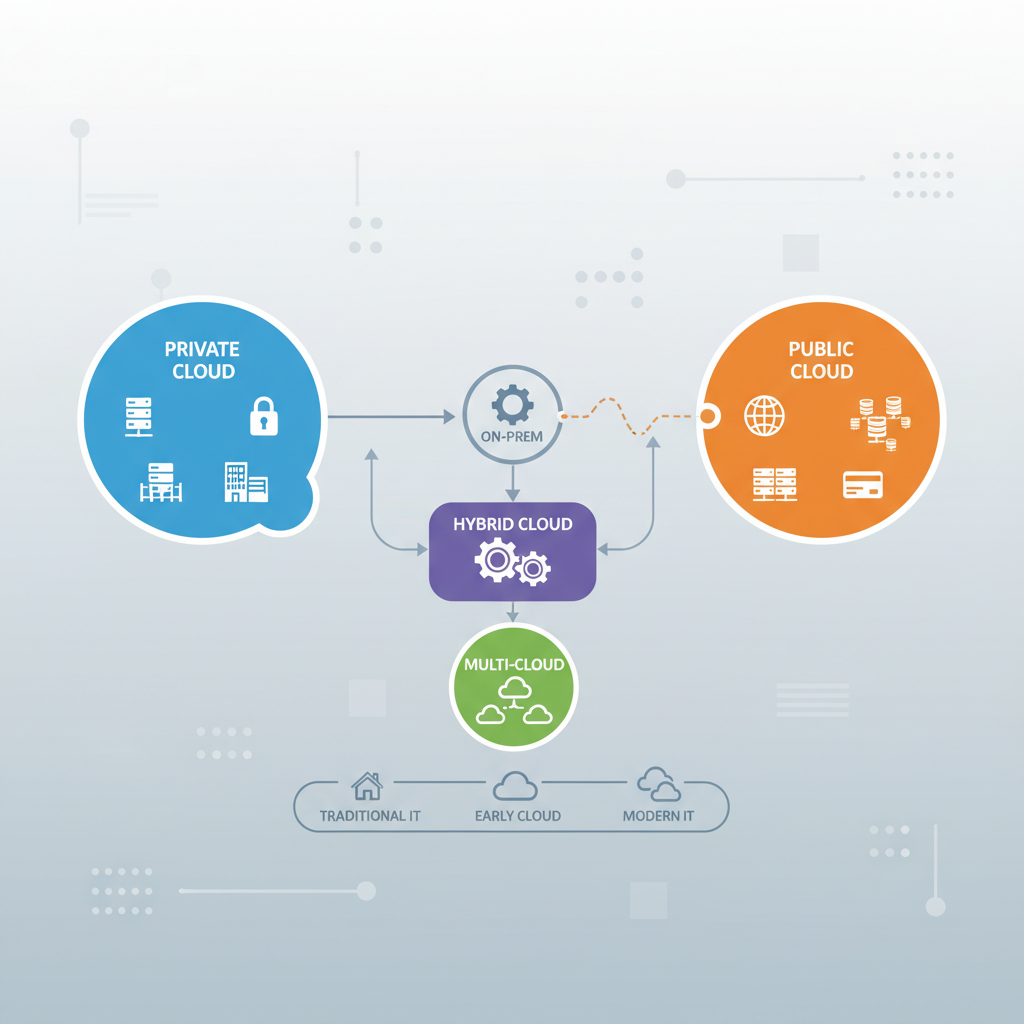
Seven Managed Cloud Alternatives Compared
Each alternative occupies a different point on the spectrum between full provider management and complete self-ownership. The right choice depends on your team's capabilities, your workload characteristics, and your tolerance for operational responsibility.
1. Self-Managed Cloud Infrastructure
A self-managed cloud gives your organization complete control over every layer of the stack. You provision and maintain servers, configure networking, manage storage, and handle all security operations. The infrastructure can run on-premise in your own data center or in leased co-location space.
This model suits organizations with mature DevOps teams and specific performance or compliance needs that managed providers cannot accommodate. The primary advantage is elimination of recurring managed service fees, which can reduce total cost of ownership by 30-50% over a three-to-five-year period for stable workloads. The trade-off is significant: you need skilled engineers for infrastructure management, capacity planning, and incident response around the clock.
Best for: Large enterprises with dedicated infrastructure teams, organizations with strict data sovereignty requirements, and workloads with predictable resource consumption patterns.
2. Private Cloud Solutions
A private cloud dedicates compute, storage, and networking resources exclusively to a single organization. Unlike the public cloud where tenants share physical hardware, a private cloud provides complete resource isolation. It can be deployed on-premise using platforms like VMware vSphere or OpenStack, or hosted by a provider such as Rackspace or IBM Cloud.
Private cloud solutions combine the operational benefits of cloud management tools (self-service provisioning, automated scaling, resource pooling) with the security and control of dedicated infrastructure. Organizations in healthcare, financial services, and government frequently choose private clouds to meet regulatory requirements while still enabling agile development workflows.
Best for: Regulated industries requiring data isolation, businesses processing sensitive customer information, and organizations that need cloud-like agility without shared tenancy risks.
3. On-Premise Infrastructure
On-premise solutions keep all hardware, software, and data within your organization's physical facilities. You own and operate every component, from servers and storage arrays to network switches and firewalls. This is the most traditional managed cloud alternative and provides maximum control over data security and physical access.
The capital expenditure is substantial: servers, cooling systems, uninterruptible power supplies, and physical security measures all require upfront investment. However, for workloads that will run continuously for years, the amortized cost of owned hardware is often lower than equivalent cloud compute. On-premise also eliminates data transfer fees and provides the lowest possible network latency for co-located applications.
Best for: Organizations with existing data center facilities, workloads requiring ultra-low latency, and businesses in jurisdictions with strict data residency laws.
4. Hybrid Cloud Deployments
Hybrid cloud integrates private infrastructure (on-premise or private cloud) with one or more public cloud services, allowing workloads and data to move between environments based on requirements. This managed cloud alternative has become the dominant enterprise strategy, with IDC reporting that 73% of organizations operate hybrid environments as of 2025.
The hybrid model lets you keep sensitive data and compliance-bound workloads on private infrastructure while using public cloud resources for development environments, seasonal demand spikes, or disaster recovery. Platforms like Azure Arc, AWS Outposts, and Google Anthos provide unified management planes that span both environments.
The challenge lies in complexity. Consistent security policies, network connectivity between environments, and workload orchestration across different platforms require specialized expertise. A well-designed hybrid cloud architecture, however, delivers unmatched flexibility in balancing cost, performance, and compliance.
Best for: Enterprises with variable workloads, organizations undergoing gradual cloud migration, and businesses needing burst capacity without committing fully to public cloud pricing.
5. Co-location Services
Co-location (colo) means placing your own servers in a third-party data center that provides the physical facility, power, cooling, and network connectivity. You retain full ownership and control of your hardware and software while benefiting from enterprise-grade physical infrastructure that would cost millions to build independently.
Co-location facilities typically offer redundant power feeds, carrier-neutral network connectivity with multiple ISPs, physical security with biometric access controls, and environmental monitoring. This makes co-location an attractive managed cloud alternative for organizations that want hardware control without the overhead of operating their own data center.
Best for: Mid-size businesses outgrowing hosted solutions, organizations requiring specific hardware configurations, and companies needing low-latency connectivity to major internet exchange points.
6. Bare Metal Servers
Bare metal servers are single-tenant physical servers with no virtualization layer between the operating system and hardware. This direct hardware access eliminates hypervisor overhead and delivers maximum compute performance, consistent I/O latency, and full control over the software stack from the kernel up.
Providers like Equinix Metal, OVHcloud, Hetzner, and Vultr offer bare metal as a service, combining the performance benefits of dedicated hardware with the provisioning speed of cloud instances. You can deploy a bare metal server in minutes rather than weeks, making this a practical managed cloud alternative for performance-critical workloads.
Bare metal is particularly valuable for high-performance computing (HPC), real-time data processing, large-scale databases, AI/ML model training, and gaming servers where consistent sub-millisecond latency matters.
Best for: Performance-intensive applications, AI/ML workloads, large databases, and any use case where virtualization overhead is unacceptable.
7. Virtual Private Server (VPS) Hosting
A VPS partitions a single physical server into multiple isolated virtual environments, each with dedicated CPU, RAM, and storage allocations. While the underlying hardware is shared, each VPS operates independently with its own operating system and root access, providing a middle ground between shared hosting and dedicated infrastructure.
VPS hosting is the most cost-effective managed cloud alternative for small and mid-size businesses that need more control and resources than shared hosting but cannot justify the expense of bare metal or private cloud. Monthly costs typically range from $5 to $100 depending on resource allocation, making it accessible for development environments, staging servers, and small production workloads.
Best for: Small to mid-size businesses, development and staging environments, and budget-conscious teams needing dedicated resources without dedicated hardware costs.
How to Choose the Right Cloud Alternative
Selecting among managed cloud alternatives requires systematic evaluation across six dimensions. Rushing this decision often leads to costly migrations later, so invest time upfront in understanding your requirements.
Cost and Total Cost of Ownership
Compare capital expenditure (CapEx) against operational expenditure (OpEx) over a three-to-five-year horizon. Managed cloud services favor predictable monthly OpEx, while alternatives like on-premise and co-location require upfront CapEx but often deliver lower long-term costs. Include staffing, maintenance, energy, licensing, and data transfer fees in your total cost of ownership calculation.
Performance and Scalability
Map your application performance requirements including CPU utilization patterns, memory demands, storage I/O throughput, and network bandwidth needs. Determine whether your workloads are steady-state (favoring dedicated infrastructure) or highly variable (favoring elastic cloud or hybrid approaches). Bare metal and private cloud excel at consistent performance, while hybrid cloud provides the best scaling flexibility.
Security and Regulatory Compliance
Identify every regulatory framework your organization must satisfy, whether HIPAA, GDPR, SOC 2, PCI DSS, or industry-specific mandates. Evaluate how each managed cloud alternative supports required controls such as encryption at rest and in transit, access logging, network segmentation, and physical security. Private cloud and on-premise solutions generally provide the strongest compliance posture for sensitive data.
Internal Team Expertise
Honestly assess your IT team's capacity to manage infrastructure. Self-managed cloud and bare metal demand deep expertise in systems administration, networking, security hardening, and incident response. If your team is lean, co-location (which offloads facility management) or VPS hosting (which simplifies server management) may be more practical choices.
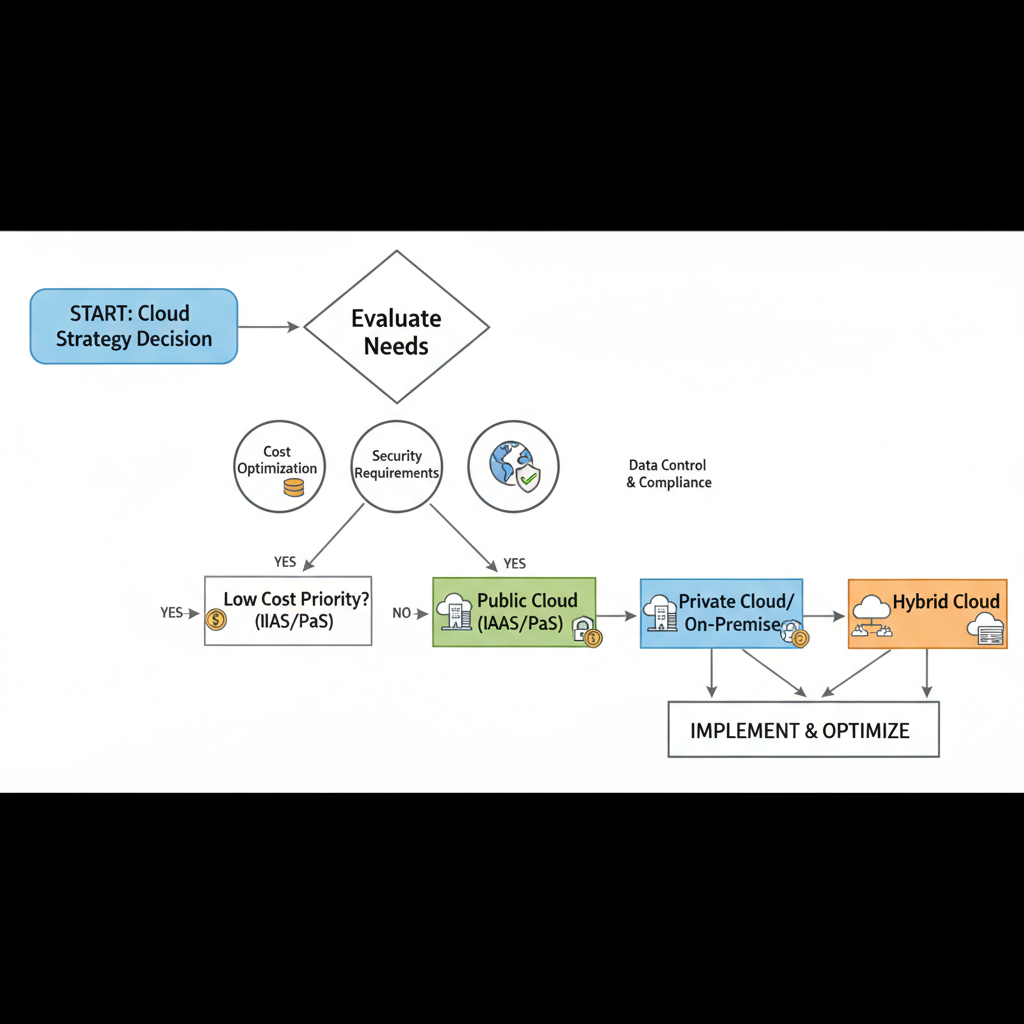
Vendor Independence and Portability
Evaluate how easily you can migrate workloads away from each option if requirements change. Managed cloud services with proprietary APIs create the highest lock-in risk. Open-source platforms like OpenStack and Kubernetes, combined with infrastructure-as-code tools like Terraform, maximize portability across managed cloud alternatives.
Integration with Current Systems
Assess compatibility with your existing applications, data pipelines, CI/CD workflows, and monitoring tools. Hybrid cloud architectures excel at gradual integration, letting you connect legacy on-premise systems with modern cloud services through consistent APIs and networking. Wholesale replacement of infrastructure rarely succeeds; phased integration is safer.
Step-by-Step Cloud Migration Framework
Transitioning to a managed cloud alternative requires disciplined execution. This six-phase framework minimizes risk while maintaining business continuity throughout the migration.
- Audit your current environment. Catalog every application, database, service dependency, and data flow. Measure actual resource utilization (not provisioned capacity) to right-size your target infrastructure. Document compliance requirements and performance baselines for each workload.
- Design the target architecture. Select your managed cloud alternative based on the evaluation criteria above. Create detailed architecture diagrams covering compute, storage, networking, security zones, and disaster recovery. Plan for both day-one requirements and anticipated growth over 18-24 months.
- Develop a data migration strategy. Choose migration methods for each dataset: online replication for minimal downtime, offline transfer for large volumes, or phased migration for complex interdependencies. Build rollback procedures for every migration phase and test them before going live.
- Deploy and configure infrastructure. Stand up your target environment following the architecture design. Install and configure all compute, networking, storage, and security components. Use infrastructure-as-code tools (Terraform, Ansible, Pulumi) to ensure repeatable, auditable deployments.
- Test exhaustively before cutover. Run load tests simulating peak traffic, execute penetration tests against the new environment, and perform disaster recovery drills. Validate that every application meets or exceeds its performance baseline from the audit phase. Do not proceed to production cutover until all acceptance criteria pass.
- Monitor and optimize continuously. Deploy comprehensive observability across metrics, logs, and traces. Establish alerting thresholds based on your performance baselines. Review resource utilization monthly and optimize configurations to eliminate waste. Cloud infrastructure is never "done" -- continuous tuning is essential for cost efficiency and reliability.
Cloud Infrastructure Trends Shaping 2026
The managed cloud alternatives landscape continues to evolve rapidly. Several trends are expanding the options available to businesses evaluating their infrastructure strategy.
Edge computing pushes processing closer to end users and data sources, reducing latency for IoT, real-time analytics, and content delivery workloads. Edge deployments often combine on-premise hardware at remote locations with centralized cloud management, creating a new category of distributed managed cloud alternatives.
FinOps and cloud cost optimization have matured from a niche practice into a standard enterprise discipline. Organizations now use automated tools to continuously right-size instances, identify idle resources, and negotiate committed-use discounts, making the cost comparison between managed services and alternatives more nuanced than simple sticker prices.
Multi-cloud orchestration platforms from vendors like HashiCorp, Crossplane, and Upbound enable organizations to deploy and manage workloads across multiple providers and on-premise infrastructure through a single control plane. This reduces the complexity penalty that previously made hybrid and multi-cloud strategies difficult to operate.
Sovereign cloud initiatives driven by data residency regulations in the EU, India, and other regions are creating demand for locally operated cloud alternatives that keep data within national borders while providing cloud-like functionality.
Frequently Asked Questions About Managed Cloud Alternatives
What are the main benefits of exploring managed cloud alternatives?
Managed cloud alternatives provide greater control over infrastructure configuration, potential cost savings over multi-year periods, and enhanced ability to meet security and compliance requirements. They allow organizations to tailor compute, storage, and networking to their exact workload characteristics, avoid vendor lock-in, and maintain data sovereignty where regulations demand it.
How do on-premise solutions compare to public cloud services?
On-premise solutions give you complete ownership and physical control of hardware and data, which satisfies strict compliance and security requirements. Public cloud services offer rapid scalability and lower upfront costs but introduce ongoing subscription expenses and third-party dependency. Managed cloud alternatives like private cloud and hybrid deployments bridge this gap by combining elements of both models.
Is a hybrid cloud a good option for all businesses?
Hybrid cloud is an excellent option for most mid-size and large enterprises, particularly those balancing compliance requirements with the need for scalable compute resources. However, smaller organizations with limited IT staff may find the integration complexity challenging. Successful hybrid cloud deployment requires careful network architecture planning and consistent security policy enforcement across environments.
What is the difference between bare metal servers and a VPS?
Bare metal servers are single-tenant physical machines providing exclusive access to all hardware resources with no virtualization overhead, delivering maximum performance for demanding workloads. A VPS is a virtualized partition of a shared physical server that provides dedicated resource allocations at a lower cost. Bare metal suits performance-critical applications, while VPS offers a cost-effective balance for general-purpose workloads.
How can I ensure security with self-managed cloud or co-location?
Security in self-managed and co-location environments requires a comprehensive internal strategy. Implement strong identity and access management, maintain rigorous patch cycles, deploy network firewalls and intrusion detection systems, encrypt data at rest and in transit, and establish continuous monitoring with automated alerting. An experienced in-house security team or a trusted managed security services partner is essential.
Building Your Cloud Strategy
The managed cloud alternatives available in 2026 give organizations more choice than ever in designing infrastructure that matches their exact requirements. Fully managed services remain valuable for teams that prioritize operational simplicity, but they are no longer the only viable path.
For businesses seeking deeper control, better cost predictability, or stronger compliance posture, alternatives like private cloud, hybrid deployments, bare metal servers, and co-location provide proven approaches backed by mature tooling and broad provider ecosystems. The key is matching your choice to your actual workload characteristics, team capabilities, and business objectives rather than following a one-size-fits-all approach.
Start with a thorough audit of your current environment, evaluate alternatives against the six criteria outlined in this guide, and plan a phased migration that protects business continuity. The right managed cloud alternative is the one that serves your organization's specific needs today while providing the flexibility to adapt as those needs evolve.