Organizations worldwide are increasingly adopting multi-cloud strategies to enhance flexibility, reduce vendor lock-in, and optimize workloads across different providers. According to the Flexera 2025 State of the Cloud Report, over 90% of enterprises now use two or more public cloud providers, reflecting a significant shift from single-cloud to multi-cloud approaches. While this strategy offers compelling benefits, it also introduces complex challenges in governance, cost management, and operational efficiency. In this comprehensive guide, we'll explore proven best practices to help you navigate the multi-cloud landscape effectively.
Why Multi-Cloud Management Matters Today
Multi-cloud computing has evolved from an experimental approach to an operational necessity for many organizations. As businesses seek to balance risk, performance, and cost, they're strategically distributing workloads across multiple cloud service providers. This shift brings both opportunities and challenges that require thoughtful management.
The Evolving Cloud Landscape
The cloud market continues to mature, with major providers like AWS, Azure, and Google Cloud expanding their offerings while regional and specialized providers fill important niches. This evolution has created a rich ecosystem where organizations can select the optimal environment for each workload based on specific requirements rather than forcing all applications into a single cloud.
Key Benefits of Multi-Cloud Solutions
- Resilience and redundancy: Distributing workloads across multiple providers reduces the impact of outages and creates natural disaster recovery options.
- Best-of-breed services: Leverage each provider's strengths—AWS for breadth of services, Azure for Microsoft integration, Google Cloud for data analytics and machine learning.
- Avoid vendor lock-in: Maintain negotiating leverage and reduce dependency on a single provider's roadmap and pricing models.
- Regulatory compliance: Meet data sovereignty requirements by selecting region-specific cloud providers that align with local regulations.
- Cost optimization: Take advantage of competitive pricing and provider-specific discounts to optimize your cloud spend.
Multi-cloud delivers flexibility, but without strategy and governance it becomes an operational burden.
Common Challenges in Multi-Cloud Management
Despite its advantages, multi-cloud adoption introduces significant complexity. Organizations frequently struggle with:
- Governance fragmentation: Different cloud providers have unique management interfaces, security controls, and compliance frameworks.
- Cost visibility and control: Tracking spending across multiple billing systems and optimizing costs becomes exponentially more difficult.
- Security inconsistency: Maintaining uniform security posture across diverse environments requires specialized expertise.
- Operational complexity: Teams need broader skill sets and more sophisticated tools to manage heterogeneous environments.
- Data integration challenges: Moving data between clouds incurs egress costs and introduces latency concerns.
- Performance monitoring: End-to-end visibility becomes harder to achieve across distributed systems.
Addressing these challenges requires a structured approach to multi-cloud management that encompasses architecture, governance, operations, and cost optimization.
Understanding the Foundations: Effective Multi-Cloud Architecture
A successful multi-cloud strategy begins with thoughtful architecture that enables flexibility while controlling complexity. By establishing core principles and design patterns, organizations can create environments that deliver the benefits of multi-cloud without overwhelming operational teams.
Principles of an Effective Multi-Cloud Architecture
- Portability: Design workloads that can move between providers with minimal refactoring, reducing dependency on provider-specific services when appropriate.
- Interoperability: Implement standards and APIs that work consistently across clouds to simplify integration and management.
- Resilience: Architect for failure by designing systems that can withstand outages in any single component or provider.
- Observability: Ensure visibility into performance, costs, and security across all environments through centralized monitoring.
Designing for Portability and Interoperability
Practical design patterns that support effective multi-cloud architecture include:
- Containerization: Package applications using Docker and orchestrate with Kubernetes to abstract provider differences and enable workload mobility.
- Cloud-agnostic CI/CD: Implement deployment pipelines that can target any cloud environment using consistent processes and templates.
- Consistent tagging: Establish uniform resource tagging strategies across all providers to support governance and cost allocation.
- Data management: Design data replication and storage strategies that account for cross-cloud latency and egress costs.
Real-World Example: A financial services company in New York uses AWS for customer-facing applications, Google Cloud for data analytics, and Azure for Microsoft-based workloads. They maintain portability through containerization and Terraform infrastructure templates, allowing them to shift workloads between providers when beneficial.
Tools and Platforms for Cross-Cloud Integration
Several technologies have emerged to support multi-cloud management:
| Category |
Tools |
Purpose |
| Container Orchestration |
Kubernetes, Google Anthos, EKS Anywhere, AKS |
Consistent application deployment and management across clouds |
| Infrastructure as Code |
Terraform, Pulumi, CloudFormation |
Declarative infrastructure provisioning with provider-agnostic abstractions |
| Service Mesh |
Istio, Linkerd, Consul |
Secure service-to-service communication across environments |
| Observability |
Prometheus, Grafana, OpenTelemetry |
Unified monitoring, logging, and tracing across providers |
| Management Platforms |
VMware Tanzu, Red Hat OpenShift, IBM Cloud Pak |
Comprehensive multi-cloud management capabilities |
These tools help standardize operations across heterogeneous environments, reducing the friction that typically accompanies multi-cloud deployments.
Governance and Compliance: Multi-Cloud Governance Frameworks
Effective governance is perhaps the most critical success factor in multi-cloud management. Without clear frameworks, policies, and accountability, organizations risk security vulnerabilities, compliance issues, and runaway costs.
Defining Multi-Cloud Governance Frameworks
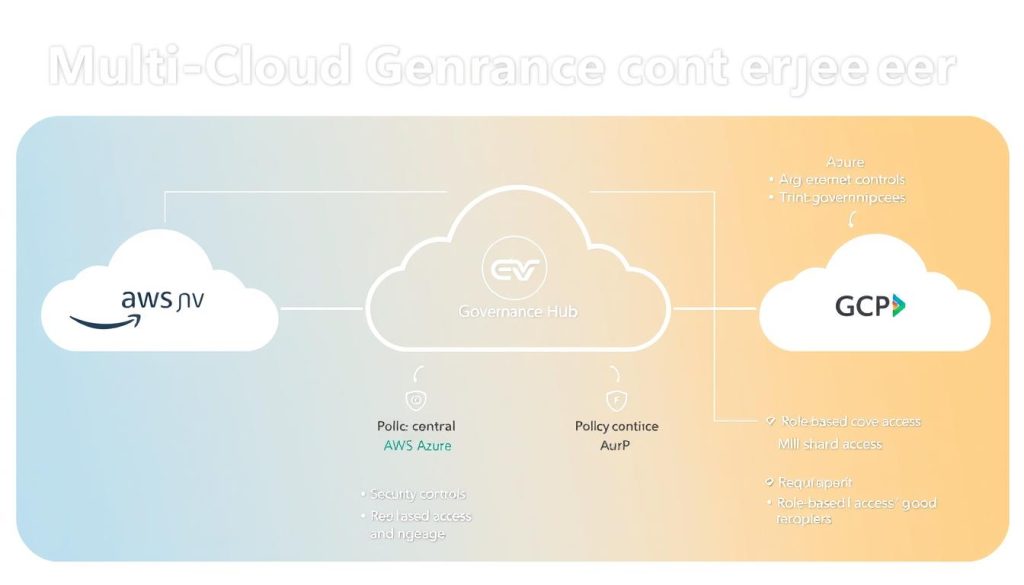
A comprehensive multi-cloud governance framework should address:
- Organizational structure: Establish a Cloud Center of Excellence (CCoE) with executive sponsorship to set strategy and standards.
- Roles and responsibilities: Define clear ownership for cloud architecture, security, operations, and financial management.
- Policy management: Create consistent policies for resource provisioning, access control, data protection, and compliance.
- Lifecycle management: Implement processes for resource approval, deployment, monitoring, and decommissioning.
Identity and Access Management Across Clouds
Consistent identity management is foundational to multi-cloud security:
- Centralized identity: Implement federated identity using SAML/OIDC with providers like Azure AD, Okta, or Ping Identity.
- Least privilege: Apply role-based access control (RBAC) consistently across all environments.
- Just-in-time access: Use temporary, short-lived credentials rather than permanent access keys.
- Automated enforcement: Implement policy-as-code using tools like Open Policy Agent to ensure consistent guardrails.
Compliance and Risk Management
Multi-cloud environments must maintain consistent compliance posture:
- Centralized audit logging: Aggregate logs from all providers into a single repository for compliance reporting.
- Automated compliance checks: Implement continuous scanning for policy violations and configuration drift.
- Risk assessment: Regularly evaluate the security posture across all environments using consistent frameworks.
- Incident response: Develop cross-cloud incident management procedures and conduct regular drills.
Compliance Tip: NIST provides valuable guidance for cloud computing security and governance through Special Publications like NIST SP 800-144 and the NIST Cloud Computing Program. These resources offer frameworks that can be adapted for multi-cloud environments.
Operational Strategies: Multi-Cloud Management Approaches
Day-to-day operations in multi-cloud environments require specialized approaches that balance centralized control with team autonomy. The right operational model depends on organizational structure, skill sets, and business requirements.
Centralized vs. Federated Management
Organizations typically adopt one of two management approaches:
Centralized Management
- Pros: Consistent standards, stronger governance, optimized resource utilization
- Cons: Potential bottlenecks, slower innovation, higher coordination overhead
- Best for: Organizations with strict compliance requirements or limited cloud expertise
Federated Management
- Pros: Greater agility, team autonomy, faster innovation cycles
- Cons: Risk of inconsistency, potential cost inefficiencies, governance challenges
- Best for: Organizations with mature DevOps practices and strong team capabilities
Many organizations adopt a hybrid approach—centralized governance and security with federated implementation—to balance control and agility.
Automation and Orchestration
Automation is essential for managing multi-cloud environments efficiently:
- Infrastructure as Code: Use declarative templates to provision and manage resources consistently across providers.
- GitOps workflows: Implement version-controlled infrastructure and application deployments with automated pipelines.
- Event-driven automation: Create cross-cloud workflows triggered by events like resource creation or performance thresholds.
Example Terraform Module for Multi-Cloud:
module "network" {
 source = "./modules/network"
 providers = {
 aws = aws.us
 azurerm = azurerm.uk
 }
 env = var.env
}
Monitoring and Observability
Unified visibility is critical for effective operations:
- Centralized monitoring: Aggregate metrics, logs, and traces from all environments into a unified platform.
- Service level objectives: Define consistent SLOs across clouds to manage user experience holistically.
- Alerting and incident management: Implement standardized alerting thresholds and response procedures.
- Performance analytics: Use AI-powered tools to identify anomalies and optimization opportunities across environments.
| Key Metric |
Description |
Target |
| Mean Time to Detect (MTTD) |
Average time to identify an incident |
|
| Mean Time to Recover (MTTR) |
Average time to resolve an incident |
|
| SLI Compliance |
Percentage of successful service level indicators |
99.9% |
| Cost per Incident |
Average financial impact of incidents |
Decreasing trend |
Cost and Performance: Multi-Cloud Cost Optimization
Managing costs across multiple cloud providers presents unique challenges. Without proper visibility and controls, organizations risk significant overspending and inefficiency.
Cost Visibility Across Providers
The first step in multi-cloud cost optimization is establishing comprehensive visibility:
- Unified cost dashboards: Implement tools that aggregate billing data from all providers into a single view.
- Consistent tagging: Apply uniform resource tagging across clouds to enable accurate cost allocation.
- Granular reporting: Break down costs by business unit, application, environment, and service type.
- Anomaly detection: Implement alerts for unexpected spending patterns or resource usage.
Optimization Tactics
Several strategies can help control and optimize multi-cloud costs:
- Rightsizing: Regularly analyze resource utilization and adjust instance types and sizes to match actual needs.
- Reserved capacity: Purchase reserved instances or savings plans for predictable workloads, saving 40-60% compared to on-demand pricing.
- Spot/preemptible instances: Use discounted interruptible instances for fault-tolerant workloads.
- Workload placement: Deploy applications to the provider with the best price-performance ratio for each specific workload type.
- Automated governance: Implement policies to prevent provisioning of oversized or unnecessary resources.
Shift from "cost as a bill" to "cost as a product"—allocate budgets to teams and measure unit costs per business metric to drive continuous optimization.
Balancing Performance and Cost
Cost optimization must be balanced with performance and availability requirements:
| Workload Type |
Performance Priority |
Availability Priority |
Cost Priority |
Recommended Approach |
| Customer-facing applications |
High |
High |
Medium |
Multi-region deployment with auto-scaling |
| Batch processing |
Medium |
Low |
High |
Spot instances with flexible scheduling |
| Development environments |
Low |
Low |
High |
Auto-shutdown policies, rightsized instances |
| Data analytics |
High |
Medium |
Medium |
Provider with best analytics pricing, reserved capacity |
By aligning cost optimization strategies with workload requirements, organizations can achieve significant savings without compromising performance or reliability.
Addressing Real-World Challenges in Multi-Cloud Management
Beyond the technical aspects, organizations face operational, organizational, and technical challenges when implementing multi-cloud strategies. Addressing these challenges proactively is essential for long-term success.
Operational and Organizational Challenges
- Tool sprawl: Multiple management consoles and tools create operational complexity and training challenges.
- Skill gaps: Teams need expertise across multiple platforms, which can be difficult to develop and maintain.
- Process fragmentation: Different providers may require unique operational procedures and workflows.
- Organizational silos: Teams may become specialized in specific providers, creating knowledge barriers.
- Governance enforcement: Ensuring consistent policy compliance across environments requires sophisticated tooling.
- Change management: Updates to one environment may have ripple effects across the multi-cloud ecosystem.

Networking and Data Challenges
Technical challenges often center around networking and data management:
- Data gravity: Large datasets tend to attract applications and services, making it expensive and time-consuming to move workloads between clouds.
- Cross-cloud networking: Establishing secure, performant connectivity between providers requires specialized expertise and often dedicated connections.
- Egress costs: Data transfer between clouds can incur significant fees that are often overlooked in initial planning.
- Latency concerns: Applications that communicate across cloud boundaries may experience performance degradation due to increased latency.
Cultural and Skillset Development
Successful multi-cloud management requires organizational adaptation:
- Cross-training: Develop teams with expertise across multiple providers rather than creating provider-specific silos.
- Cloud Center of Excellence: Establish a CCoE to share knowledge, develop standards, and provide guidance to application teams.
- FinOps culture: Foster shared responsibility for cloud costs across engineering, operations, and finance teams.
- Continuous learning: Implement regular training programs to keep teams current with evolving cloud services and best practices.
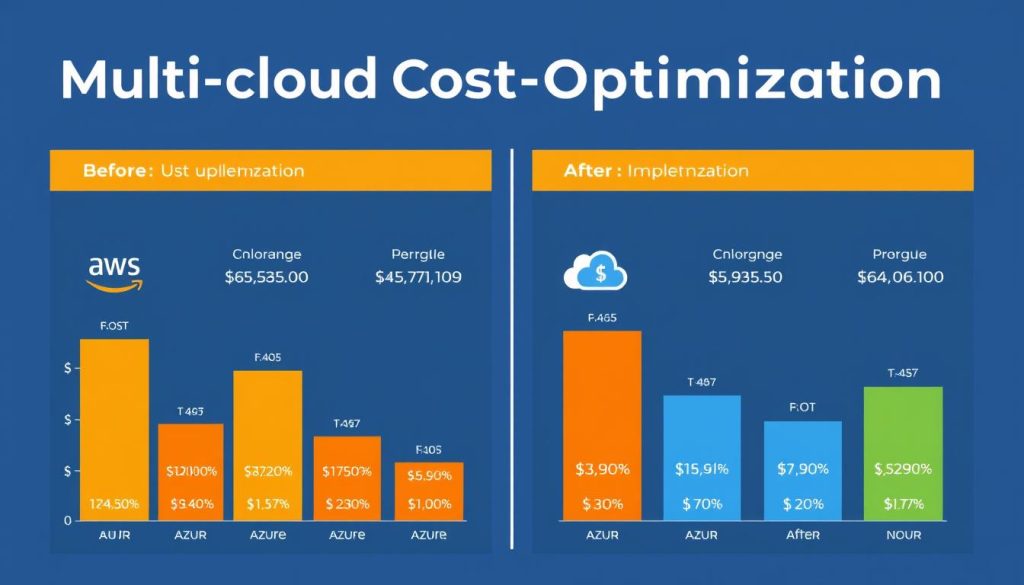
ROI Impact: According to the FinOps Foundation, organizations that implement mature FinOps practices and continuous optimization typically see cost reductions of 20-30% within the first year of implementation.
Best Practices: Practical Guidelines for Multi-Cloud Success
Based on industry experience and lessons learned from successful implementations, we've compiled a prioritized set of best practices for multi-cloud management.
Prioritized Best Practices Checklist
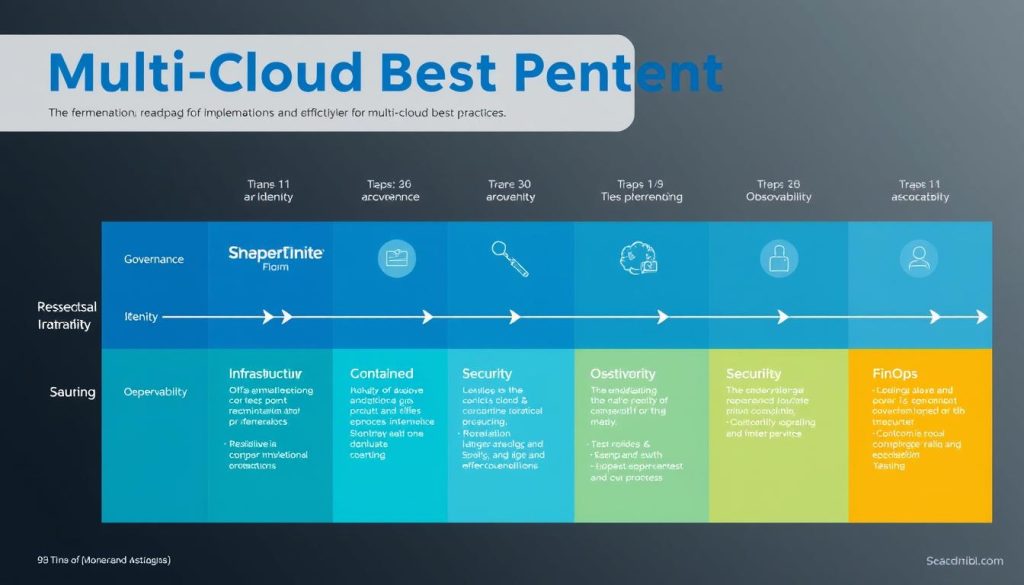
- Establish governance first: Create a Cloud Center of Excellence with executive sponsorship and clear roles before expanding multi-cloud adoption.
- Standardize identity and access: Implement federated identity and consistent access controls across all environments.
- Implement infrastructure as code: Use declarative templates to ensure consistent, repeatable deployments across providers.
- Containerize applications: Package workloads in containers to improve portability and reduce provider dependencies.
- Centralize observability: Aggregate logs, metrics, and traces from all environments into a unified monitoring platform.
- Automate security and compliance: Implement continuous scanning and policy enforcement across all cloud resources.
- Adopt FinOps practices: Create a culture of cost awareness with shared responsibility between engineering and finance.
Security-First Practices
Security must be integrated throughout the multi-cloud lifecycle:
- Shift-left security: Integrate security scanning and policy validation into CI/CD pipelines before deployment.
- Consistent encryption: Implement uniform encryption standards for data at rest and in transit across all providers.
- Vulnerability management: Regularly scan all environments for vulnerabilities and misconfigurations using automated tools.
- Secrets management: Use dedicated secrets management solutions rather than embedding credentials in code or configuration.
- Zero trust architecture: Implement least-privilege access, network segmentation, and continuous verification across all environments.
Measuring Success: KPIs and Metrics
Establish clear metrics to track the effectiveness of your multi-cloud strategy:
| Category |
Key Performance Indicator |
Target |
Measurement Frequency |
| Financial |
Cost per service/transaction |
Decreasing trend |
Monthly |
| Governance |
Percentage of resources properly tagged |
≥ 95% |
Weekly |
| Operations |
MTTD and MTTR for incidents |
|
Per incident |
| Performance |
SLO compliance percentage |
≥ 99.9% |
Daily |
| Security |
Time to remediate vulnerabilities |
|
Weekly |
Regularly review these metrics with stakeholders and use them to drive continuous improvement in your multi-cloud management practices.
Case Studies and Examples
Examining real-world implementations provides valuable insights into effective multi-cloud management strategies. The following case studies highlight different approaches and outcomes.
Small-to-Medium Enterprise: Achieving Agility
UK-Based SaaS Provider
Challenge: A growing SaaS company needed to improve analytics performance while maintaining reliable customer-facing services.
Approach: The company adopted a targeted multi-cloud strategy, using AWS for production workloads and Google Cloud for data analytics. They containerized applications using Kubernetes and implemented centralized logging with Grafana Cloud.
Results:
- Reduced time-to-deploy from days to hours through standardized CI/CD pipelines
- Improved analytics query performance by 30% by leveraging Google's BigQuery
- Achieved more predictable costs through FinOps practices and workload-specific placement
Key Takeaway: Targeted multi-cloud adoption focused on specific workload requirements can deliver significant benefits even for smaller organizations.

Large Enterprise: Governance at Scale
U.S. Multinational Retailer
Challenge: A large retailer struggled with inconsistent security practices and rising costs across hundreds of cloud accounts spanning multiple providers.
Approach: The company established a Cloud Center of Excellence, implemented centralized policy-as-code, and adopted a federated team model with clear guardrails.
Results:
- Unified security standards across all environments, reducing compliance audit time by 50%
- Implemented intelligent workload placement that reduced cross-region data transfer costs by 20%
- Achieved 30% overall cost reduction through rightsizing and reserved capacity purchases
- Improved developer productivity by standardizing deployment processes across clouds
Key Takeaway: Strong governance frameworks enable large organizations to maintain control while still benefiting from multi-cloud flexibility.
Lessons Learned and Pitfalls to Avoid
Common Multi-Cloud Pitfalls:
- Treating multi-cloud as a free-for-all: Without governance, multi-cloud quickly leads to sprawl and runaway costs.
- Copying provider-specific architectures: Designs optimized for one cloud often perform poorly or cost more when replicated elsewhere.
- Underestimating data gravity: The cost and time required to move large datasets between clouds can eliminate potential benefits.
- Neglecting egress costs: Data transfer between clouds can quickly become a major expense if not carefully managed.
- Assuming portable skills: Each cloud requires specific expertise; training and knowledge sharing are essential.
Conclusion: Next Steps and Actionable Checklist
Multi-cloud management offers compelling benefits—resilience, best-of-breed capabilities, and strategic flexibility—but requires thoughtful implementation. By focusing on governance, standardization, and operational excellence, organizations can navigate the complexity and realize the full potential of multi-cloud strategies.
Implementation Roadmap
Short-Term (30-90 Days)
- Form a Cloud Center of Excellence with clear ownership
- Implement consistent tagging and cost allocation rules
- Set up basic cross-cloud observability dashboards
- Conduct a security assessment across all environments
Medium-Term (3-12 Months)
- Adopt infrastructure-as-code for core components
- Implement automated CI/CD pipelines
- Launch FinOps practices and cost optimization
- Deploy policy-as-code for security and compliance
Long-Term (12+ Months)
- Mature governance frameworks with automated remediation
- Invest in cross-cloud training and career paths
- Continuously refine SLOs and cost targets
- Evolve architecture patterns based on lessons learned
Actionable Checklist
- Establish governance: Create a CCoE, define roles, and implement multi-cloud governance frameworks.
- Standardize identity: Implement federated identity and consistent access controls across clouds.
- Adopt portable architectures: Containerize applications and use infrastructure-as-code for deployment.
- Centralize visibility: Implement unified monitoring, logging, and cost management.
- Implement FinOps: Adopt cloud financial management practices and continuous optimization.

Resources and References
Treat multi-cloud as a strategic operating model, not just a technology choice. Focus first on governance, visibility, and cost controls—then optimize for performance and innovation.
Ready to Optimize Your Multi-Cloud Strategy?
Let our experts help you create a tailored multi-cloud roadmap that aligns with your business objectives. We'll analyze your current cloud portfolio and develop a governance framework customized for your industry and region.
Request Your Custom Multi-Cloud Assessment
Frequently Asked Questions About Multi-Cloud Management
What is the difference between multi-cloud and hybrid cloud?
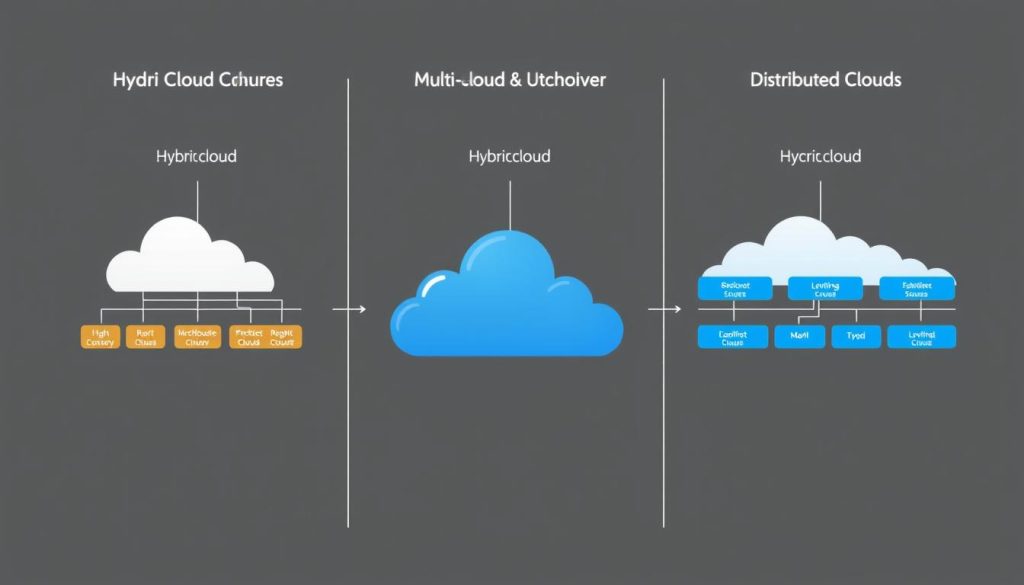
Multi-cloud refers to using services from multiple public cloud providers (e.g., AWS, Azure, GCP) for different workloads or purposes. Hybrid cloud combines public cloud services with on-premises infrastructure or private clouds. While multi-cloud focuses on distributing workloads across different public providers, hybrid cloud integrates public cloud with private infrastructure.
How do I determine which workloads should go to which cloud provider?
Workload placement should consider several factors:
- Performance requirements: Choose providers with services optimized for your specific workload type (e.g., analytics, AI/ML, enterprise applications).
- Cost structure: Compare pricing models for the specific services your workload requires.
- Data gravity: Place workloads close to the data they need to access to minimize latency and transfer costs.
- Compliance requirements: Select providers with appropriate regional coverage and compliance certifications.
- Team expertise: Consider your team's familiarity with different cloud platforms.
What are the most common challenges in implementing multi-cloud governance?
Common governance challenges include:
- Policy consistency: Maintaining uniform security, compliance, and operational policies across different environments.
- Identity management: Implementing consistent access controls and authentication mechanisms.
- Cost visibility: Aggregating and analyzing spending across multiple billing systems.
- Skill gaps: Developing expertise across multiple platforms and management tools.
- Tool fragmentation: Managing multiple provider-specific consoles and management interfaces.
These challenges can be addressed through centralized governance frameworks, federated identity, policy-as-code, and multi-cloud management platforms.
Editorial standards: This article was written by a certified practitioner and peer-reviewed by our engineering team. We update content quarterly to ensure technical accuracy. Opsio maintains editorial independence — we recommend solutions based on technical merit, not commercial relationships.