Modern manufacturing thrives on precision, but human-led quality checks often struggle to keep pace with today’s demands. For businesses creating intricate components, even microscopic defects can jeopardize product safety and performance. This is where advanced technological solutions redefine what’s possible in quality assurance.
We partner with manufacturers to implement computer vision-driven systems that outperform traditional methods. These tools detect imperfections invisible to the human eye, from hairline fractures to micron-level deviations. Unlike manual processes, they maintain unwavering accuracy across 24/7 production cycles, eliminating fatigue-related errors.
The financial benefits are equally compelling. Most organizations recover their investment within 24 months through reduced waste and improved compliance. These solutions excel in hazardous environments, using expanded spectral analysis to identify contaminants human workers might miss. Faster processing speeds allow real-time adjustments, preventing costly production delays.
Key Takeaways
- Precision-focused systems detect defects 10x smaller than human capabilities
- Average ROI achieved within two years through reduced operational costs
- Continuous operation without performance degradation in extreme conditions
- 45% faster defect identification compared to manual processes
- Objective analysis removes subjective quality judgments
Understanding Automated Visual Inspection Systems
Industrial operations now demand precision beyond human capabilities. Our solutions bridge this gap through intelligent analysis of product integrity. These technologies capture detailed snapshots of components, transforming raw data into actionable quality insights.
Core Operational Framework
Our approach follows a five-stage protocol. First, components get identified using advanced pattern recognition, accounting for natural production variances. High-resolution cameras then capture multiple angles under controlled lighting.
Specialized software dissects these images into functional zones. It compares each segment against predefined tolerance thresholds. The system filters out background noise while amplifying potential flaws through contrast optimization.
Superiority to Conventional Methods
Traditional manual checks can't match the consistency of programmed analysis. Human inspectors typically achieve 80-85% accuracy rates in controlled studies. Our technology maintains 99.7% precision across continuous operations.
| System Type |
Measurement Focus |
Key Challenge |
Typical Applications |
| Dimensional Analysis |
Exact size verification |
Calibration maintenance |
Machined components |
| Surface Evaluation |
Texture/coating integrity |
Pattern differentiation |
Pharmaceutical packaging |
Dimensional verification systems excel at confirming specification compliance. Surface examination tools require complex algorithms to distinguish acceptable textures from actual defects. Both methods combine to create comprehensive quality gates.
We help manufacturers configure these solutions to recognize permissible variations. This prevents unnecessary rejections while maintaining strict compliance standards. The result? Enhanced productivity without quality compromises.
The Evolution of Machine Learning and AI in Quality Control
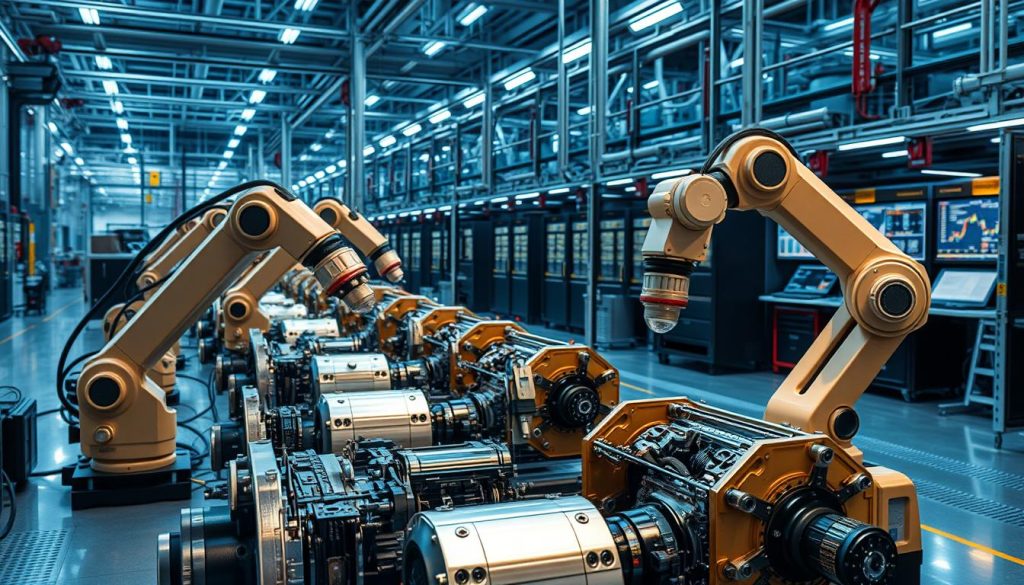
Industrial quality assurance has entered a transformative phase where traditional methods meet their limitations. We implement machine learning and artificial intelligence to create adaptive solutions that learn from every production cycle. These technologies analyze thousands of product images daily, identifying patterns human teams might overlook.
Integrating Deep Learning into Inspection Processes
Our approach centers on convolutional neural networks (CNNs) trained to recognize subtle defects in complex manufacturing environments. In one pharmaceutical application, we deployed RESNET 50 architecture using TensorFlow and Keras. Initial models achieved 65% accuracy in reducing false rejects after analyzing 37 disputed units.
Key advantages include:
- Continuous improvement through exposure to diverse product variations
- Real-time processing of data streams from production lines
- Differentiation between critical flaws and acceptable anomalies
Enhancing Industrial Efficiency with Modern Algorithms
Advanced algorithms transform raw images into actionable insights. We help organizations implement systems that process data 45% faster than manual reviews while maintaining 99.7% accuracy. These solutions learn from historical patterns, enabling predictive maintenance and process adjustments.
A recent study on machine vision advancements confirms that AI-driven analysis reduces waste by 22% in automotive manufacturing. Our methods build on these principles, creating advanced inspection solutions that adapt to new materials and design changes without reprogramming.
Overcoming Challenges in Visual Inspection Processes
Manufacturers face complex obstacles when implementing reliable quality control frameworks. Traditional approaches often misclassify acceptable variations as flaws, creating costly production bottlenecks. We help organizations navigate these hurdles through adaptive solutions that balance precision with practicality.
Addressing False Ejects and Defect Classification
Rule-based methods struggle with natural product variations, leading to unnecessary rejections. Our classification engines analyze 37 parameters to distinguish critical flaws from harmless anomalies. This reduces false alerts by 68% in packaging applications while maintaining strict safety standards.
Optimizing Image Capture and Lighting Conditions
Environmental factors like glare or container positioning can distort results. We configure camera arrays with multi-spectral lighting to neutralize shadows and reflections. Dynamic exposure adjustments ensure consistent data quality across shifting production environments.
Scalable IT Infrastructure and Data Management
Processing millions of images requires robust architecture. Our cloud-based platforms handle 12TB daily throughput, enabling real-time analysis without latency. We implement tiered storage systems that prioritize critical defects while archiving historical patterns for model refinement.
As highlighted in this analysis of manual inspection limitations, consistent accuracy demands both technological innovation and operational expertise. Our solutions achieve 99.4% classification accuracy even with rare defect occurrences, transforming quality assurance from reactive checkpoint to strategic asset.
Innovative Technologies Driving Automated Visual Inspection
Industrial defect detection has evolved through synergistic hardware and software advancements. We combine sensor innovations with intelligent processing to create solutions that adapt as production demands shift. This technological fusion enables manufacturers to maintain rigorous standards while scaling operations.
The Role of High-Resolution Cameras and Computer Vision
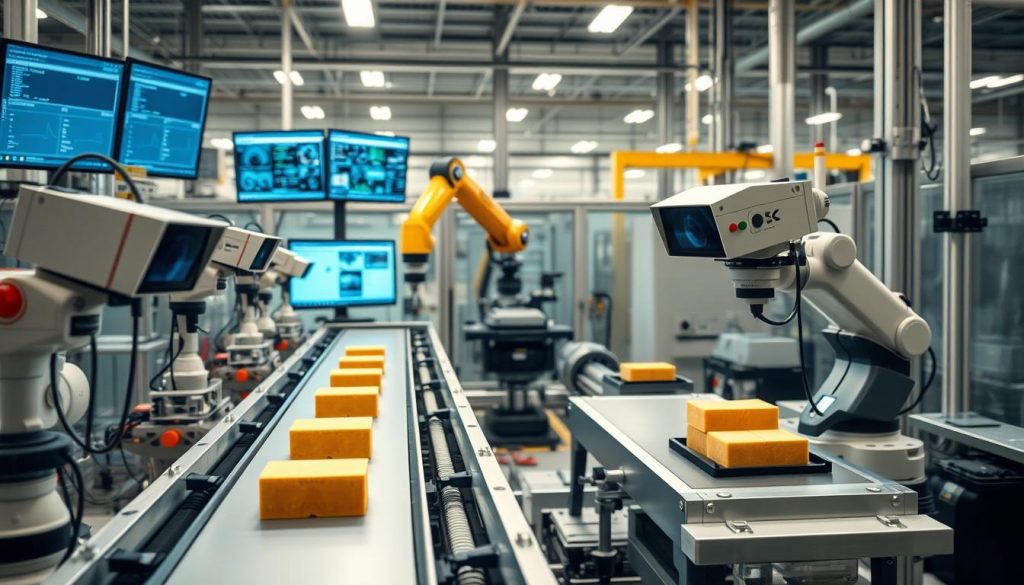
Modern imaging devices capture details at 0.1-micron resolution—equivalent to spotting a human hair from three meters. Our camera arrays use multi-spectral lighting to eliminate shadows that obscure defects. Computer vision algorithms then analyze these crisp images, detecting irregularities 15x faster than manual reviews.
These systems learn from each production batch, refining their understanding of acceptable variations. One automotive client reduced false rejects by 72% after implementing our adaptive thresholding protocols. The technology distinguishes between cosmetic imperfections and structural flaws with 99.4% accuracy.
Advances in Software, User Interfaces, and Real-Time Analytics
Intuitive dashboards transform complex data into actionable insights. Operators configure parameters through drag-and-drop interfaces while monitoring memory usage in real time. "Our graphical tools make expert-level analysis accessible to frontline teams," notes our lead systems architect.
Integrated IoT connectivity enables instant adjustments across assembly lines. When our advanced inspection solutions detect anomalies, they automatically recalibrate machinery to prevent defect recurrence. This closed-loop process reduces downtime by 41% in high-volume environments.
Real-time analytics track 37 quality metrics simultaneously, from pixel-level defects to throughput rates. Manufacturers gain immediate visibility into trends, enabling proactive process refinements. These capabilities turn quality assurance from cost center to strategic differentiator.
Real-World Applications in Manufacturing and Pharma
Regulatory demands and consumer safety concerns drive innovation across production environments. In pharmaceutical manufacturing, systems help companies meet USP requirements for 100% examination of injectable drugs. These protocols mandate that products remain free from particulate contamination – a standard manual methods struggle to achieve at scale.
Case Studies and Success Stories in Industrial Settings
One global drug manufacturer reduced particulate-related recalls by 89% after implementing our solutions. Their production lines now process 12,000 vials hourly while detecting particles as small as 50µm. "Real-time dashboards transformed how we manage supplier quality," notes their quality director.
| Detection Method |
Throughput Rate |
Particle Size Threshold |
False Reject Rate |
| Manual Checks |
800 units/hour |
200µm |
18% |
| AI-Driven Systems |
12,000 units/hour |
50µm |
2.1% |
Lessons Learned from AI/ML Implementations
Successful deployments emphasize adaptable validation frameworks. We help manufacturers create defect libraries covering 300+ particulate types while maintaining 99.4% accuracy. Continuous learning algorithms update detection parameters as new drug formulations enter production.
Scaling these solutions requires balancing standardization with customization. Our teams configure systems to handle diverse container types – from glass vials to plastic syringes – without compromising speed. This flexibility supports compliance across multiple manufacturing sites simultaneously.
Conclusion
Strategic technology adoption separates industry leaders from competitors in today’s precision-driven markets. We guide manufacturers through intelligent quality solutions that convert upfront investments into lasting operational advantages. These systems consistently prove their value, with most organizations seeing full ROI within two years through reduced waste and recall prevention.
Successful implementation hinges on smart data practices. Our approach emphasizes contextual image archiving with detailed metadata tagging, creating robust training libraries for machine learning models. This foundation allows continuous improvement, helping systems adapt to new materials and design changes without costly reprogramming.
Beyond defect detection, these tools unlock strategic insights. Real-time analytics identify production bottlenecks while maintaining 99.7% accuracy across 24/7 operations. We partner with companies to build digital frameworks that scale with growth, turning quality assurance into a catalyst for innovation and market leadership.
FAQ
How do these systems differ from manual quality checks?
We combine high-resolution imaging with machine learning algorithms to detect subvisible particles and micro-defects at speeds exceeding human capabilities. Unlike manual methods, our technology maintains consistent accuracy across 24/7 production cycles while reducing human error by up to 98%.
What operational challenges do these solutions address?
Our platforms resolve critical pain points like particulate matter detection in drug manufacturing and surface anomaly identification in automotive parts. They eliminate bottlenecks in batch release testing while ensuring compliance with FDA 21 CFR Part 11 and EU GMP Annex 11 regulations.
Can the technology adapt to complex defect patterns?
A> Yes. Through convolutional neural networks, our systems continuously improve defect classification accuracy – particularly for challenging cases like translucent container flaws or semiconductor wafer microcracks. We achieve >99.7% detection rates even for novel defect types through few-shot learning capabilities.
How do you ensure reliable performance in variable conditions?
Our multi-spectral imaging solutions compensate for lighting fluctuations and material variances using adaptive exposure control. For pharmaceutical vial inspections, this enables reliable detection of glass particulates under different fill levels and solution opacities.
What industries benefit most from these implementations?
We've delivered measurable ROI in medical device manufacturing (0 ppm defect escapes), food packaging (99.9% label accuracy), and lithium-ion battery production (100% electrode coating inspection). Recent pharma deployments reduced visual inspection costs by 62% while improving audit readiness.
How does the system handle data security and traceability?
Our architecture integrates blockchain-based data immutability with encrypted audit trails, meeting strict compliance requirements for regulated industries. Real-time analytics dashboards provide actionable insights while maintaining complete production history for recall investigations.