What if the biggest drain on your company's revenue was a problem you could see, but couldn't solve effectively with traditional methods? The American Society for Quality estimates that for many organizations, the cost of poor quality soars as high as 15-20% of annual sales. This represents billions of dollars lost annually for larger manufacturers.
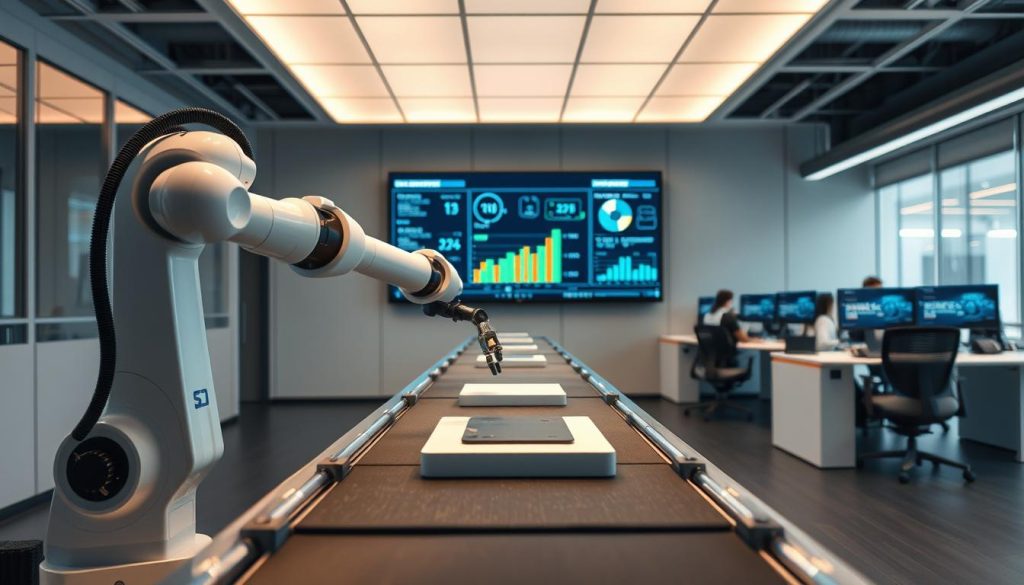
These costs stem from reworked parts, scrap, and post-sale recalls. Legacy visual inspection approaches often struggle with consistency and flexibility. They create bottlenecks that impact both production efficiency and final product quality.
We recognize this urgent need for a better solution. Modern systems represent a transformative shift. They leverage cutting-edge technologies to detect and classify defects with unprecedented accuracy. This allows manufacturers to focus on product excellence efficiently.
Key Takeaways
- Poor quality control can cost companies up to 20% of their annual sales revenue.
- Traditional inspection methods often suffer from human error and inconsistency.
- Advanced inspection technologies offer superior accuracy and consistency.
- Implementing modern systems can lead to significant cost savings and waste reduction.
- Enhanced inspection capabilities help minimize costly recalls and warranty claims.
- Adopting new inspection technology is a strategic decision for improving operational efficiency.
- These solutions are designed for rapid deployment by process engineers.
Harnessing Automated Quality Inspection AI for Superior Quality Control
The transition from manual oversight to technology-driven oversight marks a pivotal moment for production lines. We see manufacturers achieving new levels of operational excellence through this evolution. Traditional methods often struggle with the demands of modern production.
Impact on Manufacturing Efficiency
We have witnessed how these systems fundamentally transform manufacturing efficiency. They operate at significantly higher speeds than human inspectors. This enables businesses to handle large product volumes faster.
The impact extends beyond speed alone. These solutions replace human eye-based decisions influenced by fatigue and mood variations. Operators can then focus on higher-value tasks while the system maintains constant vigilance.

Enhanced Defect Detection and Consistency
Enhanced detection capabilities represent a compelling advantage. These systems eliminate the subjectivity inherent in manual processes. They ensure consistent, accurate identification across all production shifts.
Consistency in control is critical for maintaining brand reputation. The technology applies identical detection criteria to every product. This occurs regardless of time of day or production pressures.
The combination of accuracy and consistency creates powerful benefits. Fewer defective products reach later stages or customers. This reduces rework costs and minimizes waste.
Innovative Technologies and Benefits in Inspection Processes
Contemporary production environments demand sophisticated detection systems that can adapt to complex manufacturing scenarios. We develop integrated solutions that combine multiple technological approaches for comprehensive oversight.
Utilizing Machine Vision, Sensors, and Deep Learning
Our approach integrates industrial cameras with specialized optics and lighting systems. These components capture ultra-high resolution images revealing surface imperfections.
Deep learning neural networks analyze these images with remarkable precision. They handle natural variations in acceptable products while identifying subtle defects.
| Technology Component |
Primary Function |
Key Benefit |
| Industrial Cameras |
Capture high-resolution images |
Detects pixel-level defects |
| Specialized Lighting |
Illuminate parts effectively |
Reveals surface variations |
| Deep Learning Algorithms |
Analyze complex patterns |
Adapts to product variations |
| Processing Units |
Run analysis in real-time |
Enables immediate decisions |
Operational Efficiency and Cost Reduction
These systems dramatically reduce manual labor requirements. They achieve this while maintaining consistent oversight across all production shifts.
The technology builds accurate models with significantly fewer training images. This accelerates implementation while reducing associated expenses.
Real-time Data Analysis and Process Optimization
Continuous data generation enables proactive quality management. Manufacturers can identify trends and predict potential issues before escalation.
This analytical capability supports informed decision-making for process improvements. It creates a foundation for sustained competitive advantage.
Overcoming Challenges and Seamless Integration in Quality Control
Adopting new technology requires careful planning to address real-world complexities. We focus on making this transition smooth for manufacturers.

Navigating Complex Production Processes
Every manufacturing environment is unique. We understand that automotive parts differ greatly from food packaging or electronics.
Our systems are designed to handle these variations. They learn the specific patterns of your production lines.
This flexibility allows for accurate detection of deviations on different surfaces and parts.
Integrating AI with Existing Systems
We believe in building upon what already works. Our solutions connect with your current control systems.
This integration provides valuable data without halting your processes. It enhances your existing operations with advanced intelligence.
Our team works closely with your staff to ensure a perfect fit.
| Challenge |
Our Solution |
Benefit |
| Complex Process Variations |
Adaptive learning algorithms |
Handles diverse product lines |
| System Integration |
Compatible data protocols |
Seamless connectivity |
| Initial Implementation |
Phased deployment strategy |
Reduces operational costs |
| Data Management |
Real-time analysis |
Improves decision speed |
FAQ
How does this technology enhance consistency in production?
Our systems maintain consistent standards by continuously monitoring production lines for deviations. We identify variations in real-time, ensuring every component meets specifications without human error.
What types of defects can your system detect?
Our advanced vision systems identify surface flaws like scratches, measure dimensions, and spot irregularities across various materials. Deep learning algorithms adapt to detect both common and unique defect patterns.
Can this solution integrate with existing manufacturing operations?
A>Yes, we design our technology to seamlessly integrate with current manufacturing systems. Our team works closely with manufacturers to ensure smooth implementation without disrupting ongoing processes.
How does real-time data analysis benefit our operations?
Immediate data processing allows for quick adjustments during manufacturing, reducing waste and improving overall efficiency. This proactive approach helps maintain high standards throughout production.
What industries benefit most from this technology?
While applicable across sectors, manufacturers in automotive, electronics, and food production see significant improvements in accuracy and speed using our intelligent inspection solutions.
How does this approach reduce operational costs?
By automating visual inspection tasks, we help minimize manual labor requirements and decrease errors. This leads to lower production costs and higher throughput while maintaining superior product quality.
Editorial standards: This article was written by a certified practitioner and peer-reviewed by our engineering team. We update content quarterly to ensure technical accuracy. Opsio maintains editorial independence — we recommend solutions based on technical merit, not commercial relationships.