Can a move to a new cloud environment truly boost your business while avoiding the outages and delays most teams fear? We often see leaders expect a quick lift and then meet unexpected complexity, so we built a clear, repeatable approach that focuses on outcomes, not just technical change.
We guide your organization through a pragmatic migration process, aligning cloud goals with business metrics and establishing accountability from day one. Our method covers discovery, design, migration, go-live, and ongoing support, with rehearsals and rollback plans to protect service levels.
We measure success against KPIs for user experience, application health, and infrastructure use, and we prioritize minimal disruption through workload sequencing that respects peak periods. With a named migration architect and embedded cost governance, your team gains skills, documentation, and observability that drive continuous optimization.
Key Takeaways
- We pair technical planning with business-focused KPIs for measurable results.
- Clear phases and decision gates reduce risk and make timelines predictable.
- Rehearsals, rollback readiness, and sequencing minimize downtime.
- Named ownership keeps architecture, budgets, and schedules aligned.
- Ongoing support, training, and cost governance enable long-term success.
Why cloud migration matters now: context, benefits, and business impact
Right now, leaders accelerate moves toward modern hosting because speed, security, and cost control shape competitiveness.
Present-day drivers include rapid vendor investment and broad market adoption; nearly 80% of small firms had migrated their infrastructure by 2020, and public spending is forecast above $678.8B in 2024, which fuels faster rollout of new features and agile operating models.
Security, scalability, and performance gains
We see stronger defenses via managed identity, encryption-by-default, and continuous patching, which reduce risk and ease audits.
Elastic scaling and global regions lower latency, while managed services improve throughput for critical user journeys, preserving conversion and uptime during spikes.
Reducing disruption while maximizing ROI
Good governance—landing zones, policy-as-code, and clear budgets—keeps drift low and costs visible.
- Sequence low-dependency components first, rehearse cutovers, and use reverse proxy patterns for safe traffic shifts.
- Track ROI levers: faster time-to-market, higher developer velocity, fewer incidents, better customer satisfaction.
We pair phased practice with stakeholder communications, raising confidence and ensuring the shift delivers measurable business value.
Defining your migration process: phases and operating models
We break the program into clear phases so teams can track progress and limit risk.
Discovery, design, migration, go-live, and ongoing support
Discovery catalogs systems, maps dependencies, records SLAs, and sets KPIs tied to business results.
Design produces a target blueprint that covers network topology, identity, resilience patterns, and observability.
Migration covers infrastructure builds, app transfers, and data validation with rollback guardrails.
Go-live focuses on final sync, cutover rehearsals, and performance verification.
Ongoing support defines SLOs, operational handoffs, and continuous optimization.
Models and architectural choices
We compare public, private, hybrid, and community models, weighing governance, scalability, and control, then align the selected model to regulatory needs and workload criticality.
Single-provider designs simplify integration, while multi-provider and vendor-agnostic patterns reduce lock-in but add orchestration work.
| Model |
Governance |
Scalability |
Best use |
Trade-off |
| Public |
Policy-driven |
High |
Web tiers, analytics |
Vendor integration |
| Private |
Strict |
Moderate |
Regulated systems |
Higher infra cost |
| Hybrid |
Mixed |
Flexible |
Compliance + elasticity |
Operational complexity |
| Community |
Shared rules |
Variable |
Sector-specific needs |
Limited scale |
Example: keep regulated databases on private infrastructure while using public cloud services for web and analytics. This eases compliance and improves performance during peaks.
Align business goals and requirements before you move
Before any cutover, we translate executive priorities into measurable outcomes so every technical choice links back to business value.
Translating objectives into success drivers and KPIs
We convert strategic aims—growth, agility, resilience, and customer experience—into clear success drivers with measurable KPIs.
That includes user metrics like response time and error rates, application signals such as availability, and infrastructure indicators like CPU and network throughput.
Baselines and target thresholds are recorded so go/no-go decisions are objective and post-move improvements are verifiable.
Risk, compliance, and cost considerations for your organization
We capture regulatory requirements up front, including data residency, encryption, and retention policies that shape architecture and provider selection.
Risk assessments span tech, ops, and finance, and we add mitigations such as phased cutovers, rollback plans, and contingency budgets.
Cost discipline is enforced with OpEx tagging and showback so executives see spend aligned with value, and budget owners manage variance.
We integrate security, finance, and operations into a single requirements document and formalize acceptance criteria for each phase, which preserves schedule and accountability.
Assessment first: inventory, dependencies, and current environment baselines
Assessment starts with facts — a service map, baseline metrics, and a readiness score that guides sequencing. We catalog systems, capture traffic patterns, and measure peak behavior so decisions rest on representative data.
Mapping systems, databases, and infrastructure
We inventory applications, integrations, databases, messaging queues, and batch jobs, producing a visual service map. This reveals hidden coupling and identifies replication and failover paths.
Identifying pain points and readiness
We flag constraints like old OS versions, scaling limits, noisy neighbors, and slow provisioning. Each item gets a remediation category: refactor, containerize, or reuse.
Setting measurable baselines
We collect KPIs for user lag, error rates, availability, CPU, memory, and network throughput over representative and peak windows. That creates targets for post-move validation.
Deliverables
| Artifact |
What it shows |
Impact |
Next action |
| Service map |
Dependencies and flows |
Safe sequencing |
Prioritize waves |
| Readiness scorecard |
Complexity and risk |
Prioritized list |
Assign refactor effort |
| Baseline report |
Performance and costs |
Validation targets |
Inform sizing |
| Findings & recommendations |
Actionable plan |
Accelerated planning |
Move into design |
From strategy to plan: migration architecture, provider, and deployment choices
We translate strategy into an executable architecture that balances risk, cost, and operational readiness. This creates a single reference that guides design, provider selection, and the production switchover.
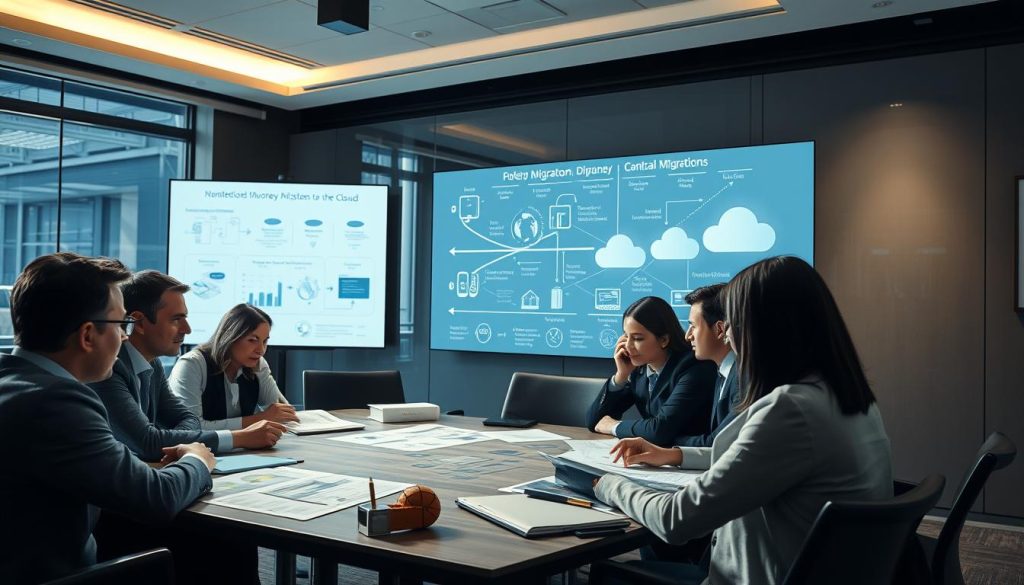
Establishing the migration architect role and governance
We appoint a migration architect who owns end-to-end coherence, from target architecture to governance and cutover rules.
The architect sets refactor scope, sequences data movement, and defines rollback criteria so teams can act with clarity.
Choosing a provider and service expectations
We evaluate providers against regions, SLAs, managed services, identity, networking, and compliance certifications.
That scorecard drives the choice of provider and the documented service level expectations for latency, availability, and support.
Rehost, replatform, refactor: selecting the right approach
We match each workload to a strategy: rehost for speed, replatform for near-term gains, or refactor for long-term elasticity.
Design decisions consider auto-scaling, serverless options, and cloud-native datastores where they deliver measurable benefit.
Creating a migration plan that minimizes downtime
We build a wave-based migration plan with baselined KPIs, cutover windows, training, and clear rollback gates.
Cost and capacity guardrails are set up with tags and alerts, and final acceptance criteria link every work item to a measurable outcome.
| Focus |
Deliverable |
Why it matters |
| Architecture |
Documented target blueprint |
Guides build and testing |
| Provider |
Selection & SLA matrix |
Aligns expectations and risk |
| Plan |
Waves & rollback playbooks |
Minimizes downtime and preserves trust |
application migration to cloud steps
We sequence work by risk and dependency so teams gain early wins while limiting service impact. This makes the program measurable and keeps user disruption low.
Prioritize components and sequence workloads
Dependency maps guide which services move first: low-coupling systems, stateless web tiers, and noncritical APIs get priority. That reduces blast radius and builds confidence.
Prepare infrastructure: provisioning, configuration, and connectivity
We provision networks, compute, and storage with infrastructure as code, harden OS images, and set IAM rules before any cutover. Connectivity tests verify links between legacy systems and the new environment, and we log results in runbooks.
Migrate applications with testing and CI/CD updates
Applications move in controlled waves, with CI/CD pipelines updated for environment parity and ephemeral test environments. Automated smoke and regression tests run after each wave, and KPIs gate progress.
Data ETL, validation, and quality controls in the new environment
Data transfers follow ETL patterns with schema checks, checksum comparisons, and reconciliation reports. We use dual-write or sync where needed, rehearse point-in-time restores, and only cut over consumers in staged windows.
- Backups: Keep point-in-time recovery ready and rehearse restores.
- Automation: Run smoke tests and baseline performance checks post-deploy.
- Documentation: Maintain runbooks and change logs for every wave.
| Phase |
Key action |
Guardrail |
| Prioritization |
Dependency map and waves |
Low-coupling first |
| Infrastructure |
Provisioning & connectivity tests |
IaC, hardened images |
| Application |
CI/CD updates & automated tests |
Environment parity |
| Data |
ETL, checksums, reconciliation |
Dual-write or staged cutover |
We align the migration plan with maintenance windows and customer demand, so cutovers avoid peak revenue moments and restore confidence in operations.
Deep dive: data migration strategies that protect performance and integrity
Successful transfers hinge on pragmatic sync patterns, resource sizing, and thorough validation under load. We involve the migration architect early, so data plans align with network topology, compute placement, and rollback rules.
Bi-directional sync, phased cutover, and managed services
Options: long-running bi-directional sync for gradual switchover, or one-way replication with a controlled cutover to reduce drift.
We leverage managed replication tools for bulk seeding and continuous replication, then validate throughput, lag, and conflict resolution under representative load.
Latency, placement, and datastore selection
Place data near compute for chatty services, and choose datastores by access patterns—relational for ACID needs, document or key-value for fast reads, analytics stores for reporting.
We model peak windows, provision replication capacity, and run reconciliation jobs so user-facing performance stays steady during transition.
| Strategy |
When to use |
Key validation |
| Bi-directional sync |
Long transition, low write contention |
Conflict resolution tests, lag under load |
| One-way with cutover |
Decisive switch, simpler drift control |
Final sync checksums, cutover dry-runs |
| Managed migration service |
Large datasets, minimal ops burden |
Throughput benchmarks, security audit |
Example: keep on-premises as the record of truth while cloud consumers are validated, then flip writes and deprecate legacy paths. We document runbooks for monitoring, failure recovery, and key management so teams act quickly and confidently.
Switching on production: go-live tactics and rollback readiness
Switching live traffic requires precise timing, clear gates, and rehearsed fallbacks so service continuity is never left to chance.
We schedule a data freeze inside an agreed maintenance window, run a final sync, and validate checksums so the new environment has a clean baseline. Trial runs simulate the full cutover, measuring sync time, smoke tests, and proxy or DNS propagation.
Data freeze, final sync, and trial runs
We lock writes for the shortest time practical, perform the final transfer, and run integrity checks before any traffic shift. Then we run at least one full rehearsal that mirrors peak conditions.
All-at-once cutover vs. phased customer switchover
All-at-once is simpler for small, stateless stacks and gives a single validation point.
Phased switchover is safer for high-risk systems: start with internal users, then a small external cohort, then full release, gating each phase with KPIs and an error budget.
Reverse proxy strategies and contingency plans
We use a reverse proxy or global traffic manager to steer traffic, enabling blue/green or canary patterns and rapid rollback.
We predefine rollback criteria, confirm backups and snapshots, and document the restore workflow so a reversion is fast if key indicators breach thresholds.
| Focus |
Action |
Why it matters |
Gate |
| Data |
Freeze, final sync, checksum validation |
Prevents mismatches and data loss |
Integrity pass |
| Cutover Mode |
All-at-once or phased cohorts |
Balances speed and risk |
KPI gates per phase |
| Routing |
Reverse proxy / traffic manager |
Controlled routing and fast failback |
Traffic shift monitoring |
| Rollback |
Pre-approved restore playbook |
Minimizes downtime if needed |
Restore validated |
Observability is essential: logs, traces, metrics, and synthetic checks must be live before traffic moves so anomalies are detected and traced quickly.
We communicate schedules and impact to teams and customers, keep contingency plans for third-party failures, and finish with a post-cutover checklist that checks data currency, access controls, and feature parity across the new environment.
Operate and optimize: governance, observability, and cost control
Sustained value arrives when governance, telemetry, and cost controls are embedded in daily operations. Post-cutover routines protect performance and keep spend predictable, while automated guardrails reduce human error and speed recovery.
Security updates, compliance, and performance monitoring
We enforce monthly patching, dependency scans, secret rotation, and drift detection so the environment meets audits and keeps threats at bay.
Observability spans logs, metrics, traces, RUM, and synthetics, giving teams early warning of regressions and a fast path for remediation.
Right-sizing, auto-scaling, and resource allocation best practices
We review resource allocation regularly and move workloads from static capacity to dynamic scaling to avoid overprovisioning and reduce costs.
Right-sizing combines automated utilization reports, commitment analysis, and lifecycle policies for storage and compute.
DevOps enablement and continuous improvement in the cloud
We enable teams with CI/CD, infrastructure as code, and automated testing so deployments are frequent, reversible, and safe.
SLIs and SLOs translate performance into business terms; error budgets balance reliability work with feature delivery.
- Governance: identity, network controls, encryption, backups, and change approvals enforced by policies.
- Databases: PITR tests, backup verification, index tuning, and storage class optimization.
- Platform: leverage managed caching, serverless, and eventing to reduce toil and increase resilience.
- Support: runbooks, on-call rotations, and postmortems that close the learning loop.
| Focus |
Ongoing Action |
Business Benefit |
| Governance |
Policy automation & audits |
Lower risk, faster compliance |
| Observability |
Full-stack telemetry |
Faster incident detection |
| Cost |
Right-sizing & alerts |
Predictable OpEx |
We tie spend dashboards to business metrics, run periodic load and application-level tests, and keep teams focused on continuous optimization so the investment delivers sustainable outcomes for the organization.
Conclusion
We close by reaffirming that disciplined planning, clear ownership, and measured gates make a complex migration process predictable and safe.
Appoint a named architect, set KPIs, and sequence workloads with rehearsed rollback plans so teams can act with confidence, not guesswork.
Data strategies—sync choices, placement, and integrity checks—must come early, and go-live should be a managed event with trials, communications, and contingencies that protect customer experience.
After cutover, sustain value with observability, governance, right‑sizing, and DevOps practices that reduce costs and drive continuous improvement.
We invite collaboration to adapt this framework to your context and accelerate results with proven patterns and experienced guidance for successful cloud migration.
FAQ
What is the typical order of phases in our expert process?
We begin with discovery, then design, followed by the move itself, go-live activities, and ongoing support. Each phase includes inventory, dependency mapping, testing, and governance checkpoints so teams, data, infrastructure, and services move in a controlled sequence that minimizes downtime and risk.
Why should an organization consider moving its workloads now?
Modern business drivers include faster time-to-market, predictable operational costs, improved resilience, and the ability to scale resources on demand. Adopting a new environment also unlocks managed services, better security controls, and analytics capabilities that help improve performance and reduce total cost of ownership.
How do we protect security and compliance during the transition?
We apply a layered approach: baseline assessments, role-based access, encryption in transit and at rest, continuous monitoring, and compliance checks against relevant standards. Governance and change control are enforced throughout the process so controls remain effective from planning through steady-state operations.
Which operating models should we evaluate: public, private, hybrid, or community?
Selection depends on regulatory constraints, latency needs, and cost targets. Public providers offer rapid elasticity and broad managed services, private clouds deliver stronger isolation, hybrid blends on-premises systems with hosted services, and community clouds suit shared compliance needs. We align model choice with business goals and KPIs.
Should we use a single provider, multiple clouds, or remain cloud-agnostic?
Each approach has trade-offs: a single provider simplifies management and can reduce costs through committed usage, multi-cloud avoids vendor lock-in and optimizes best-of-breed services, while cloud-agnostic designs emphasize portability but may increase complexity. We recommend a strategy driven by application criticality, data residency, and long-term vendor strategy.
How do we translate business objectives into measurable success criteria?
We map objectives to KPIs such as latency, availability, cost per transaction, and deployment frequency. Clear SLAs and success gates are defined during planning so stakeholders can track progress and validate that performance, resilience, and financial targets are met after the move.
What should an initial assessment cover for inventory and readiness?
The assessment catalogs servers, services, databases, middleware, and network topology, captures dependencies and constraints, measures current performance baselines, and evaluates cloud readiness. This inventory informs cost models, migration sequencing, and any required refactoring.
How do we choose between rehost, replatform, and refactor approaches?
We recommend rehosting for rapid moves with minimal code changes, replatforming to exploit managed services with moderate changes, and refactoring when long-term agility and cost savings justify deeper redesign. Decisions are based on lifecycle, technical debt, and expected ROI.
What techniques reduce downtime during the cutover?
Proven tactics include phased migration, blue/green deployments, canary releases, bi-directional synchronization, and final sync windows with brief data freeze. We also prepare rollback plans and automated tests so teams can revert quickly if issues arise.
How do we handle data transfer while preserving integrity and performance?
We use staged ETL, secure transfer protocols, checksum validation, and consistency checks. For large datasets, we apply parallel transfers, compression, and placement strategies to reduce latency, and we validate data quality in the target environment before cutover.
What are the key go-live readiness checks?
Readiness includes successful end-to-end testing, validated backups, performance baselines met, monitoring and alerting configured, stakeholder sign-off, and a rehearsed rollback procedure. We also confirm DNS, routing, and security policies are live and monitored.
How do we control ongoing costs and optimize resources after the move?
We implement observability, tagging, rightsizing, reserved or committed usage where appropriate, and automated scaling. Regular reviews identify orphaned resources, inefficient instance types, and opportunities to adopt managed platform services that lower operational burden and cost.
What role does DevOps play in post-move operations?
DevOps enables continuous delivery, faster incident response, and automation of provisioning and testing. We establish CI/CD pipelines, infrastructure-as-code, and monitoring integrations so teams can iterate safely and improve performance through measurable feedback loops.
How do we choose the right provider and define service expectations?
Provider selection considers service catalog, regional presence, security posture, pricing models, and support SLAs. We draft clear service expectations covering availability, recovery time objectives, and escalation procedures, aligning them with contractual terms and business needs.
What contingencies should be planned for rollback scenarios?
Contingency planning includes validated backups, automated rollback scripts, preserved source environment integrity, and communication plans. We perform trial rollbacks during testing to ensure teams can restore services quickly with minimal data loss if required.