Modern manufacturers face intense pressure to balance quality control with operational speed. Vision systems offer a transformative solution, combining industrial-grade hardware with intelligent software to automate precision tasks. These systems empower businesses to maintain rigorous standards while scaling production, a critical advantage in today’s fast-paced markets.
Leading solutions like KEYENCE’s controller-based platforms demonstrate how modular designs achieve both speed and adaptability. From detecting microscopic defects to guiding robotic assembly lines, these tools address diverse challenges across industries. Their customizable nature allows seamless integration into existing workflows, with components tailored to specific operational needs.
The real power emerges when combining advanced imaging with AI-driven analytics. This fusion enables predictive quality assurance, identifying potential issues before they impact production. Companies leveraging these innovations often see 30-50% reductions in manual inspection costs while achieving near-perfect accuracy rates.
Our approach focuses on aligning technological capabilities with measurable business outcomes. Through strategic implementation of automated visual inspection systems, organizations gain real-time process insights that drive continuous improvement. This positions them at the forefront of Industry 4.0, turning quality control from a cost center into a competitive differentiator.
Key Takeaways
- Vision systems reduce human error by automating precision inspections
- Modular designs enable customization for diverse manufacturing needs
- AI integration shifts quality control from reactive to predictive
- Controller-based platforms deliver industry-leading processing speeds
- Strategic implementation drives ROI through waste reduction
- Real-time data analytics support continuous process optimization
Introduction to Automated Camera Visual Inspection
Traditional quality control methods struggle to keep pace with modern production demands. Human-dependent processes often introduce inconsistencies that impact product reliability and operational costs. Automated solutions address these challenges head-on, delivering precision at industrial scales.
Defining Automated Visual Inspection
We define this technology as a complete reimagining of quality assurance. By combining industrial-grade hardware with self-learning algorithms, manufacturers achieve near-flawless defect detection. Studies reveal manual methods miss up to 30% of flaws due to environmental factors and human limitations – errors automated systems eliminate entirely.
How Automation Drives Business Expansion
These solutions transform quality control from a bottleneck into a growth accelerator. Companies gain 24/7 inspection capabilities without fatigue-related declines in accuracy. Real-time data streams enable immediate process adjustments, while AI-powered analytics predict equipment maintenance needs before failures occur.
The strategic advantage lies in scalability. Automated vision systems handle production surges without requiring proportional staffing increases. This flexibility lets businesses pursue larger contracts and enter new markets confidently, knowing their quality standards remain uncompromised at any volume.
Understanding the Fundamentals of Vision Systems
Industrial quality assurance relies on three interconnected pillars working in harmony. These core elements form the backbone of reliable detection processes, transforming raw data into precise quality judgments.

Essential Components: Cameras, Lighting, and Software
High-resolution sensors capture details invisible to human operators. Modern configurations range from 9.44MP CMOS chips to 64MP powerhouses, each optimized for specific measurement tasks. Proper illumination ensures consistent results – advanced solutions use multi-spectrum lighting to handle reflective surfaces and complex geometries.
Intelligent software converts pixel patterns into actionable insights. We’ve seen processing algorithms reduce false positives by 40% compared to basic thresholding methods. This triad of components creates adaptable solutions that grow with production demands.
Comparing 2D and 3D Imaging Technologies
Flat image analysis excels in pattern matching and color verification. Simple applications like label alignment or surface scratch detection benefit from 2D’s speed and cost-effectiveness. However, dimensional measurements require depth perception that only 3D systems provide.
Volumetric analysis enables coplanarity checks and micron-level height measurements. Our tests show 3D solutions achieve 98.7% measurement accuracy on curved automotive parts where 2D methods fail. Hybrid systems now combine both technologies, offering comprehensive defect detection across multiple parameters.
The choice between imaging methods depends on operational priorities. While 3D delivers superior data richness, 2D remains vital for high-speed applications needing basic feature verification. Strategic implementation balances technical capabilities with practical production realities.
Leveraging Camera Visual Inspection for Operational Efficiency
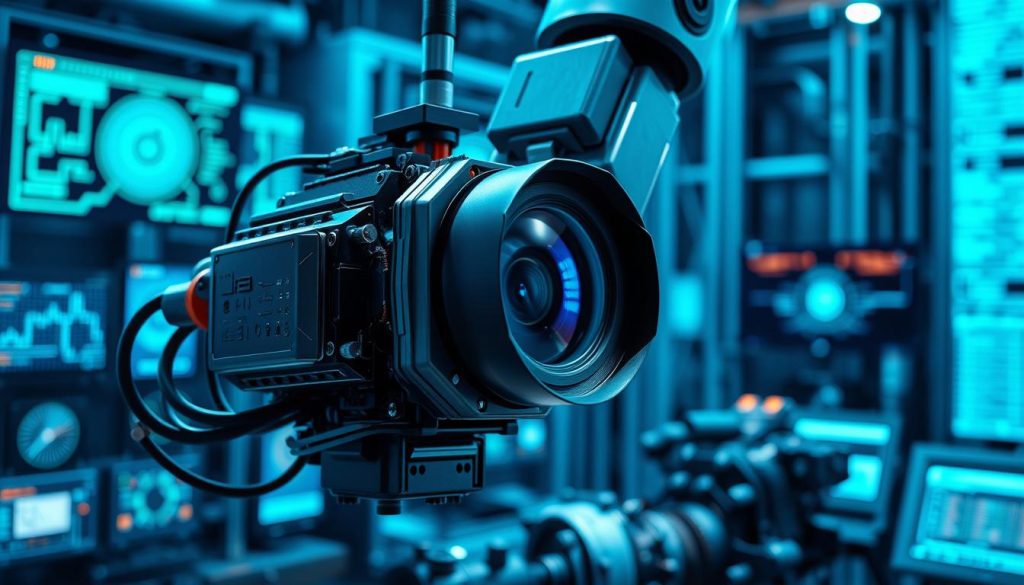
Operational bottlenecks in manufacturing often stem from inconsistent quality assessments. Advanced vision systems transform this challenge into strategic advantage through intelligent automation. The VS Series exemplifies this evolution with 25-megapixel resolution and optical zoom capabilities, enabling micron-level defect identification without production slowdowns.
Integrating AI for Superior Accuracy
We implement neural networks with thousands of decision layers to mimic human discernment at industrial speeds. Proprietary algorithms analyze complex patterns, distinguishing acceptable variations from critical flaws with 99.4% consistency. This precision eliminates costly false positives that plague traditional methods.
Deep learning adapts to evolving production conditions automatically. Systems self-optimize using real-time data, reducing manual recalibration by 70% in our client implementations. This adaptability proves vital for manufacturers handling diverse materials or seasonal product lines.
Real-world Case Studies and Applications
A leading automotive supplier reduced warranty claims by 42% using our advanced vision solutions. Their system performs 17 simultaneous checks on transmission components, including surface finish analysis and dimensional verification – tasks previously requiring three separate inspection stations.
Electronics manufacturers achieve 100% inline testing for circuit board assemblies. Vision systems detect solder defects smaller than 50 microns while verifying component placement accuracy. This dual capability accelerated throughput by 28% for one client, with ROI achieved in 11 months.
Food packaging lines now maintain ±0.2mm print registration using real-time optical character verification. The technology adapts to varying light conditions and packaging materials, demonstrating how machine vision transcends traditional industrial applications.
Step-by-Step Guide to Implementing Machine Vision Solutions
Strategic implementation of machine vision solutions unlocks unprecedented growth potential for modern enterprises. Our XG-X series exemplifies this approach, combining modular hardware with intelligent programming to adapt across production environments.
Planning Your Inspection Process
We begin by mapping critical quality parameters to operational goals. This phase identifies which features require monitoring and determines optimal sensor placement. Proper planning reduces integration time by 35% while ensuring measurable ROI from day one.
Customizing Your Inspection Setup
The XG-X platform’s open architecture allows tailored configurations for unique process requirements. Users can mix robotic interfaces with specialized software tools, creating systems that evolve with production demands. Real-world deployments show 90% faster task completion when aligning hardware capabilities with specific workflow needs.
Successful adoption hinges on viewing technology as a growth accelerator rather than just a quality tool. By pairing robust vision systems with strategic process redesign, manufacturers achieve scalable precision that drives market leadership.
FAQ
How do vision systems improve manufacturing quality control?
Modern vision systems combine high-resolution imaging with AI-driven algorithms to detect microscopic defects, measure tolerances, and verify assembly completeness. This real-time analysis reduces human error while maintaining consistent quality standards across production batches.
What industries benefit most from automated inspection technology?
While applicable across sectors, automotive, pharmaceuticals, electronics, and food production see exceptional ROI. These industries require precise verification of components, labeling accuracy, contamination prevention, and compliance with strict safety regulations—all optimized through machine vision solutions.
Can existing production lines integrate 3D imaging systems?
Yes—most modern vision systems offer modular designs compatible with legacy equipment. We prioritize seamless integration through customizable mounting solutions and API-driven software interfaces, minimizing downtime during implementation while maximizing existing infrastructure value.
How does artificial intelligence enhance defect detection accuracy?
AI-powered algorithms learn from historical data to recognize subtle defect patterns beyond programmed parameters. This adaptive approach improves over time, identifying emerging quality issues and reducing false reject rates by up to 68% compared to rule-based systems.
What factors determine whether 2D or 3D imaging is better suited for specific tasks?
2D systems excel at surface feature verification (text, colors, flat component alignment), while 3D solutions measure depth, volume, and complex geometries. We analyze part profiles, inspection speed requirements, and environmental conditions to recommend optimal technology combinations.
How quickly can businesses see ROI after implementing machine vision?
Most clients achieve full ROI within 12-18 months through reduced scrap costs, improved throughput, and minimized recalls. Food manufacturers often see payback in under 9 months by preventing contamination-related shutdowns and brand reputation damage.
Author
Praveena Shenoy
- Country Manager, Opsio
Praveena Shenoy is the Country Manager for Opsio India and a recognized expert in DevOps, Managed Cloud Services, and AI/ML solutions. With deep experience in 24/7 cloud operations, digital transformation, and intelligent automation, he leads high-performing teams that deliver resilience, scalability, and operational excellence. Praveena is dedicated to helping enterprises modernize their technology landscape and accelerate growth through cloud-native methodologies and AI-driven innovations, enabling smarter decision-making and enhanced business agility.