Mastering Infrastructure as Code Tools for Efficient IT Management
March 12, 2026|7:30 AM
Unlock Your Digital Potential
Whether it’s IT operations, cloud migration, or AI-driven innovation – let’s explore how we can support your success.
Home /
Work /
Blogs /
Mastering Infrastructure as Code Tools for Efficient IT Management
Understanding Infrastructure as Code Tools: Your 2026 How-To Guide
The landscape of modern IT infrastructure demands speed, consistency, and reliability. Manual infrastructure provisioning and management are no longer sustainable in today’s dynamic environments. This is where infrastructure as code (IaC) tools step in, revolutionizing how organizations define, deploy, and manage their computing resources.
This comprehensive guide will demystify infrastructure as code tools, providing you with a foundational understanding and practical insights. We will explore key concepts, delve into leading IaC automation tools, and offer a step-by-step approach to implementation. By the end, you’ll be well-equipped to leverage IaC for your own projects, ensuring efficient and scalable infrastructure management.
Why Adopt Infrastructure as Code? Unlocking Key Benefits
Embracing infrastructure as code tools offers a multitude of benefits that address common challenges in traditional IT operations. From enhanced reliability to accelerated deployment, IaC transforms the way infrastructure is handled. It shifts the paradigm from manual processes to automated, repeatable workflows.
One primary advantage is consistency. By defining infrastructure in code, you eliminate human error and ensure that every environment, whether development, testing, or production, is provisioned identically. This drastically reduces configuration drift and “it works on my machine” scenarios.
Speed is another significant benefit. IaC automation tools allow for rapid provisioning of entire environments in minutes, not hours or days. This agility supports continuous integration and continuous delivery (CI/CD) pipelines, accelerating time to market for applications and services. Furthermore, version control systems manage IaC configurations, providing a clear history of changes and enabling easy rollbacks if issues arise.
Cost efficiency is also a major driver for IaC adoption. By automating infrastructure provisioning and scaling, organizations can optimize resource utilization and reduce operational overhead. This translates into tangible savings, especially in cloud environments where precise resource allocation is crucial. Disaster recovery also becomes streamlined, as entire infrastructures can be rebuilt quickly from their code definitions.
Key Principles of Effective Infrastructure as Code
Successful implementation of infrastructure as code tools hinges on adhering to several core principles. These principles ensure that your IaC practices are robust, maintainable, and deliver maximum value. Understanding them is crucial before diving into specific IaC frameworks.
One fundamental principle is idempotency. This means that applying your IaC configuration multiple times will result in the same infrastructure state without causing unintended side effects. Each execution produces the desired outcome, making operations predictable and safe.
Version control is another cornerstone. All IaC code should be stored in a version control system like Git. This allows teams to track changes, collaborate effectively, review code, and easily revert to previous configurations when necessary.
Declarative versus Imperative approaches define how you specify your infrastructure. Declarative IaC (like Terraform) focuses on “what” the desired state of the infrastructure should be, letting the tool figure out “how” to achieve it. Imperative IaC (like traditional scripts) specifies the exact steps to take. Most modern IaC automation tools favor a declarative approach for its simplicity and robustness.
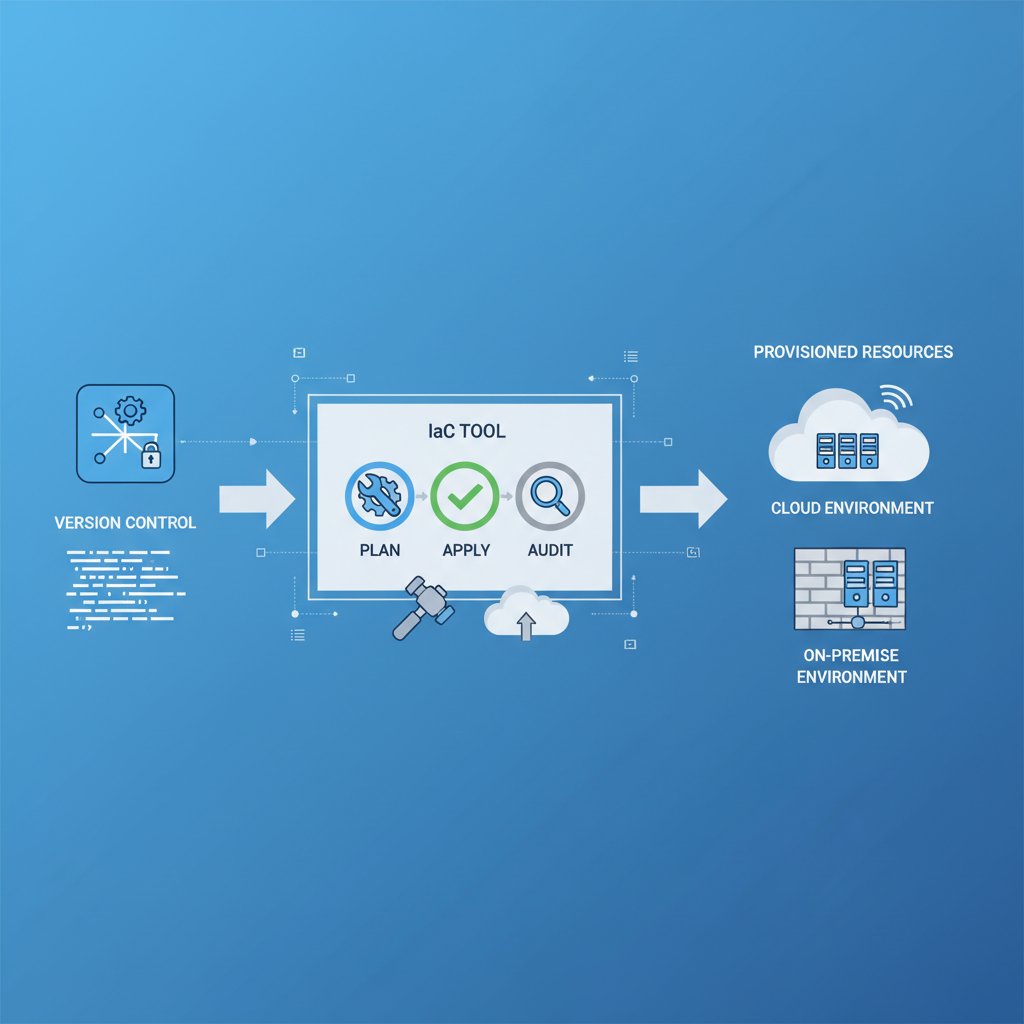
A diagram showing the IaC workflow, starting from code in version control, moving through an IaC tool, and finally provisioning resources in a cloud or on-premise environment.
Modularity is also vital. Breaking down your infrastructure definitions into smaller, reusable modules or components enhances readability and manageability. This allows for creating standardized blocks of infrastructure that can be easily composed to build complex environments. Security by design should be integrated throughout, ensuring that infrastructure is provisioned with appropriate access controls and configurations from the outset.
✓ Free consultation ✓ No commitment required ✓ Trusted by experts
Top Infrastructure as Code Tools in 2026
The market for infrastructure as code tools is vibrant, with several powerful solutions available. Each tool has its strengths, ideal use cases, and preferred syntax. Choosing the right one often depends on your specific cloud environment, team’s skill set, and project requirements. Here, we highlight some of the leading IaC automation tools.
Terraform
Terraform, developed by HashiCorp, is arguably one of the most popular infrastructure provisioning software solutions available. It is an open-source tool that allows you to define and provision datacenter infrastructure using a declarative configuration language known as HashiCorp Configuration Language (HCL). Terraform excels at managing infrastructure across multiple cloud providers (AWS, Azure, GCP, VMware, OpenStack, etc.) and on-premises environments.
Teams use Terraform to manage everything from virtual machines and networks to databases and load balancers. Its provider-based architecture allows it to integrate with virtually any platform that exposes an API. This makes it an incredibly versatile tool for multi-cloud strategies.
Key features include its state file, which tracks the real-world state of your infrastructure, and its `terraform plan` command, which shows you exactly what changes will be applied before execution. This predictive capability is invaluable for preventing unexpected outcomes. Many consider Terraform an essential component of modern IaC frameworks.
Ansible
Ansible, an open-source project sponsored by Red Hat, primarily functions as a configuration management tool and orchestration engine. Unlike Terraform, which focuses on provisioning infrastructure, Ansible specializes in automating software provisioning, configuration management, and application deployment on existing infrastructure. It uses YAML for its playbooks, making it highly readable and relatively easy to learn.
Ansible is agentless, meaning it doesn’t require any special software to be installed on the managed nodes. It communicates over standard SSH for Linux/Unix hosts and WinRM for Windows hosts. This simplicity greatly reduces overhead and simplifies setup.
While not strictly an infrastructure provisioning software like Terraform, Ansible can certainly be used for provisioning tasks, especially in hybrid environments. It’s excellent for tasks like installing software, managing services, updating configurations, and even orchestrating multi-tier application deployments across various servers. Many organizations use Ansible alongside other infrastructure as code tools.
Pulumi
Pulumi is a relatively newer entrant to the IaC space but has gained significant traction for its unique approach. It allows developers to define infrastructure using familiar programming languages like Python, JavaScript, TypeScript, Go, and C#. This makes it an appealing choice for teams already proficient in these languages.
Pulumi operates on the principle of “IaC with real languages.” This means you can leverage existing programming concepts such as loops, functions, classes, and testing frameworks directly in your infrastructure definitions. It supports major cloud providers including AWS, Azure, Google Cloud, and Kubernetes.
For developers looking to unify their application and infrastructure codebases, Pulumi offers a powerful and flexible IaC framework. It provides strong type safety and IDE support, which can significantly enhance the development experience and catch errors early.
AWS CloudFormation
AWS CloudFormation is Amazon Web Services’ native infrastructure as code tool. It allows you to model and provision AWS resources in a declarative way using templates written in JSON or YAML. CloudFormation is tightly integrated with the AWS ecosystem, offering comprehensive support for virtually all AWS services.
For organizations heavily invested in AWS, CloudFormation provides a robust and reliable way to manage their infrastructure. It handles dependency management between resources, ensuring that resources are provisioned in the correct order. CloudFormation also provides rollback capabilities, making it safer to deploy infrastructure changes.
While CloudFormation is an excellent choice for AWS-exclusive environments, its vendor lock-in can be a limitation for multi-cloud strategies. However, its deep integration, strong security features, and native support make it a powerful choice for AWS users.
Choosing the Right Infrastructure as Code Tool for Your Needs
Selecting the ideal infrastructure as code tool is a crucial decision that impacts your team’s efficiency and your infrastructure’s reliability. There’s no one-size-fits-all answer, as the best choice depends on several factors specific to your organization. Carefully consider these points when evaluating IaC automation tools.
First, assess your existing cloud environment. Are you primarily using a single cloud provider like AWS, Azure, or Google Cloud? Or do you operate in a multi-cloud or hybrid environment? Tools like AWS CloudFormation are excellent for single-cloud deployments, while Terraform and Pulumi shine in multi-cloud scenarios.
Next, consider your team’s current skill set. Do your engineers have a strong background in Python or TypeScript? Pulumi might be a natural fit. Are they comfortable with declarative configuration languages like HCL or YAML? Terraform and Ansible could be more suitable. The learning curve for any new tool should also be factored in.
Also, think about the scope of your automation. Are you mainly focused on provisioning new infrastructure (servers, networks, databases)? Terraform and Pulumi are strong infrastructure provisioning software solutions. Do you need to manage configurations on existing servers, install software, or deploy applications? Ansible excels as a configuration management tool. Often, a combination of tools provides the most comprehensive solution, such as Terraform for provisioning and Ansible for configuration.
Implementing Infrastructure as Code: A Step-by-Step Approach
Implementing infrastructure as code involves a structured approach to ensure smooth adoption and maximize benefits. Follow these steps to integrate IaC automation tools into your development and operations workflows. This process is designed to be adaptable to various IaC frameworks.
Step 1: Define Your Infrastructure Requirements
Begin by clearly outlining the infrastructure components you need to provision and manage. This includes virtual machines, networks, databases, storage, security groups, and any other resources. Document their desired states, configurations, and interdependencies. This foundational step ensures you know exactly what you’re building before writing any code.
Step 2: Select Your Infrastructure as Code Tool(s)
Based on the factors discussed earlier, choose the infrastructure as code tools that best fit your cloud environment, team’s expertise, and project scope. You might opt for a single tool or a combination, such as Terraform for provisioning and Ansible for post-provisioning configuration. This decision guides the subsequent coding phase.
Step 3: Write Your IaC Configuration Files
Start writing your infrastructure definitions in the chosen tool’s language (e.g., HCL for Terraform, YAML for Ansible, Python for Pulumi). Break down your infrastructure into logical, modular components. For example, create separate files or modules for networking, compute, and databases to improve readability and reusability. Focus on declarative configurations where possible, describing the desired state.
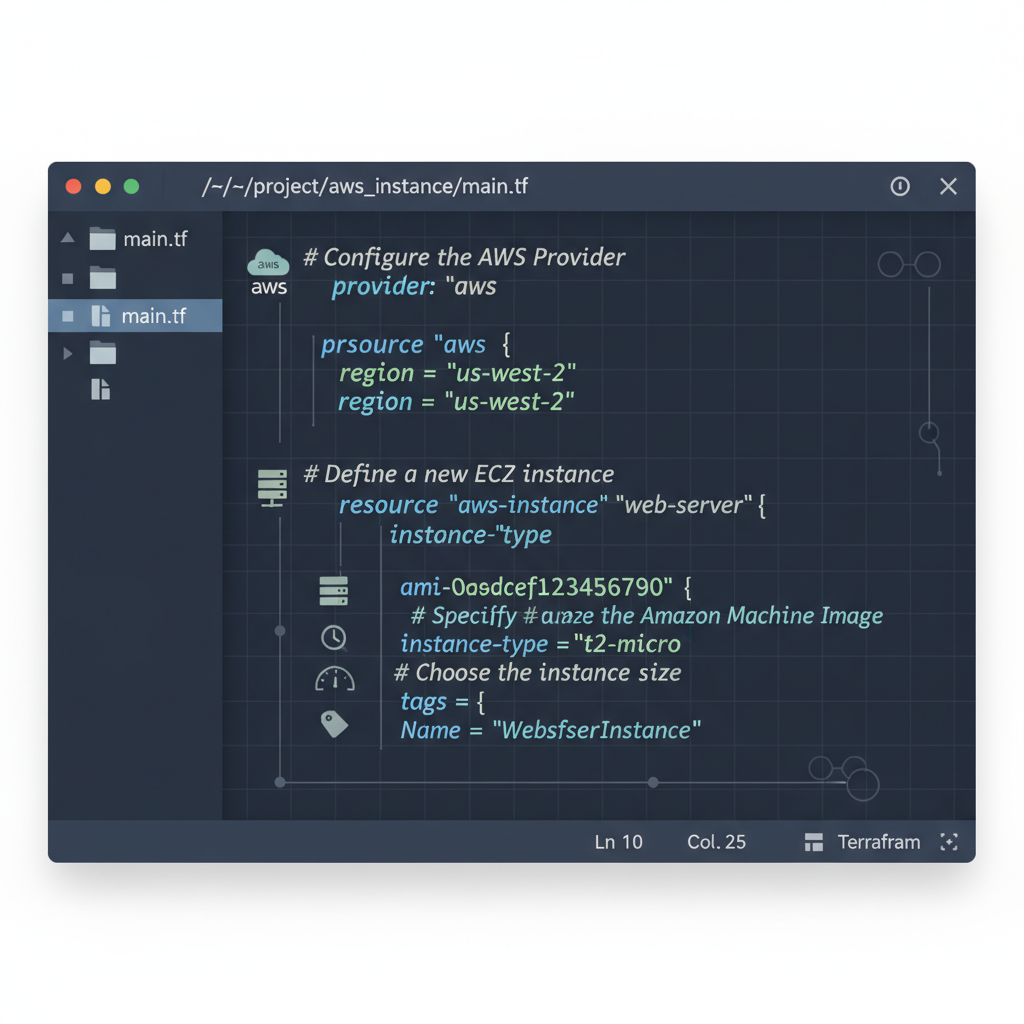
A screenshot of a code editor showing a simple Terraform configuration file defining an AWS EC2 instance, with comments explaining different sections.
Step 4: Version Control Your IaC Code
Store all your IaC configuration files in a version control system like Git. This is a non-negotiable step. Use branching strategies (e.g., Gitflow) and pull requests for code reviews and collaboration. Version control provides a historical record of all changes, facilitates collaboration, and enables easy rollbacks to previous stable states. Treat your infrastructure code with the same rigor as application code.
Step 5: Plan and Apply Changes
Before applying any changes to your actual infrastructure, always use the planning feature of your IaC tool (e.g., `terraform plan`). This step allows you to review exactly what resources will be created, modified, or destroyed. Once satisfied, apply the changes to provision or update your infrastructure. For critical environments, implement approval gates for deployment.
Step 6: Monitor and Maintain Your IaC
After deployment, continuously monitor your infrastructure to ensure it remains in the desired state. Regularly review your IaC code, keeping it updated with any changes in requirements or best practices. Automate testing of your IaC configurations to prevent regressions and ensure desired outcomes. This ongoing maintenance ensures the long-term health and stability of your infrastructure.
Best Practices for Infrastructure as Code
Adopting infrastructure as code tools is more than just using a new piece of software; it’s a paradigm shift. To fully leverage its potential, adhering to best practices is essential. These guidelines will help you build robust, maintainable, and secure IaC implementations.
Modularity and Reusability: Design your IaC configurations in modular blocks. Create reusable components for common infrastructure patterns, such as a standard virtual network or a database cluster. This reduces duplication, improves consistency, and makes your code easier to manage.
Version Everything: As emphasized earlier, treat your infrastructure code like application code. Store it in a version control system and follow standard branching, merging, and review processes. This ensures traceability and facilitates team collaboration.
Automate Testing: Implement automated tests for your IaC code. This can include linting for syntax checks, unit tests for individual modules, and integration tests to verify that components interact correctly. Testing catches errors early and increases confidence in your deployments.
Implement CI/CD for IaC: Integrate your infrastructure code into your Continuous Integration/Continuous Delivery (CI/CD) pipeline. Automate the planning, testing, and deployment of infrastructure changes. This ensures consistent application of changes and accelerates delivery.
Principle of Least Privilege: When defining users, roles, and resource access within your IaC, always apply the principle of least privilege. Grant only the necessary permissions required for a resource or user to perform its function. This minimizes the attack surface.
Secure Sensitive Data: Never hardcode sensitive information like API keys, passwords, or secrets directly into your IaC files. Use secure methods for managing secrets, such as environment variables, secret managers (e.g., AWS Secrets Manager, HashiCorp Vault), or parameter stores.
Document Your Infrastructure: While IaC itself acts as documentation, supplement it with clear comments in your code and external documentation explaining design decisions and complex configurations. Good documentation helps new team members understand the infrastructure quickly.
Regularly Review and Refactor: As your infrastructure evolves, regularly review your IaC code. Refactor it to improve clarity, efficiency, and adherence to best practices. This keeps your IaC codebase healthy and adaptable.
Frequently Asked Questions
This section addresses common queries about infrastructure as code tools, providing quick answers to help deepen your understanding.
What are infrastructure as code tools?
Infrastructure as code tools are software applications that allow you to define, provision, and manage IT infrastructure using configuration files rather than manual processes or graphical user interfaces. These tools automate the deployment of servers, networks, databases, and other resources. They treat infrastructure like software, enabling version control, testing, and automated deployment.
What is the difference between Terraform and Ansible?
Terraform is primarily an infrastructure provisioning software that focuses on defining and deploying the *state* of your infrastructure across various cloud providers. It creates, updates, and destroys resources. Ansible is a configuration management tool used for *configuring* existing servers, deploying applications, and orchestrating workflows. While they can overlap, they are often used together: Terraform provisions the infrastructure, and Ansible configures the applications and services on that infrastructure.
Is IaC suitable for small projects?
Yes, IaC is beneficial even for small projects. While the initial setup might seem like an overhead, the benefits of consistency, reproducibility, and faster iteration cycles quickly outweigh it. For small projects, IaC ensures that environments can be easily recreated or scaled, preventing configuration drift and simplifying future management.
How do IaC tools improve security?
IaC tools enhance security by enforcing consistent configurations, reducing human error, and enabling security policies to be codified. Security configurations, such as firewall rules, network segmentation, and access controls, are defined as code and can be reviewed, versioned, and automatically applied. This ensures that security best practices are consistently implemented across all environments.
What are the main types of IaC frameworks?
IaC frameworks can generally be categorized by their approach. Some focus on infrastructure provisioning (e.g., Terraform, Pulumi, CloudFormation) which creates the underlying resources. Others specialize in configuration management (e.g., Ansible, Chef, Puppet) which configures software and services on already provisioned resources. Some frameworks also lean towards declarative (desired state) versus imperative (step-by-step) definitions.
✓ Free consultation ✓ No commitment required ✓ Trusted by experts
Conclusion
Infrastructure as code tools have become an indispensable part of modern IT operations, offering unparalleled consistency, speed, and reliability. By treating infrastructure definitions as code, organizations can achieve greater agility, reduce errors, and streamline their entire development lifecycle. From multi-cloud provisioning with Terraform to robust configuration management with Ansible, the available IaC automation tools empower teams to build and manage scalable, resilient systems efficiently.
Embracing IaC is not just about adopting new tools; it’s about shifting to a more disciplined, automated, and collaborative approach to infrastructure management. By understanding the core principles and implementing best practices, you can unlock the full potential of IaC and drive significant improvements in your infrastructure operations. The future of IT is undeniably defined by code, and mastering these powerful frameworks is a crucial step towards building the infrastructure of tomorrow.
Johan Carlsson is a cloud architecture specialist and frequent speaker focused on scalable workloads, AI/ML, and IoT innovation. At Opsio, he helps organizations harness cutting-edge technology, automation, and purpose-built services to drive efficiency and achieve sustainable growth. Johan is known for enabling enterprises to gain a competitive advantage by transforming complex technical challenges into powerful, future-ready cloud solutions.