Migrating legacy applications to the cloud represents a pivotal transformation for modern enterprises. It’s not merely an IT initiative but a strategic business decision that impacts operational efficiency, market agility, and competitive positioning. As organizations face increasing pressure to innovate while managing costs, cloud migration has become essential rather than optional. This guide explores proven legacy application cloud migration strategies, helping you navigate the complexities of modernization while minimizing risk and maximizing business value.
Why Migrate Legacy Systems to the Cloud Now?
The business case for migrating legacy systems to cloud platforms has never been stronger. Organizations that successfully modernize their application portfolio gain significant advantages over competitors still anchored to aging infrastructure.
Strategic planning for legacy application migration delivers measurable business outcomes
The Business Case for Cloud Migration
- ROI and Cost Predictability: Cloud migration can reduce capital expenditures by 10-30% by converting fixed costs to variable operating expenses. Pay-for-use models eliminate overprovisioning and align costs with actual business demand.
- Scalability and Agility: Cloud environments enable rapid scaling to meet fluctuating demands without lengthy procurement cycles. This translates to faster time-to-market and improved responsiveness to business opportunities.
- Enhanced Security and Compliance: Major cloud providers invest billions in security infrastructure that few organizations could match independently. They maintain compliance with evolving regulations and industry standards.
- Competitive Advantage: Modernized applications enable faster innovation cycles, improved customer experiences, and the ability to integrate emerging technologies like AI, machine learning, and advanced analytics.
Cloud migration is often the enabler for digital transformation — but only when paired with a thoughtful modernization plan.
Common Drivers for Migration Decisions
Organizations typically initiate legacy application cloud migration projects when facing:
- Hardware or software reaching end-of-life (EOL) status
- Escalating maintenance costs for aging systems
- Difficulty finding talent to support outdated technologies
- Regulatory changes requiring improved security or data management
- Competitive pressure to accelerate innovation cycles
- Data center contract expirations or consolidation initiatives
Legacy Application Cloud Migration Strategies: The 6 Rs Framework
When planning your migration approach, the industry-standard “6 Rs” framework provides a structured way to evaluate each application in your portfolio. Each strategy offers different tradeoffs between speed, cost, risk, and long-term value.
The 6 Rs framework guides strategic decision-making for each application in your portfolio
Rehost (Lift and Shift)
The rehosting strategy involves moving applications to the cloud with minimal changes to the underlying architecture. This approach offers the fastest path to cloud adoption.
Advantages
- Fastest migration timeframe
- Minimal code changes required
- Lower initial migration costs
- Reduced risk of functionality changes
Limitations
- Limited cloud-native benefits
- May not optimize performance
- Higher long-term operational costs
- Technical debt remains unaddressed
Best for: Non-critical applications, systems with limited remaining lifespan, or as a first step in a phased modernization approach.
Replatform (Lift and Reshape)
Replatforming makes targeted optimizations to take advantage of cloud capabilities while maintaining the core architecture. This balanced approach delivers some cloud benefits without complete redevelopment.
Advantages
- Moderate cloud optimization
- Reduced operational overhead
- Better performance than rehosting
- Manageable migration timeframe
Limitations
- Requires some code changes
- More complex than rehosting
- May not fully leverage cloud-native services
- Potential for integration issues
Best for: Applications with reasonable technical debt levels that would benefit from specific cloud services like managed databases or auto-scaling.
Refactor/Re-architect
Refactoring involves substantial redesign of the application to fully leverage cloud-native capabilities. This approach delivers maximum long-term benefits but requires significant investment.
Advantages
- Full cloud-native benefits
- Improved scalability and resilience
- Enhanced performance
- Reduced long-term operational costs
Limitations
- Highest initial investment
- Longest implementation timeline
- Requires specialized skills
- Increased short-term risk
Best for: Strategic applications with long expected lifespans, systems requiring significant scalability, or applications where technical debt severely impacts business agility.
Replace (Repurchase)
The replacement strategy involves transitioning to commercial SaaS solutions that provide equivalent or enhanced functionality compared to the legacy application.
Advantages
- Immediate access to modern features
- Reduced maintenance burden
- Predictable subscription costs
- Regular vendor updates and improvements
Limitations
- Potential loss of customizations
- Data migration challenges
- Vendor lock-in concerns
- Process adaptation requirements
Best for: Commodity functions like CRM, HR, or email where industry-standard solutions exist and customization needs are minimal.
Retire
The retirement strategy involves decommissioning applications that no longer provide sufficient business value to justify their maintenance costs.
Advantages
- Immediate cost savings
- Reduced security exposure
- Simplified IT landscape
- Resources redirected to higher-value initiatives
Limitations
- Potential loss of historical data
- User adjustment period
- May require process redesign
- Archival requirements for compliance
Best for: Redundant systems, applications with minimal usage, or functions that have been superseded by other solutions.
Retain (Revisit)
The retention strategy acknowledges that some applications may not be suitable for immediate migration and should remain in their current environment until circumstances change.
Advantages
- No immediate disruption
- Focused resources on higher-priority migrations
- Time to develop proper migration strategy
- Avoids forced migrations for complex systems
Limitations
- Continued technical debt accumulation
- Ongoing legacy infrastructure costs
- Delayed realization of cloud benefits
- Potential security and compliance risks
Best for: Applications with significant regulatory constraints, systems near end-of-life, or applications where migration complexity outweighs immediate benefits.
Legacy System Assessment for Cloud: Evaluate Before You Move
A thorough assessment is the foundation of any successful migration initiative. This critical phase helps identify suitable migration candidates, potential challenges, and the optimal strategy for each application.

Comprehensive assessment reduces migration risk and optimizes strategy selection
Application Portfolio Discovery and Analysis
Begin with a complete inventory of your application landscape to understand what you have before deciding what to migrate:
- Application inventory: Document all applications, their business functions, users, and criticality
- Infrastructure mapping: Catalog servers, databases, middleware, and network components
- Dependency analysis: Identify integration points, data flows, and service dependencies
- Performance baselines: Establish current metrics for response times, throughput, and resource utilization
- Usage patterns: Analyze peak loads, seasonal variations, and growth trends
Pro Tip: Automated discovery tools can identify up to 40% more dependencies than manual documentation processes, reducing the risk of overlooked connections during migration.
Cloud Readiness Evaluation Criteria
Assess each application against these key dimensions to determine migration suitability:
| Evaluation Dimension |
Key Questions |
Impact on Strategy |
| Business Value |
How critical is this application to core operations? What is its expected lifespan? |
Higher value justifies more investment in refactoring; lower value may indicate rehost or retire |
| Technical Architecture |
How modular is the application? Is it stateful or stateless? What are its dependencies? |
Monolithic apps may require replatforming first; microservices are easier to refactor |
| Compliance Requirements |
What regulatory constraints apply? Are there data residency requirements? |
May limit cloud provider options or require specific security controls |
| Performance Needs |
What are the latency, throughput, and availability requirements? |
High-performance needs may require refactoring or specialized cloud services |
| Data Characteristics |
How much data? How sensitive? What are the access patterns? |
Large datasets may drive migration approach due to transfer constraints |
TCO Analysis and Business Case Development
Develop a comprehensive business case that considers all aspects of migration costs and benefits:
- Current costs: Infrastructure, licensing, maintenance, support, and operational overhead
- Migration costs: Planning, implementation, testing, training, and potential downtime
- Future cloud costs: Compute, storage, network, managed services, and optimization tools
- Business benefits: Improved agility, reduced time-to-market, enhanced capabilities
- Risk mitigation: Reduced technical debt, improved security, and better disaster recovery
Most organizations underestimate migration complexity by 20-30%. Build contingency into your timeline and budget to account for unexpected challenges.
Modernization Approaches: Choosing the Right Path
Beyond the basic 6 Rs framework, there are specific modernization patterns that can guide your implementation approach. The right choice depends on your risk tolerance, timeline constraints, and technical complexity.
Incremental migration reduces risk while big-bang approaches accelerate timeline completion
Incremental vs. Big-Bang Migration
Organizations typically choose between two fundamental implementation approaches:
Incremental Migration
The incremental approach breaks the migration into manageable phases, migrating components or functions over time while maintaining interoperability between old and new environments.
- Strangler Pattern: Gradually replace specific functions of the legacy application with modern services while maintaining the overall system functionality
- Domain-Driven Decomposition: Identify business domains and migrate them independently based on priority
- Parallel Implementation: Build new capabilities alongside legacy systems with synchronized data until cutover
Best for: Complex systems with many dependencies, business-critical applications where downtime must be minimized, or organizations with limited migration experience.
Big-Bang Migration
The big-bang approach involves migrating the entire application at once, with a single cutover from the old environment to the new cloud platform.
- Complete Rehost: Move the entire application stack to the cloud with minimal changes
- Full Replacement: Switch from legacy to new implementation on a specific date
- Scheduled Cutover: Plan for a maintenance window where the transition occurs
Best for: Smaller, self-contained applications, systems with few external dependencies, or situations where maintaining two environments is prohibitively expensive.
Containerization and Microservices Transformation
Modern cloud architectures often leverage containerization and microservices to improve scalability, resilience, and development agility:
- Containerization: Package applications with their dependencies into standardized units for consistent deployment across environments
- Microservices Decomposition: Break monolithic applications into smaller, independently deployable services organized around business capabilities
- API-First Design: Expose functionality through well-defined interfaces to enable loose coupling between services
- Event-Driven Architecture: Use message queues and event streams to coordinate between services asynchronously
Microservices architecture enables independent scaling and deployment of application components
Risk Management in Legacy Migration: Planning for Uncertainty
Effective risk management is critical to migration success. By identifying potential issues early and developing mitigation strategies, you can reduce the likelihood of disruption and ensure business continuity throughout the transition.
Systematic risk assessment helps prioritize mitigation efforts for critical migration challenges
Common Migration Risks and Mitigation Strategies
| Risk Category |
Common Challenges |
Mitigation Strategies |
| Technical Risks |
- Undocumented dependencies
- Performance degradation
- Data integrity issues
- Integration failures
|
- Comprehensive discovery and dependency mapping
- Performance testing in pre-production
- Data validation and reconciliation processes
- API-based integration with fallback mechanisms
|
| Operational Risks |
- Extended downtime during cutover
- Inadequate monitoring
- Skill gaps in cloud operations
- Insufficient disaster recovery
|
- Blue/green deployment with quick rollback capability
- Implement comprehensive observability solutions
- Training and cloud certification programs
- Test DR procedures before production migration
|
| Business Risks |
- Budget overruns
- Schedule delays
- User resistance
- Compliance violations
|
- Phased approach with clear milestones and gates
- Regular stakeholder communication
- Early user involvement and training
- Compliance assessment before and after migration
|
Rollback Planning and Business Continuity
Even with careful planning, issues may arise during migration. A robust rollback strategy ensures you can quickly restore service if needed:
- Snapshot backups: Create complete system images before migration begins
- Database rollback procedures: Document steps to restore data to pre-migration state
- DNS and routing controls: Maintain ability to redirect traffic back to original systems
- Synchronized environments: Keep legacy systems operational until new environment stability is confirmed
- Documented decision points: Establish clear criteria for rollback decisions
Important: Test your rollback procedures before migration. A plan that exists only on paper may fail when needed most.
Security and Compliance Considerations
Migration presents both security challenges and opportunities to improve your overall security posture:
- Shared responsibility model: Understand which security controls are your responsibility versus the cloud provider’s
- Identity and access management: Implement least-privilege principles and strong authentication
- Data protection: Ensure encryption for data in transit and at rest
- Network security: Configure proper segmentation, firewalls, and security groups
- Compliance validation: Verify that cloud environments meet regulatory requirements
- Security monitoring: Implement detection and response capabilities for the new environment
Best Practices for Legacy Migration: Execution and Validation
Successful execution requires disciplined project management, thorough testing, and operational readiness. These best practices help ensure a smooth transition and stable operations post-migration.
Automated testing and deployment pipelines ensure consistent, repeatable migration processes
Project Governance and Stakeholder Alignment
Establish clear governance structures to maintain focus and accountability throughout the migration:
- Executive sponsorship: Secure visible support from leadership to overcome organizational barriers
- Cross-functional teams: Include representatives from development, operations, security, and business units
- Clear decision authority: Define who can make critical decisions about scope, timeline, and approach
- Regular communication: Maintain transparency with stakeholders about progress, challenges, and changes
- Success metrics: Define and track KPIs that align with business objectives
Testing and Validation Strategy
Comprehensive testing is essential to verify that applications function correctly in the cloud environment:
- Functional testing: Verify that all features work as expected after migration
- Performance testing: Confirm that the application meets or exceeds baseline performance metrics
- Security testing: Validate that security controls are properly implemented
- Integration testing: Ensure that all connections to other systems function correctly
- User acceptance testing: Involve business users to validate critical workflows
- Disaster recovery testing: Verify that recovery procedures work as designed
Systematic testing across multiple dimensions ensures migration quality
Operationalizing Cloud-Based Applications
Prepare your operations team and processes for managing applications in the cloud environment:
- Monitoring and observability: Implement comprehensive monitoring for performance, availability, and user experience
- Incident response: Develop playbooks for common failure scenarios
- Automation: Use infrastructure as code and automated deployment pipelines
- Cost management: Implement tagging, budgeting, and optimization practices
- Documentation: Maintain updated runbooks, architecture diagrams, and configuration details
- Skills development: Train operations staff on cloud-specific tools and practices
Organizations with mature DevOps practices typically complete migrations 30% faster and experience 50% fewer post-migration incidents than those using traditional operations models.
Overcoming Common Challenges in Legacy Migration
Even well-planned migrations encounter obstacles. Understanding these common challenges and having strategies to address them increases your chances of success.
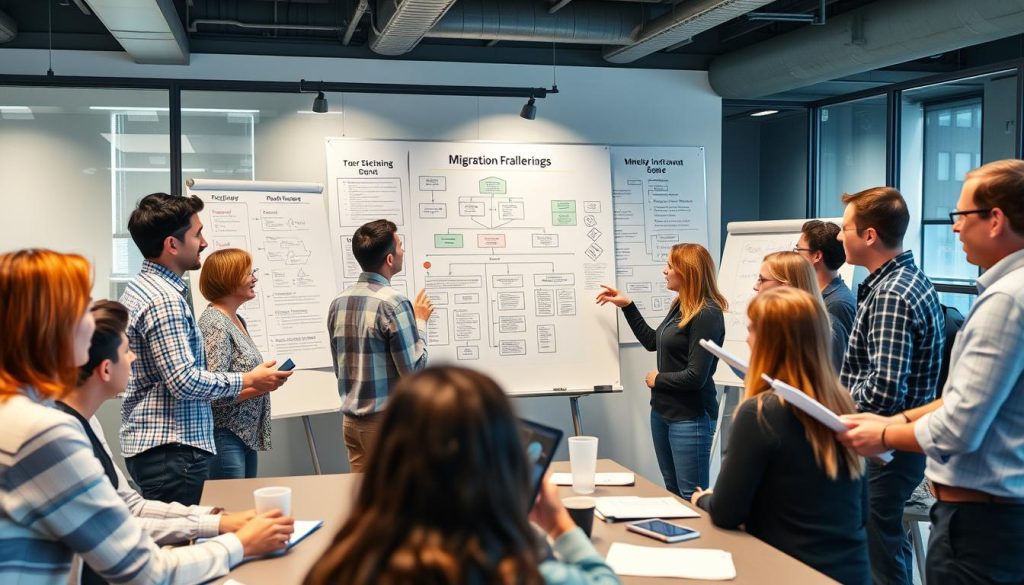
Collaborative problem-solving helps overcome complex migration challenges
Technical Debt and Hidden Dependencies
Legacy applications often accumulate technical debt and undocumented dependencies that complicate migration:
- Code analysis tools: Use static and dynamic analysis to identify dependencies and quality issues
- Incremental refactoring: Address critical technical debt before migration
- Runtime monitoring: Observe application behavior to discover hidden dependencies
- Documentation sprints: Dedicate time to improving system documentation
- Knowledge transfer: Capture insights from experienced team members
Data Migration Complexities
Moving data safely while maintaining integrity and minimizing downtime presents significant challenges:
- Data profiling: Understand data volumes, types, and quality before migration
- Change Data Capture (CDC): Implement real-time data synchronization between old and new systems
- Dual-write strategies: Write to both environments during transition periods
- Data validation: Verify data integrity after migration through reconciliation processes
- Phased migration: Move data in manageable chunks to reduce risk
Effective data migration strategies maintain integrity while minimizing business disruption
Organizational and Cultural Resistance
Technical challenges are often easier to solve than human ones. Address organizational resistance through:
- Early stakeholder involvement: Include key users and teams from the beginning
- Clear communication: Explain the benefits and address concerns transparently
- Training programs: Prepare teams for new tools and processes
- Quick wins: Demonstrate value early to build momentum
- Executive sponsorship: Ensure visible support from leadership
Cost Management and Optimization
Cloud costs can escalate without proper governance and optimization:
- Right-sizing: Match resource allocation to actual needs
- Auto-scaling: Configure dynamic scaling based on demand
- Reserved instances: Commit to longer-term usage for discounted rates
- Resource tagging: Implement consistent tagging for cost allocation
- Monitoring and alerts: Set up notifications for unusual spending patterns
- Regular reviews: Conduct periodic cost optimization assessments
Next Steps: Your Legacy Application Cloud Migration Roadmap
Successful migration requires a structured approach. This prioritized roadmap provides a framework to guide your journey from initial assessment through execution and optimization.
A structured migration roadmap ensures comprehensive planning and execution
- Conduct a comprehensive assessment
- Inventory applications and infrastructure
- Map dependencies and data flows
- Establish performance baselines
- Evaluate cloud readiness
- Develop your migration strategy
- Categorize applications using the 6 Rs framework
- Prioritize migration candidates
- Select target cloud platforms and services
- Create a phased implementation plan
- Build your migration foundation
- Establish cloud landing zones
- Implement security controls and governance
- Set up connectivity between environments
- Create automation pipelines
- Execute pilot migrations
- Select low-risk, high-value applications
- Validate migration processes
- Refine approach based on lessons learned
- Document successful patterns
- Scale migration efforts
- Apply proven patterns to additional applications
- Implement parallel migration streams
- Track progress against KPIs
- Continuously improve processes
Ready to Start Your Migration Journey?
Begin with a comprehensive discovery sprint to assess your legacy applications and develop a prioritized migration roadmap. Our cloud migration experts can help you navigate the complexities of modernization while minimizing risk and maximizing business value.
Schedule Your Discovery Sprint
Conclusion: Transforming Legacy Applications for Future Success
Legacy application cloud migration represents both a technical challenge and a strategic opportunity. By approaching migration with a comprehensive strategy, organizations can not only reduce technical debt and operational costs but also position themselves for greater agility and innovation.
The most successful migrations share common characteristics: thorough assessment, clear strategy selection, robust risk management, disciplined execution, and continuous optimization. By following the frameworks and best practices outlined in this guide, you can navigate the complexities of migration while minimizing disruption and maximizing business value.
Remember that migration is not the end goal but rather a means to enable digital transformation. The true measure of success is not just completing the technical migration but realizing the business benefits that modern cloud platforms enable: faster innovation, improved customer experiences, greater operational efficiency, and enhanced competitive positioning.
The organizations that thrive in the digital economy will be those that successfully modernize their legacy applications while maintaining business continuity and accelerating innovation.
Frequently Asked Questions About Legacy Application Cloud Migration
How long does a typical legacy application migration take?
Migration timelines vary significantly based on application complexity, size, and chosen strategy. Simple rehosting migrations might complete in 4-12 weeks, while complex refactoring projects can take 6-18 months. Most enterprise migration programs span 1-3 years for a complete portfolio. The key is to prioritize applications based on business value and migration complexity, starting with quick wins to build momentum.
What are the most common reasons legacy migrations fail?
Common failure points include inadequate discovery and dependency mapping, underestimating migration complexity, insufficient testing, lack of executive sponsorship, and poor change management. Organizations can mitigate these risks through thorough assessment, realistic planning, incremental approaches, comprehensive testing, and strong governance.
How do we maintain business continuity during migration?
Business continuity during migration requires careful planning and execution. Key strategies include implementing blue/green deployments, maintaining synchronized environments during transition periods, scheduling cutovers during low-traffic periods, developing comprehensive rollback plans, and conducting thorough testing before production migration.
What skills are needed for successful legacy application cloud migration?
Successful migrations require a mix of technical and business skills. Technical skills include cloud architecture, infrastructure as code, containerization, API development, and security. Business skills include project management, change management, business analysis, and stakeholder communication. Many organizations supplement internal teams with external expertise for specialized migration knowledge.
How do we measure the success of our migration initiative?
Success metrics should align with your original business objectives. Common metrics include cost reduction (infrastructure, operational, licensing), performance improvements (response time, throughput, availability), operational efficiency (deployment frequency, mean time to recovery), and business outcomes (time-to-market, customer satisfaction, revenue impact).