What if every product that left your facility could meet the highest standards of quality? The pursuit of perfection in manufacturing is a constant challenge. Flawed products cost companies billions each year through rework, waste, and damaged customer trust.
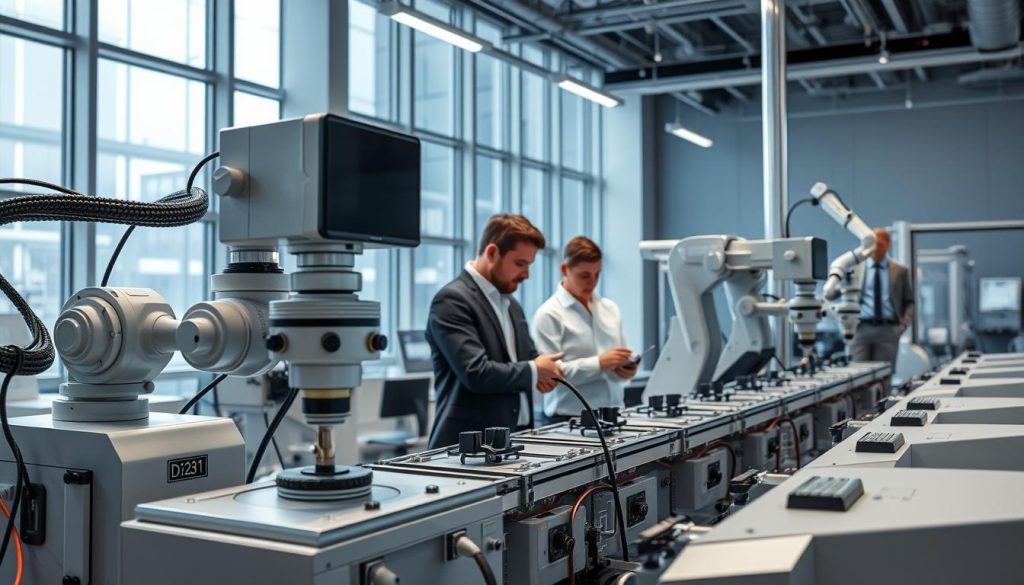
Traditional methods, which often rely on manual sampling, are no longer sufficient. They miss subtle variations and struggle to keep pace with changing production conditions. This creates significant vulnerabilities.
We are now entering a transformative period. Advanced technology offers a powerful solution. These new systems analyze data in real time, learning patterns that are invisible to the human eye. This evolution turns quality control into a proactive force.
We help manufacturers implement these intelligent solutions. Our goal is to deliver unprecedented accuracy and consistency, creating a sustainable competitive advantage through operational excellence.
Key Takeaways
- Manufacturing flaws lead to massive annual financial losses.
- Traditional manual inspection methods are often inconsistent and slow.
- New technological solutions provide real-time, data-driven analysis.
- Proactive detection helps prevent errors before they escalate.
- Implementing advanced systems builds stronger customer relationships.
- Superior product quality creates a distinct market advantage.
Introduction to AI-Powered Quality Inspection in Manufacturing
Manufacturing operations are undergoing a profound transformation through intelligent quality inspection technologies. Traditional approaches to quality control often relied on manual sampling, leaving room for human error and inconsistency. These new systems represent a fundamental paradigm shift in how we approach manufacturing excellence.
Modern inspection systems integrate seamlessly into existing production environments. They capture high-resolution images and process vast datasets in real time. This enables immediate corrective actions without disrupting the manufacturing flow. The technology learns continuously from accumulated data, refining detection algorithms to recognize new patterns.
We help organizations move from reactive defect detection to proactive prevention strategies. These intelligent systems address quality issues before they manifest in finished products. They deliver uniform standards across all shifts and production lines, ensuring every item meets specifications.
The implementation of advanced quality control creates measurable business value. It positions product quality as a strategic competitive differentiator. Our collaborative approach helps manufacturers understand capabilities and develop customized solutions for specific production challenges.
The Evolution of Quality Control and AI Advancements
The journey of manufacturing quality control has been marked by continuous innovation. We have moved from methods that depended heavily on human precision to those that leverage computational power. This evolution represents a fundamental shift in how we approach production excellence.
From Manual to Automated Inspection Methods
Early quality control relied on manual visual checks. Human inspectors, while adaptable, face biological limitations. Research indicates they can miss up to 30% of flaws due to factors like fatigue. These methods, though flexible, introduced inconsistency.
Automated inspection systems emerged to address these challenges. They brought greater speed and uniformity to the process. However, early versions operated on rigid, pre-programmed rules. They struggled to adapt to new variations or complex product lines.
Contextual Intelligence and Data-Driven Insights
The latest advancement introduces contextual intelligence. This approach allows systems to understand the broader production environment. They analyze information from various sources simultaneously.
These intelligent systems process data from sensors and historical records. They identify patterns that connect environmental factors to product quality. This enables a proactive stance, moving beyond simple flaw identification to root cause analysis. It represents a significant leap forward in manufacturing intelligence.
The Challenge of Manufacturing Defects in Today’s Industry
The financial toll of production flaws represents a critical challenge for modern industrial operations. According to Boston Consulting Group, an automotive plant producing 250,000 vehicles annually faces up to $8 million in additional costs for each single percentage point increase in defect rates. These expenses stem from direct costs like rework and scrap, plus indirect impacts on throughput and customer relationships.
Poor quality can consume 5% to 35% of total revenue depending on product complexity. For a $50 million company, this translates to potential annual losses reaching $17.5 million. We categorize manufacturing imperfections into three severity levels:
| Severity Level |
Description |
Impact |
Industry Examples |
| Minor |
Aesthetic issues affecting customer perception |
Brand reputation damage |
Color variations in textiles |
| Major |
Functional problems requiring rework |
Production delays and costs |
Component misalignment in automotive |
| Critical |
Safety or regulatory failures |
Catastrophic consequences |
Pharmaceutical compliance breaches |
Defect manifestations vary significantly across sectors. Automotive operations confront weld quality concerns, while electronics face soldering problems. Textiles deal with weaving inconsistencies, and pharmaceuticals manage strict integrity requirements.
Today’s accelerating production speeds and tightening tolerances create environments where traditional inspection methods struggle. Rising customer expectations further compound these challenges, making advanced solutions essential for competitive survival.
Reduce defects with AI vision
Organizations seeking to eliminate production imperfections are turning to sophisticated visual analysis systems. The global market for these technologies demonstrates remarkable growth, expanding from $15.48 billion in 2023 to a projected $89.73 billion by 2033.

These advanced solutions leverage computer vision algorithms to capture high-resolution images with microscopic precision. They identify subtle variations that human inspectors might miss, classifying issues by type and severity at production speeds.
The technology processes thousands of parts per minute, far exceeding human capacity. This eliminates fatigue-related errors and maintains consistent standards across all shifts. Machine learning algorithms continuously improve detection accuracy over time.
Real-world implementations show significant results. BMW’s system decreased manufacturing flaws by nearly 40%, while a steel producer achieved 98% detection accuracy. This generated over $2 million in annual savings with exceptional return on investment.
We help manufacturers implement these comprehensive systems that integrate imaging hardware, processing algorithms, and contextual intelligence. This transforms quality control from reactive inspection to proactive prevention.
Implementing AI Quality Control Solutions
Strategic deployment of predictive quality solutions begins with comprehensive process analysis and phased implementation. We guide manufacturers through this transition, ensuring minimal disruption while maximizing early success indicators.
Leveraging Machine Learning for Early Anomaly Detection
Machine learning models analyze historical production data to establish baseline patterns. These systems continuously monitor real-time parameters, flagging subtle deviations before they become finished product issues.
The technology adapts to seasonal variations and process changes. This improves its ability to distinguish true quality anomalies from normal fluctuations. Early detection enables proactive interventions that prevent problem escalation.
Integrating with Existing Quality Systems
Successful implementation requires seamless integration with manufacturing execution systems and quality management platforms. We ensure bidirectional data flow between new and existing control systems.
Our approach includes compatible interfaces and intuitive dashboards. This helps quality teams leverage machine learning insights while applying their expertise to interpret findings.
| Implementation Phase |
Key Activities |
Expected Outcomes |
| Assessment |
Process analysis and high-impact area identification |
Clear implementation roadmap |
| Pilot Deployment |
Limited scope testing and algorithm training |
Proof of concept and early success metrics |
| Full Integration |
System-wide deployment and team training |
Comprehensive quality control enhancement |
This integrated framework maximizes previous technology investments while extending detection capabilities. It creates comprehensive quality management where predictive models complement traditional control methods.
Leveraging Contextual Intelligence for Enhanced Detection
Modern quality control transcends simple flaw identification by incorporating comprehensive environmental understanding. We implement systems that analyze manufacturing conditions holistically, considering how multiple factors interact to influence product outcomes. This approach moves beyond isolated inspection to integrated quality management.
Our methodology establishes connections between seemingly unrelated production variables. This creates a predictive framework that anticipates quality issues before they manifest. The system learns from continuous operational feedback, refining its detection capabilities over time.
Multi-Modal Data Fusion Strategies
We combine information streams from diverse sources to create complete quality pictures. Visual inspection data integrates with equipment sensor readings and production parameters. Historical records provide crucial context for current manufacturing conditions.
This fusion strategy reveals patterns that single data sources cannot detect. For example, night shift operations show different quality characteristics than daytime production. Our systems account for these variations automatically, maintaining consistent standards across all working hours.
Predictive Correlation and Adaptive Learning Models
Our detection algorithms identify hidden relationships between production variables and quality outcomes. They recognize how specific combinations of temperature, material properties, and equipment status influence defect probability. This enables preventive interventions before issues escalate.
The learning models evolve continuously based on new information and performance feedback. They adapt to changing production conditions without requiring extensive manual retraining. This ensures sustained detection accuracy as manufacturing processes evolve.
These adaptive systems maintain high true detection rates while minimizing false positives. They represent the next generation of intelligent quality management, where prevention replaces reaction as the primary strategy.
Enhancing Defect Detection with Advanced AI Tools
The integration of sophisticated neural networks represents a breakthrough in industrial quality assurance. We deploy systems that automatically learn optimal detection strategies from training data, eliminating the need for manual rule definition.
Deep Learning Algorithms for Precise Visual Inspection
Convolutional Neural Networks revolutionize visual inspection by automatically extracting hierarchical features from product images. These algorithms learn to recognize patterns across multiple scales, from microscopic texture variations to larger structural anomalies.
The training process involves analyzing thousands of labeled images containing both acceptable and defective examples. Neural networks gradually distinguish quality characteristics through backpropagation algorithms, developing robust capabilities that generalize to new variations.
These models excel at identifying subtle, complex issues that challenge traditional approaches. They detect irregular texture patterns, color gradients, dimensional deviations, and multi-characteristic quality problems with exceptional precision.
| Detection Method |
Feature Extraction |
Adaptation Capability |
Implementation Speed |
| Traditional Computer Vision |
Manual programming required |
Limited to predefined rules |
Extended setup time |
| Deep Learning Algorithms |
Automatic hierarchical learning |
Continuous improvement |
Rapid deployment |
Our systems continuously refine classification accuracy through exposure to diverse production data. They adapt to new defect types encountered during operation, learning from corrections to maintain high precision while minimizing missed issues.
Transfer learning capabilities allow models trained on one product type to rapidly adapt to similar products. This significantly reduces implementation time when expanding quality inspection to new manufacturing lines.
Optimizing Production Efficiency with Predictive Analytics
Forward-thinking manufacturers are now harnessing the power of predictive analytics to fundamentally reshape their operational landscape. This approach moves beyond simple monitoring, enabling a shift from reactive problem-solving to proactive process optimization. We help organizations implement systems that anticipate challenges before they impact output.

These sophisticated analytics models delve deep into historical production data. They identify subtle patterns that correlate with quality issues, learning which combinations of process parameters and material characteristics predict problems. This provides an advance warning system, enabling preventive interventions.
Real-Time Monitoring and Data-Driven Decision Making
Real-time monitoring capabilities form the backbone of this strategy. They enable continuous tracking of critical parameters across all manufacturing lines. Instant detection of deviations from optimal conditions triggers automated alerts, giving teams immediate visibility.
This empowers data-driven decision making, replacing intuition-based management with objective insights. Manufacturers can prioritize initiatives based on quantified impact, allocating resources to address root causes effectively.
McKinsey research validates this approach, showing that manufacturers implementing these advanced systems achieve remarkable results. They see up to a 50% reduction in flaw rates while simultaneously realizing 30% higher productivity levels. This proves that quality and efficiency are complementary goals.
We establish continuous improvement cycles where data informs refinements. Successful strategies are standardized across production lines, building organizational capability to prevent future issues. This creates a sustainable advantage in a competitive market.
Leveraging Computer Vision to Automate Visual Inspection
Modern manufacturing facilities increasingly rely on automated optical systems to ensure consistent product quality standards. These advanced technologies capture detailed product information with microscopic accuracy, transforming how companies approach quality assurance.
High-resolution cameras capture extraordinarily detailed product images at various manufacturing stages. These systems reveal surface characteristics, dimensional features, and structural elements that exceed human visual capabilities.
High-Resolution Imaging and Rapid Processing
The image processing pipeline begins with acquisition and preprocessing to optimize contrast. Feature extraction algorithms then identify relevant visual characteristics for analysis. Classification models categorize findings as acceptable quality or specific issue types.
These systems achieve remarkable speeds, processing thousands of high-resolution images per minute. This enables comprehensive quality verification without creating production bottlenecks. The technology maintains consistent standards across all shifts and production lines.
| Inspection Method |
Processing Speed |
Detection Accuracy |
Consistency |
| Manual Visual |
10-12 images/second |
Variable (70-90%) |
Subject to fatigue |
| Automated Computer Vision |
Thousands/minute |
Consistent (>98%) |
Uniform across shifts |
Precision computer vision identifies minute inconsistencies that escape human detection. This includes surface texture variations, subtle color shifts, and dimensional deviations. The technology provides objective quality assessments for every manufactured item.
We help manufacturers implement these intelligent imaging systems that deliver reliable results. Our approach ensures seamless integration with existing production processes while maximizing quality control effectiveness.
Overcoming Implementation Challenges and Best Practices
Adopting intelligent quality systems involves navigating complex implementation challenges that span technology, processes, and people. We help manufacturers address these hurdles through proven methodologies that ensure smooth transitions and measurable results.
Starting with targeted pilot projects builds organizational confidence. These focused initiatives demonstrate quick value on specific production lines. They establish practical learning experiences and create internal champions.
Team Training and Scaling AI Initiatives
Comprehensive training programs equip teams with both technical and strategic understanding. We focus on how these systems augment human expertise rather than replace it. This fosters collaborative relationships between workers and technology.
Scaling beyond initial pilots requires systematic approaches. We help establish standardized implementation methodologies. This ensures consistent quality standards across all manufacturing operations.
Continuous Model Enhancement and Iterative Improvements
Regular performance reviews assess detection accuracy and system effectiveness. We implement feedback loops that collect input from quality teams. This data drives continuous model refinement.
The iterative improvement process creates a virtuous cycle. Operational data enhances system performance over time. Improved accuracy builds user trust and increases adoption rates.
This approach ensures that quality systems remain effective as production conditions evolve. It represents our commitment to long-term partnership and continuous improvement.
Future Trends in AI-Powered Quality Control
Emerging technological synergies are set to redefine how manufacturers approach quality management in the coming years. We see these technologies converging to create more intelligent and responsive systems.
Integration of IoT and Edge Computing
The combination of Internet of Things sensors with edge computing enables immediate quality assessment. These systems process information directly at the source rather than relying on cloud connectivity.
Deloitte’s analysis confirms that facilities using these integrated technologies achieve double-digit improvements in throughput. This approach could address the $1.4 trillion in global unplanned downtime costs identified by Gartner.
Advancements in Explainable AI and Real-Time Feedback
New developments in machine learning provide clearer reasoning behind quality decisions. These technologies highlight specific factors that influence detection outcomes.
Real-time feedback systems offer immediate guidance to production equipment. This creates closed-loop control where correction happens within seconds. The industry benefits from enhanced transparency and faster response times.
We help manufacturers navigate these evolving technologies to improve operational performance. Our approach ensures these advanced systems deliver measurable value across the manufacturing industry.
Conclusion
Today’s competitive landscape demands a revolutionary approach to production quality assurance. Intelligent inspection technology represents a fundamental shift in how manufacturers approach excellence, delivering measurable benefits across operations.
These advanced systems provide dramatic improvements in detection accuracy while boosting operational efficiency. The return on investment consistently exceeds implementation costs, creating sustainable competitive advantages through superior product quality.
We partner with manufacturers to implement tailored advanced quality control solutions that address specific production challenges. Ready to explore how these technologies can transform your quality processes? Request a demonstration to see the benefits firsthand.
FAQ
How does AI-powered quality control improve product quality on production lines?
Our solutions leverage deep learning and computer vision to automatically inspect products with high precision. This automation significantly enhances quality standards by identifying subtle defects and anomalies that human inspectors might miss, ensuring superior product quality and consistency across manufacturing operations.
What is the role of machine learning in defect detection systems?
Machine learning models are trained on vast datasets of product images to recognize complex defect patterns. This training enables the system to perform accurate detection and analysis in real-time, continuously improving its performance and adapting to new quality control challenges without requiring constant manual reprogramming.
How difficult is it to integrate these inspection technologies with our existing manufacturing processes?
We design our systems for seamless integration with your current production lines and quality systems. Our approach focuses on minimal disruption, leveraging your existing infrastructure while adding advanced analytics and detection capabilities to enhance your overall operational efficiency and process control.
Can AI vision systems handle the high-speed demands of modern manufacturing?
Absolutely. Our computer vision technologies utilize high-resolution imaging and rapid processing algorithms capable of operating at production line speeds. This ensures comprehensive inspection without creating bottlenecks, maintaining throughput while delivering critical insights into your manufacturing process.
What kind of training data is required to implement an effective AI quality control system?
Successful implementation requires a curated dataset of images representing both acceptable products and various defect types. We work collaboratively to gather and label this data, ensuring the models learn the specific quality standards and anomaly patterns relevant to your industry and product specifications.
How do predictive analytics contribute to manufacturing efficiency?
Predictive analytics transform inspection data into actionable intelligence, identifying trends and potential issues before they impact production. This proactive approach enables data-driven decision making, reduces downtime, and optimizes your entire manufacturing process for greater efficiency and reliability.
Author
Praveena Shenoy
- Country Manager, Opsio
Praveena Shenoy is the Country Manager for Opsio India and a recognized expert in DevOps, Managed Cloud Services, and AI/ML solutions. With deep experience in 24/7 cloud operations, digital transformation, and intelligent automation, he leads high-performing teams that deliver resilience, scalability, and operational excellence. Praveena is dedicated to helping enterprises modernize their technology landscape and accelerate growth through cloud-native methodologies and AI-driven innovations, enabling smarter decision-making and enhanced business agility.