Did you know that human inspectors miss up to 30% of visible flaws during manual quality checks? This startling reality costs manufacturers billions annually in recalls and wasted materials. We see how this challenge affects industries from automotive to electronics.

Traditional visual inspection methods struggle with consistency and speed. They cannot match the precision needed in today’s high-volume production environments. This is where advanced computational methods create significant improvements.
We leverage sophisticated algorithms that learn from vast image datasets. These systems identify irregularities with remarkable accuracy. They operate continuously without fatigue, transforming how we maintain product standards.
Open-source platforms provide accessible tools for implementing these solutions. Manufacturers can now deploy powerful inspection systems without massive upfront investment. This democratizes advanced quality assurance across business sizes.
The technology progresses through three complexity levels: classification, localization, and quantification. Each stage addresses specific operational needs. This structured approach ensures comprehensive coverage of quality requirements.
Key Takeaways
- Manual inspection methods have high error rates that impact product quality
- Advanced computational systems offer superior consistency and speed
- Open-source resources make sophisticated tools accessible to businesses
- Implementation follows a logical progression from basic to complex tasks
- These solutions reduce operational costs and improve product reliability
- Businesses can achieve better quality control without excessive investment
Introduction
Modern industrial facilities encounter significant obstacles when relying on human-based quality verification systems. These traditional approaches struggle to maintain consistency across extended production runs and varying operational conditions.
Overview of Surface Defect Detection
We recognize this methodology as a fundamental component in contemporary manufacturing operations. It involves systematic examination of finished goods and critical equipment components throughout the production process.
This comprehensive approach extends beyond simple product assessment to include storage tanks, pressure vessels, and piping systems. The scope ensures complete quality assurance across diverse industrial applications.
Importance in Modern Quality Control
The financial implications of manual examination methods present substantial challenges for organizations. Trained quality inspectors command annual salaries ranging from $26,000 to $60,000, creating significant operational expenses.
Beyond direct labor costs, human error rates between 20% and 30% contribute to production bottlenecks and potential field failures. These inefficiencies directly impact profitability in time-sensitive manufacturing environments.
| Aspect |
Manual Inspection |
Automated Systems |
Impact Difference |
| Error Rate |
20-30% |
Under 5% |
75% reduction |
| Processing Speed |
Limited by human capacity |
Continuous operation |
300% faster |
| Cost Per Inspection |
$26,000-$60,000 annually |
One-time implementation |
60% savings long-term |
| Adaptation Time |
Weeks of training |
Immediate deployment |
90% faster adjustment |
Industry 4.0 demands rapid adaptation to new products and generalized production lines. Traditional methods cannot meet these contemporary manufacturing requirements effectively.
Understanding Surface Defect Detection
Industrial quality assessment presents a structured hierarchy of visual examination tasks that build upon one another. This progression moves from basic identification to precise measurement, creating a comprehensive framework for material evaluation.
We distinguish these industrial examination requirements from standard computer vision applications. Manufacturing scenarios present unique challenges with subtle imperfections and variable material textures.
The three primary levels address different analytical needs. Classification determines what type of imperfection exists. Localization identifies the exact position of irregularities. Segmentation measures the extent and quantity of affected areas.
| Task Level |
Primary Question |
Technical Approach |
Output Complexity |
| Classification |
What type exists? |
Basic pattern recognition |
Simple category label |
| Localization |
Where is it located? |
Bounding box coordinates |
Spatial positioning data |
| Segmentation |
How extensive is it? |
Pixel-level analysis |
Detailed area mapping |
Traditional machine vision methods rely on conventional processing algorithms. These approaches use manually engineered features combined with classical classifiers for analysis.
Proper image acquisition serves as the foundation for successful examination. Careful lighting setup and camera positioning ensure consistent results across different production environments.
Advanced neural networks represent the natural evolution beyond traditional methods. These systems automatically learn relevant features from data rather than requiring manual engineering.
Deep Learning’s Role in Quality Control
A significant paradigm shift is occurring across production facilities regarding quality verification processes. We are witnessing the transition from rigid, rule-based systems to adaptive approaches that learn directly from data.
Traditional methods rely on manually programmed algorithms that struggle with variability. These systems require extensive expert knowledge and cannot easily adapt to new product lines.
Transitioning from Traditional to AI Methods
Modern computational approaches eliminate the need for hand-crafted rules. Instead, they automatically discover optimal feature representations from training examples.
This advancement means manufacturers can deploy systems that improve continuously with additional data. The flexibility supports rapid production line changes and product diversification.
Improving Consistency in Visual Inspection
Human-based examination inevitably suffers from fatigue and subjective judgment. Our approach delivers objective, repeatable assessments that maintain precision over extended periods.
These intelligent systems process images at remarkable speeds while maintaining accuracy. They operate continuously without performance degradation, ensuring consistent product quality.
The learning paradigm enables quick adaptation to new specifications. This capability is essential for modern manufacturing environments that demand rapid reconfiguration.
Challenges in Industrial Defect Detection
Industrial implementation of visual inspection technologies encounters specific hurdles that demand tailored solutions for successful deployment. These obstacles differ significantly from standard computer vision applications, requiring specialized approaches for manufacturing environments.
Small Sample Problem and Data Scarcity
We face a fundamental data scarcity issue in manufacturing settings. Unlike academic datasets containing millions of images, real production scenarios often provide only a few dozen flawed examples. This limited number of samples creates substantial training challenges for automated systems.
The paradox of successful quality control further compounds this problem. As manufacturers improve their processes, flaws become increasingly rare. This natural reduction in problematic occurrences limits the available training data for automated detection systems.
Real-Time Constraints in Production
Production environments impose strict timing requirements that academic research often overlooks. While accuracy remains important, operational efficiency demands rapid processing speeds. Models must deliver predictions within milliseconds to maintain production line pace.
We balance model complexity against inference speed to meet these industrial demands. The three-stage workflow—data annotation, model training, and model inference—requires careful optimization at each step. This ensures systems operate effectively without creating production bottlenecks.
Key Datasets and Benchmarks in Defect Detection
The foundation of any successful automated quality system lies in robust, well-structured datasets that accurately represent real-world manufacturing conditions. We rely on standardized benchmarks to develop and validate our inspection technologies, ensuring they perform effectively across diverse industrial applications.
NEU-CLS, Severstal, and More
We consider the NEU-CLS dataset a fundamental resource for steel quality assessment. This collection contains 1,800 grayscale images representing six common imperfection categories in hot-rolled steel. Each class maintains exactly 300 samples, providing balanced training material.
The Severstal Steel Defect Detection dataset offers authentic industrial challenges from a leading manufacturer. This competition-grade resource reflects actual production line scenarios, enabling practical solution development.
KolektorSDD presents unique characteristics with its focus on electrical commutators. The dataset captures eight non-overlapping surface images per item, totaling 399 images with only 52 containing flaws. This imbalance mirrors real production environments where most items pass inspection.
DAGM 2007 contributes significantly to weakly supervised learning research. Its artificially generated images simulate real-world problems with elliptical labels indicating approximate flaw locations rather than precise annotations.
Available resources span multiple materials and industries, demonstrating broad applicability. From solar panels and printed circuit boards to fabric and railway surfaces, these datasets support comprehensive quality assurance development across manufacturing sectors.
surface defect detection deep learning github
The collaborative nature of modern software development has created powerful hubs for quality control innovation. We explore how these platforms accelerate industrial implementation through shared resources.
Featured GitHub Repositories and Resources
Comprehensive repositories serve as central hubs for researchers and practitioners in industrial quality assessment. These platforms continuously curate open-source materials and practical implementation code.
Important research papers dating back to 2017 are organized in dedicated Papers folders. The repository contents include dataset downloads through multiple cloud storage options for convenient access.
We highlight an AWS solution that implements an end-to-end workflow using modern frameworks. This production-ready system can be deployed with minimal configuration through 1-Click Launch functionality.
The collaborative ecosystem enables practitioners to share improvements and best practices. This approach helps organizations avoid duplicating effort when developing inspection systems.
Deep Learning Architectures for Defect Detection
Architectural innovation in computational systems has transformed how we approach visual quality assessment in manufacturing. We leverage sophisticated network designs that provide unprecedented accuracy in identifying product irregularities.
U-Net and Its Variants
The U-Net framework employs a distinctive dual-path structure with encoder and decoder components. This architecture progressively captures contextual information while enabling precise localization of anomalies.
This network operates as a fully convolutional system without dense layers. This design choice allows processing of images with varying dimensions, offering crucial flexibility for industrial applications.
Skip connections bridge corresponding encoder and decoder layers, preserving fine-grained spatial information. This mechanism combines early-layer details with high-level features for accurate boundary delineation.
We’ve observed successful adaptations incorporating attention mechanisms and multi-scale feature fusion. These variants address the challenge of identifying subtle irregularities against complex backgrounds.
This model compares favorably with other architectures like Faster R-CNN and segmentation networks. Its efficiency in training and inference makes it particularly valuable for production environments requiring real-time analysis.
Data Preparation and Preprocessing Techniques
Before any analytical model can begin its work, a meticulous preparation phase ensures that input materials meet exacting standards. We transform raw industrial photographs into structured training-ready formats through systematic procedures.
Specialized functions like load_images_masks() extract visual files alongside their corresponding segmentation masks. This maintains critical spatial relationships between irregular areas and their labels. The process handles various annotation formats including bounding boxes and pixel-level masks.

Normalization procedures standardize intensity distributions across different acquisition conditions. We typically center pixel values around a mean of 127 with standard deviation of 40. This preprocessing step significantly improves model convergence by ensuring consistent input ranges.
Consistent resizing balances computational efficiency with information preservation. Target dimensions such as 512 x 1408 pixels maintain aspect ratios while fitting within GPU memory constraints. This optimization supports efficient processing without compromising analytical accuracy.
| Annotation Type |
Use Case |
Output Format |
Implementation Complexity |
| Bounding Boxes |
Basic localization tasks |
Coordinate values |
Low |
| Pixel Segmentation |
Detailed area analysis |
Binary masks |
High |
| Weak Labels |
Semi-supervised approaches |
Elliptical regions |
Medium |
Quality control measures verify label accuracy and handle edge cases where irregularities are partially visible. We establish consistent train-validation-test splits that ensure representative sampling across all categories and severity levels.
Enhancing Sample Sizes with Data Augmentation
Manufacturers often face a critical challenge: a lack of sufficient flawed examples to train effective quality control models. We address this data scarcity through sophisticated augmentation strategies that artificially expand training collections. These methods create realistic variations from existing images, building robust systems without extensive manual effort.
Techniques for Synthetic Defect Generation
We employ geometric transformations as a foundational approach. Simple operations like mirroring, rotation, and scaling generate plausible variations of existing flawed samples. This process expands the data set while preserving the essential characteristics of each irregularity.
Photometric adjustments further enhance model resilience. By altering brightness, contrast, and adding noise, we simulate varying production line conditions. This prepares systems for real-world scenarios with different lighting and camera settings.
Synthetic generation creates entirely new training examples. We extract irregular patterns from available images and superimpose them onto normal background textures. This method produces diverse combinations that help models recognize problems independently of their location.
Advanced generative models offer solutions for extreme scarcity. These systems learn the underlying distribution of flaw appearances to create novel examples. This approach provides alternatives when even basic examples are rare.
We maintain a careful balance between diversity and realism. Excessive transformations can introduce artificial patterns that reduce model accuracy. Our domain expertise ensures augmented samples remain representative of actual production scenarios.
Transfer Learning and Model Fine-Tuning
We overcome data limitations through strategic knowledge transfer from general visual recognition to specific industrial applications. This approach leverages knowledge acquired from massive datasets containing millions of diverse images.
Our methodology follows a structured two-stage process. Initial pre-training establishes robust feature extraction capabilities that recognize fundamental visual patterns. Subsequent fine-tuning adapts these capabilities to identify specific irregular patterns in manufacturing contexts.
Layer freezing strategies prevent overfitting when working with limited samples. Early convolutional layers capturing universal features remain fixed during adjustment. Later layers encoding task-specific information undergo retraining for specialization.
| Architecture |
Model Capacity |
Inference Speed |
Best Application |
| ResNet |
High |
Medium |
Complex texture analysis |
| VGG |
Medium |
Slow |
High-accuracy requirements |
| EfficientNet |
Balanced |
Fast |
Real-time processing |
| MobileNet |
Lower |
Very Fast |
Edge device deployment |
Domain adaptation techniques bridge visual differences between natural images and industrial contexts. Gradual unfreezing and discriminative learning rates help networks adjust to specialized manufacturing environments.
This strategic approach delivers significant performance improvements while maintaining computational efficiency. Manufacturers achieve accurate quality assessment without extensive data collection efforts.
Accelerating Model Inference for Real-Time Applications
In today’s fast-paced manufacturing landscape, the speed of automated quality assessment directly determines production line efficiency. We focus on computational acceleration to ensure systems keep pace with high-volume operations.
Optimizing for Industrial Efficiency
Our approach begins with quantization techniques that reduce numerical precision. This compression dramatically shrinks model size while maintaining accuracy, enabling deployment on edge devices.
Pruning methodologies systematically eliminate redundant network connections. This reduces computational requirements by 50-90% while preserving detection capabilities.
Hardware acceleration options include GPUs for batch processing and FPGAs for customized logic. These solutions offer lower power consumption and faster inference speeds.
Cloud-based deployment provides cost-effective alternatives. Complete solutions can execute for approximately $8 USD on platforms like AWS SageMaker.
This balanced approach ensures that automated inspection systems meet real industrial demands. Manufacturers achieve optimal performance without compromising quality.
Industrial Applications and Case Studies
Manufacturers today leverage sophisticated imaging technologies to achieve unprecedented levels of product consistency. These industrial applications span numerous sectors, from electronics to heavy manufacturing. We implement solutions that process product images and identify irregular regions with bounding boxes.
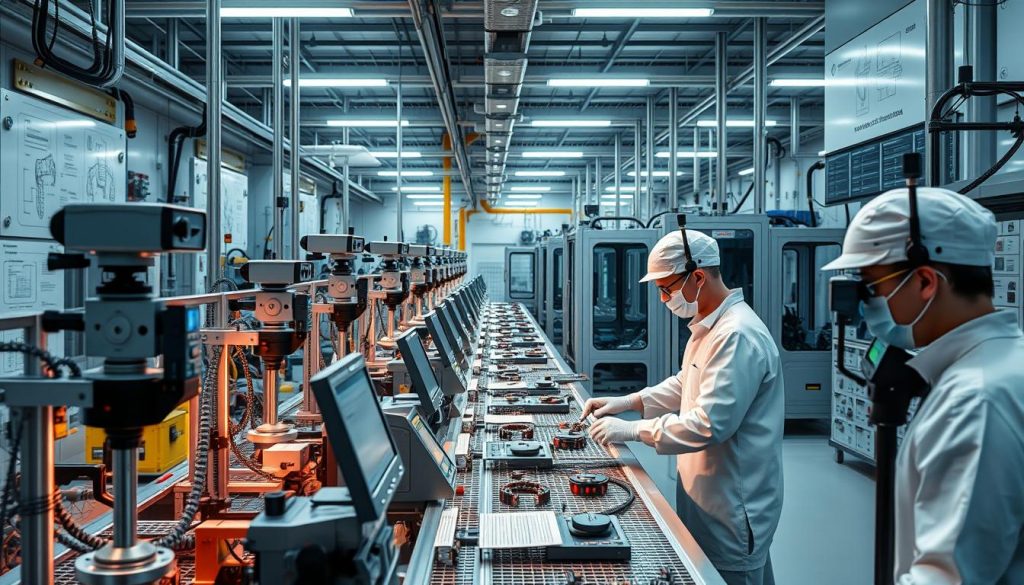
Our systems provide accurate classifications and assessments of various irregularities. This approach delivers consistent quality control across diverse production environments.
| Industry |
Application Focus |
Key Metrics |
Implementation Impact |
| Steel Manufacturing |
Hot-rolled strip examination |
6 primary irregularity types |
Real-time quality decisions |
| 3C Electronics |
Microscopic component analysis |
Solder joint integrity |
Sub-micron anomaly identification |
| Textile Production |
Pattern consistency verification |
Stain and hole detection |
Texture variation differentiation |
| Automotive |
Paint finish assessment |
Weld quality monitoring |
Surface imperfection prevention |
In steel manufacturing, we address six typical surface conditions including rolling scale and inclusions. The system processes high-speed production lines while maintaining accuracy. This industrial application significantly reduces human error rates.
Fabric and textile operations benefit from pattern irregularity identification. The technology distinguishes between intentional design elements and actual production flaws. This capability represents a significant advancement in textile quality assurance.
These implementations demonstrate tangible operational benefits across industries. Organizations achieve higher production standards while reducing costs. We invite you to contact us today at https://opsiocloud.com/contact-us/ for customized solutions.
Future Trends and Innovations in Defect Detection
The horizon of industrial quality assurance is expanding through novel computational paradigms that require minimal supervision. We are developing systems that learn exclusively from normal production samples, eliminating the need for extensive flaw examples.
These advanced approaches model the distribution of defect-free surfaces, flagging anomalies as statistical deviations. This methodology potentially resolves the data scarcity challenge that currently limits widespread deployment.
Self-supervised paradigms create training signals from unlabeled data through pretext tasks. Models learn useful representations from abundant normal images before fine-tuning on limited labeled samples.
Few-shot and meta-learning methods mimic human ability to recognize new problem types from minimal examples. These systems learn across multiple related tasks, then rapidly adapt to novel categories with minimal additional training.
Architecture innovations include neural search that automatically discovers optimal structures for specific tasks. Attention mechanisms help focus on relevant regions while ignoring background variations.
We anticipate integration of multiple modalities beyond standard imaging, including thermal and hyperspectral options. Multi-modal fusion combines complementary information sources for comprehensive quality assessment.
Field-programmable gate arrays are becoming attractive alternatives to GPU computing for specialized applications. These hardware advancements support the evolving computational demands of next-generation inspection systems.
FAQ
What are the primary advantages of using deep learning for quality control?
Our approach leverages deep learning to achieve superior accuracy in identifying product anomalies, significantly reducing false positives and enhancing production line efficiency. This technology adapts to complex patterns, ensuring consistent quality assurance.
How do you address the challenge of limited training data in industrial settings?
We employ advanced data augmentation and synthetic generation techniques to expand datasets effectively. This strategy allows our models to learn from diverse examples, improving their robustness even with scarce initial samples.
Can these systems operate in real-time within fast-paced manufacturing environments?
A> Absolutely. We optimize our neural networks for rapid inference speeds, enabling seamless integration into high-speed production lines without compromising on detection accuracy or operational workflow.
What role does transfer learning play in your model development process?
A> Transfer learning accelerates our implementation by utilizing pre-trained networks as a foundation. This method reduces training time and resource requirements while maintaining high performance across various industrial applications.
How do you ensure model adaptability to different product types or materials?
A> Our architecture features flexible design principles that facilitate quick customization for new product lines. Through targeted fine-tuning and domain adaptation, we ensure reliable performance across diverse manufacturing scenarios.
What measures are in place to handle complex background textures during inspection?
A> We implement sophisticated preprocessing techniques and convolutional neural networks specifically designed to distinguish between intricate background patterns and genuine product flaws, ensuring precise anomaly identification.
How does your solution integrate with existing quality management systems?
A> Our systems are built with compatibility in mind, featuring standardized APIs and output formats that seamlessly connect with most enterprise quality management platforms for comprehensive operational oversight.
Author
Praveena Shenoy
- Country Manager, Opsio
Praveena Shenoy is the Country Manager for Opsio India and a recognized expert in DevOps, Managed Cloud Services, and AI/ML solutions. With deep experience in 24/7 cloud operations, digital transformation, and intelligent automation, he leads high-performing teams that deliver resilience, scalability, and operational excellence. Praveena is dedicated to helping enterprises modernize their technology landscape and accelerate growth through cloud-native methodologies and AI-driven innovations, enabling smarter decision-making and enhanced business agility.