

Open-source deep learning repositories on GitHub have made automated defect detection accessible to manufacturing teams of every size, eliminating the need to build computer vision systems from scratch. According to the American Society for Quality, manufacturing facilities lose an estimated $20 billion each year to undetected product flaws that escape traditional quality control. Deep learning models trained on industrial image datasets now routinely outperform human inspectors, especially during repetitive, high-speed production runs where fatigue-driven errors compound.
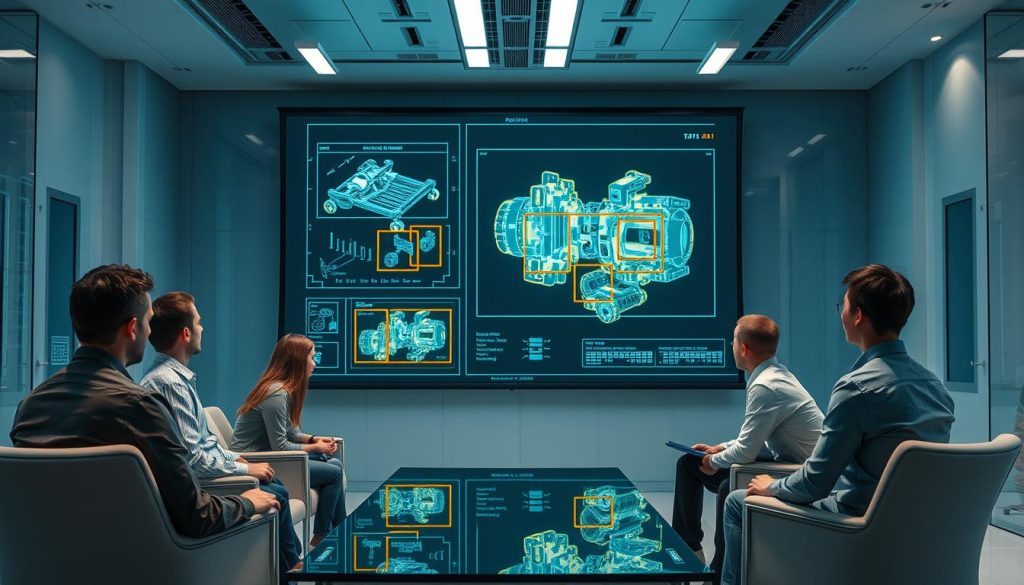
This guide walks through the best GitHub projects for AI-powered defect detection, explains which neural network architectures suit different inspection tasks, reviews benchmark datasets, and breaks down real cloud training costs. Whether you are scoping a proof-of-concept or scaling an existing inspection pipeline, the information below will help you make data-driven decisions.
Key Takeaways
- Deep learning detects product defects with 90–99% accuracy, far surpassing human inspectors whose error rates reach 20–30% under sustained workloads
- GitHub repositories like the AWS SageMaker Defect Detection lab offer production-ready code with built-in cost tracking
- Transfer learning from pre-trained models cuts data requirements to as few as 200–500 labeled images per defect class
- Cloud training costs range from about $8 for a quick-start notebook to $140 for full hyperparameter optimization
- Benchmark datasets such as NEU Steel Surface (1,800 images, 6 defect types) and Severstal (13,000+ images) provide standardized evaluation baselines
- A two-stage pipeline—lightweight classification followed by targeted segmentation—balances speed and precision for production use
Why Deep Learning Beats Traditional Inspection Methods
Human visual inspectors miss 20–30% of defects during complex or sustained tasks, according to research in the International Journal of Advanced Manufacturing Technology, making automated alternatives a financial necessity. Fatigue, inconsistent judgment, and the sheer volume of items on modern production lines all degrade manual inspection reliability.
Deep learning solves this by learning visual patterns directly from labeled image data. Unlike rule-based machine vision that demands hand-coded feature definitions, neural networks automatically discover the features most relevant for separating defective from acceptable products. Once trained, these models deliver consistent results across shifts without degradation.
The economic argument is compelling. Quality inspector salaries in the United States range from $29,000 to $64,000 annually (Bureau of Labor Statistics). Even well-compensated inspectors miss subtle anomalies when production pressure rises. AI-powered inspection systems reduce warranty claims, scrap rates, and rework costs while maintaining consistent throughput.
Three tiers of detection sophistication serve different operational needs:
| Detection Level | What It Does | Best For |
|---|---|---|
| Classification | Labels an image as defective or non-defective | Simple pass/fail quality gates |
| Localization | Identifies where defects appear in the image | Targeted rework and root-cause analysis |
| Segmentation | Maps exact defect boundaries at pixel level | Severity scoring and automated repair guidance |
Most production deployments start with classification to prove value, then progress to localization or segmentation as the system matures and the labeled dataset grows.
Best Open-Source GitHub Projects for Defect Detection
Several well-maintained GitHub repositories deliver complete training-to-deployment workflows, lowering the barrier for manufacturing teams without dedicated machine learning engineers. Choosing the right starting point depends on your target material, existing cloud infrastructure, and team skill set.
The AWS SageMaker Defect Detection project remains the most production-oriented reference. It demonstrates fine-tuning pre-trained models on Amazon SageMaker with built-in cost tracking, scalable inference endpoints, and sample data pipelines. For teams already invested in AWS, this repository provides the shortest path from experiment to deployment.
Other notable repositories address specialized domains:
- Steel surface detection — projects pairing the NEU dataset with ResNet and U-Net architectures for hot-rolled steel anomaly classification
- PCB inspection — frameworks targeting soldering defects, missing components, and trace shorts on printed circuit boards
- Fabric and textile analysis — implementations handling wide morphological variation, subtle color shifts, and pattern irregularities
- General-purpose object detection — modular codebases using Faster R-CNN, SSD, or YOLO that adapt to any manufacturing context through transfer learning
When evaluating a repository, look for performance benchmarks against real industrial data, complete pipeline code (not just model definitions), and clear documentation. Projects that include sample datasets and reproducible training scripts save weeks of integration work. For a broader look at how AI transforms factory-floor quality processes, see our guide to AI defect detection for industrial automation.
Neural Network Architectures Compared
The right architecture depends on whether your application prioritizes detection accuracy, inference speed, or resource-constrained edge deployment. Modern frameworks have matured enough that teams can select from proven options rather than designing networks from scratch.
| Architecture | Primary Strength | Ideal Use Case | Key Trade-Off |
|---|---|---|---|
| Faster R-CNN | High accuracy on small defects | Precision-critical inspection | Slower inference, higher compute cost |
| SSD (Single Shot Detector) | Fast real-time inference | High-speed production lines | Lower accuracy on tiny anomalies |
| YOLOv8+ | Speed-accuracy balance | High-throughput inline inspection | Requires careful anchor configuration |
| ResNet-50 (backbone) | Deep feature extraction | Complex defect classification | GPU-intensive training |
| MobileNet (backbone) | Lightweight efficiency | Edge and embedded deployment | Reduced capacity for complex patterns |
| U-Net / Res-U-Net | Pixel-level segmentation | Precise boundary mapping | Memory-intensive at high resolution |
Backbone networks like ResNet-50 serve as feature extraction engines inside larger detection frameworks. ResNet's residual connections solve vanishing gradient problems, enabling training of very deep networks. MobileNet sacrifices some representational power for dramatically lower compute requirements, making it practical for edge computing and embedded vision deployments.
A practical strategy for production: deploy a lightweight classifier for initial pass/fail screening, then route only flagged items through a more resource-intensive segmentation model. This two-stage approach reduces total compute costs while preserving high detection quality.
Data Preparation for Reliable Detection Models
Training data quality sets the ceiling for model performance—no architecture can compensate for a poorly curated or unrepresentative dataset. Industrial computer vision projects fail more often from data problems than from model selection mistakes.
A robust data pipeline involves five stages:
- Image collection — capture representative samples across every lighting condition, camera angle, and product variant encountered in production
- Annotation — label defect locations with bounding boxes (for object detection) or pixel masks (for segmentation), using consistent criteria across all annotators
- Class balancing — address the inherent imbalance where defective samples are far rarer than good products, using oversampling, class weighting, or focal loss
- Preprocessing — normalize pixel values, standardize image dimensions, and correct for illumination variation across the production environment
- Augmentation — expand limited datasets through rotation, flipping, color jittering, elastic deformation, and synthetic defect generation
Format requirements vary by framework. The SageMaker implementation uses RecordIO files, while most PyTorch-based projects expect COCO-format JSON annotations. Plan format conversion into your pipeline from the start to avoid bottlenecks during iteration.
Allocate at least 40–60% of total project time to data preparation. A well-curated dataset of 2,000 images routinely outperforms a noisy dataset of 20,000 because clean labels and representative coverage matter more than raw volume.
Benchmark Datasets for Training and Evaluation
Publicly available benchmark datasets provide standardized baselines for training, validating, and comparing detection approaches across manufacturing domains. Starting with established benchmarks lets teams gauge model quality before investing in proprietary data collection.
| Dataset | Domain | Size | Defect Types | Best For |
|---|---|---|---|---|
| NEU Surface Defect | Steel manufacturing | 1,800 grayscale images | 6 types (crazing, inclusion, patches, pitting, rolled-in, scratches) | Foundational classification benchmarking |
| Severstal Steel | Steel production | 13,000+ RGB images | 4 defect classes with 73% class imbalance | Large-scale segmentation and imbalance handling |
| DAGM 2007 | Textured surfaces | ~8,000 images | 10 texture defect categories | Texture anomaly detection research |
| PCB Defect Dataset | Electronics | Varies by source | Missing, short, open, and spur defects | Circuit board inspection pipelines |
The Severstal dataset deserves special attention because its severe class imbalance (one defect type represents 73% of all anomalies) mirrors real production conditions. Working through this imbalance teaches practical strategies—oversampling, class weighting, focal loss—that transfer directly to any production deployment.
The strongest approach combines public benchmarks with proprietary images from your own production lines. Use public data for rapid prototyping and architecture comparison, then fine-tune with domain-specific images before deployment. For more on surface-level inspection across industries, see our guide to surface defect detection techniques.
Transfer Learning: Build Effective Models With Less Data
Transfer learning enables effective defect detection without collecting thousands of labeled images or training neural networks from scratch, cutting both time and cost by an order of magnitude. By starting with a model pre-trained on large-scale datasets like ImageNet or COCO, teams fine-tune only the final layers for their specific inspection task.
The practical advantages are significant:
- Faster convergence — fine-tuning typically finishes in under one hour versus 8+ hours for training from scratch
- Smaller data requirements — effective results with 200–500 labeled images per defect class instead of thousands
- Lower cloud costs — basic fine-tuning runs cost approximately $1.50 on GPU instances, compared to $25+ for full training
- Better generalization — pre-trained features encode fundamental visual patterns (edges, textures, shapes) that transfer across manufacturing domains
Hyperparameter optimization adds $30–$92 depending on search space and parallel job count, but often yields significant accuracy improvements. For budget-constrained projects, start with a manual learning rate sweep before investing in automated search.
The critical decision is how many layers to freeze versus fine-tune. For defects that visually resemble objects in the pre-training dataset, freeze most layers and train only the classification head. For highly specialized defects such as microscopic surface textures, unfreeze deeper layers so the network learns domain-specific features.
Cloud Deployment Costs and Architecture
A complete inspection pipeline spans data ingestion, model training, validation, and serving—each stage with distinct cost and infrastructure requirements that cloud platforms like AWS SageMaker simplify.
Typical Cloud Training Architecture
The standard workflow uses Amazon S3 for image storage, SageMaker notebooks for experimentation, SageMaker Training Jobs for GPU-accelerated model fitting, and CloudWatch for monitoring. Inference endpoints can be configured as real-time (for inline inspection) or batch (for end-of-line audits).
Cost Breakdown by Approach
| Approach | Time | Estimated Cost | Best For |
|---|---|---|---|
| Pre-built notebook (quick start) | <1 hour | ~$8 USD | Proof of concept and feasibility testing |
| Training from scratch | ~8 hours | $25+ USD | Custom architectures and novel defect types |
| Fine-tuning with hyperparameter optimization | Variable | $130–$140 USD | Production-grade accuracy optimization |
Spot instances offer 60–90% savings for fault-tolerant training jobs. Implementing early stopping criteria and learning rate scheduling further reduces unnecessary compute spend. For inference, model quantization and compilation tools like TensorRT or SageMaker Neo cut per-prediction latency and cost.
Instance selection matters: p3.2xlarge instances on AWS deliver effective price-performance for most training workloads. For teams considering AWS migration strategies, starting with SageMaker provides a natural on-ramp to cloud-native ML infrastructure.
Industry Applications and Inspection Challenges
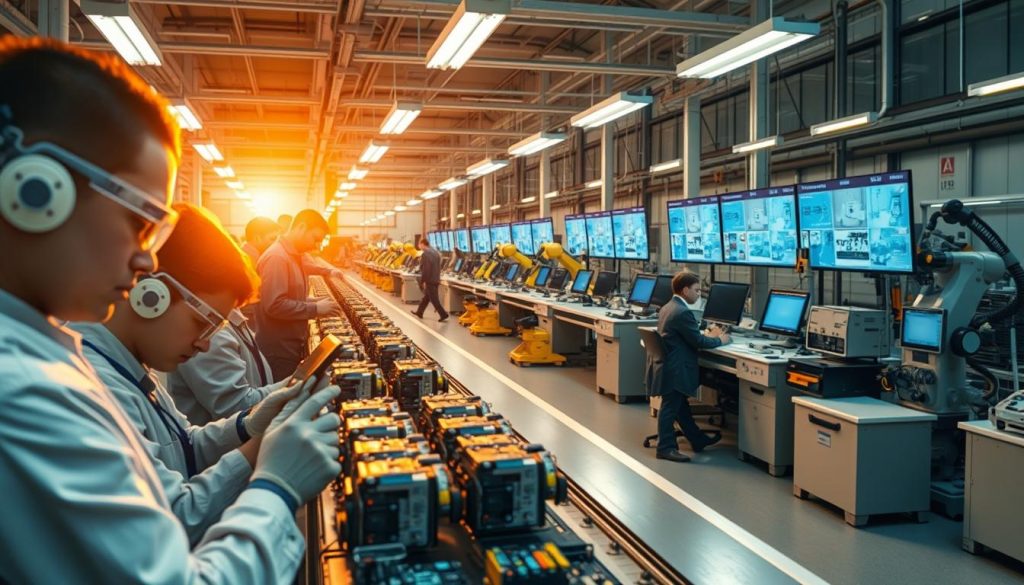
Every manufacturing sector presents distinct inspection challenges that demand tailored detection approaches, from microscopic electronics defects to large-scale textile pattern variations.
 visual inspection system checking products on a high-speed manufacturing line" width="750" height="428" srcset="https://opsiocloud.com/wp-content/uploads/2025/11/quality-control-visual-inspection-manufacturing-1024x585.jpeg 1024w, https://opsiocloud.com/wp-content/uploads/2025/11/quality-control-visual-inspection-manufacturing-300x171.jpeg 300w, https://opsiocloud.com/wp-content/uploads/2025/11/quality-control-visual-inspection-manufacturing-768x439.jpeg 768w, https://opsiocloud.com/wp-content/uploads/2025/11/quality-control-visual-inspection-manufacturing.jpeg 1344w" sizes="(max-width: 750px) 100vw, 750px" />
| Industry | Primary Challenges | Common Defect Types | Business Impact |
|---|---|---|---|
| Steel Manufacturing | High-speed rolling, variable surface texture | Crazing, inclusions, pitting, scratches | Downstream structural integrity failures |
| Electronics (PCB) | Microscopic components, diverse failure modes | Soldering flaws, missing parts, short circuits | Product reliability and safety compliance |
| Textiles | Wide morphological variation, subtle color shifts | Fabric flaws, weave errors, dye inconsistencies | Brand reputation and consumer returns |
| Food Processing | Contamination under variable lighting | Foreign objects, packaging seal failures | Consumer safety and regulatory penalties |
| Medical Devices | Sterility requirements, tight tolerances | Surface imperfections, dimensional errors | Patient safety and regulatory compliance |
Organizations that implement AI-powered visual inspection typically report detection rate improvements of 30–50% compared to manual processes. Beyond catching more defects, these systems generate inspection data that feeds back into process control, helping teams identify root causes rather than just symptoms.
Case Study: ResNet-50 and Res-U-Net Pipeline
Combining ResNet-50 for binary classification with Res-U-Net for pixel-level segmentation demonstrates how a practical two-stage pipeline handles real manufacturing data at production scale. Residual connections in both architectures overcome vanishing gradient challenges, enabling training on complex industrial images.
Using the Severstal Steel dataset (13,000+ high-resolution RGB images, 7,000+ defective samples), this approach first applies binary classification to separate defective from acceptable items. Only confirmed defectives pass to the computationally expensive segmentation stage, reducing overall GPU utilization.
Performance Benchmarks
| Model Configuration | Mean Average Precision (mAP) | Key Detail |
|---|---|---|
| DDN Baseline | 0.08 | Basic implementation without optimization |
| Type 1 Standard | 0.067 | Classification-first approach |
| Type 1 with HPO | 0.226 | After hyperparameter optimization |
| Type 2 Enhanced | 0.371 | Residual connections, improved architecture |
| Type 2 with HPO | 0.375 | Fully optimized end-to-end pipeline |
The progression from 0.08 to 0.375 mAP—a 4.7x improvement—shows the compounding effect of architectural refinement plus systematic hyperparameter tuning. The classification stage achieves an F1 score above 0.86 with 88% average accuracy, providing a reliable first filter before the heavier segmentation model runs.
Emerging Trends Shaping the Field in 2026
Edge AI, vision transformers, and closed-loop Industry 4.0 integration are accelerating adoption of automated inspection systems across manufacturing sectors.
- Edge deployment — running inference directly on production-line hardware eliminates cloud latency and network dependency, which matters for time-sensitive inline inspection where milliseconds count
- Vision Transformers (ViT) — attention-based architectures focus computational resources on the most informative image regions, improving accuracy on small or subtle defects while reducing reliance on hand-crafted augmentation
- Industry 4.0 integration — connecting inspection results with upstream process control creates closed-loop systems that not only detect defects but trace them to root causes in real time
- Synthetic data generation — generative models create realistic defect images for training, addressing the chronic shortage of labeled anomaly data in manufacturing
- Democratization through open source — frameworks like Ultralytics YOLOv8, Detectron2, and MMDetection mean small and medium manufacturers can now implement capabilities that were previously limited to enterprises with large AI teams
For organizations evaluating readiness, the typical path from proof-of-concept to production takes 3–6 months depending on data availability and integration complexity. Starting with a documented GitHub project and a public benchmark dataset is the fastest way to validate feasibility before committing to full-scale deployment.
Getting Started With Opsio
Deploying production-grade inspection systems requires expertise that bridges AI model development, cloud infrastructure, and manufacturing operations. Opsio helps organizations navigate this intersection.
cloud consulting for AI inspection solutions" src="https://opsiocloud.com/wp-content/uploads/2025/11/contact-collaboration-innovative-solutions-1024x585.jpeg" alt="Engineering team planning AI-powered quality inspection deployment with cloud infrastructure support" width="750" height="428" srcset="https://opsiocloud.com/wp-content/uploads/2025/11/contact-collaboration-innovative-solutions-1024x585.jpeg 1024w, https://opsiocloud.com/wp-content/uploads/2025/11/contact-collaboration-innovative-solutions-300x171.jpeg 300w, https://opsiocloud.com/wp-content/uploads/2025/11/contact-collaboration-innovative-solutions-768x439.jpeg 768w, https://opsiocloud.com/wp-content/uploads/2025/11/contact-collaboration-innovative-solutions.jpeg 1344w" sizes="(max-width: 750px) 100vw, 750px" />
Our consultation-based approach starts with your specific manufacturing environment, defect types, and operational constraints. From there, we recommend an implementation strategy—whether that means evaluating open-source frameworks, configuring cloud training pipelines on AWS or Azure, or deploying optimized inference endpoints at the edge.
Contact Opsio to discuss how cloud-based AI inspection can strengthen quality control in your production environment.
Conclusion
Deep learning defect detection has moved from research prototype to practical manufacturing tool, powered by accessible open-source GitHub resources and managed cloud infrastructure. The combination of pre-trained models, established benchmark datasets, and services like AWS SageMaker has reduced both the technical barrier and the financial risk of adoption.
Successful implementations follow a consistent pattern: start with a public dataset and an open-source framework to validate feasibility, fine-tune with proprietary production data, deploy as a controlled pilot, and scale based on measured results. Transfer learning makes this incremental approach both cost-effective and technically sound, even for teams with limited labeled defect data.
The resources in this guide provide a clear starting point. Approach implementation as an iterative process—validate with benchmarks, fine-tune with your data, pilot on a single line, and expand as detection accuracy and operational integration mature.
FAQ
What accuracy can deep learning achieve for defect detection?
Production-grade systems typically achieve 90–99% accuracy, depending on defect complexity and training data quality. On standard steel surface benchmarks, ResNet-50 classification models reach F1 scores above 0.86, while optimized segmentation pipelines achieve 0.375 mAP for pixel-level defect mapping.
How many labeled images do I need to train a defect detection model?
With transfer learning from pre-trained models, effective results are achievable with as few as 200–500 labeled images per defect class. Public benchmark datasets like NEU (1,800 images) and Severstal (13,000+ images) provide useful starting points for initial prototyping before you collect proprietary production data.
What does it cost to train a defect detection model in the cloud?
Costs vary by approach: quick-start notebooks run for about $8 in under an hour, fine-tuning costs approximately $1.50–$25, and full hyperparameter optimization ranges from $30 to $140. Using spot instances on AWS can reduce these figures by 60–90%.
Can a single model handle multiple materials and defect types?
General-purpose architectures like Faster R-CNN and YOLO can train on multiple defect types simultaneously. However, specialized models fine-tuned for a specific material (steel, PCB, fabric) typically outperform generalists. Multi-task architectures with shared feature extraction layers offer a practical middle ground when covering diverse product lines.
Should I deploy on cloud infrastructure or edge devices?
The best choice depends on latency and connectivity requirements. Cloud deployment suits batch inspection, model experimentation, and offline quality audits. Edge deployment using lightweight models like MobileNet is essential for real-time inline inspection where milliseconds matter. Many production systems use a hybrid approach with edge inference and cloud-based retraining.
Which open-source framework should I start with?
For teams on AWS, the SageMaker Defect Detection project provides a complete end-to-end workflow with cost tracking. For PyTorch-native development, Detectron2 and MMDetection offer modular, well-documented frameworks. Ultralytics YOLOv8 is a strong choice when inference speed is the top priority.