

Continuous compliance replaces periodic audits with real-time validation, so regulated cloud environments stay audit-ready every day rather than once a quarter. Most compliance failures do not stem from negligence; they stem from the gap between how fast cloud environments change and how slowly traditional controls are reviewed. Opsio closes that gap as a regulation-first cloud partner, embedding control validation, evidence collection, and governance directly into day-to-day operations for enterprises that cannot afford compliance drift.
Why Annual Compliance Audits Fail in Cloud Environments
Traditional compliance models built around annual or quarterly reviews cannot keep pace with the velocity of modern cloud deployments. The fundamental disconnect between the speed of infrastructure change and the cadence of compliance validation introduces risk that compounds over time. According to the Cloud Security Alliance, organizations that rely on periodic compliance checks experience an average of 45 days per year where their cloud environments are out of compliance without their knowledge.
The following problems recur across regulated enterprises that have not adopted continuous compliance monitoring:
- Deployment velocity outpaces approval cadence. Teams ship infrastructure changes daily through CI/CD pipelines, but compliance reviews happen monthly or quarterly, creating a growing backlog of unvalidated changes.
- Access permissions expand without governance. Every incident, project, or onboarding event adds permissions. Without continuous access review, privilege creep accumulates silently until the next audit surfaces it.
- Configuration drift introduces hidden violations. Even properly configured resources drift from baselines through manual changes, automated scaling, or upstream provider updates.
- Evidence collection becomes a scramble. When evidence is gathered only before an audit, teams spend weeks reconstructing what happened months ago, often with gaps and inconsistencies.
- Controls exist on paper but not in practice. Written policies rarely match operational reality when there is no mechanism for ongoing validation.
These challenges intensify under frameworks that carry real enforcement consequences. Healthcare organizations operating under HIPAA must protect PHI across hybrid cloud architectures, financial institutions face PCI DSS requirements for cardholder data environments, and government contractors must maintain FedRAMP authorization status across every change window.
What Continuous Compliance Actually Means
Continuous compliance is the practice of automating regulatory validation and evidence collection so that cloud environments remain in a provably compliant state at all times, not just during audits. Unlike traditional compliance programs that treat audits as discrete events, this approach integrates monitoring, policy enforcement, and documentation into the operational fabric of cloud infrastructure.
The concept draws from the same principles behind continuous integration and continuous delivery in software development. Just as CI/CD pipelines validate code quality on every commit, automated policy validation checks regulatory adherence on every infrastructure change.
This model transforms audit readiness from a quarterly scramble into a persistent operational state. When every change is validated as it happens, the audit itself becomes a confirmation of what is already known, not a discovery exercise.
For regulated workloads specifically, this means three things: (1) every configuration change is checked against the applicable control baseline before or immediately after deployment, (2) evidence of compliance is collected automatically as a byproduct of operations, and (3) compliance status is visible in real time rather than reconstructed retroactively.
Measurable Benefits of Continuous Compliance
Organizations that shift from periodic to ongoing compliance monitoring consistently report reduced audit costs, fewer findings, and faster time-to-compliance for new workloads. The benefits span both operational efficiency and risk reduction.
Operational Gains
- 60-80% reduction in manual evidence collection effort through automated artifact generation
- Real-time visibility into compliance posture across all cloud accounts and regions
- Faster remediation cycles because issues are caught within hours, not months
- Reduced friction between security, operations, and compliance teams through shared dashboards
Business Impact
- Lower total cost of compliance by replacing manual review cycles with automation
- Reduced risk of regulatory penalties, which under GDPR alone can reach 4% of annual global revenue
- Accelerated cloud adoption for regulated functions that previously avoided cloud due to compliance concerns
- Stronger positioning in vendor due diligence and customer trust evaluations
How Opsio Implements Continuous Compliance
Opsio uses a regulation-first model that maps compliance controls to operational routines, validates them continuously, and produces audit-ready evidence as a natural byproduct. Rather than bolting compliance onto existing operations as an afterthought, this approach makes regulatory requirements the starting point for how cloud infrastructure is managed. The model has three integrated layers.
Layer 1: Control Mapping to Operational Routines
Abstract compliance requirements become concrete, repeatable tasks that teams execute as part of their normal workflow. This is where most compliance programs fail: they define controls in policy documents but never translate them into specific actions with clear owners and cadences.
Opsio maps each applicable control to a specific operational routine:
- Access review cadence: Structured schedules for validating permissions, with automated flagging of accounts that have not been reviewed within the required window. This directly addresses the access governance requirements in HIPAA, PCI DSS, and FedRAMP.
- Change governance linked to risk tier: Risk-based approval workflows where routine, low-impact changes flow through automated validation while high-impact changes require explicit review. This prevents compliance from becoming a bottleneck while maintaining control over consequential changes.
- Incident response exercises: Regular tabletop exercises and controlled incident simulations that test response capabilities and generate evidence of preparedness.
- Third-party risk reviews: Systematic evaluation of cloud provider services, SaaS dependencies, and subprocessor compliance status on a defined schedule.
By embedding controls into operational routines, compliance becomes part of how teams work rather than a separate activity that competes for attention. Teams that operate under Opsio's model do not "do compliance" as a side task; they maintain compliance through the same workflows they use to manage their cloud infrastructure.
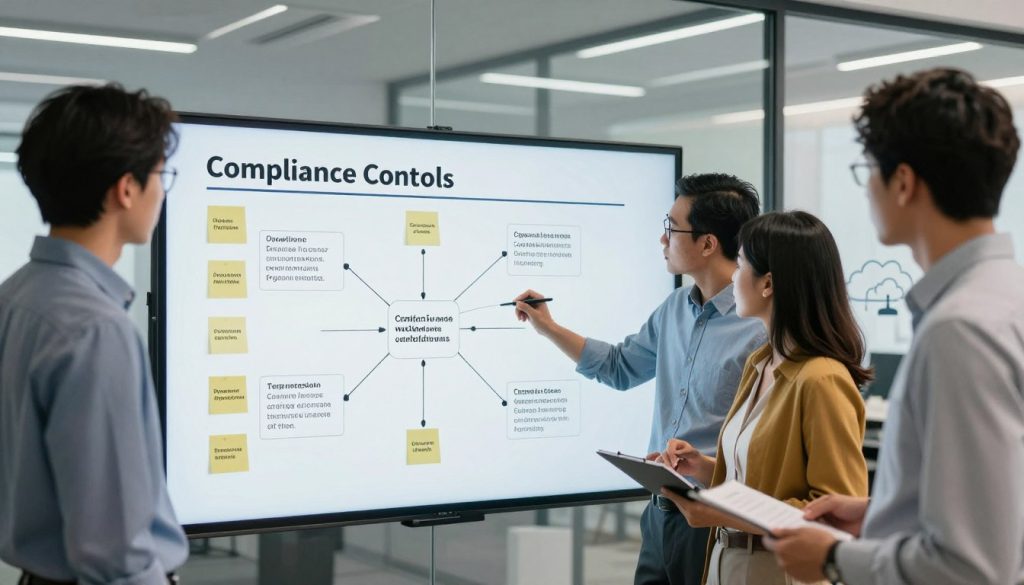
Layer 2: Continuous Validation Checkpoints
Automated and scheduled validation checks confirm that controls are working as intended, catching drift before it becomes a finding. Instead of discovering violations during an audit, Opsio's validation layer surfaces issues in near real time, giving teams the opportunity to remediate before any regulatory exposure occurs.
- Configuration baseline checks: Automated scans compare live cloud configurations against the approved baseline for each regulatory framework. Deviations trigger alerts and, where safe, automated remediation.
- Pre-deployment compliance gates: Infrastructure-as-code pipelines include compliance validation as a required step before deployment proceeds, implementing compliance as code in practice.
- Monitoring coverage verification: Regular checks confirm that logging, alerting, and retention policies meet the requirements of each applicable framework.
- Evidence refresh cadence: Compliance artifacts such as access review logs, configuration snapshots, and change records are refreshed on a schedule tied to each control's requirements.
These validation checkpoints create an ongoing feedback loop. When a check fails, the responsible team is notified immediately. When it passes, the result is logged as evidence. Over time, this produces a dense evidence trail that satisfies auditors without any additional effort from operations teams.
Layer 3: Audit Readiness as a Natural Byproduct
When compliance is continuous, formal audits confirm existing practices rather than exposing gaps. Organizations that operate under Opsio's model enter audit cycles with complete evidence packages, consistent narratives, and zero last-minute preparation.
- Stable compliance narratives: Well-documented descriptions of how each control is implemented, tested, and maintained, updated incrementally rather than rewritten before each audit.
- Consistent evidence artifacts: Standardized formats for logs, reports, and attestations that meet auditor expectations and can be produced on demand.
- Clear ownership and operating cadence: Every control has a named owner, a defined execution schedule, and a documented escalation path.
This layer is what makes automated compliance validation pay for itself. The cost of audit preparation drops dramatically when evidence already exists and is organized. Teams that previously lost weeks to audit preparation can redirect that time to productive cloud operations work.
Compliance as Code: The Technical Foundation
Compliance as code encodes regulatory requirements as machine-readable policies that are version-controlled, testable, and enforceable within CI/CD pipelines. This approach, sometimes called policy-as-code, is the technical mechanism that makes always-on regulatory validation scalable.
In practice, compliance as code works at three levels:
Preventive Controls
Infrastructure-as-code templates include compliance guardrails by default. For example, a Terraform module for provisioning an S3 bucket enforces encryption, access logging, and versioning before the resource is created. Non-compliant configurations fail to deploy.
Detective Controls
Automated scanning tools evaluate running infrastructure against policy definitions on a continuous schedule. Tools like AWS Config Rules, Azure Policy, and open-source engines like Open Policy Agent (OPA) compare live state against desired state and report deviations.
Corrective Controls
Auto-remediation workflows respond to detected violations by reverting configurations to their compliant baseline. This is appropriate for well-understood, low-risk deviations. Higher-risk corrections are routed to human reviewers.
Opsio helps regulated enterprises adopt compliance as code incrementally, starting with the highest-risk controls and expanding coverage as the organization's infrastructure-as-code maturity grows. This pragmatic approach avoids the common pitfall of attempting full automation before foundational practices are in place.
Where Automation Helps and Where It Does Not
Automation is essential for scaling automated compliance checks, but human judgment remains critical for interpreting regulatory intent, evaluating risk, and making decisions that policies cannot encode. The most effective compliance programs combine both strategically.
| Capability | Automate | Human Judgment Required |
| Configuration validation against baselines | Yes, fully automatable with policy engines | Only for exceptions and compensating controls |
| Evidence collection and organization | Yes, triggered by operational events | Quality review and narrative context |
| Access review and recertification | Flag overdue reviews, remove inactive accounts | Evaluate business justification for access |
| Regulatory interpretation | No | Yes, always requires expert judgment |
| Risk-based prioritization | Scoring models can assist | Final prioritization decisions |
| Incident response and root cause analysis | Automated detection and initial triage | Investigation, communication, and remediation |
Opsio's approach uses automation to handle the volume and velocity of cloud security compliance checks while preserving human oversight for the decisions that require context, experience, and regulatory expertise. This balance is particularly important for organizations subject to multiple overlapping frameworks.
Continuous Compliance Across Regulatory Frameworks
Regulated enterprises often must comply with multiple frameworks simultaneously, and ongoing regulatory monitoring creates efficiencies by identifying shared control objectives. Rather than maintaining separate compliance programs for each framework, Opsio maps controls once and reuses validation routines and evidence across overlapping requirements.
| Framework | Continuous Compliance Approach | Key Controls Automated | Typical Validation Cadence |
| HIPAA | Automated PHI access validation, encryption verification, audit log monitoring | Access controls, encryption at rest/transit, audit logging, backup verification | Daily access review, real-time encryption checks |
| PCI DSS | Continuous network segmentation testing, vulnerability scanning, cardholder data flow monitoring | Network segmentation, vulnerability scanning, file integrity monitoring | Continuous scanning, weekly penetration testing |
| FedRAMP | Ongoing control assessment, automated POA&M tracking, continuous monitoring of all control families | Configuration management, access control, system integrity, audit and accountability | Monthly vulnerability scans, ongoing control checks |
| GDPR | Automated data mapping, processing activity validation, consent management monitoring | Data inventory updates, access logging, retention policy enforcement | Real-time processing validation, quarterly DPIA reviews |
| NIS2 | Supply chain risk monitoring, incident reporting readiness, security measure validation | Supply chain checks, incident detection and escalation, risk assessment updates | Continuous threat monitoring, quarterly risk reviews |
For organizations subject to both EU and US frameworks, Opsio's unified approach is especially valuable. A single access review routine can satisfy HIPAA's workforce access requirements, PCI DSS Requirement 7, FedRAMP AC controls, and GDPR's access limitation principles simultaneously. Learn more about NIS2 compliance requirements and how they interact with existing frameworks.
Implementing Continuous Compliance: A Phased Approach
Moving from periodic to always-on compliance requires a structured transition that balances immediate risk reduction with long-term sustainability. Opsio guides organizations through three phases, each designed to deliver measurable value before the next phase begins.
Phase 1: Assessment (Weeks 1-3)
Map current compliance posture against applicable frameworks. Identify the highest-risk gaps, document existing controls and their execution consistency, and prioritize the controls that will deliver the most risk reduction when automated.
Phase 2: Foundation (Weeks 4-8)
Implement core validation checkpoints for the top-priority controls. Deploy automated configuration scanning, establish evidence collection pipelines, and define ownership and escalation paths for every control in scope.
Phase 3: Expansion (Ongoing)
Extend continuous compliance automation to additional control families, integrate compliance gates into CI/CD pipelines, and refine detection and remediation based on operational data. This phase is iterative and continues as the organization's cloud footprint evolves.
This phased approach ensures that organizations begin realizing value within weeks rather than waiting for a full transformation. The most critical compliance gaps are addressed first, and each phase builds on the foundation established by the previous one.
Outcomes Opsio Delivers for Regulated Enterprises
Opsio's ongoing compliance model produces measurable improvements in audit readiness, operational efficiency, and risk posture for enterprises operating under regulatory scrutiny. Clients working with Opsio consistently report:
- Predictable compliance cadence: Compliance activities follow a defined rhythm aligned with operational workflows, eliminating the cycles of neglect and panic that characterize traditional programs.
- Faster time-to-compliance for new workloads: New cloud services and applications reach compliant status faster because the validation infrastructure already exists. Teams provision compliant-by-default infrastructure rather than remediating after deployment.
- Reduced audit findings: When every control is validated continuously, auditors confirm practices rather than discovering problems. This shifts audit conversations from remediation to improvement.
- Governance without delivery friction: Compliance gates are integrated into deployment pipelines, so teams experience compliance as a quality check rather than a roadblock. Co-managed service models ensure that compliance expertise is available without building large in-house teams.
Frequently Asked Questions
Does continuous compliance monitoring increase daily workload?
No, it reduces overall effort by distributing compliance activities across the operational lifecycle. Instead of concentrating weeks of work before each audit, this approach spreads smaller tasks across daily operations and automates the most labor-intensive components, particularly evidence collection and configuration validation. Most organizations report a net reduction in compliance-related labor after the initial implementation period.Can Opsio manage compliance across multiple regulatory frameworks?
Yes, and this is one of the primary advantages of the regulation-first model. Opsio maps controls once and reuses validation routines and evidence across overlapping framework requirements. For example, a single access review process can satisfy requirements from HIPAA, PCI DSS, FedRAMP, and GDPR simultaneously, reducing duplication and ensuring consistency.How quickly can continuous compliance be implemented?
The first high-priority controls can be under continuous monitoring within 3-4 weeks. Opsio prioritizes the controls that carry the highest regulatory risk and the greatest audit impact first. Full coverage across all applicable control families typically takes 2-4 months depending on the complexity of the cloud environment and the number of frameworks in scope.What is the difference between continuous compliance and compliance as code?
Compliance as code is one technique within the broader continuous compliance approach. Compliance as code specifically refers to encoding regulatory requirements as machine-readable policies that can be version-controlled and enforced in CI/CD pipelines. The broader practice of ongoing compliance validation that also includes operational routines, human oversight, evidence management, and audit coordination. Compliance as code is a powerful enabler of this approach, but it is not sufficient on its own.Does continuous compliance work in multi-cloud environments?
Yes, Opsio's approach is cloud-agnostic and focuses on control objectives rather than provider-specific implementations. Validation routines are adapted to each cloud provider's native tools and APIs (AWS Config, Azure Policy, GCP Organization Policy) while maintaining consistent compliance outcomes and unified reporting across all environments.Moving from Compliance Burden to Operational Capability
Always-on compliance represents a fundamental shift from treating regulatory adherence as a periodic disruption to embedding it as a permanent operational capability. For regulated enterprises operating in cloud environments, this shift is not optional; it is the only approach that scales with the velocity of modern infrastructure change.
Opsio's regulation-first model ensures that compliance requirements inform operational design from the start. Through structured control mapping, automated validation checkpoints, and evidence collection that happens as a byproduct of normal operations, organizations maintain a provable compliance posture without sacrificing the speed and agility that cloud enables.
The organizations that treat ongoing compliance automation as a strategic investment rather than a cost center will find themselves better positioned for regulatory scrutiny, faster in their cloud adoption, and more efficient in their operations.
Build Always-On Compliance Into Your Cloud Operations
Opsio helps regulated enterprises implement always-on compliance monitoring that keeps pace with cloud change. Start with a compliance posture assessment to identify your highest-priority gaps.
Schedule a Compliance Assessment