

Cloud solutions for smart manufacturing have become the backbone of Industry 4.0, enabling factories to collect real-time production data, run predictive analytics at scale, and automate decision-making across globally distributed operations. For manufacturers facing tighter margins, supply-chain volatility, and rising quality expectations, cloud computing delivers the agility and intelligence required to stay competitive without the capital burden of on-premise infrastructure.
According to Deloitte research, manufacturers adopting cloud-based systems reduce IT infrastructure costs by 10 to 40 percent while gaining access to advanced analytics and AI capabilities that would be prohibitively expensive to build and maintain on-premise. As production environments generate ever-larger volumes of sensor data, the elastic scalability of cloud platforms has shifted from a nice-to-have into a strategic necessity.
This guide explains how cloud manufacturing platforms work, which technologies matter most in 2026, and how to measure the return on your investment.
How Cloud Computing Powers Smart Manufacturing
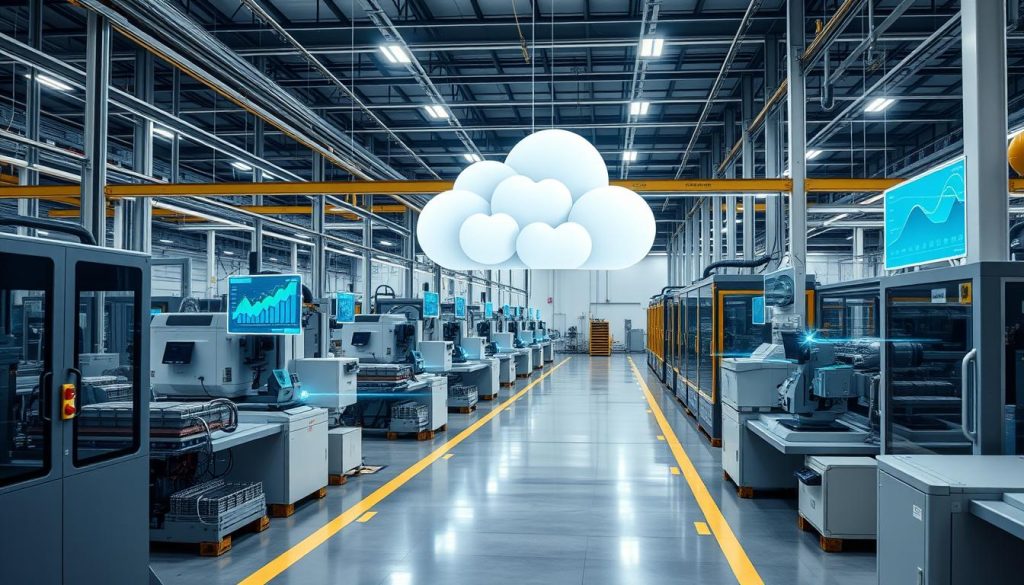
Cloud computing in manufacturing refers to the delivery of computing resources—servers, storage, databases, networking, analytics, and AI—over the internet on a pay-as-you-go basis. Instead of purchasing and maintaining on-site data centers, manufacturers consume capacity on demand, scaling up during peak production and scaling down during maintenance windows.
This model shifts spending from capital expenditure to operational expense, freeing budget for innovation while granting access to technologies that would otherwise be cost-prohibitive for a single plant. For multi-site manufacturers, cloud computing also centralizes data governance, making it possible to compare performance across facilities, standardize processes, and roll out improvements globally from a single platform.
Core Building Blocks of Cloud Manufacturing
- Infrastructure as a Service (IaaS): On-demand compute, storage, and networking resources that replace physical server rooms.
- Platform as a Service (PaaS): Development environments purpose-built for manufacturing applications such as MES and SCADA extensions.
- Software as a Service (SaaS): Ready-to-use cloud ERP manufacturing, quality management, and supply-chain planning tools.
- Data lakes and warehouses: Centralized repositories for production, sensor, and business data.
- AI and ML services: Pre-trained models and training infrastructure for predictive maintenance, visual inspection, and demand forecasting.
Key Benefits for Manufacturers
- IT infrastructure cost reductions of 10–40 percent, according to Deloitte research on cloud adoption in industrial settings.
- Elastic scalability that matches fluctuating production demand without over-provisioning hardware.
- Unified data accessibility across global manufacturing sites, enabling cross-plant benchmarking.
- Faster innovation cycles by providing development teams with sandbox environments in minutes.
- Built-in disaster recovery and geo-redundant storage that strengthen operational resilience.
Cloud-Based IIoT Platforms for the Factory Floor
Industrial Internet of Things (IIoT) platforms are the connective tissue between shop-floor equipment and cloud analytics. Services such as AWS IoT Core, Azure IoT Hub, and Google Cloud IoT connect sensors, PLCs, and edge gateways to the cloud, enabling secure device management, telemetry ingestion, and real-time monitoring at scale.
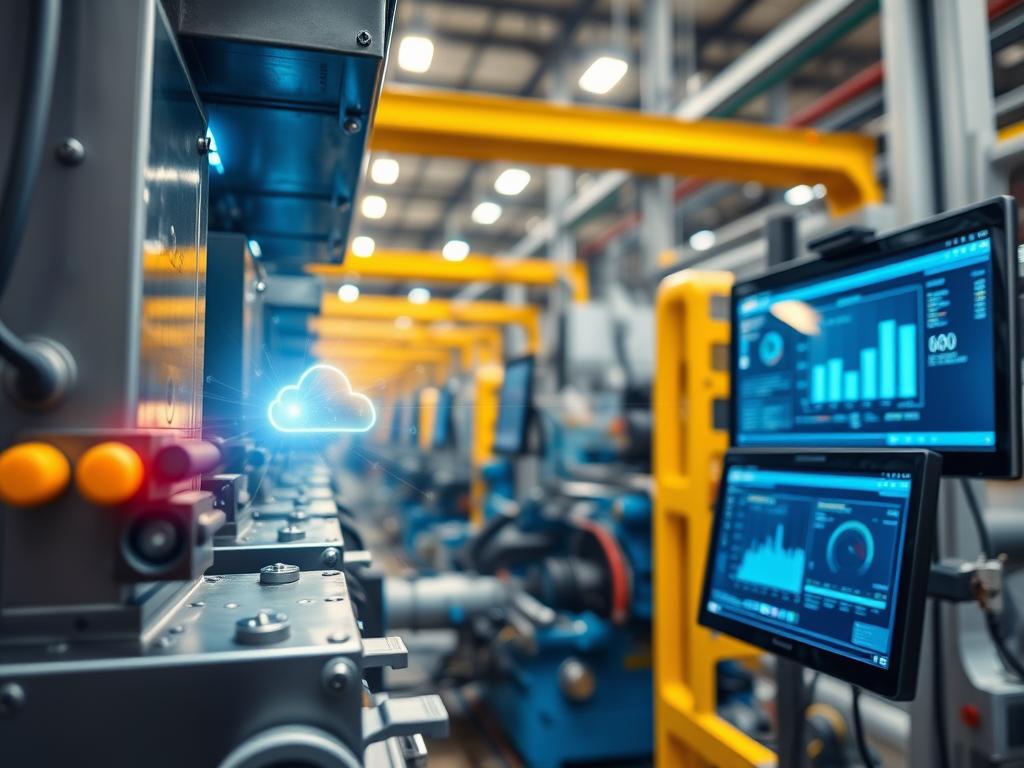
A practical example: an automotive OEM deployed AWS IoT to stream torque, vibration, and temperature data from hundreds of assembly robots. Cloud-based anomaly detection models flag deviations in real time, alerting maintenance teams before a breakdown occurs. The result was a 35 percent reduction in unplanned downtime and measurably longer equipment life cycles.
What makes cloud-based IIoT platforms particularly powerful is their ability to handle heterogeneous protocols. Factory floors typically run a mix of OPC-UA, MQTT, Modbus, and proprietary protocols. Cloud IoT services include protocol translation layers that normalize this data into a unified schema, enabling consistent analytics regardless of the source equipment vendor or generation.
Edge-Cloud Hybrid Architectures
Not every manufacturing workload can tolerate cloud round-trip latency. Edge-cloud hybrid architectures split processing between local edge devices and centralized cloud platforms so that each workload runs where it performs best.
- Edge layer: Real-time machine control, safety interlocks, local model inference, protocol translation, and data filtering.
- Cloud layer: Historical data storage, advanced analytics, model training, cross-facility optimization, and dashboard reporting.
This topology ensures sub-millisecond response times for safety-critical functions while harnessing cloud-scale compute for pattern recognition and long-term trend analysis. Modern edge gateways from vendors like AWS Outposts, Azure Stack Edge, and Google Distributed Cloud run containerized workloads locally while synchronizing with the cloud whenever connectivity allows, providing resilience even during network outages.
Cloud Analytics, AI, and Predictive Maintenance
The computational depth of cloud platforms makes them ideal for processing the massive data volumes that modern factories generate. Machine-learning pipelines hosted in the cloud can train on months of production telemetry, identify subtle degradation patterns, and deploy updated models back to the edge for real-time inference.
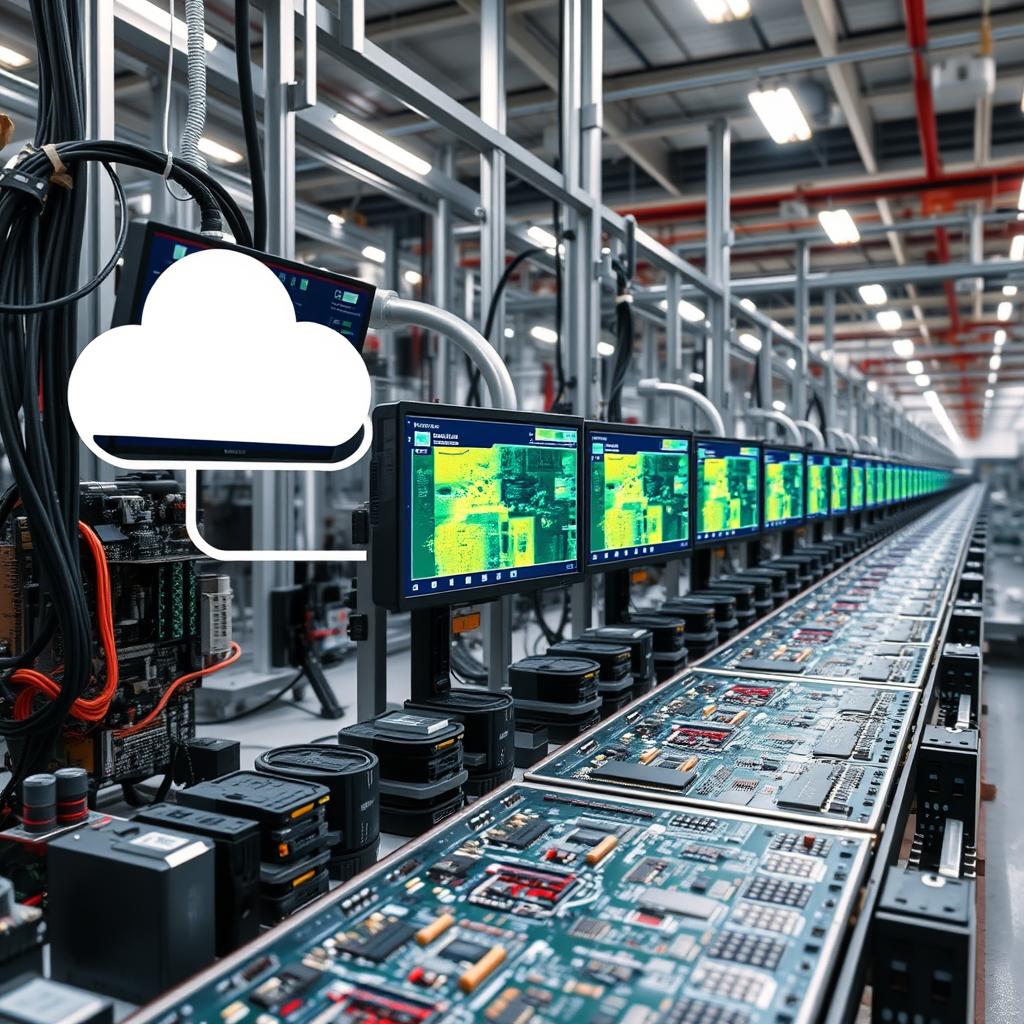
An electronics contract manufacturer illustrates the impact: by deploying cloud-based visual inspection AI to detect solder defects on circuit boards, the company achieved a 12 percent increase in first-pass yield and a 40 percent reduction in quality-control labor costs. The cloud GPU resources that power the inspection models would have been prohibitively expensive to purchase on-premise.
Predictive maintenance is another high-value use case. Instead of following fixed maintenance schedules that either replace parts too early or too late, cloud-hosted ML models analyze vibration spectra, thermal signatures, and power-draw anomalies to predict the remaining useful life of critical components. Manufacturers implementing these systems consistently report 30 to 50 percent reductions in unplanned downtime and significant extensions in asset lifespan.
Need Help Moving Your Factory to the Cloud?
Opsio designs and manages cloud environments purpose-built for manufacturing workloads—from IIoT ingestion to predictive maintenance pipelines.
Talk to a Cloud Manufacturing SpecialistDigital Twin Manufacturing in the Cloud
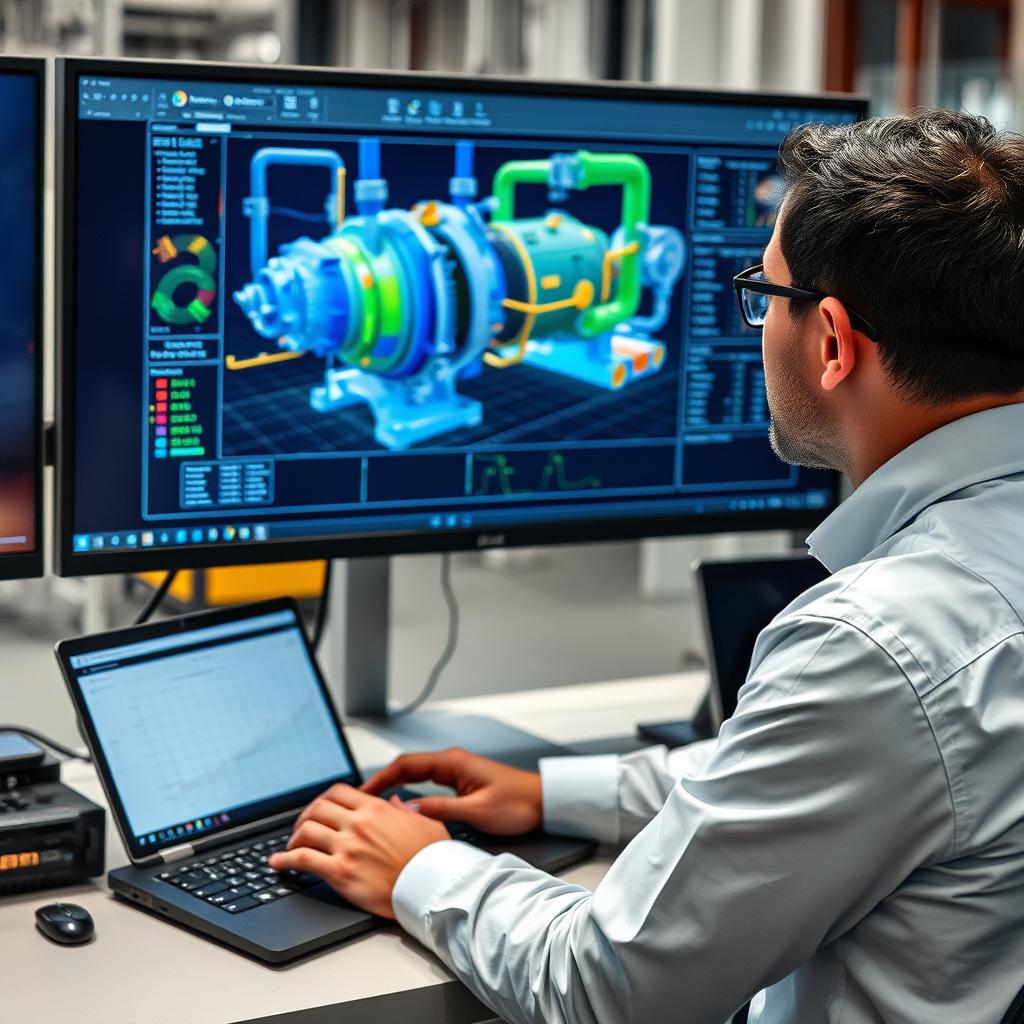
Digital twins—virtual replicas of physical assets, production lines, or entire factories—have moved from concept to competitive advantage. Cloud platforms supply the storage and compute needed to maintain these complex simulations, letting manufacturers test layout changes, process tweaks, and failure scenarios virtually before committing resources on the physical floor.
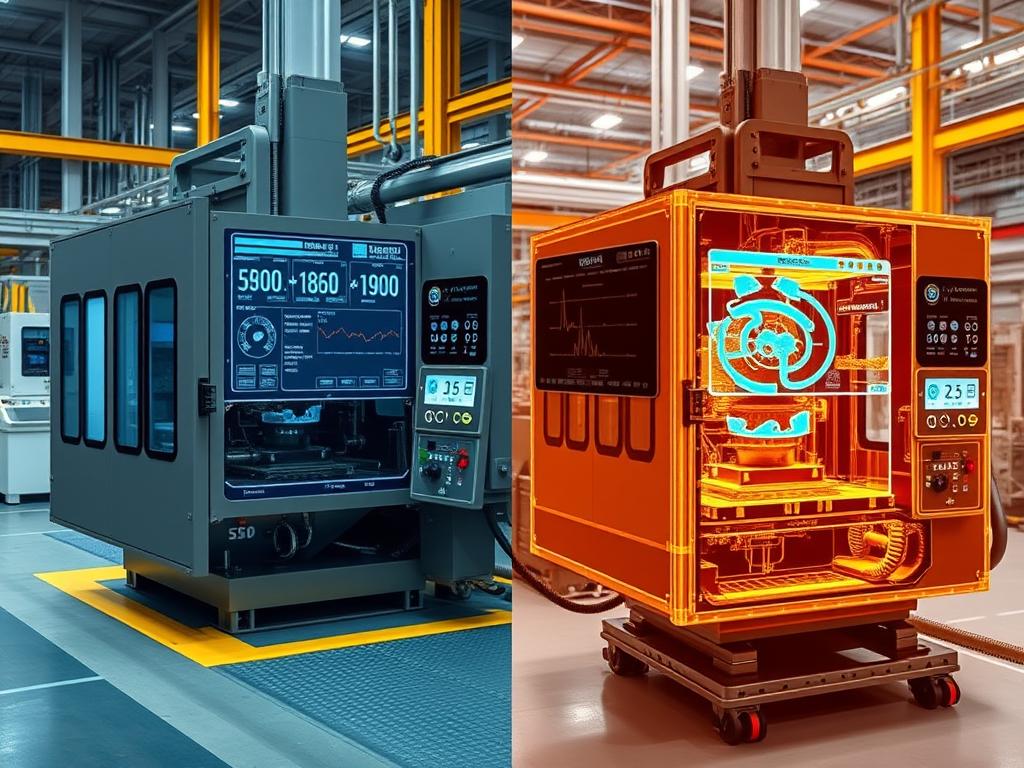
Deloitte research indicates that manufacturers using cloud-hosted digital twins have reduced commissioning time for new production lines by up to 30 percent. A German machinery manufacturer leveraged this approach to simulate different production scenarios, optimizing equipment layouts and workflows before physical deployment, which cut post-installation adjustments by 30 percent.
Serverless Computing and Containerization in Manufacturing
Serverless functions and container orchestration (Kubernetes, ECS) are changing how manufacturing applications ship and scale. Containers package analytics workloads into portable units that run identically on edge hardware and cloud data centers, while serverless functions execute on demand without dedicated infrastructure.
A beverage producer demonstrated this by deploying containerized fault-detection services across multiple bottling lines. When an anomaly is detected, a serverless function automatically creates a maintenance ticket and adjusts line speed. Deployment cycles dropped from weeks to hours, and infrastructure costs fell by 40 percent.
For manufacturers operating across multiple geographies, containerization also solves the consistency problem. The same analytics container that runs in a plant in Stuttgart performs identically in a facility in Shanghai, eliminating environment-specific bugs and simplifying compliance with regional data-handling requirements through location-aware deployment policies.
Measuring the Return on Cloud Manufacturing Investments
Key Performance Indicators
| KPI Category | Specific Metrics | Typical Improvement |
|---|---|---|
| Operational Efficiency | Overall Equipment Effectiveness (OEE), Throughput | 15–25% increase |
| Maintenance | Unplanned Downtime, Mean Time to Repair | 30–50% reduction |
| Quality | First Pass Yield, Defect Rate | 10–20% improvement |
| Cost | Maintenance Spend, Energy Consumption | 10–40% reduction |
| Innovation | Time-to-Market, New Product Introduction | 20–35% reduction |
Real-World Results
Automotive OEM
A major U.S. automotive manufacturer rolled out cloud-based predictive maintenance across stamping operations. Vibration, temperature, and power-consumption data feeds machine-learning models that predict failures before they occur. Results: 35 percent reduction in unplanned downtime, $3.2 million annual maintenance savings, and 22 percent OEE improvement.

Electronics Manufacturer
A UK-based contract manufacturer deployed cloud-powered visual inspection AI for PCB solder-defect detection. Thousands of high-resolution images per hour are analyzed by cloud GPU clusters. Results: 12 percent first-pass yield gain, 40 percent quality-control labor reduction, and 15 percent faster production cycles.
Industrial Equipment Maker
A German OEM used cloud-hosted digital twins to simulate and optimize production-line configurations before shipping equipment to customer sites. Results: 25 percent shorter commissioning, 18 percent better initial production efficiency, and 30 percent fewer post-installation adjustments.
Implementation Roadmap for Manufacturing Cloud Solutions
Choosing the Right Cloud Model
Public Cloud Advantages
- Lowest upfront investment with pay-per-use pricing.
- Rapid elastic scaling for variable production workloads.
- Immediate access to cutting-edge AI, IoT, and analytics services.
- Global availability zones for multi-site manufacturing operations.
Private and Hybrid Cloud Considerations
- Data sovereignty and regulatory compliance requirements (GDPR, ITAR).
- Ultra-low-latency workloads such as real-time machine control.
- Legacy system integration where direct cloud connectivity is impractical.
- Intellectual property protection for proprietary process data.
Security and Compliance Best Practices
Manufacturing data frequently includes trade secrets, customer specifications, and regulated information. A robust cloud security posture should include:
- Zero-trust architecture: Authenticate and authorize every user and device regardless of network location.
- Encryption everywhere: Protect data in transit with TLS 1.3 and at rest with AES-256.
- Role-based access control: Restrict data access to the minimum permissions each role requires.
- Compliance alignment: Map controls to ISO 27001, NIST CSF, and sector-specific standards.
- Continuous assessment: Run automated vulnerability scans and periodic penetration tests.
Manufacturing environments present unique security challenges because operational technology (OT) networks were historically air-gapped and not designed for internet connectivity. Bridging OT and IT through cloud platforms requires careful network segmentation, industrial-grade firewalls, and anomaly detection tuned to recognize manufacturing-specific attack patterns such as unauthorized PLC firmware changes or unexpected protocol traffic.
Change Management and Workforce Upskilling
Technology alone does not guarantee results. Successful cloud adoption requires organizational readiness:
- Executive sponsorship that ties cloud initiatives to measurable business outcomes.
- Cross-functional teams combining OT engineers, IT architects, and data scientists.
- Phased rollouts that prove value on a single line before scaling plant-wide.
- Structured training in cloud architecture, data engineering, IoT device management, and MLOps.
- Clear communication plans that address workforce concerns about automation and role changes.
Organizations that treat cloud adoption as purely a technology project often stall after the pilot phase. The most successful transformations embed cloud literacy into ongoing professional development programs and create career pathways that reward employees who bridge traditional manufacturing expertise with data-engineering and cloud-operations skills.
Future of Cloud and Smart Manufacturing
5G-Enabled Edge Computing
5G private networks will deliver sub-millisecond latency between edge devices and cloud platforms, unlocking use cases such as cloud-coordinated autonomous mobile robots (AMRs) and real-time holographic remote assistance for maintenance technicians.

AI-Driven Autonomous Manufacturing
Cloud platforms will increasingly host reinforcement-learning agents that optimize production parameters in real time—adjusting temperature, pressure, speed, and material flow without human intervention. These systems learn continuously from production outcomes, pushing efficiency and quality beyond what manual tuning can achieve.
The combination of cloud-scale training, edge inference, and digital-twin simulation creates a closed loop: the digital twin tests parameter changes virtually, the cloud trains updated models on aggregated production data, and edge devices execute optimized settings on the physical line. This approach accelerates continuous improvement cycles from months to days.
Federated Learning for Secure Collaboration
Federated learning enables multiple manufacturers or supply-chain partners to train shared machine-learning models without exposing proprietary data. Cloud infrastructure coordinates model updates across participants, preserving intellectual property while capturing the collective intelligence of an entire value chain.
This approach is especially relevant for industries like aerospace and automotive, where tier-one suppliers and OEMs share quality and logistics data. Federated learning hosted on cloud platforms allows each party to benefit from better-performing models trained on a broader dataset while keeping sensitive process parameters strictly within organizational boundaries.
Frequently Asked Questions
What is cloud manufacturing?
Cloud manufacturing is the application of cloud computing—on-demand servers, storage, analytics, and AI services delivered over the internet—to manufacturing operations. It replaces or augments on-premise IT infrastructure, giving factories elastic scalability, real-time data access, and advanced capabilities without large capital investments.
How does cloud computing improve smart factory efficiency?
Cloud platforms collect and process production data from sensors, machines, and enterprise systems in a single environment. This enables real-time monitoring, predictive maintenance that prevents unplanned downtime, AI-powered quality inspection, and cross-plant performance benchmarking—all of which drive measurable efficiency gains.
Is cloud computing secure enough for manufacturing data?
Major cloud providers offer enterprise-grade security features including encryption at rest and in transit, identity and access management, network segmentation, and compliance certifications (ISO 27001, SOC 2, NIST). When combined with a zero-trust architecture and continuous monitoring, cloud environments can meet or exceed the security posture of most on-premise data centers.
What does a cloud manufacturing implementation cost?
Costs vary widely depending on scope, but the pay-as-you-go model eliminates large upfront capital expenditure. Manufacturers typically see IT infrastructure cost reductions of 10–40 percent compared to on-premise alternatives, with additional savings from reduced downtime, improved quality, and faster time-to-market.
How long does it take to migrate manufacturing systems to the cloud?
A focused pilot—such as predictive maintenance on a single production line—can be operational within 8–12 weeks. Full-scale migration of MES, ERP, and analytics platforms across multiple sites typically takes 6–18 months, depending on legacy system complexity and organizational readiness.
What is the difference between edge computing and cloud computing in manufacturing?
Edge computing processes data locally at or near the production equipment, delivering sub-millisecond response times for safety-critical and real-time control tasks. Cloud computing centralizes storage, advanced analytics, and model training in remote data centers. Most smart factories use both in a hybrid architecture—edge devices handle latency-sensitive operations while the cloud manages historical analysis, cross-plant optimization, and AI model development.