Industry data reveals a striking fact: manufacturers leveraging modern digital execution systems achieve up to 25% higher operational productivity. This isn’t just about new software. It’s about a fundamental strategic choice that defines your factory floor’s future.
Today’s business leaders face a critical decision in selecting a Manufacturing Execution System. The path you choose between two primary deployment models directly shapes your operational agility and return on investment.
We wrote this article to provide a clear, data-driven comparison. Our goal is to help you optimize performance and make an informed choice for your unique production environment.

Modern manufacturing demands real-time visibility and the ability to respond with speed. Advanced execution systems enable this agile control over complex processes.
Several key factors influence this pivotal decision. These include your cost structure, internal IT resources, security requirements, and plans for future growth.
Within the competitive U.S. landscape, speed to market and operational efficiency are paramount. Selecting the right technological partner can unlock significant advantages and sustainable benefits over time.
We approach this discussion as your collaborative guide. Our mission is to combine wisdom with supportive guidance, helping you navigate this complex landscape to unlock growth and reduce operational burden.
Key Takeaways
- The choice between deployment models is a strategic business decision with long-term impact.
- Contemporary production requires real-time data visibility and agile process control.
- Critical decision factors include upfront cost, IT capability, security, and scalability needs.
- Optimizing this technological investment directly boosts productivity and return.
- The U.S. market emphasizes speed and efficiency for maintaining a competitive edge.
- A detailed, tailored analysis is essential to align a solution with specific operational goals.
- Expert partnership simplifies the evaluation process and ensures a fit for your business.
Introduction: Navigating the Critical MES Deployment Decision
Selecting the deployment model for a production management platform is more than a technical checkbox; it’s a commitment to a specific operational philosophy. This choice determines how you collect data, manage shop floor activities, and optimize your entire workflow. It serves as the digital backbone for real-time control and visibility.
The fundamental importance of this decision cannot be overstated. Your manufacturing execution system is the central nervous system of your operations. It translates plans into actions and turns machine data into actionable intelligence for your team.
Core trade-offs immediately come into focus. Leaders must weigh upfront capital investment against predictable ongoing operational costs. There is also a balance between maintaining internal command and leveraging external scalability for growth.
Security, compliance needs, and IT maintenance burdens are other pivotal factors. Each deployment approach handles these elements differently, impacting your long-term agility and resilience.
Drawing from our direct experience, we have implemented cloud, on-premise, and hybrid models across diverse industries. This hands-on work gives us a practical, partnership-focused perspective on what truly drives success in production environments.
A critical differentiator often overlooked is the licensing structure. Traditional models that charge per user, per screen, or per data point can create artificial barriers. They limit data access and make scaling use cases across multiple sites prohibitively expensive.
In contrast, innovative models like per-gateway pricing unlock new possibilities. This method aligns the cost with value and enables seamless multi-site expansion without punitive fees. It removes the friction that stifles broader adoption of your operational software.
Ultimately, this is a strategic business choice, not just an IT procurement. It aligns technology directly with goals for efficiency, growth, and competitive advantage. We guide you to see beyond the initial setup to the lasting impact on your operational destiny.
Defining the Models: What is Cloud-Based MES?
The architecture of a cloud MES liberates production teams from the constraints of physical hardware and localized IT management. This approach fundamentally reimagines the deployment of shop floor software, treating it as a managed service rather than a static asset.
We define this model as a true Software-as-a-Service (SaaS) offering. The operational platform resides off-site, enabling a new paradigm of agility and centralized command.
Core Architecture and Access
In this framework, the software and its data live on remote servers hosted by a specialized provider. These servers typically run on massive-scale platforms like Amazon Web Services (AWS), Microsoft Azure, or Google Cloud.
Manufacturers connect to their production system securely via a web browser. This grants remote access from any authorized device with an internet connection.
A primary advantage is the complete transfer of infrastructure responsibility. The cloud partner manages all server maintenance, security patching, and performance tuning. Your internal IT staff is freed from these routine burdens.
This creates a single, unified data hub for the entire enterprise. Teams from different plants or corporate offices can view the same real-time information. This fosters collaboration and drives faster, more informed decisions across multiple locations.
The Subscription-Based (SaaS) Model
Financially, this model operates on an operational expenditure (OpEx) basis. Instead of a large, upfront capital outlay, you pay a predictable, recurring subscription fee.
This fee covers not only the use of the software but also the ongoing service. It includes critical elements like automatic updates, robust data backups, and technical support from the vendor.
The economic clarity is significant. Costs become a regular, scalable operating expense aligned with actual usage. This eliminates surprise refresh cycles for aging on-premise hardware.
Technologies like Ignition Cloud Edition are built for this purpose. They are designed specifically for rapid cloud deployment of manufacturing execution systems.
Such platforms minimize IT overhead and dramatically accelerate time-to-value. Your team can focus on configuring workflows and gaining visibility, not managing servers.
Ultimately, the cloud mes solution offers a streamlined path. It delivers enterprise-grade capability with a modern, service-oriented approach that scales with your ambition.
Defining the Models: What is On-Premise MES?
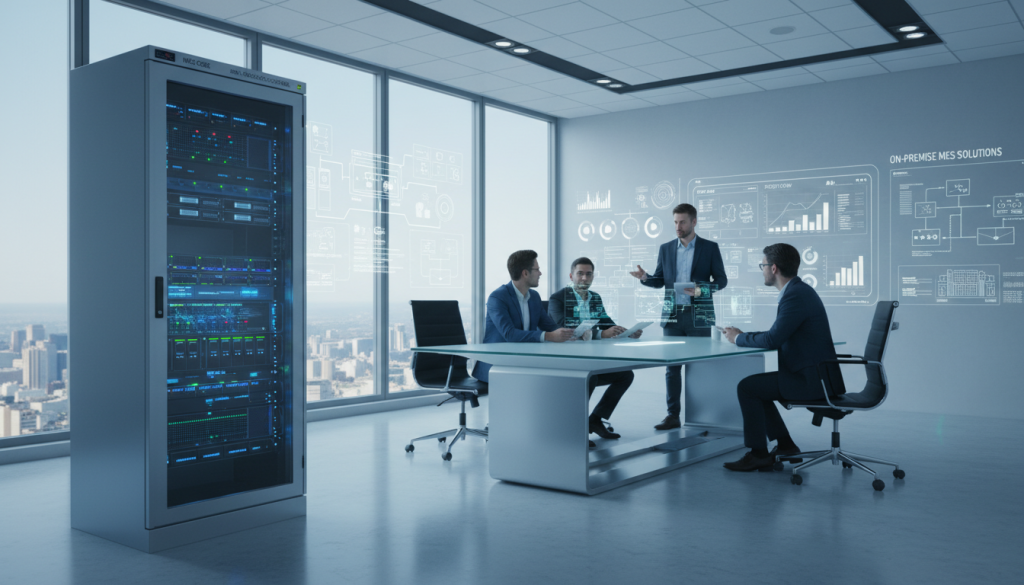
For decades, the physical presence of servers within factory walls represented the gold standard for manufacturing execution system deployment. This traditional model is defined by ownership and direct physical management of the entire technological stack.
An on-premise mes involves installing the core software on hardware located within your own facility. All responsibility for running, securing, and updating the platform rests entirely with your internal team.
Traditional Infrastructure and Control
This approach demands a significant commitment to physical infrastructure. You must procure and host dedicated local servers, along with the necessary networking and power systems.
A robust, specialized IT department is essential. Their role extends beyond support to active system administration, maintenance, and security hardening.
The primary reward for this investment is an unparalleled degree of control. Your organization governs every aspect, from data sovereignty and security protocols to the timing of software updates.
This hands-on command allows for deep customization of workflows. Teams can tailor the solution to match unique processes without external constraints.
The Upfront Capital Investment Model
Financially, this model is characterized by a substantial capital expenditure (CapEx). Significant upfront investment is required for hardware, perpetual software licenses, and implementation services.
These costs are incurred before the system delivers any operational value. They represent a long-term bet on your internal infrastructure and IT capabilities.
The burden of ongoing maintenance is a critical consideration. Manual updates, security patches, and hardware refreshes demand continuous internal time and budget.
This can stretch implementation timelines and limit agility. Scaling to new lines or facilities often requires repeating the entire capital procurement cycle.
We acknowledge this framework’s enduring strength for specific operations. It is often mandated for compliance with strict data residency laws.
It also provides a definitive answer for manufacturers needing ultra-low, predictable network latency. In these cases, the model’s trade-offs align perfectly with non-negotiable operational requirements.
Cloud-Based vs On-Prem MES Solutions USA: A Head-to-Head Comparison
When evaluating execution platforms, the most critical step is a structured comparison across the dimensions that impact daily operations and long-term strategy. We provide a direct, point-by-point analysis of the two primary deployment models.
This framework examines the most pressing decision criteria for American production leaders. It moves beyond theory to the practical trade-offs that define your shop floor’s efficiency and agility.
Total Cost of Ownership: Upfront Investment vs. Ongoing OpEx
The financial profiles of these two paths are fundamentally different. An on-premise solution requires a significant capital expenditure (CapEx) before any value is realized.
This upfront investment covers hardware, perpetual software licenses, and implementation services. It often reaches six figures for a single production site.
In contrast, a cloud mes operates on a subscription-based, operational expenditure (OpEx) model. Initial costs are typically much lower, involving setup and configuration fees.
Long-term financial implications are stark. The on-premise model carries hidden costs for hardware refreshes every 3-5 years and manual updates.
The cloud approach bundles these expenses into a predictable monthly or annual fee. This includes maintenance, security patches, and automatic updates managed by the provider.
Deployment Speed and Implementation Complexity
Time-to-value is a major differentiator. A cloud-based system can often be provisioned and accessed remotely within weeks.
The provider manages the core infrastructure on their servers. Your team focuses on configuring workflows and user permissions via a web interface.
An on-premise deployment follows a more traditional, linear timeline. It requires physical hardware procurement, racking, networking, and on-site software installation.
This process frequently extends over several months. It demands significant time from both internal IT and the vendor’s implementation specialists.
The complexity inherently delays the moment your team gains real-time visibility and control. For businesses needing rapid adaptation, this delay carries an opportunity cost.
Accessibility and Enterprise Visibility
Modern manufacturing demands information flow beyond the factory floor. A cloud mes delivers this by design, enabling secure access from any location with an internet connection.
Authorized personnel log in via a web browser. Plant managers, quality engineers, and corporate executives can view the same live production data simultaneously.
This fosters unprecedented enterprise-wide visibility and collaborative decision-making. Role-based security ensures individuals only see relevant information.
Traditional on-premise systems are typically bound to the local network. Remote access requires complex virtual private network (VPN) setups, which can be slow and create security vulnerabilities.
Data tends to remain siloed within the physical plant. This limits the agility of multi-site operations and can hinder a unified view of business performance.
IT Maintenance and Update Management
The ongoing burden on your technical staff is a pivotal consideration. With a cloud solution, the vendor’s team handles all backend maintenance.
This includes server health monitoring, performance tuning, and applying software patches. Updates and new features are rolled out automatically, often with zero downtime.
Your internal IT resources are liberated from these routine tasks. They can focus on higher-value projects that directly support core manufacturing processes.
An on-premise installation places the full weight of system upkeep on your shoulders. Your team must schedule and execute all updates, which often requires taking the system offline.
They are also responsible for hardware diagnostics, failure recovery, and ensuring compliance with evolving security standards. This represents a continuous drain on internal expertise and budget.
| Comparison Criteria |
Cloud-Based MES |
On-Premise MES |
| Financial Model |
Operational Expenditure (OpEx). Predictable subscription fee covers software, hosting, and updates. |
Capital Expenditure (CapEx). High upfront cost for licenses, servers, and implementation. |
| Deployment Timeline |
Weeks. Rapid, remote provisioning with no physical hardware setup required. |
Months. Lengthy process involving hardware procurement, installation, and on-site configuration. |
| Access & Visibility |
Anywhere, anytime via web browser. Enables real-time, multi-site enterprise visibility. |
Primarily local network. Remote access requires VPN, often limiting data flow and collaboration. |
| IT Responsibility |
Vendor-managed. Provider handles maintenance, security, patches, and automatic updates. |
Internally managed. Your team is responsible for all maintenance, updates, and hardware refreshes. |
| Scalability |
High. Elastic resources allow for quick scaling of users, data, or new sites. |
Limited. Scaling often requires purchasing and deploying additional hardware and licenses. |
Security and Data Control: Perceptions vs. Modern Realities
In the digital age, safeguarding production information is paramount. The path to robust security is not as simple as choosing where your servers reside.
We often encounter a persistent belief that local infrastructure guarantees superior protection. This perception requires a clear-eyed examination against today’s threat landscape and technological capabilities.
True security is a function of continuous vigilance and expert resource allocation. It extends far beyond the physical location of data storage.
Our analysis separates enduring truths from outdated assumptions. We provide a balanced view to inform your critical control decisions.
On-Premise: Internal Control and Internal Risks
The traditional model offers complete physical and administrative command over your system. All data remains within the facility’s network perimeter.
This creates a strong sense of sovereignty. Your team dictates every security policy, firewall rule, and access protocol.
However, this absolute control carries a correspondingly absolute burden. The responsibility for threat detection, patch management, and intrusion prevention falls entirely on your internal IT staff.
Risks are not solely external. Without stringent internal protocols, threats can originate from within your operations. A robust on-premise defense requires significant, ongoing investment in expertise and maintenance.
Cloud-Based: Provider-Managed Security and Advanced Protocols
Modern cloud solutions leverage the security infrastructure of major platforms like AWS or Microsoft Azure. These providers invest billions in protecting their global data centers.
Your production information benefits from enterprise-grade defenses. These include end-to-end encryption, multi-factor authentication, and regular independent audits like SOC 2.
Dedicated security teams work around the clock to monitor for threats and apply patches. This specialized focus often surpasses the capabilities of a typical internal IT department.
The provider assumes the heavy lifting of infrastructure hardening. This allows your technical resources to focus on configuring processes and user permissions within a secured environment.
Compliance with Evolving US Regulations
Adhering to industry and government standards is a non-negotiable aspect of manufacturing business. Frameworks like NIST, ITAR, or industry-specific rules dictate strict data handling requirements.
Both deployment paths can achieve compliance. The mechanisms for maintaining it differ significantly.
A cloud mes platform is often updated proactively by the vendor to align with new regulations. This service is part of the subscription, reducing your team’s cost and effort for continuous monitoring.
An on-premise installation requires manual updates and configuration changes to meet evolving standards. This can create lag and increase the risk of non-compliance without diligent oversight.
Ultimately, the choice hinges on your capacity to manage complex security systems internally. A modern cloud solution offers a compelling path to robust protection and simplified compliance.
Scalability and Flexibility for Growth
Growth is not merely an ambition for successful manufacturers; it is a daily operational reality that demands a flexible technological foundation. The ability to scale your execution platform efficiently becomes a decisive competitive advantage. It determines how quickly you can ramp up production, enter new markets, or integrate acquired facilities.
We explore scalability as the critical bridge between current operations and future business goals. This analysis contrasts the inherent elasticity of modern cloud architecture with the physical constraints of traditional infrastructure.
The right model removes artificial barriers, allowing your systems to expand in lockstep with your ambition. It turns technological investment into a genuine engine for growth.
Cloud MES: Elastic Scaling and Pay-as-You-Grow
A cloud mes platform is built on the principle of elastic scaling. Computing resources—like processing power and data storage—can be provisioned or scaled back on-demand. This matches your actual production volumes and data needs in real time.
Your provider manages this behind the scenes. There is no need to purchase and install physical hardware for every expansion. This architecture delivers instant updates and new features without disruptive deployment projects.
The financial model aligns perfectly with this flexibility. A pay-as-you-grow pricing structure means your costs directly correlate with usage. You avoid large, upfront capital outlays.
This operational expenditure approach provides remarkable budget predictability. It transforms scaling from a capital-intensive project into a manageable, ongoing business process. The advantages for growing organizations are profound.
On-Premise MES: Hardware-Limited Expansion
Scaling a traditional, on-prem installation is a fundamentally different process. Expansion is intrinsically tied to physical capacity. Increasing system capabilities necessitates purchasing, installing, and configuring additional server hardware.
This triggers a familiar cycle: a capital procurement request, a lengthy vendor selection, and an IT project timeline. Each step introduces delay between recognizing a business need and achieving new operational control.
The result is often a solution that lags behind market opportunities. Scaling to a new production line or facility can take months. It also requires dedicating significant internal IT resources to the deployment and maintenance of the new infrastructure.
This model can create a scalability bottleneck. Growth becomes a series of costly, discrete projects rather than a smooth, continuous evolution.
Innovative Licensing Models (e.g., Per Gateway)
True technological scalability is often hindered not by infrastructure, but by restrictive licensing. Traditional models that charge per user, per screen, or per site create artificial economic barriers. They punish manufacturers for expanding data visibility or applying new use cases.
We champion a different approach through our per-gateway licensing. This solution, exemplified by our Kanoa MES on the Ignition platform, eliminates these punitive fees. You license the gateway connection to your cloud or on-premise environment, not each individual asset or person.
The benefits for multi-site operations are substantial. We have customers running a single cloud-hosted Ignition Gateway across five facilities and over 400 assets. This deployment delivers massive cost savings compared to per-site or per-asset pricing.
| Scaling Mechanism |
Financial Impact |
Time to Scale |
| Cloud MES: Elastic Resources |
Operational Expenditure (OpEx). Predictable, usage-based subscription. |
Near-instant. Resources provisioned via software configuration. |
| On-Premise MES: Hardware Addition |
Capital Expenditure (CapEx). Significant upfront cost for new servers and licenses. |
Months. Requires hardware procurement, shipping, and physical installation. |
| Per-Gateway Licensing |
Fixed cost for gateway, unlimited assets/users within connected sites. Enables massive ROI at scale. |
Immediate for adding assets. No new license procurement needed. |
This innovative model is critical for unlocking genuine scalability. It allows American manufacturers to expand access and apply new analytical processes across their enterprise. Growth is no longer constrained by punitive software costs.
The right licensing strategy turns your manufacturing execution system into a true growth platform. It supports your ambition without imposing artificial limits on your operations.
Operational Resilience: Uptime, Latency, and Internet Dependency
Operational resilience transcends mere uptime statistics. It embodies the system’s capacity to deliver consistent performance for critical shop floor controls under all conditions.
This is a non-negotiable requirement for continuous manufacturing. Your execution platform must maintain flawless operations regardless of external network stability or internal hardware events.
We define this resilience as a combination of availability, responsiveness, and data integrity. It directly impacts your ability to meet production schedules and maintain quality standards.
The core challenge lies in balancing local control with enterprise connectivity. Each deployment approach addresses this challenge with distinct architectural philosophies.
On-Premise: Offline Operation and Low Latency
The traditional on-premise mes model offers inherent strength in this area. It functions completely independently of external internet connectivity.
All processes and data reside within the local network. This ensures uninterrupted production even during widespread internet outages.
The primary advantage is ultra-low, predictable latency. Real-time machine control and data acquisition happen within milliseconds.
Critical shop floor operations remain highly responsive. They do not rely on the variable speed of an external network connection.
This model provides absolute uptime assurance for local systems. It is often mandated for manufacturers with safety-critical or highly synchronized processes.
The trade-off is a siloed data environment. Information may not flow seamlessly to enterprise analytics platforms without additional integration effort.
Cloud-Based: Connectivity and Mitigation Strategies
A cloud solution openly depends on a stable internet connection for full functionality. This dependency, however, is effectively managed with modern technologies.
Proven mitigation strategies ensure high levels of uptime and responsiveness. They transform potential vulnerability into managed reliability.
The lightweight MQTT protocol is central to this strategy. Message Queuing Telemetry Transport ensures fast and reliable data transmission from the shop floor.
It operates efficiently even over bandwidth-constrained or intermittent networks. Data packets are small and can be queued for delivery when connectivity is restored.
Architectural approaches like edge computing create a resilient buffer. Components such as Ignition Edge run locally on the factory floor.
They handle data collection and basic operator interfaces. This local node can buffer information if the cloud connection is temporarily lost.
Store-and-forward modules, like those from CirrusLink, further strengthen data reliability. They ensure no production data point is lost during a network disruption.
These technologies collectively create a hybrid-like layer for cloud deployments. They deliver the benefits of centralized analytics without sacrificing local robustness.
With proper planning, a cloud-based mes achieves the uptime required for modern production. It offers a compelling balance of global access and local resilience.
Our experience confirms this. We have customers successfully running platforms like our Kanoa MES across multiple sites using a single cloud-hosted gateway.
This setup, detailed in our cloud vs. on-prem MES comparison, illustrates scalable, resilient cloud deployment. It provides continuous operations with consolidated enterprise visibility.
- Local Autonomy: On-premise systems guarantee operation during internet outages, offering peace of mind for mission-critical lines.
- Managed Redundancy: Cloud architectures use edge devices and robust protocols to maintain data flow and access despite network issues.
- Speed Assurance: Latency-sensitive controls often favor on-premise, while cloud strategies optimize data routing for overall system responsiveness.
- Strategic Choice: The decision hinges on which type of resilience—absolute local uptime or managed global accessibility—aligns with your core processes.
Ultimately, both paths can deliver the operational resilience manufacturers demand. The key is selecting a solution and partner that transparently addresses these fundamental performance requirements.
The Hybrid MES Approach: Blending the Best of Both Worlds
For complex operations where neither pure cloud nor pure on-premise fully satisfies, a blended architecture emerges as the strategic answer. This hybrid model intentionally combines local and remote elements to serve distinct operational needs.
We view it as a pragmatic solution for manufacturers who refuse to compromise. They require both absolute local control for critical processes and expansive enterprise visibility for strategic decisions.
This approach is not a default starting point. It is often an evolution. Most organizations begin with one primary deployment and extend to a hybrid setup when specific, compelling use cases arise.
The goal is to balance resilience with analytical power. It enables local uptime for mission-critical production while leveraging cloud scalability for data aggregation and cross-facility coordination.
Use Cases for a Hybrid Architecture
Specific scenarios reveal where a hybrid mes excels. It solves problems that a single-environment system struggles to address efficiently.
A primary use case is multi-site data consolidation. A company may have several plants running traditional on-premise mes servers for local line control.
A synchronized cloud instance can aggregate data from all these sites. It creates a unified, central dashboard for executive reporting and comparative analytics.
Another powerful scenario involves separating function by latency sensitivity. Ultra-fast, real-time machine control and operator interfaces run on local hardware.
Simultaneously, data streams to a cloud environment. There, it fuels advanced analytics, predictive maintenance algorithms, and supply chain coordination.
This is ideal for manufacturers with strict data residency or compliance requirements for certain processes. Sensitive data stays on-site, while other information flows freely for broader business insight.
Balancing Local Uptime with Cloud Analytics
The technical architecture of a hybrid setup is designed for this precise balance. It requires careful planning but delivers unparalleled operational flexibility.
An on-premise server handles real-time, latency-sensitive functions. This ensures continuous operations regardless of external network conditions.
A synchronized cloud instance manages data aggregation, historical reporting, and cross-facility coordination. The two environments communicate through secure, robust data pipelines.
Technologies like edge gateways are crucial. They act as local data buffers and protocol translators. They ensure no production data is lost during temporary network disruptions.
This architecture does introduce increased complexity. Managing two integrated environments requires more sophisticated maintenance and potentially higher infrastructure costs.
From our experience, the payoff is substantial for the right organization. We have customers successfully running platforms like our Kanoa mes in this exact configuration.
They achieve bulletproof uptime on the shop floor. At the same time, they gain the scalability and analytical power of a centralized cloud deployment.
| Component |
Location |
Primary Function |
Key Benefit |
| Local Execution Server |
On-Premise |
Real-time machine control, operator interfaces, and low-latency data acquisition. |
Guarantees uptime and performance for critical line functions, independent of internet. |
| Edge Gateway / Buffer |
On-Premise (Shop Floor) |
Collects machine data, translates protocols, and securely buffers data for transmission. |
Ensures no data loss during network outages; enables connectivity to legacy equipment. |
| Cloud Analytics Instance |
Remote (Provider Cloud) |
Aggregates data from multiple sites, runs advanced analytics, and hosts enterprise reporting dashboards. |
Provides unified visibility across the organization; enables scalable computing for complex algorithms. |
| Synchronization Service |
Both (Managed Service) |
Securely replicates relevant data between the local server and the cloud instance in near real-time. |
Maintains data consistency across the hybrid environment without manual intervention. |
This approach represents a strategic choice for complex, multi-facility operations. It is for those who have outgrown the limitations of a single deployment model.
It demands a clear understanding of which processes belong where. With that clarity, a hybrid architecture delivers a best-of-both-worlds outcome for modern production challenges.
The Future of MES: Trends Shaping US Manufacturing
The technological horizon for American production is being redrawn by a convergence of data intelligence and architectural flexibility. We are moving beyond the basic debate of deployment location. The focus now shifts to capabilities—how platforms learn, adapt, and connect within an increasingly digital ecosystem.
This evolution is driven by a clear mandate for agility. Manufacturers must respond to volatile supply chains and shifting consumer needs with unprecedented speed. The next generation of manufacturing execution tools will be the cornerstone of this responsive operation.

We identify two interconnected trajectories defining this future. One pushes the boundaries of intelligence and accessibility in remote platforms. The other redefines the purpose of local infrastructure within a networked world.
Understanding these trends is essential for strategic planning. Your choice today must create a foundation ready for tomorrow’s innovations.
The Shift Toward Cloud-Native and AI Integration
The future lies not in simple cloud hosting, but in truly cloud-native architectures. These platforms are built from the ground up to leverage the elasticity, global distribution, and managed services of major cloud providers.
This foundational shift enables seamless integration of artificial intelligence and machine learning. These advanced capabilities move from experimental projects to core, accessible business tools.
We see AI transforming key production areas. Predictive maintenance algorithms analyze equipment data streams to forecast failures before they cause downtime. Computer vision systems perform real-time quality assurance with superhuman consistency.
Dynamic scheduling engines optimize workflows by simulating countless scenarios in minutes. These powerful features are increasingly delivered as continuous updates within a Software-as-a-Service (SaaS) model.
This makes advanced manufacturing execution solutions more accessible. A mid-sized plant can now leverage the same analytical power as a global enterprise, without a massive upfront investment in hardware or data science teams.
The cloud mes platform becomes a living system. It grows smarter and more capable over time, directly translating data into actionable intelligence and profit.
The Evolving Role of On-Premise in a Connected Ecosystem
While cloud adoption accelerates, traditional on-premise mes deployments are not disappearing. Their role is evolving from a standalone system to a robust, intelligent edge node within a larger connected ecosystem.
In this future, local software excels at what it does best: guaranteeing ultra-low latency control and absolute uptime for mission-critical processes. It then acts as a secure data source, feeding a rich stream of operational information to centralized cloud analytics.
This is critically enabled by the explosive growth of the Industrial Internet of Things (IIoT). Smart machines and sensors generate a massive inflow of data. Both deployment models are adapting to handle this deluge.
An on-premise execution system can provide the initial processing and filtering at the source. It ensures only valuable, contextualized information is transmitted, optimizing internet bandwidth and security.
This creates powerful synergies. Local infrastructure handles real-time responsiveness and deep customization. The cloud layer provides unlimited scalability for storage, cross-facility visibility, and complex computational analysis.
For manufacturers with strict data residency requirements, this hybrid edge-cloud approach offers a perfect path. It maintains compliance while still participating in enterprise-wide digital transformation.
Our analysis is forward-looking yet grounded in practical reality. The key for decision-makers is to select a path that is not just suitable for today’s production needs.
Choose a platform and partner that embrace this connected, intelligent future. The right mes solutions will turn emerging trends into your sustained competitive advantage.
Conclusion: Choosing the Right MES Path for Your US Operation
We believe the best choice is not a universal answer but a tailored strategy that empowers your specific production environment. Your final decision between an on-premise or cloud deployment hinges on unique business priorities, technical constraints, and growth ambitions.
Each model offers distinct advantages. On-premise solutions provide ultimate control and offline resilience for mission-critical processes. Cloud-based platforms deliver accelerated innovation, elastic scalability, and reduced IT maintenance.
A hybrid approach can balance these competing demands. The critical factor is selecting a flexible architecture and licensing model, like our per-gateway pricing, to prevent vendor lock-in and support future expansion. For a deeper framework on evaluating these options, consider insights on how to choose the best MES system.
We invite you to partner with us. Let’s analyze your operational needs and design a manufacturing execution system that boosts productivity and drives growth. Take the next step in your digital transformation with a solution built for adaptability.
FAQ
What is the primary financial difference between cloud and on-premise manufacturing execution systems?
The core difference lies in the financial model. An on-premise solution requires a significant upfront capital investment for software licenses, servers, and infrastructure. In contrast, a cloud-based MES typically operates on a subscription-based, operational expense model. This approach spreads costs over time and often includes maintenance and updates, reducing initial financial barriers and improving cash flow predictability.
How does data security compare between these two deployment models?
Security perceptions are evolving. While an on-premise system offers direct, internal control over your data center, this also places the full burden of security maintenance on your IT team. Modern cloud providers invest heavily in advanced, enterprise-grade security protocols, dedicated threat monitoring, and physical data center protection that often surpass what a single manufacturer can deploy. They also manage compliance updates for standards relevant to US operations.
Which option provides better scalability for a growing production facility?
Cloud-based manufacturing software offers superior elasticity for scaling. You can easily add users, production lines, or even new facilities without procuring and configuring new hardware. This pay-as-you-grow model allows you to align software costs directly with business expansion. Scaling an on-premise deployment usually involves purchasing additional servers and software licenses, a process that is slower and requires more capital.
Is an internet connection a single point of failure for a cloud MES?
While connectivity is essential, modern architectures mitigate this risk. Leading solutions use lightweight protocols like MQTT that can buffer data locally at the machine gateway level during a temporary outage, syncing seamlessly once the connection is restored. This design maintains operational continuity and data integrity, ensuring that a brief internet interruption does not halt production or result in data loss.
Can we get the benefits of both local and remote systems?
Yes, a hybrid architecture is a powerful option for blending these advantages. This model might use a local server to ensure ultra-low latency control and uptime for critical shop floor processes, while leveraging the cloud for enterprise-wide data aggregation, advanced analytics, and remote access for management. This balances immediate operational resilience with strategic business visibility.
What is the future direction for manufacturing execution platforms?
The trend is moving decisively toward cloud-native platforms that seamlessly integrate with other business systems and leverage artificial intelligence. These systems enable predictive analytics, real-time performance optimization, and a truly connected factory ecosystem. On-premise solutions will continue to play a role, particularly in hybrid models or for specific use cases requiring absolute air-gapped isolation, but innovation is increasingly cloud-driven.
Author
Johan Carlsson
- Country Manager
Johan Carlsson is a cloud architecture specialist and frequent speaker focused on scalable workloads, AI/ML, and IoT innovation. At Opsio, he helps organizations harness cutting-edge technology, automation, and purpose-built services to drive efficiency and achieve sustainable growth. Johan is known for enabling enterprises to gain a competitive advantage by transforming complex technical challenges into powerful, future-ready cloud solutions.