



What is Managed Private Cloud?
Have you ever wondered how big companies keep their dedicated computing environments running smoothly? They don’t have to deal with the hassle of physical hardware and complex systems. This is because they face a big challenge: they need robust, secure technology but often don’t have the IT resources or know-how.
A managed private cloud services model is a great solution to this problem. It gives your company single-tenant computing resources in professional data centers. A third-party provider takes care of all the technical work.

This Infrastructure as a Service (IaaS) solution is different from traditional setups or shared public platforms. It offers enterprise-grade capabilities with expert management. We help organizations set up private cloud infrastructure that supports multi-cloud and hybrid strategies. This way, you keep your data safe while cutting down on operational work.
The hosting provider takes care of the hardware, does the initial setup, and keeps everything running smoothly. This partnership lets your team focus on strategic initiatives. You can grow your business through technology without the usual complexity.
Key Takeaways
- Single-tenant architecture provides dedicated computing resources exclusively for your organization, ensuring enhanced security and performance isolation
- Third-party providers handle hardware provisioning, maintenance, and infrastructure management, reducing your operational responsibilities
- IaaS platform enables flexible multi-cloud and hybrid strategies while maintaining control over critical business applications
- Professional management allows your internal teams to concentrate on core business objectives rather than technical infrastructure concerns
- Enterprise-grade capabilities deliver the security, customization, and control of on-premises systems with the agility of modern computing
- This solution bridges the gap between traditional data centers and public platforms, offering a strategic middle path for organizations
What is Managed Private Cloud?
More companies are looking for alternatives to shared public cloud services. Managed private cloud offers exclusive computing resources and professional management. It’s a middle ground between on-premises data centers and public cloud platforms.
Understanding cloud deployment models is key for businesses. Managed private cloud solves specific challenges that public clouds and self-managed infrastructure can’t.
Definition and Core Concept
A managed private cloud is one instance of computing infrastructure for one client organization. A third-party provider handles all management tasks. This is different from public clouds where many organizations share the same servers.
The provider takes care of the hardware, including servers, storage, and networking. They also manage the data center facilities.
This setup is different from on-premises deployments and public clouds. It offers the control of private infrastructure with the ease of outsourced management.
Companies get access to top-notch infrastructure without the costs of building their own data centers. The provider has the expertise in infrastructure, security, and planning that in-house teams often lack.
Key Characteristics of Managed Private Cloud
Managed private cloud has three main features. These features make it a great solution for enterprises, reducing the burden on operations.
Dedicated Infrastructure
Your organization gets computing, storage, and networking resources that are never shared. This ensures consistent performance. You avoid the impact of other customers’ workloads.
Dedicated infrastructure also means you have more control over hardware. You can customize servers, storage, and networks to fit your needs.
We set up resources according to your specifications and compliance needs. This customization isn’t possible in standard public cloud offerings.
Professional Management Services
The cloud service provider manages infrastructure operations like an extension of your IT team. They handle:
- Infrastructure provisioning and configuration – setting up servers, storage, and networking components according to your specifications
- Continuous monitoring and performance optimization – tracking system health, identifying bottlenecks, and implementing improvements
- Security patching and updates – applying operating system patches, firmware updates, and security enhancements
- Capacity planning and scaling – forecasting resource needs and expanding infrastructure before constraints impact operations
- Technical support and incident response – providing expert assistance when issues arise and resolving problems quickly
This approach lets your teams focus on strategic initiatives. We handle the technical complexities, so you can focus on business outcomes and application development.
Companies without cloud expertise benefit from these services. The provider brings years of experience and best practices that internal teams might take months or years to develop.
Single-Tenant Environment
Each organization has its own isolated computing space. This single-tenant environment provides architectural isolation. Your data, applications, and configurations are separate from other customers.
This isolation enhances security. You have more control over access policies, encryption, and compliance without considering other tenants’ security needs.
We implement network segmentation and access controls. This creates clear boundaries around your environment. It supports stringent data sovereignty requirements, especially for regulated industries or sensitive customer information.
The single-tenant environment also offers more configuration flexibility. You can implement custom security policies and deploy specialized software. This operational independence is a key advantage for companies with unique technical or compliance needs.
How Does Managed Private Cloud Work?
We built managed private cloud solutions on top-notch technology. This gives dedicated computing power without the hassle of managing infrastructure. It combines physical data centers with advanced software, making it easy for organizations to use IT resources like cloud computing. This setup lets organizations control their environment while enjoying cloud flexibility.
The architecture has many layers that turn raw hardware into smart, self-service infrastructure. Each layer does specific tasks to improve performance, security, and manageability. This multi-layered approach means organizations get top-notch infrastructure without the usual private data center challenges.
Infrastructure Components
The foundation of a hosted private cloud includes physical and virtual components working together. We use these elements in secure data centers for reliability and fault tolerance. The infrastructure includes compute resources, storage, networking, and virtualization technology.
These components are connected by fast networks and managed through central systems. This setup lets resources be allocated, monitored, and optimized based on business needs and app demands.
Hardware and Physical Resources
At the base, we have enterprise-grade servers as the compute backbone. These servers have redundant power, multiple processors, and lots of memory for demanding workloads. They’re in climate-controlled data centers with backup power and cooling for the best conditions.
Storage arrays are the data and app persistence layer. They offer different performance levels for various needs. Network switches and routers ensure data flows efficiently with low latency and high reliability.
Physical security includes biometric access, video surveillance, and environmental monitoring. We handle all hardware lifecycle needs, from procurement to decommissioning, saving clients from capital expenses and specialized expertise.
Virtualization Technology
Hypervisor software abstracts computing resources from physical hardware. It lets us create multiple virtual machines on shared servers. Each virtual machine has its own OS, apps, and resources.
Software-defined networking applies virtualization to networks. It lets admins create virtual networks and set up security through software, not hardware. This gives cloud flexibility while keeping resources dedicated to one organization.
Storage virtualization pools physical storage into logical units for virtual machines. It offers features like snapshots and live migration. This turns rigid infrastructure into flexible, programmable resources that adapt to business needs.
Management and Monitoring Layer
Orchestration platforms above the virtualization layer provide the control center. Customers can manage virtual machines and resources here. We use management software to automate resource allocation and security policies.
The monitoring part tracks infrastructure health and performance in real time. Our team uses this to prevent issues before they affect business. This ensures the environment runs smoothly and is always available.
Automation makes tasks faster and more accurate. It gives more control over resources. Tools maintain consistency and apply updates without manual effort. This reduces errors and speeds up deployment and response.
Service Delivery Model
The value goes beyond just setting up infrastructure. We manage it all, from hardware to virtualization, so clients can focus on their business. This model changes IT infrastructure from a big expense to a managed service.
Service delivery includes capacity planning, performance tuning, and security. Our teams work with clients to understand their needs and implement best practices. Regular reviews ensure the environment meets business goals.
This model offers dedicated infrastructure as a service. Users interact with virtual machines like physical ones but without the maintenance hassle. Support options range from basic to 24/7 with guaranteed response times. This comprehensive approach gives technology, expertise, and support to leverage it effectively.
The managed private cloud model balances control and customization with the simplicity of public cloud services. We handle the complexity, so organizations can focus on governance, security, and performance. This makes hosted private cloud attractive for demanding workloads and regulated industries.
Managed Private Cloud vs Public Cloud
Understanding the differences between managed private cloud and public cloud is key. It helps decision-makers choose the right infrastructure for their business. These choices affect everything from security to how much money is spent.
A private cloud is different because it’s only for one organization. It’s like having your own cloud. Public cloud, on the other hand, is shared by many. It’s like a big apartment building where everyone shares the same space.
Control and Customization Differences
Managed private cloud gives you more control over your cloud. You can customize it to fit your needs. This is important for things like security and how your applications work.
Public cloud is more standard. It’s easy to use but you can’t change it as much. If you need something special, private cloud is better.
Managing your cloud is different too. Private cloud lets you update when you want. Public cloud updates when the provider says so. This can be a problem if you need to change fast.
Security and Compliance Considerations
Private cloud is safer because it’s just for you. You can make it secure in a way that fits your needs. This is important for keeping data safe.
“In highly regulated industries, the ability to audit physical infrastructure and customize security controls at the hardware level isn’t just preferable—it’s frequently mandatory for compliance certification.”
Public cloud is safe too, but you can’t see everything. You have to trust the provider to keep your data safe. This can be a problem if you need to know exactly how your data is stored.
For companies that handle sensitive data, private cloud is better. It lets you control how your data is kept safe and secure.
Performance and Resource Allocation
Private cloud is more reliable because it’s just for you. You don’t have to worry about other users slowing you down. This is great for applications that need to work fast.
Public cloud can be slower because many people use it. It’s like living in a busy apartment building. You might have to wait for things to work.
Private cloud gives you all the resources you need. Public cloud shares resources, which can be unpredictable. This makes planning your cloud needs easier with private cloud.
Cost Structure Comparison
The cost of private and public cloud is different. Private cloud costs more upfront but can be cheaper in the long run. Public cloud is cheaper at first but can cost more over time.
| Cost Factor | Managed Private Cloud | Public Cloud |
|---|---|---|
| Initial Investment | Higher baseline costs for dedicated data center infrastructure | No upfront infrastructure purchase required |
| Billing Model | Predictable monthly fees covering all infrastructure and management services | Pay-as-you-go consumption with variable monthly costs |
| Long-Term Economics | Lower per-unit costs at scale with better cost predictability | Potentially higher cumulative costs for sustained workloads |
| Hidden Expenses | Transparent pricing with comprehensive service coverage | Data egress fees, API calls, and premium support charges |
Public cloud is cheaper at first because you don’t have to buy anything. It’s good for trying new things or when you don’t know how much you’ll need. But, if you need a lot of resources, private cloud might be cheaper in the long run.
Private cloud is more predictable because you pay for everything upfront. This makes it easier to budget and plan for the future. It helps you make smart financial decisions.
Managed Private Cloud vs Hybrid Cloud
When designing cloud infrastructure, the mix of managed private cloud and hybrid cloud offers strategic benefits. These models are not just alternatives but complementary approaches. They help meet diverse business needs and application portfolios. By understanding managed private cloud’s role in hybrid strategies, decision-makers can create solutions that balance private performance and public cloud services.
Managed private cloud provides a single, dedicated infrastructure environment for consistent performance and security. Hybrid cloud, on the other hand, spans multiple platforms to leverage their unique strengths.
Architecture and Deployment Models
Managed private cloud offers a dedicated infrastructure where all resources are allocated to one organization. Third-party experts manage this platform, ensuring predictable performance and simplified governance. This model operates under consistent security policies and procedures.
Hybrid cloud combines private and public cloud environments, connected through orchestration layers. Managed private cloud often serves as the secure foundation, hosting regulated data and critical applications. It connects to public platforms like AWS, Azure, Google Cloud, Oracle Cloud, and SaaS providers for specialized services.
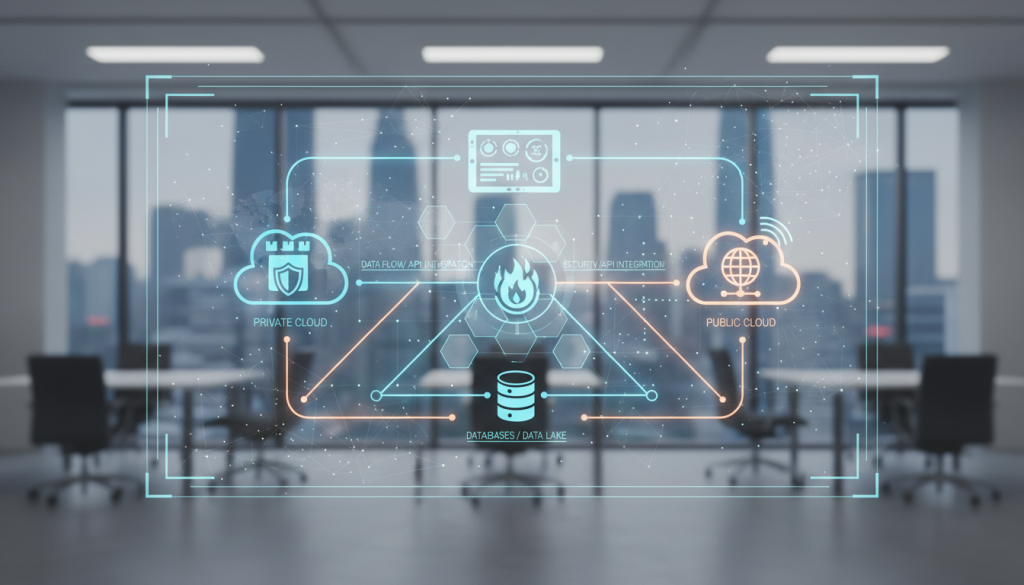
This integration transforms managed private cloud into a strategic anchor for multi-cloud initiatives. Organizations can extend their dedicated infrastructure with public cloud resources, maintaining security and performance. This flexibility adapts to changing business needs while keeping the architecture coherent.
Workload Distribution
Hybrid cloud architectures allow for strategic application and data placement. We help clients assess workloads to determine the best infrastructure for each. This ensures cloud resources align with business priorities, not just one deployment model.
Managed private cloud hosts regulated data, mission-critical applications, and performance-sensitive workloads. It provides consistent resource availability and strict security controls. Applications with strict latency requirements, like financial transactions and healthcare records, thrive on dedicated private infrastructure.
Public cloud components handle variable workloads and applications that use cloud-native services. This strategic distribution keeps sensitive operations in managed private cloud while accessing public platforms for innovation and reach. It optimizes security and operational efficiency.
Integration Complexity
Hybrid cloud implementations face technical challenges like network connectivity and data synchronization. Organizations must manage different environments with distinct APIs and security models. This requires seamless user experiences and consistent governance frameworks.
Latency considerations arise when data and applications span multiple environments. Strategic architecture design and high-bandwidth connections mitigate these impacts. However, organizations must evaluate application communication patterns and data transfer requirements during planning.
Managed private cloud providers simplify integration with connectivity solutions and architectural guidance. However, organizations must invest in orchestration platforms and staff expertise. Hybrid approaches require careful evaluation against business objectives and technical capabilities.
| Aspect | Managed Private Cloud Standalone | Hybrid Cloud with MPC Component | Key Consideration |
|---|---|---|---|
| Infrastructure Scope | Single dedicated environment with exclusive resource allocation | Multiple integrated environments spanning private and public platforms | Architectural complexity increases with environment diversity |
| Workload Placement | All applications hosted on unified private infrastructure | Strategic distribution based on security, performance, and cost requirements | Requires workload assessment and placement criteria |
| Management Approach | Centralized control through single provider interface | Distributed management requiring orchestration across platforms | Orchestration tools and governance frameworks essential |
| Connectivity Requirements | Internal network within dedicated environment | High-bandwidth interconnections between cloud resources and platforms | Network architecture impacts latency and data transfer costs |
| Use Case Optimization | Consistent performance for all workloads with predictable characteristics | Flexibility to match workload requirements with optimal infrastructure | Hybrid model offers greater flexibility with increased complexity |
Key Benefits of Managed Private Cloud
Choosing private cloud solutions offers immediate and long-term benefits. It helps solve big business challenges and prepares for growth and innovation. We help companies across many industries with infrastructure that boosts efficiency and flexibility.
This approach improves security, performance, cost management, and compliance. It adds value to every part of IT operations.
Switching to managed environments brings more benefits than expected. It affects many areas of the business. The new model lets you use top technology without big upfront costs.
This change makes it easier to manage finances and stay agile. It helps in making strategic decisions and allocating resources wisely.
Enhanced Security and Data Privacy
Managed private cloud offers multiple layers of protection for your data and apps. It uses dedicated infrastructure to keep your environment separate from others. This gives you control over access, encryption, and monitoring.
Cloud security also lets you customize controls to fit your risk profile. You can set up firewalls, intrusion detection, and data loss prevention without worrying about others. Your security policies won’t conflict with others.
Data privacy gets a boost from physical and logical isolation. Your data stays separate from others at every layer. We keep your data completely isolated from others.
Consistent and Predictable Performance
Dedicated resources mean no performance issues like in shared environments. Your apps get guaranteed CPU cycles, memory, storage, and network bandwidth. This is great for apps that need fast performance.
Apps that use a lot of resources get predictable performance. This helps meet service level agreements with stakeholders and customers. The dedicated setup keeps performance stable, even when demand is high.
We customize resources for your apps’ needs. This includes processor, memory, and storage. We also optimize network architecture for your apps.
Reduced IT Management Burden
Working with managed private cloud providers means less work for your IT team. They handle infrastructure tasks, freeing up your team for more important work. This includes managing hardware, data centers, and system updates.
Your IT team can focus on strategic projects and app development. We manage the day-to-day tasks, ensuring your platform is always available and secure. This way, you don’t need to hire more staff or spend on training.
Integration with existing systems is also easier. We help connect your software, services, and apps with the cloud infrastructure. We tailor integration to fit your technology ecosystem.
Scalability with Dedicated Resources
Managed private cloud offers scalability benefits like public cloud but with dedicated performance. We make it easy to add more resources as your business grows. This means no long waits for new hardware or data center space.
Scalability doesn’t hurt performance, even as you grow. You can handle more work without slowing down. This is great for businesses that grow quickly or have seasonal peaks.
Scalability works on your schedule, not the provider’s. You can grow fast or slow, depending on your needs. This is useful for sudden growth or market opportunities.
Regulatory Compliance Support
We have all the compliance certifications you need. We also do regular audits and follow strict security controls. This makes it easier for you to meet regulatory requirements.
Our dedicated infrastructure helps with data residency, audit trails, and control issues. This is hard to do in shared public cloud environments. It’s especially useful for heavily regulated industries like healthcare and finance.
Having compliance certifications from us reduces your audit work. It shows you meet standards without the hassle of traditional environments. This lowers the risk of non-compliance and software licensing issues.
Who Should Use Managed Private Cloud?
Managed private cloud is great for certain types of organizations. It’s perfect for those under strict regulations, with big workloads, or lacking in technical skills. It offers the best value when it matches a company’s needs and capabilities.
It’s especially good for companies needing control, security, and performance. It’s also easy to manage. Businesses with unpredictable needs and a need for better resource control should look into it. While it might be expensive for small businesses, it’s worth it for bigger ones and those with strict rules.
Regulated Industries and Compliance-Driven Organizations
Companies in strict regulatory fields are ideal for managed private cloud. It gives them better control and audit capabilities. This setup is great for meeting complex compliance needs.
Financial, healthcare, and government sectors use it to meet rules without needing a lot of internal knowledge. It helps with network security, encryption, and logging that regulators want. Industries like agriculture and education also use it for reliable computing and to meet rules.
Healthcare and HIPAA Requirements
Healthcare providers benefit a lot from managed private cloud for HIPAA compliance. It supports the strict security needed for health data. It helps with digital health records and analytics while keeping data safe.
Providers for healthcare offer special agreements and security for HIPAA. They keep data safe from mixing with other data. This lets healthcare organizations innovate while keeping patient data safe.
Financial Services and PCI DSS
Financial companies use managed private cloud for PCI DSS and banking rules. It’s great for keeping financial data safe. It’s a good choice for banks because it offers top privacy and security.
It helps with network security and encryption for transactions. It also ensures apps run smoothly. The management keeps security up to date, making it easier for companies to follow rules.
- Network isolation preventing unauthorized access to cardholder data environments
- Encryption protocols for data at rest and in transit meeting financial industry standards
- Access controls with multi-factor authentication and role-based permissions
- Audit capabilities providing detailed logs for regulatory examinations and compliance reporting
- Vulnerability management with regular security assessments and patch management
Enterprises with Resource-Intensive Applications
Companies with big computing needs find a good match in managed private cloud. It’s perfect for apps that need a lot of power. It avoids the problems of shared resources.
It ensures apps run well by managing the infrastructure. This lets companies scale as needed. It’s great for databases and analytics.
It’s perfect for apps that need a lot of power. It helps with planning and keeps apps running smoothly. It avoids the problems of shared resources.
Organizations Lacking In-House Cloud Expertise
Companies that want cloud but lack the skills can use managed solutions. It’s a way to get cloud benefits without needing to build a team. It’s a big help for companies that can’t afford to hire experts.
It lets companies use cloud tech without needing to know how it works. It’s a way to get help from experts. This lets companies focus on their business goals.
Managed teams have a lot of experience. They help companies without the need for them to learn. It’s a big help for companies that don’t have the time or resources to learn about cloud.
Common Use Cases for Managed Private Cloud
Businesses use managed private cloud in many ways. It helps them meet their specific needs. This model offers dedicated resources, professional management, and customizable infrastructure.
Companies with changing needs find it useful. They get better control and security. They can also scale resources as needed.
Managed private cloud is used for many things. It protects important systems and helps with development. It uses tools like Veeam and Zerto for backup and disaster recovery.
It also supports virtual desktops and automation. This makes complex operations easier. It reduces the work for IT teams.
Mission-Critical Application Hosting
Managed private cloud is great for apps that can’t be down. Systems like ERP and CRM need to work all the time. Dedicated infrastructure does better than shared clouds.
Dedicated resources and 24/7 monitoring keep workloads running smoothly. Service level agreements ensure reliability. This gives leaders confidence in their systems.
Customization is key for critical apps. It lets companies optimize infrastructure for their needs. This includes storage, network settings, and security.
Large-Scale Database Management
Big databases benefit from managed private cloud. It offers high-performance storage and dedicated resources. This means databases run smoothly without the issues of shared clouds.
Custom storage and computing resources are big advantages. They let admins optimize databases for their workloads. This is better than public cloud services.
Integration with database tools is also supported. This gives visibility into performance. It helps plan and optimize databases.
Disaster Recovery and Business Continuity
Managed private cloud is a great disaster recovery target. It has built-in resilience for business continuity. It provides dedicated resources for recovery.
It works with disaster recovery platforms like Zerto. This enables automated failover and replication. It also simplifies testing.
Geographic distribution is supported. This helps protect against regional outages. Virtual machines can be replicated to other locations.
Disaster recovery goes beyond backup. It includes comprehensive business continuity planning. This meets compliance and gives operational confidence.
Development, Testing, and Staging Environments
Managed private cloud is perfect for pre-production workloads. It provides production-like performance and security. This is without using production resources.
It helps speed up software delivery. It reduces the risk of production issues. Developers can test thoroughly before deploying.
It supports automation tools like Terraform and Ansible. This improves consistency and efficiency in software development. It lets teams define infrastructure as code.
Customizations like Active Directory integration are supported. This ensures development environments are complete. This thorough replication helps validate code and integration points.
It supports DevOps and continuous integration/continuous deployment. This accelerates innovation while maintaining quality. Automated testing frameworks provide quick feedback to teams.
| Use Case | Primary Benefits | Key Technologies | Typical Workloads |
|---|---|---|---|
| Mission-Critical Hosting | Guaranteed availability, dedicated resources, 24/7 monitoring, SLA accountability | ERP systems, CRM platforms, core banking applications | Customer-facing systems, revenue-generating applications, operational systems |
| Database Management | High-performance storage, customizable configurations, consistent performance | Transactional databases, data warehouses, analytics platforms | Large-scale databases, business intelligence, real-time analytics |
| Disaster Recovery | Dedicated recovery resources, automated failover, geographic distribution | Veeam, Commvault, Rubrik, Zerto | Backup targets, replicated production systems, business continuity infrastructure |
| Development Environments | Rapid provisioning, production-like configurations, automation integration | Terraform, Ansible, CI/CD pipelines | Application testing, staging environments, development infrastructure |
Technical Architecture of Managed Private Cloud
The technical blueprint of managed private cloud platforms has many layers. Each layer is designed to deliver specific infrastructure capabilities. This ensures that organizations get dedicated cloud resources without the hassle of managing the underlying infrastructure.
Understanding the technical architecture helps IT professionals and decision-makers see how different components work together. This integration creates a cohesive environment that supports both traditional and modern applications.
Compute and Processing Resources
We provide managed private cloud environments with enterprise-grade server hardware. This hardware delivers consistent, predictable performance for various application workloads. The compute layer is the foundation for all processing activities.
Our host catalog includes configurations from 16 cores with 512GB RAM to 64 cores with 2048GB RAM. Each server has NVMe storage integrated directly into it. This enables customers to select the right compute profile based on their application needs.

Virtualization platforms allow customers to provision, configure, and manage virtual machine instances. We provide template-based provisioning and resource allocation adjustments. These capabilities give application teams the flexibility to manage their computing environments while we handle the underlying infrastructure operations.
Integration with automation tools enables infrastructure-as-code practices. This improves consistency and accelerates deployment processes. Organizations can define infrastructure configurations through code repositories and deploy consistent environments across different environments.
Container Orchestration
Modern managed private cloud platforms support containerized workloads alongside traditional virtual machines. We offer Kubernetes environments and container registries. This enables organizations to run microservices-based applications while maintaining security and compliance benefits.
The container layer provides automated scaling, health monitoring, and service discovery features. Development teams can deploy applications using container images. This capability supports DevOps practices and accelerates application delivery cycles.
Storage Infrastructure
We implement software-defined storage systems that provide multiple tiers and technologies optimized for different workload characteristics. The storage infrastructure delivers flexible capacity management and automated data protection. Storage resources scale independently from compute resources, allowing organizations to expand capacity without overprovisioning processing capabilities.
Our vSAN-based storage architecture includes encryption at rest and in transit. This approach eliminates the complexity of managing separate storage area networks while providing enterprise-grade reliability and performance. Virtual machines can access storage resources with minimal latency, supporting demanding application workloads.
Block Storage
Block storage provides persistent volumes that attach directly to virtual machines. It delivers the performance characteristics required for database workloads, application storage, and file systems. We provision block storage in various performance tiers, from high-IOPS NVMe storage for latency-sensitive applications to capacity-optimized storage for general-purpose workloads.
The block storage layer integrates with database management systems, enterprise applications, and operating system file systems through standard protocols. This compatibility ensures that applications perform identically to traditional storage infrastructure while benefiting from cloud flexibility and software-defined management capabilities.
Object Storage
Object storage systems provide scalable repositories for unstructured data, backups, archives, and content distribution. We design object storage with horizontal scalability characteristics, allowing capacity to expand to petabyte scales without performance degradation. The object storage layer supports S3-compatible APIs, enabling integration with backup applications, content management systems, and data analytics platforms.
Organizations use object storage for long-term data retention, compliance archiving, and content delivery use cases. The cost-effectiveness of object storage makes it ideal for data that requires infrequent access but must remain available for regulatory or business continuity purposes.
Network Architecture
Sophisticated networking capabilities create secure, high-performance network environments. We implement redundant network infrastructure with each cabinet including two redundant switches featuring 48 ports at 25Gbps each, with inter-cabinet bandwidth reaching 400Gbps. This architecture ensures network availability and eliminates single points of failure that could disrupt application connectivity.
Software-defined networking technologies enable virtual LANs, micro-segmentation, load balancing, and firewall policies that adapt to changing security requirements. Organizations can define network topologies through management interfaces, implement granular security controls between application tiers, and establish VPN connectivity to data center facilities. The network architecture supports cloud migration strategies by providing high-bandwidth, low-latency connections between on-premises environments and managed private cloud platforms.
We offer various connectivity options that integrate managed private cloud with customer facilities, public cloud platforms, and SaaS providers. Direct interconnection services bypass public internet paths, reducing latency and improving security for hybrid cloud architectures. These connectivity capabilities enable organizations to distribute workloads across multiple environments while maintaining consistent network performance.
Virtualization and Hypervisor Layer
The hypervisor layer provides the foundational technology that enables resource abstraction, efficient resource utilization, and the flexibility characteristics essential to cloud computing. We build managed private cloud environments on VMware VCF blueprints with NSX networking and vSAN storage, delivering enterprise-proven technology foundations that ensure reliability and compatibility. The management domain and customer workloads share a single cluster with separate resource pools, optimizing resource allocation while maintaining isolation between operational functions.
Our platforms include VCF Installer, Fleet Management, Operations, vCenter, NSX Managers and Edges, Identity Broker, and HCX for cloud migration support. These integrated components provide comprehensive management capabilities, from initial deployment through ongoing operations. Core management services including Active Directory Domain Services, DNS, Certificate Authority, and NTP ensure that the environment operates with enterprise standards for identity management and time synchronization.
We manage hypervisor operations, security patching, and version upgrades as part of our managed services. This eliminates operational complexity for customers while maintaining platform stability and security. This approach allows organizations to benefit from the latest virtualization capabilities without dedicating internal resources to platform maintenance. The hypervisor layer supports live migration of virtual machines between hosts, enabling maintenance activities without application downtime.
| Architecture Component | Technology Foundation | Key Capabilities | Business Benefits |
|---|---|---|---|
| Compute Resources | Enterprise servers with 16-64 cores, 512-2048GB RAM | VM provisioning, container orchestration, resource scaling | Performance flexibility, workload diversity support |
| Storage Infrastructure | vSAN with NVMe, block and object storage | Multi-tier storage, encryption, automated protection | Data security, cost optimization, capacity flexibility |
| Network Architecture | Redundant 25Gbps switches, 400Gbps inter-cabinet links | Software-defined networking, VPN connectivity, load balancing | High availability, security isolation, hybrid integration |
| Virtualization Layer | VMware VCF with NSX and vSAN | Resource abstraction, management automation, migration tools | Operational simplicity, platform stability, enterprise compatibility |
The integrated architecture delivers enterprise-grade infrastructure capabilities while maintaining the operational simplicity that distinguishes managed services from self-operated environments. Organizations benefit from sophisticated technology stacks without investing in specialized expertise or dedicating internal resources to infrastructure management. This architectural approach supports both immediate business requirements and long-term growth strategies, providing a foundation for digital transformation initiatives.
Security Features in Managed Private Cloud
We use multi-layered security in managed private clouds to protect your important assets. This includes physical protections, advanced encryption, and strict access controls. These steps help meet strict rules for regulated industries and offer top-notch protection without the need for huge investments.
Our security framework covers all layers, from physical data centers to application levels. This creates strong defense strategies that stop unauthorized access and quickly respond to threats. Working with managed private cloud providers means you get constant security checks and expert threat handling.
Physical Security and Data Center Protection
We run our managed private cloud in top-notch, carrier-grade data centers. These centers have strong physical security to stop unauthorized access and protect against environmental dangers. They have 24/7 security teams and use biometric access controls to ensure only authorized people get in.
Video surveillance keeps an eye on everything, creating records of who accesses what. Mantrap entries block unauthorized people from following authorized ones into secure areas. Visitor management ensures all non-employees are documented, escorted, and their access is limited in time. Systems also monitor temperature, humidity, and other factors that could affect the infrastructure.
The physical setup includes Secure Cabinet Express, where Equinix handles the cabinet, power, and access controls. This gives you top-notch physical security without needing your own data center. Regular security checks make sure these protections stay up to date, keeping your cloud security strong against new threats.
Data Encryption at Rest and in Transit
Our managed private clouds use strong encryption to protect data at all times. This makes data unreadable to anyone who shouldn’t see it, even if storage media or network transmissions are compromised. vSAN architecture provides encryption for data at rest, working quietly in the background to keep your data safe.
Data encryption also protects data as it moves, using secure communication protocols. Network encryption creates secure tunnels to stop eavesdropping and man-in-the-middle attacks. We handle encryption keys, rotate them regularly, and offer options for you to manage your own keys.
This two-layer encryption keeps your data safe no matter where it is or how it moves through the system. It’s especially good for businesses handling sensitive data, like financial information or health records. This way, you don’t have to worry about managing encryption yourself, as we take care of it for you.
Identity and Access Management
We connect your managed private cloud with your existing identity systems. This uses Identity Broker technology and secure LDAP protocols to link with your Active Directory. It lets users use their corporate credentials, making access easier and stronger.
This integration supports enterprise directory services and federation protocols. It makes access across different environments seamless. It also creates a single audit trail for all user activities, making it easier to manage access and track changes.
Multi-Factor Authentication
Multi-factor authentication adds extra steps to verify identities, making it harder for attackers to get in. It requires something you know, something you have, or something you are. This makes it much harder for hackers to get past your security.
We support many multi-factor authentication methods, like one-time passwords, mobile push notifications, and hardware tokens. You can choose to require it for all users or just for those with special access. This lets you balance security with user convenience based on your needs.
Role-Based Access Control
Role-based access control gives permissions based on job roles and responsibilities. It limits access to what users need, following the least-privilege principle. We set up permissions that match your organization’s structure and workflows.
This approach reduces insider threats and prevents accidents by limiting what users can do. It keeps admin functions separate from regular user access, with special access for authorized personnel. Regular reviews ensure permissions stay up to date, helping you meet compliance requirements for access management.
Compliance Certifications and Audits
Reputable managed private cloud providers have certifications for standards like SOC 2, ISO 27001, and PCI DSS. These come from thorough third-party audits that check if security controls work as they should. We regularly check to make sure we still meet these standards.
Getting certified means we document our security policies and control implementations. Auditors review this for completeness and effectiveness. We provide reports and support to help you meet your compliance requirements too. This lets your audit teams verify our controls without doing a full assessment themselves.
Our 24/7 management and monitoring keep you compliant by catching security issues early. This reduces risks by fixing problems before they cause trouble. Our certified infrastructure and expert management offer security levels that are hard to achieve on your own.
We also have advanced network security features like NSX Gateway Firewall and Distributed Firewall. These control traffic and block threats. IDS/IPS systems detect and block attacks, and malware prevention scans traffic to block known threats.
| Security Layer | Protection Mechanisms | Key Benefits | Compliance Support |
|---|---|---|---|
| Physical Security | 24/7 monitoring, biometric access, video surveillance, environmental controls | Prevents unauthorized facility access and infrastructure tampering | Supports SOC 2, ISO 27001 physical security requirements |
| Data Encryption | vSAN encryption at rest, network encryption in transit, key management | Protects data confidentiality throughout lifecycle | Meets PCI DSS, HIPAA encryption mandates |
| Identity Management | AD integration, multi-factor authentication, role-based access control | Ensures only authorized users access resources | Addresses compliance requirements for access governance |
| Network Security | Gateway firewall, distributed firewall, IDS/IPS, malware prevention | Blocks threats and unauthorized network access | Provides cloud security controls for regulatory frameworks |
| Compliance Management | Regular audits, certification maintenance, documentation, 24/7 monitoring | Reduces compliance burden and demonstrates adherence | Delivers service level agreements with security guarantees |
The security we offer addresses the main reasons businesses choose managed private clouds. We combine physical protections, encryption, access controls, and compliance checks to create strong defenses. This lets you focus on your business while we handle the security.
Our detailed security documentation, regular reports, and audit support give you confidence. The service level agreements we have include security promises with clear goals and response plans. This framework holds us accountable for keeping your assets safe.
Cost Considerations for Managed Private Cloud
When looking at managed private cloud, companies face a complex financial landscape. Pricing, total cost of ownership, and strategic value are key to making decisions. Financial evaluation goes beyond just the cost of infrastructure. It includes various cost factors, billing methods, and long-term value metrics.
A managed private cloud reduces upkeep costs by outsourcing management to the managed cloud provider. This turns unpredictable capital investments into manageable operational expenses. It supports business planning by aligning infrastructure spending with goals.
While the provider handles servers, network, and platform infrastructure, the client pays for services through clear billing. Understanding these financial dynamics helps predict expenses accurately. It ensures infrastructure spending aligns with organizational objectives.
The decision to adopt a managed private cloud must consider business objectives and budget. This is crucial for successful cloud deployment.
Pricing Models and Billing Structures
Managed cloud providers offer different pricing approaches to meet various customer needs. We provide clear cost frameworks for selecting billing models that fit financial planning cycles and operational needs. Pricing structures range from predictable monthly subscriptions to flexible consumption-based models.
The choice of pricing models affects budget predictability and financial forecasting accuracy. Organizations must choose a billing structure that supports their operational patterns and growth. Moving from CAPEX to OPEX and pay-per-use options eliminates large upfront costs.
Subscription-based models offer consistent monthly fees for dedicated infrastructure and management services. Pricing is based on specific resource allocations. This approach provides cost predictability, simplifying budgeting processes.
Fixed monthly pricing eliminates billing surprises, making infrastructure expenses manageable. It improves financial planning. Organizations gain clear visibility into monthly obligations, enabling accurate cash flow management and long-term financial projections.
Consumption-Based Pricing
Usage-based models charge customers for actual resource consumption. We implement metering systems to track compute hours, storage consumption, and network transfer. This approach maintains dedicated infrastructure benefits.
Consumption-based pricing allows organizations to scale expenses with workload demands. It retains single-tenant security and performance. The flexibility supports seasonal business fluctuations and growth phases without fixed capacity commitments.
Total Cost of Ownership Analysis
Comprehensive cost of ownership evaluation compares managed private cloud expenses with on-premises data center operations and public cloud alternatives. We encourage organizations to consider factors beyond infrastructure fees. This includes personnel costs, facility expenses, hardware refresh cycles, and software licensing requirements.
Additional cost of ownership considerations include compliance investments, opportunity costs of staff time, and risk costs. Organizations often overlook these indirect expenses. Since deployments are done in a single-tenant environment, the total financial picture requires careful examination.
Comprehensive TCO analysis often shows managed private cloud offers superior value for sustained workloads. The calculation becomes favorable when accounting for operational burden reduction and risk mitigation. We help clients develop TCO frameworks to reveal these hidden value drivers.
Hidden Costs and Additional Fees
Organizations must identify potential cost factors beyond base infrastructure pricing to avoid budget surprises. We recommend thorough investigation of data transfer charges, backup storage fees, premium support costs, and professional services for migration or architecture design. These ancillary expenses can significantly impact total project costs if not discovered during initial evaluation.
Additional fee categories include licensing costs for software components, connectivity solution expenses, and charges for specialized security or compliance features. Some providers structure pricing to appear competitive on base services while recovering margins through ancillary fees. Encouraging thorough cost discovery during provider evaluation ensures accurate financial planning for cloud deployment initiatives.
We advocate for complete transparency in all pricing discussions, providing detailed cost breakdowns. This reveals every potential charge throughout the service relationship. It enables clients to compare providers accurately and budget comprehensively for their infrastructure investments. Understanding the complete cost structure prevents mid-engagement financial surprises that can derail project success.
ROI and Value Proposition
Organizations should evaluate managed private cloud investments through comprehensive value analysis. We emphasize that return on investment extends beyond infrastructure economics. It includes risk reduction, operational efficiency gains, staff productivity improvements, and compliance cost avoidance. These strategic benefits often deliver greater value than direct cost savings.
The value proposition includes business agility enhancements, opportunity costs of delayed digital transformation initiatives, and competitive positioning. Faster time-to-market for new applications improves revenue generation potential. Enhanced customer experiences through reliable infrastructure support brand reputation and customer retention.
The true value of managed private cloud lies not in what you spend, but in what you gain—operational freedom, strategic focus, and the ability to innovate without infrastructure constraints holding you back.
We enable business growth through cloud innovation while reducing operational burden. This transforms IT from a cost center into a strategic enabler. The shift creates measurable business value through improved service delivery, reduced downtime costs, and enhanced security posture.
Organizations that evaluate cost of ownership alongside strategic value discover compelling justification for managed private cloud adoption. This goes beyond simple price comparisons.
The financial analysis should answer whether managed private cloud investment supports organizational objectives, delivers acceptable returns, and positions the business for sustained competitive advantage. This comprehensive evaluation framework ensures that infrastructure decisions align with broader business strategy rather than focusing narrowly on line-item costs.
How to Choose a Managed Private Cloud Provider
Finding the right managed private cloud provider can be tough. Many vendors seem similar but offer different experiences. It’s important to look at more than just the price. You need to check their expertise, support quality, and how well they work with you.
Choosing the right provider affects your business in many ways. It impacts your security, compliance, innovation, and costs over time. Create a plan to evaluate providers based on their technical skills, business practices, and how well they fit your culture.
Evaluating Provider Experience and Track Record
The success of your cloud provider depends on their experience and track record. Look at how long they’ve been in business, their customer retention, and financial health. Providers with a long history are more reliable and can handle complex tasks.
It’s also important to see if they understand your industry. Ask for references from similar businesses. Talking to these customers can give you insights into the provider’s quality and partnership potential.
Check the technical certifications of the provider’s team. Look for VCDX-certified architects for complex deployments. VMware expertise and support are key to getting the best infrastructure.
Service Level Agreements and Guarantees
Service level agreements (SLAs) are crucial. They outline what the provider promises, like uptime and support. Good SLAs protect your interests by being clear and specific.
Look for SLAs that are detailed and realistic. They should have clear metrics, reporting, and remedies for when they don’t meet expectations.
Uptime Commitments
Uptime is a key SLA metric. Top providers aim for 99.95% uptime, which means less than 22 minutes of downtime a month. This shows if the provider meets your business needs.
Higher uptime means more redundancy and reliability. Achieving 99.999% uptime requires a lot of investment but offers top reliability for critical apps.
Response Time Standards
Response times are critical for support. Top providers aim to respond quickly to issues, especially critical ones. They aim to solve problems fast to keep your business running.
Make sure the provider has a 24/7 support team. This ensures you get help when you need it, not just during business hours.
| Incident Priority | Initial Response Time | Target Resolution Time | Business Impact |
|---|---|---|---|
| Priority 1 (Critical) | Under 30 minutes | Within 4 hours | Complete service outage affecting production |
| Priority 2 (High) | Under 60 minutes | Within 24 hours | Significant degradation impacting operations |
| Priority 3 (Medium) | Under 120 minutes | Within 5 business days | Minor issues with workaround available |
Support Options and Monitoring Capabilities
Good support goes beyond fixing problems. It includes proactive monitoring and strategic advice. Look for providers with various support channels and dedicated account managers.
Proactive monitoring is key. It helps identify and fix issues before they cause problems. Leading providers have advanced monitoring tools for this.
Look for providers that offer regular health checks and optimization advice. This shows they’re committed to improving your infrastructure and business.
Migration Planning and Onboarding Support
Moving to a managed private cloud needs careful planning. Check how providers support this process, including assessment and architecture design. They should also manage the project well.
Migration tools can make a big difference. Look for providers with advanced tools and experienced migration specialists. This ensures a smooth transition.
Good onboarding programs make the transition smooth. They include training, documentation, and support. This builds trust and sets the stage for a successful partnership.
Vendor Lock-In Considerations
Choose providers that offer flexibility for the future. Look for open standards and widely adopted platforms. This makes it easier to change providers if needed.
Look for providers that support data portability and have clear exit procedures. This shows they’re confident in their service and want to keep you happy.
Understand the contract terms and how to exit if needed. Choosing a provider that balances current needs with future flexibility is key.
Top providers include Rackspace, CenturyLink, Microsoft, Adobe, Azaleos, and ConnectSolutions. They offer different strengths and approaches. Careful evaluation helps you make the best choice for your business.
Conclusion
Choosing the right private cloud infrastructure is a key decision for your business. It affects how well your company works, its security, and how it stands out in the market. Managed private cloud offers top-notch features without needing your team to handle complex setups.
Looking at cloud computing options requires careful thought about what you need. Companies in strict industries get special help and support. Those with critical apps get steady performance and expert care. Businesses without the right skills get top-notch services from experienced teams.
Private cloud is best for bigger companies with big computing needs. Look at providers carefully, compare costs, and make sure your cloud fits your business goals. Ask for demos, check service agreements, and talk to other companies with similar needs.
Good cloud strategies use different models for different needs. Private cloud is great for sensitive data and apps that need to run smoothly. Public cloud and SaaS are better for other business tasks.
We’re here to help with your digital transformation. Our team knows how to set up and manage private cloud for your specific needs. Contact us to see how managed private cloud can help your business grow, work better, and stay ahead.
FAQ
What exactly is managed private cloud and how does it differ from traditional hosting?
How does managed private cloud compare to public cloud platforms like AWS or Azure?
Is managed private cloud the same as hybrid cloud?
What are the primary security advantages of managed private cloud?
How much does managed private cloud typically cost?
What types of organizations benefit most from managed private cloud?
Can managed private cloud scale like public cloud?
How long does it take to migrate to managed private cloud?
What level of control do I have over managed private cloud infrastructure?
What happens if my managed private cloud provider experiences an outage?
How does managed private cloud support disaster recovery and business continuity?
Can I integrate managed private cloud with my existing on-premises infrastructure?
What compliance certifications should I look for in a managed private cloud provider?
How is support typically structured with managed private cloud providers?
What are the risks of vendor lock-in with managed private cloud?