



What is Managed Cloud?
Are you spending too much time on technical operations? You could be focusing on strategic growth instead. Navigating cloud infrastructure can be overwhelming for business leaders.
Managed cloud services offer a solution. They outsource your technology infrastructure to a specialized third-party provider. This lets your team focus on core business objectives.

The cloud service provider or MCSP handles everything. This includes migration, configuration, system upgrades, and ongoing management. This partnership ensures your systems run efficiently, saving time and money.
In this guide, we’ll dive into how managed cloud services change your IT landscape. We’ll look at the basics, service models, and benefits. This approach is becoming more popular in the United States.
Key Takeaways
- A managed service provider handles daily operations, security, and optimization of your cloud environment, freeing your team to focus on strategic business goals
- Organizations partner with an MCSP to reduce operational overhead while gaining access to specialized expertise without significant internal investment
- Cloud infrastructure management includes migration, configuration, system upgrades, maintenance, and proactive monitoring by the provider
- The primary purpose of engaging a cloud service provider is to optimize benefits while minimizing time and cost burdens on your business
- Managed cloud services deliver enhanced security postures, improved system performance, and better uptime through professional oversight
- This outsourcing model provides access to disaster recovery, compliance management, and incident response capabilities that would be costly to develop internally
- The right partnership aligns with your business needs, resource constraints, and strategic objectives while reducing technical complexity
1. What is Managed Cloud?
Cloud technology has evolved, offering a way for businesses to outsource cloud operations while keeping control over their digital setup. This model helps companies use cloud computing benefits without using up valuable internal resources. It’s a big change in how companies handle their technology, moving from doing it all themselves to partnering and optimizing.
When looking at their technology plans, it’s key for organizations to understand the differences between cloud service models. The managed cloud model is a middle ground. It gives businesses flexibility, expertise, and predictable costs that other models can’t match.
Definition and Core Concept
A managed cloud service is when a third-party cloud provider takes care of managing, maintaining, and operating a company’s cloud setup. This partnership turns a big, resource-heavy project into a simple, predictable expense with expert oversight.
The core idea is about giving up control without losing it. Companies keep their data, apps, and strategic plans. But they let experts handle the day-to-day management of their cloud setup.
Customers don’t have to set up, install, or keep their software or hardware running. The service provider owns and runs the data centers and infrastructure. They make these resources available through cloud services that ensure they’re accessible, reliable, and perform well.
“The purpose of a managed cloud is to ensure that cloud resources are running optimally while avoiding the costs of hiring and maintaining an entire team dedicated solely to cloud resource management.”
This approach gives big strategic advantages. It lets IT teams focus on innovation, not just keeping things running. This shift helps businesses use their most valuable asset—human talent—on projects that grow revenue and make customers happy.
The Role of Managed Service Providers
Managed service providers do more than just host or offer basic support. They bring a wide range of skills that cover the whole cloud lifecycle. They know a lot about cloud architecture, security, compliance, and how to make clouds work better for businesses.
They watch over system health, find and fix problems before they affect business. They also make sure systems are secure and follow important rules like HIPAA, PCI-DSS, or GDPR.
They handle planning for how much capacity is needed, making sure resources grow or shrink as needed. This helps avoid running out of resources or wasting money on unused capacity.
Choosing the right managed service provider is important. Look at their technical skills, experience, and how well they fit with your company. The best providers work like an extension of your team, understanding your goals and finding technical solutions that help you achieve them.
| Provider Responsibility | Business Benefit | Impact Area |
|---|---|---|
| 24/7 infrastructure monitoring | Reduced downtime and faster issue resolution | Operational efficiency |
| Security implementation and updates | Enhanced protection against threats and compliance | Risk management |
| Performance optimization | Improved application speed and user experience | Customer satisfaction |
| Capacity planning and scaling | Cost control with appropriate resource allocation | Financial predictability |
Managed Cloud vs. Self-Managed Infrastructure
Managed cloud and self-managed infrastructure are very different. Managed cloud offers better resource use, risk management, and efficiency. Self-managed setups need a lot of IT talent, which is expensive and hard to keep up with.
Self-managed setups also need a lot of time and money for tools, security, and maintenance. This takes away from time that could be spent on things that really grow the business.
Self-managed setups cost a lot, not just in money. They also mean spending a lot on training, tool licenses, and using top talent on maintenance instead of innovation.
Managed cloud, on the other hand, lets businesses use the provider’s setup, skills, and scale. This means faster setup, predictable costs, better security, and more flexibility to change as needed.
Companies that choose managed services often see a 40-60% improvement in getting value from their technology. This is because providers have ready-made solutions, best practices, and teams that know how to use new tech.
Risk levels are also different. Self-managed setups mean the company has to deal with all the risks. Managed providers share the risk through agreements, insurance, and proven ways to handle problems.
The choice between managed and self-managed depends on what the company wants, what they can do, and their goals. Companies with strong tech teams and special needs might do better with self-management. But most companies find it better to outsource to experts who bring efficiency, expertise, and peace of mind.
2. How Managed Cloud Services Work
Managed cloud services are complex, but they make daily operations smooth. They help businesses make smart choices when picking a provider. Cloud management involves many steps to keep systems running well.
Service Delivery Model
Our cloud services use a subscription-based framework. This model gives businesses fixed costs each month. It makes managing cloud resources easy, without needing to handle everything yourself.
With this model, you know what you’re spending each month. We keep your systems running by using backup systems and automatic switches. You get top-notch infrastructure without the big upfront costs.
We offer services in many places, like your own office, public clouds, or a mix of both. This lets businesses pick what works best for them, based on their needs and rules.
We use advanced cloud monitoring tools to watch over your systems. These tools alert us to any problems before they get big. This is what makes our services different from just fixing things after they break.
We keep your systems up to date with regular checks and tweaks. We do this during times when it won’t bother your business too much. This keeps your systems safe and working well.
We don’t just check if things are up or down. We look at how fast your apps are, how well your databases work, and how users feel. This helps us find ways to make things better for you.
Incident Response and Resolution
We have teams ready to help when things go wrong. They work fast to fix problems, keeping your business running smoothly. This is part of our promise to you.
Our team handles everything from finding the problem to fixing it and making sure it doesn’t happen again. We learn from each problem to get better next time. This way, we can handle big or small issues well.
When a big problem happens, we get our best people on it right away. We work with other companies to solve problems that need more than one person’s help.
Client Communication and Reporting
We keep you in the loop with regular updates. You’ll know about any changes or issues before they affect you. This helps you plan better and trust us more.
Our reports give you the details you need to make smart choices. They show how your systems are doing, security-wise and otherwise. We make sure the info is easy for everyone to understand.
We have monthly meetings to talk about how things are going. We look at trends, solve problems, and plan for the future together. This helps us keep improving for you.
Integration with Existing Systems
We work with your IT team to make sure everything works together smoothly. We plan carefully to keep your data safe and your systems running. This way, you can use cloud services without changing everything you already have.
Getting everything to work together takes a lot of planning. We make sure your data is safe as it moves around. Our team knows how to make different systems work together, no matter how complex they are.
We test everything before we make it live. This makes sure it works right and keeps your systems running smoothly. We’re careful to avoid any problems that might slow you down.
3. Core Components of Managed Cloud
Managed cloud services have key parts that work together. They make your business environment secure, efficient, and strong. Knowing these parts helps you see the full value of cloud services, not just hosting.
Working with a managed cloud provider means you get a system where infrastructure management, security, backup, and performance all work together. These parts help your business run smoothly. We take care of things like moving your data, setting up systems, and keeping them running.
Infrastructure Management
Infrastructure management is the base of your cloud setup. We manage your hardware and virtual layers. This keeps your systems running well, even when they’re busy.
We also plan for growth and make sure your systems can handle more. We watch how your systems are doing to find ways to make them better. This helps keep your business running smoothly.
Server and Network Management
Server management is about keeping your servers running well. We handle things like setting up your servers and making sure they’re secure. This keeps your systems efficient and safe.
Network configuration is about how your data moves around. We design your network to be fast and reliable. Our strategic approach to network architecture balances speed and security, supporting your business now and in the future.
Storage Management
Good data storage is key. We use smart strategies to store your data in a way that’s both fast and affordable. This means your important data is quick to access, and your less-used data is cheaper to store.
We also make sure you have enough storage as your data grows. Our team knows how to set up your storage for different tasks. We keep an eye on how your storage is doing to find ways to save money and improve performance.
Security and Compliance
Security and following rules are very important to us. We use many layers of defense to keep your data safe. Our security measures are always up to date to protect against new threats.
We don’t just focus on technology. We also make sure your business has good security policies and practices. Our team works hard to keep your data safe and make sure you’re following the rules.
Threat Detection and Prevention
We use advanced tools to watch for threats. These tools help us find and stop problems before they become big issues. We use systems that learn from your data to spot unusual activity.
Our team is ready to act fast if we find a threat. We use our knowledge and technology to stay ahead of attacks. This helps keep your business safe and reduces the work for your team.
Compliance Management
We know a lot about rules like HIPAA and GDPR. We help make sure your cloud setup follows these rules. Our approach makes it easier to meet these standards.
We help with reports and getting certifications. Our team works on keeping your setup in line with the rules. This lets you focus on your business, not on following rules.
Backup and Disaster Recovery
Keeping your data safe is very important. We have backup plans that run in the background. These plans make sure your data is safe, even if something goes wrong.
We also have plans for when disaster strikes. We test these plans to make sure they work. This means we can quickly get your business back up and running if something bad happens.
We work with you to figure out how much downtime you can handle. Then, we make sure our backup plans fit your needs. This way, you get the protection you need without spending too much money.
Performance Optimization
We always work to make your cloud setup better. We look at how your systems are doing to find ways to improve. Our team uses tools and their knowledge to find and fix problems.
We make sure your systems are running well and efficiently. We also try to save you money by making sure you’re not wasting resources. This helps your business grow and stay efficient.
We also look for ways to save money without sacrificing performance. By analyzing your usage and our knowledge of cloud platforms, we can suggest changes that save you money. This helps your cloud setup deliver the best value for your business.
4. Types of Managed Cloud Services
Every business is different, and so are their cloud needs. We help find the right cloud model for your security, performance, and compliance goals. The market offers various cloud models to meet different needs and strategies.
These models let us create custom solutions for your business. We provide the expertise and support to make the most of your cloud investment.
Managed Public Cloud
We use big cloud platforms like Amazon Web Services (AWS), Microsoft Azure, and Google Cloud Platform (GCP). This gives you access to their global infrastructure and innovation. We handle the setup, optimization, and management for you.
Public cloud management is great for quick setup, global reach, and new tech without buying hardware. We focus on cost savings, security, and performance to ensure you get the most value from your cloud.
Managed Private Cloud
Our private cloud services give you your own dedicated resources. This means better control, customization, and security than public clouds. It’s perfect for those with strict security needs or special performance requirements.
We manage your private cloud, so you can focus on your business. You get to control your infrastructure and meet data residency rules. Plus, you get predictable performance that public clouds can’t always offer.
Managed Hybrid Cloud
Our hybrid cloud solutions combine public and private clouds. This lets you move workloads and data easily based on your needs. We connect your environments and ensure security and governance across them.
This setup lets you run sensitive workloads privately and use public clouds for other needs. We handle the complexity of keeping everything secure and consistent, so your hybrid cloud works as one system.
Managed Multi-Cloud
We help you manage multiple public clouds at once. This avoids vendor lock-in and lets you pick the best services for each task. It also helps you save money and makes your systems more resilient.
Managing multiple clouds is complex, but we make it work smoothly. We ensure everything is integrated, managed, and secure across your multi-cloud setup.
We offer services at different layers to fit your needs:
- Infrastructure-as-a-Service (IaaS) gives you control over computing resources like servers and storage
- Platform-as-a-Service (PaaS) offers tools and environments for app development and deployment
- Software-as-a-Service (SaaS) provides ready-to-use apps that are easy to use and require little maintenance
5. Key Benefits of Managed Cloud
Managed cloud services offer many advantages to businesses. They help align technology with business goals. Leaders need to understand how managed cloud adds value in different ways.
It’s especially important in today’s fast-changing tech world. Companies find it hard to keep up with security and performance needs. Working with managed cloud providers helps them transform in ways they couldn’t on their own.
Reduced IT Overhead and Costs
One big benefit is the cost savings from managed cloud services. Companies don’t need to hire and train cloud experts. This saves a lot of money on salaries, benefits, and training.
Managed cloud providers handle the technical work. This lets companies focus on growing their business. It makes IT work more efficient and effective.
Self-managed cloud operations cost a lot in tools and software. Managed providers share these costs with their clients. This makes it easier to budget and plan financially.
“The shift to managed cloud services typically reduces total IT infrastructure costs by 30-40% while simultaneously improving service quality and reliability.”
Access to Specialized Expertise
Managed cloud providers have teams with deep cloud expertise. They know many platforms and security frameworks. This expertise is hard to get without a lot of time and money.
These experts also bring strategic insights. They know how to set up infrastructure for the best performance. This knowledge helps all clients, no matter their size or industry.
This cloud expertise is crucial in critical situations. Providers have dealt with many challenges before. They can guide clients through tough times with confidence and speed.
Enhanced Security and Compliance
Managed cloud providers focus on protecting client data and following rules. They use advanced security measures. This includes firewalls, encryption, and threat monitoring.
They also handle compliance needs. Providers keep up with changing rules. This saves companies from having to do it themselves.
These security measures are always being updated. Providers have teams ready to handle threats. This is something most companies can’t do on their own.
Improved Performance and Uptime
Managed cloud providers manage infrastructure well. They watch system health closely. This means less downtime and better performance.
They also plan maintenance during quiet times. This keeps disruptions low. And they have systems that switch over if something fails. This keeps services running smoothly.
24/7 Monitoring
Managed providers watch systems all the time. They respond quickly to any issues. This is great for companies with customers all over or in industries where downtime is costly.
This monitoring gives business leaders peace of mind. They know their systems are always being watched. This lets them focus on growing their business.
Faster Issue Resolution
When problems happen, managed providers fix them fast. They have the right skills and know-how. They can solve issues quickly and effectively.
This means less downtime for companies. They can keep serving customers without interruption. This is good for business and customer satisfaction.
Scalability and Flexibility
Managed cloud services offer big advantages in resource scaling and operational flexibility. They can quickly add or remove resources as needed. This is fast and cost-effective compared to buying new hardware.
They can also scale down when business is slow. This saves money. It means companies only pay for what they use, not for unused capacity.
This flexibility is a big plus for businesses. It lets them take on new projects and grow without worrying about infrastructure. It removes technical barriers to expansion.
| Benefit Category | Primary Impact | Business Value | Time to Realize |
|---|---|---|---|
| Cost Reduction | 30-40% lower total IT costs | Improved financial predictability | Immediate upon migration |
| Security Enhancement | Multi-layered protection and compliance | Reduced risk exposure | Within first 30 days |
| Performance Improvement | Higher uptime and faster response | Better customer experience | Within first 60 days |
| Scalability Access | Rapid resource adjustment capability | Business agility and growth enablement | Ongoing continuous benefit |
These benefits make managed cloud a strong choice for companies. It helps them work better, be more secure, and adapt quickly. This is why more and more businesses are choosing managed cloud services.
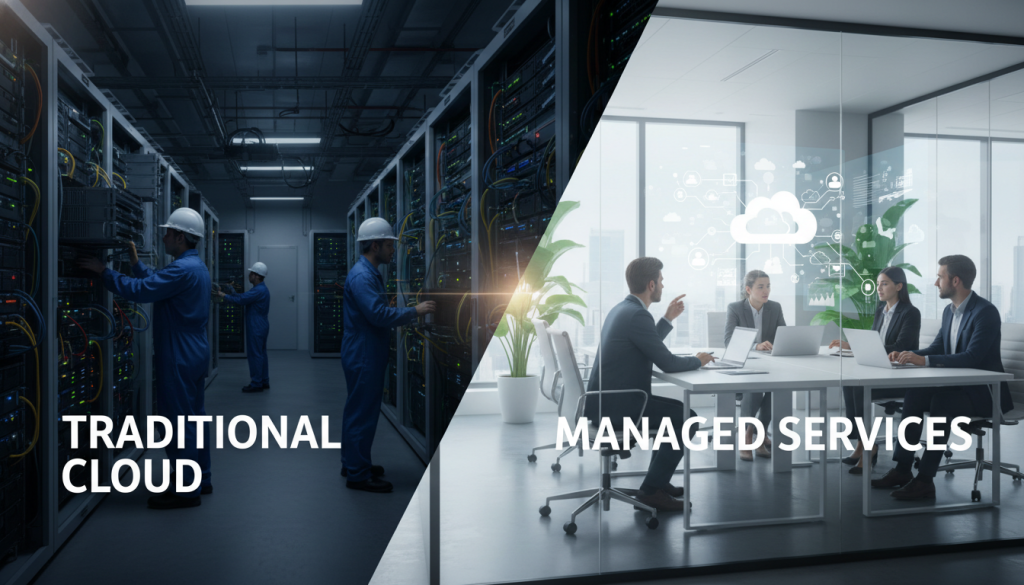
6. Managed Cloud vs. Traditional Cloud
Looking at managed cloud services and traditional cloud computing shows key differences. These differences affect control, resources, costs, and how fast you can start using cloud technology. Choosing between them depends on your organization’s skills, goals, and what’s most important to you.
Traditional cloud computing lets you use computing resources like software and infrastructure over the internet. You pay as you go. You have full control over your cloud resources and handle all the management and maintenance yourself.
Managed cloud services, on the other hand, give control to the service provider. They take care of running, maintaining, and supporting your cloud setup.
Level of Control and Responsibility
The biggest difference is the shared responsibility model. With traditional cloud computing, you have full control over your setup. You decide on architecture, platform, and settings.
This control means you’re fully responsible for everything. Your team must handle monitoring, troubleshooting, security, and more without help.
Managed cloud services change this. The provider handles day-to-day tasks and maintenance. You still make big decisions but don’t worry about the daily work.
This setup has many benefits:
- You get the provider’s deep platform knowledge
- They have experience from many clients
- Your team doesn’t have to deal with infrastructure
- You can focus on your business apps
Resource Requirements
Self-managed cloud and managed services need different resources. Traditional cloud setups require a lot of internal skills and resources.
Building a self-managed cloud needs a lot of staff. You need cloud architects, administrators, security experts, and more. You also need tools and solutions for monitoring and security.
This can be expensive, especially for small IT budgets or when you have other tech priorities.
Managed cloud services are leaner. Your IT team can focus on strategy, not just keeping things running. The provider handles the day-to-day tasks.
| Resource Category | Traditional Cloud Computing | Managed Cloud Services |
|---|---|---|
| Technical Staff | Cloud architects, administrators, security specialists, network engineers, database experts | Application specialists, business analysts, strategic planners |
| Management Tools | Monitoring platforms, configuration systems, security solutions, backup tools | Included in provider service package |
| Training Investment | Ongoing certifications, platform updates, security training | Minimal, focused on business applications |
| Operational Focus | Infrastructure maintenance and optimization | Business innovation and growth |
Cost Structure Differences
The cost comparison between managed and traditional cloud models is more than just monthly fees. Traditional cloud services seem cheaper because you only pay for resources. But, you also have to consider the cost of your team and tools.
Managed cloud services have higher fees that cover both resources and management. This model is more predictable and saves you from hiring a lot of staff.
With managed services, you only pay for what you use. This avoids the cost of having too much capacity or dealing with complex issues.
Time to Value
Managed cloud services are faster to implement than traditional cloud setups. Providers use existing infrastructure and proven methods to get you up and running quickly.
Managed services can deploy new environments in weeks, not months. This is especially helpful for new cloud users or those moving from on-premises setups.
Building a self-managed cloud takes time. You’ll face learning curves and potential mistakes that need fixing. Testing and optimization add to the time needed.
Managed cloud services let you start seeing benefits right away. Providers use established methods to reduce risks and speed up your time to value. This lets you focus on using cloud technology, not building it from scratch.
7. Who Needs Managed Cloud Services?
Figuring out if managed cloud services are right for your company involves looking at your business’s unique needs. It’s about understanding which companies benefit most from these services. This helps you see if they match your current setup, resources, and goals.
Choosing to work with a managed service provider is more than just about money or technical issues. It’s about where to best use your limited resources. It’s about scaling quickly and focusing on what makes you stand out from the competition.
Small and Medium-Sized Businesses
SMB cloud solutions are perfect for small and medium-sized businesses. These companies often can’t afford to build their own cloud teams. They can’t compete with big companies that have dedicated teams.
Small businesses struggle to find and keep skilled cloud workers. The job market is tough, and salaries are high. Even big companies find it hard to build a strong cloud team.
Small companies also have tight budgets. Spending a lot on IT is hard when you need to invest in other areas like sales and marketing. These areas are key to growing your business.
With limited staff, small companies can’t spend too much time on IT. They need to focus on projects that help the business grow. Having a dedicated cloud manager can take away from other important work.
Managed cloud services give small companies access to top-notch technology without needing a big IT team. They offer expertise, management, and set costs. This is great for small businesses looking to grow.
Enterprises with Limited IT Resources
Even big companies can benefit from enterprise cloud management if they’re short on IT staff. This is common, especially when companies are growing fast or changing digitally.
Big companies often have to keep old systems running. This takes up a lot of resources. Resources that could be used for new ideas and cloud adoption.
Managing complex apps is another challenge for big IT teams. Teams focused on ERP, CRM, and other apps can’t handle cloud tasks too. This makes it hard to do everything well.
IT staffing challenges get worse when companies grow fast. They can’t find enough skilled cloud workers. This means they can’t keep up with the demand for cloud services.
Location also plays a role in enterprise cloud management choices. Companies in areas with few cloud experts find managed services a good solution. They don’t have to pay high salaries or move to find talent.
Outsourcing cloud work is especially helpful during cloud migration. Managed providers have lots of experience. They help you choose the right services and manage your cloud and DevOps.
This support is key when setting up complex hybrid or multi-cloud setups. Providers handle the technical stuff. Your team can focus on other important work.
Organizations with Compliance Requirements
Compliance-driven organizations in regulated industries really benefit from managed cloud services. They need to meet strict security and documentation standards. This includes healthcare, finance, government, and payment processing.
Keeping up with rules like HIPAA, PCI DSS, and GDPR is a big job. It needs detailed records, regular checks, and constant monitoring. This is hard for teams not used to these rules.
Managed providers with the right certifications and experience are a big help. They set up the right controls from the start. This saves you from costly mistakes or failed audits.
Managed cloud partnerships offer more security for regulated industries. They help avoid big fines, legal trouble, or damage to your reputation. Providers keep the necessary records, help with reports, and document security measures.
IT staffing challenges hit compliance efforts hard. Finding people with cloud and regulatory knowledge is very hard. Managed providers have these teams, so you don’t have to rely on just a few people.
Companies Focused on Core Business
Companies that focus on innovation, customer service, market knowledge, or operational excellence benefit from managed cloud partnerships. This business focus means they know not all tech investments are equal.
While good tech infrastructure is key, building it yourself might not help your unique value. A drug company competes with new medicines, not data centers.
For example, a retail company stands out with great products, efficient supply chains, and customer service. Cloud architecture isn’t their main focus.
This business focus makes working with specialized providers smart. They handle the tech, so your team can focus on what really matters.
Companies going through digital changes find managed services very helpful. Providers help with the transition, manage risks, and ensure benefits without overwhelming your team.
Managed cloud services are great for companies focused on growth and innovation. They let you concentrate on your core business without worrying about building an IT team.
8. Choosing a Managed Cloud Provider
Finding the right managed cloud provider is a big task. You need to carefully evaluate vendors to make sure they meet your needs. This choice is crucial because your provider will handle important parts of your technology for years.
When picking a provider, you must look at several things. You need to check their technical skills, how stable they are as a business, and if they fit your company’s culture. Each of these areas is important for a good partnership and happy cloud services.
Our guide on choosing a cloud provider has more tips. It’s smart to use a checklist that shows what’s important to your company.
Essential Selection Criteria
Having clear criteria helps you compare providers fairly. Create a scorecard that looks at both technical and business aspects of a provider.
Your criteria should include things like financial health, how well they keep clients, and their reputation. These show if a provider can be a long-term partner and keep improving their services.
Cultural alignment is also key. A good partnership needs good communication and shared values. This makes working together easier and more productive.
Technical Capabilities
Checking a provider’s technical skills is the first step. Look at their experience with cloud platforms like AWS, Azure, or Google Cloud.
AWS has over 165 services in 25 global regions. Providers with AWS Partner status show they’re skilled and have direct access to AWS for help.
Microsoft Azure has more data centers than any other cloud provider. An Azure certified partner knows Microsoft’s cloud well, which is great for companies already using Microsoft tech.
Google Cloud is strong in AI and machine learning. A Google Cloud partner can help you use these advanced tools to get ahead.
Providers with experience in your industry are a big plus. They know what you need and can offer solutions that work.
They can also help you avoid problems that might not be obvious. This is because they understand your business and technical needs well.
It’s good to talk to references who are similar to you. This way, you can get honest feedback about a provider’s skills and how they work.
Service Level Agreements
Service Level Agreements (SLAs) are important. They set standards for how well a provider should perform. They also say what happens if they don’t meet those standards.
SLA requirements should match what your business needs. Look at the targets and also check if the provider has met those targets before.
It’s also important to know what’s not covered and how to claim if there’s a problem. Some SLAs might not protect you as much as you think, and some might be hard to use. Make sure you understand these things before you choose a provider.
| SLA Component | What to Evaluate | Critical Questions |
|---|---|---|
| Availability Targets | Uptime percentages and measurement methodology | Does the target meet your business requirements? |
| Response Times | Initial response and resolution commitments by severity | Are response times adequate for critical issues? |
| Performance Standards | Specific metrics for application and infrastructure performance | Do standards align with user experience expectations? |
| Remedies and Credits | Compensation structure for SLA violations | Are remedies meaningful and accessible? |
Provider Certifications and Partnerships
Certifications from big cloud platforms are important. They show a provider’s skills and their relationship with the platform. These certifications mean a provider has passed tough tests set by the platform.
Cloud certifications like AWS Partner Network tiers or Microsoft Azure Expert MSP show deep knowledge. Providers with these certifications have direct access to the platform for help and new features.
Security certifications like SOC 2, ISO 27001, and industry-specific ones show a provider’s commitment to safety. Healthcare companies should look for HITRUST, and companies handling payment data need providers with PCI DSS.
These certifications mean a provider is serious about following best practices. We see them as a must-have, not just a plus, because good providers always keep up with the latest standards.
Support and Communication Channels
The quality of customer support is key to a good cloud service experience. It’s important to carefully check how a provider supports you. This is because you’ll be working with them a lot.
Knowing how to contact a provider for different needs is important. You should understand how to get help for everyday things and urgent problems. Also, find out if they’re available 24/7 when you need them.
Having dedicated contacts who know your setup makes things easier. This way, you don’t have to explain your setup over and over. It also lets you talk about how to improve things.
Regular updates and reviews keep you in the loop about your setup’s health. We suggest setting clear expectations for proactive communication about issues, changes, and ways to improve.
9. Managed Cloud Pricing Models
Understanding cloud pricing is key for your business. Different billing structures fit various needs and budgets. The subscription model offers many payment options, each tailored for different businesses.
It’s vital to know about pricing transparency when picking a provider. We help you find the best value based on your workload and financial plans. This ensures your cloud pricing supports your business goals.

Fixed Monthly Pricing
Fixed monthly pricing means you pay a set amount each month. It’s great for budgeting because costs are predictable. This model is perfect for businesses with steady workloads.
The main benefit is it helps with accurate cloud budget planning. Your finance team can budget for the year with confidence. This makes it easier to plan and get budget approvals.
However, you need to plan your capacity well. Make sure you have enough resources for your typical usage and some extra for growth. This way, you avoid paying for unused capacity or extra charges when demand goes up.
Pay-Per-Use Models
Pay-per-use models charge you for what you use. This means you only pay for resources you actively use. It’s best for businesses with changing needs or development environments.
This model is great for businesses with unpredictable workloads. Your costs adjust with your activity, saving money when it’s slow and covering peaks without issues. It’s perfect for startups or businesses growing fast.
But, it requires more monitoring to avoid high costs. Some find it harder to budget for than fixed pricing. We help clients use tools and set alerts to keep costs in check while enjoying flexibility.
Tiered Service Packages
Tiered packages offer different levels of service at various prices. They let you choose what fits your needs now and change as needed. We design our tiers to clearly show the value at each level.
Lower tiers are more affordable and suitable for small businesses or non-critical workloads. Higher tiers add more services like advanced security and 24/7 support. This way, you can manage costs while getting the services you need.
This model is great for growing businesses. You can upgrade as you grow without changing providers. It offers a balance between predictability and flexibility.
| Pricing Model | Cost Predictability | Best Suited For | Flexibility Level | Primary Advantage |
|---|---|---|---|---|
| Fixed Monthly | High – Same amount each month | Stable workloads with predictable demand | Low – Requires planning to change | Budget certainty and simplified financial planning |
| Pay-Per-Use | Low – Varies with consumption | Variable workloads and development environments | High – Scales automatically with usage | Pay only for resources actually consumed |
| Tiered Packages | Medium – Predictable within tier limits | Growing businesses needing upgrade paths | Medium – Can change tiers as needed | Balance between predictability and flexibility |
Cost Factors to Consider
When evaluating managed cloud services, look beyond the basic pricing. Consider what’s included in the base price and what costs extra. Data transfer costs can add up quickly, so it’s important to factor them in.
Ask if services like backup storage, disaster recovery, and security tools are included. Also, consider one-time costs for setup and design. We help clients create detailed cost projections to ensure pricing transparency.
Look for providers that offer cost management services. These can help you save money by optimizing resources and architecture. We regularly review costs for our clients to find savings opportunities.
Compare the total costs of managed cloud services to self-managed alternatives. Include staff salaries, tools, and training costs. This comprehensive view often shows managed services are more cost-effective, despite initial appearances.
We suggest creating detailed cost models for three to five years. This long-term view helps you see how pricing structures work as your business grows. Thorough financial analysis during provider selection ensures your chosen model supports your goals and fits your budget.
10. Conclusion
Your cloud transformation journey is a key moment for your organization’s tech growth. The managed services choice you make today will impact your business’s cloud use for years ahead.
Cloud adoption requires careful thought about many factors. Your team’s skills, budget, security needs, and business goals are all important. A good partnership with a managed cloud provider can speed up your journey and lower risks.
Managed cloud services help your team innovate instead of worrying about tech details. This lets you focus on growth and new ideas, not just keeping the tech running.
Choosing between managed and self-managed cloud depends on your situation. Be honest about your current abilities and where outside help could make a big difference. Aligning your cloud plan with your business goals is key, whether you go full managed or mix it up.
Start by looking at potential providers based on our criteria. Ask for detailed plans, check service agreements, and talk about how they handle clients and solve problems.
FAQ
What exactly is managed cloud, and how does it differ from regular cloud services?
How do managed service providers monitor and maintain my cloud infrastructure?
What are the main types of managed cloud services available?
How much do managed cloud services typically cost?
What security measures do managed cloud providers implement?
Who benefits most from managed cloud services?
How quickly can I implement managed cloud services?
What should I look for when selecting a managed cloud provider?
Can managed cloud services help with regulatory compliance?
What happens if there’s an outage or security incident with my managed cloud environment?
How does managed cloud compare to hiring internal staff to manage cloud infrastructure?
Can I customize my managed cloud service package?