Are you thinking if your Artificial Intelligence project is a good investment? The tech world changes fast. It’s key to check if your AI ideas are worth it before spending a lot.
We know how vital it is to test if your AI projects can work. A Proof of Concept is a small project. It shows if an AI solution can solve a business problem.

Doing a POC helps companies avoid risks. It lets them make smart choices about their AI plans. We offer expert advice on POC in AI. This includes what it is, why it’s good, and how to do it right. For specific advice, reach out to us.
Key Takeaways
- Understand the concept of Proof of Concept in AI
- Learn how POC helps mitigate risks in AI initiatives
- Discover the benefits of conducting a POC in AI
- Get expert guidance on implementing POC in your organization
- Make informed decisions about your AI projects with our support
What Is a POC in AI and Why Is It Critical for Business Success?
AI is now a key part of business operations. An opsio Proof of Concept in AI is vital to make sure AI projects work well and meet business goals. It’s a first step to check if AI solutions can really help.
Definition and Core Components of AI Proof of Concept
A Proof of Concept in AI is a small test project to see if an AI solution works. It has a clear problem, goals, scope, and a way to check results. This makes sure the AI POC is useful and effective.
The Strategic Value of POCs in AI Implementation
POCs in AI are very valuable. They give businesses important insights into AI project risks and benefits. This helps them decide if they should go ahead with AI on a bigger scale.
Risk Mitigation Benefits
One big plus of AI POCs is they help avoid risks. Testing AI on a small scale lets businesses find and fix problems early. This saves them from big failures later on.
Cost-Effectiveness Advantages
AI POCs also save money. They check if AI solutions work before spending a lot. This way, businesses can use their money better and avoid wasting it.
| Benefits of AI POC | Description | Business Impact |
|---|
| Risk Mitigation | Identifies potential challenges early | Reduces risk of costly failures |
| Cost-Effectiveness | Validates AI solution feasibility before large-scale investment | Avoids unnecessary expenditures |
In conclusion, a POC in AI is key for businesses wanting to use AI well. Knowing what a POC is, what it includes, and its benefits helps companies use AI safely and wisely.
How Does a POC Differ from MVP, Prototype, and Pilot in AI Projects?
Starting an AI project? Knowing the difference between a Proof of Concept (POC), Minimum Viable Product (MVP), prototype, and pilot is key. Each has its own role in making and using AI solutions.
Comparing Different Project Validation Approaches
A POC in AI checks if a tech or solution works. It’s a small test to see if it’s worth more work. An MVP is a product with basic features to get early feedback. An AI prototype is an early version to test and improve before full development. Lastly, an AI pilot project tests the AI in a small part of the organization to see how it works in real life.
When to Choose POC Over Other Validation Methods
Choosing the right method depends on your project’s goals and needs. A POC is great when you’re not sure about an AI project’s tech or value. It’s a safe way to try new AI without big costs.
Decision Framework for Validation Strategy
Deciding on a validation strategy involves a few things:
- How unsure you are about the AI tech’s workability
- The AI’s possible effect on your business
- The resources (time, money, people) you can use
- The stage of your AI project (exploration, development, or growth)
By looking at these points and knowing the differences, you can pick the best validation method for your AI project. This ensures a smoother and more successful journey.
What Business Problems Can AI POCs Help Solve?
AI Proof of Concepts (POCs) are now used to solve many business challenges. They help improve how companies work and how they treat customers. This makes businesses more efficient and customer-friendly.
Common Business Challenges Addressed by AI POCs
AI POCs tackle big problems like making things work better, improving customer service, and handling data. Operational efficiency improvements are a big win for AI POCs. They automate tasks and make processes better, saving money and boosting productivity.
For example, AI chatbots can offer 24/7 customer support. They quickly solve problems, making customers happier. This also helps human support agents by taking some of their workload.
Industry-Specific Applications of AI Proof of Concepts
AI POCs have many uses across different industries. They help make things work better and improve how customers are treated. Let’s dive into these uses.
Operational Efficiency Improvements
In fields like manufacturing and logistics, AI POCs can make supply chains better and predict when things need fixing. This cuts down on downtime and boosts efficiency.
For instance, AI can predict when equipment might fail. This lets companies fix things before they break, avoiding expensive downtime.
In retail and online shopping, AI POCs make customer experiences better. They offer personalized product suggestions and better support. AI chatbots help find products and answer questions.
By using AI POCs, businesses can stand out by offering better customer experiences and working more efficiently.
What Are the Key Stages of a Successful POC in AI?
For an AI POC to succeed, a detailed plan is key. This includes setting goals, implementing the plan, and checking results. This method helps businesses see if their AI ideas will work and how well they might do.
Planning and Scoping Your AI POC
The first step is to set clear goals and define the scope of the POC. We need to know what problem we’re solving, what success looks like, and what data we have. We also check if our tech can handle the POC.
Implementation and Testing Phases
Next, we build and test the AI solution in a safe space. This means getting data ready, creating the AI model, and testing it. Testing is key to see if the AI works right and to fix any problems.
Evaluation and Decision-Making Process
After testing, we check how well the POC did against our goals. We look at if it’s technically possible, if it’s good for business, and if it’s worth the cost. This helps us decide if we should use it for real.
Go/No-Go Decision Criteria
Deciding to use the AI solution depends on a few important things:
| Criteria | Description | Weightage |
|---|
| Technical Feasibility | Checking if we can make and use the AI within our tech limits. | 30% |
| Business Value | Looking at the benefits and cost-effectiveness for the business. | 40% |
| Data Quality and Availability | Checking if we have enough good data for the AI to work well. | 30% |
By looking at these points, we can decide wisely. This way, we make sure our investment will pay off big time.
How Do You Define Clear Objectives for Your AI Proof of Concept?
A successful AI POC starts with clear, measurable goals that match business objectives. This focus ensures the POC brings real value to the organization.
Setting Measurable Goals and Success Criteria
To set clear objectives, we need to define measurable goals and success criteria. We identify key performance indicators (KPIs) to measure success. For example, if the AI POC aims to better customer service, KPIs could be response time, customer satisfaction, or resolution rates.

Aligning POC Objectives with Business Outcomes
It’s vital that AI POC objectives match the business strategy. We must see how the POC will lead to outcomes like more revenue, lower costs, or better efficiency. Aligning objectives with outcomes ensures the project stays relevant and valuable.
SMART Goal Framework for AI POCs
The SMART goal framework is useful for setting effective objectives. It stands for Specific, Measurable, Achievable, Relevant, and Time-bound. Here’s how it applies to AI POCs:
| SMART Criteria | Example for AI POC |
|---|
| Specific | Improve customer service response time |
| Measurable | Reduce response time by 30% |
| Achievable | Based on historical data and AI capabilities |
| Relevant | Aligns with business goal of enhancing customer experience |
| Time-bound | Achieve within the next 6 months |
Using the SMART framework helps us set clear, actionable objectives for our AI POC. This ensures it is focused and likely to succeed.
What Resources Are Required for an Effective AI Prototype Testing?
To test an AI prototype well, you need the right tools and people. Businesses must have enough resources. This includes technical setup, data, and human skills.
Technical Infrastructure and Data Requirements
A strong technical setup is key for AI testing. You’ll need fast computers, lots of storage, and the right software. Using cloud services is a good idea for flexibility and growth.
Data is also very important. You need good, varied, and relevant data to train and test AI models. Keeping data safe and private is a must.
Team Composition and Expertise Needed
Building a team with the right skills is crucial. You’ll need data scientists, AI engineers, experts in the field, and project managers. Each person has a special role in making and testing the AI.
- Data scientists work on the AI model.
- AI engineers make sure the AI fits with the current setup.
- Domain experts know the business problem well.
- Project managers keep things on track and on time.
Budget Considerations and Time Investment
Planning your budget for AI testing is important. You need to think about costs for setup, people, and data. Make sure your budget fits the project’s goals and scope.
Resource Scaling Guidelines
| Resource | Initial Investment | Scaling Factor |
|---|
| Computing Resources | High-performance servers or cloud services | 2-3 times initial investment |
| Data Storage | Scalable storage solutions | 1.5-2 times initial investment |
| Personnel | Data scientists, AI engineers, domain experts | Dependent on project complexity |
With good planning and resource allocation, businesses can make AI testing successful. This leads to effective AI use.
How Long Should an AI Pilot Project Take to Complete?
Knowing how long an AI pilot project takes is key for planning. The time needed can change a lot. This depends on the project’s complexity, the AI solution’s scope, and the resources you have.
Typical Timeframes for Different Types of AI POCs
AI pilot projects vary in time needed. For example:
- Simple AI POCs: These can finish in 6-8 weeks. They often involve simple tasks like chatbots or basic predictive models.
- Moderate Complexity AI POCs: Projects with more complex models or integrations might take 3-6 months.
- Complex AI POCs: Big AI projects need a lot of time. They can take 6-12 months or more, depending on the scope.
Factors That Influence POC Duration
Several things can affect how long an AI pilot project lasts. These include:
- Data Availability and Quality: Projects with good, ready data move faster. Those needing lots of data take longer.
- Technical Complexity: More complex AI solutions take longer to develop and test.
- Team Experience and Size: Bigger, more experienced teams can finish projects quicker than smaller ones.
Complexity vs. Timeline Considerations
It’s important to balance project complexity with time. Quick results might not always be the best. On the other hand, too complex projects can lose support.
What Are the Common Challenges in AI POC Development?
Starting an AI POC comes with many challenges. These include technical, organizational, and data-related issues. It’s key to know how these can affect your AI POC’s success and how to deal with them.
Technical Obstacles and How to Overcome Them
Technical challenges are a big hurdle in AI POC development. These can include:
- Insufficient technical expertise: Not having enough skilled people to work on AI.
- Infrastructure limitations: Not having the right hardware or software for AI.
- Integration complexities: Trouble combining AI with current systems.
To beat these technical hurdles, companies can train their staff, use cloud services for AI, and pick AI solutions that are easy to add to existing systems.
Organizational and Cultural Barriers
Organizational and cultural barriers can also slow down AI POC development. These can be:
- Resistance to change: Employees might not want to use new AI processes.
- Lack of clear vision: Unclear goals for the AI POC can cause confusion.
- Inadequate change management: Poor planning for the changes AI brings.
To tackle these barriers, strong leadership, clear communication, and a good plan for change are needed.
Data Quality and Availability Issues
Data quality and availability are key for AI POC success. Common problems include:
- Data silos: Data spread out in different places or systems.
- Data quality problems: Bad, missing, or mixed-up data.
- Data access restrictions: Hard to get to data because of security or privacy.
Mitigation Strategies for Common Roadblocks
To tackle these data issues, companies can set data rules, work on making data better, and make sure data access is safe and controlled. By tackling these problems early, businesses can boost their AI POC success chances.
How Do You Measure the Success of Your AI Experiment Validation?
Validating AI experiments needs a mix of numbers and feedback. To really know if AI works, companies must look at both sides. This means using a balanced way to check how well AI experiments do.
Quantitative and Qualitative Success Metrics
Numbers tell us how well AI models perform. We look at things like accuracy and how well they remember things. But, feedback from users also matters. It’s key to use both numbers and feedback to truly understand AI success.
Evaluating Technical Feasibility vs. Business Value
It’s important to balance how easy it is to make AI with how it helps the business. We check if AI can be made and used, and if it will help the business grow. A good AI experiment should work well and bring real benefits.
Creating a Balanced Scorecard for POC Evaluation
A balanced scorecard for checking POCs should have different metrics. We track things like how well AI models do, how much money they make, and how users like them.
Using a balanced scorecard helps companies fully check AI experiments. This way, they can make smart choices about where to invest next.
What Comes After a Successful AI Demonstration Project?
A successful AI proof of concept (POC) is just the start. The real challenge is making it ready for production. After proving an AI project’s worth, businesses must plan for its next steps.
Transitioning from POC to Production
Going from a POC to full production takes several steps. You need to improve the AI model, make it more reliable, and ensure it works well with other systems. Key considerations include:
- Scaling the AI solution to handle larger datasets and more complex scenarios
- Optimizing performance for real-time processing and decision-making
- Implementing robust security measures to protect sensitive data
Scaling Your AI Solution Across the Organization
Scaling an AI solution across the organization needs careful planning. Effective scaling involves:
- Identifying key areas where the AI solution can drive significant business value
- Developing a change management strategy to support widespread adoption
- Establishing a center of excellence to oversee AI initiatives and ensure consistency
Roadmap Development for Full Implementation
Creating a detailed roadmap is key for AI solution implementation. This roadmap should outline milestones, timelines, and resources needed. 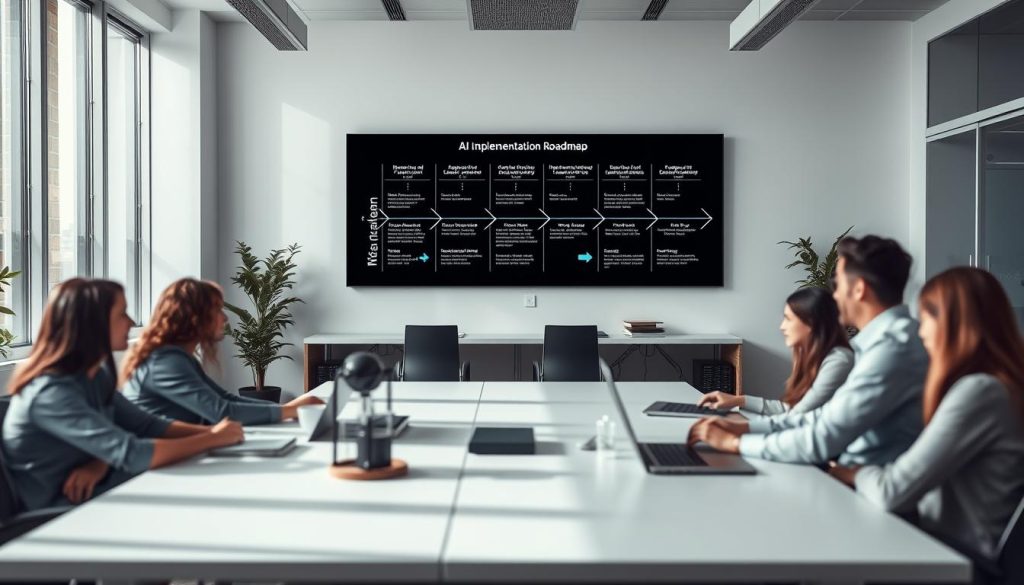
By following these steps and making a thorough roadmap, businesses can turn their AI projects into fully implemented solutions. This drives significant value and innovation.
How Can You Secure Stakeholder Buy-in for Your AI Trial Run?
Getting stakeholders on board is key to a successful AI trial run. We must create a strong business case and talk clearly to various groups.
Building a Compelling Business Case
A solid business case is essential for winning over stakeholders. We should explain how the AI trial run will help, like making things more efficient and saving money. Key parts of a good business case are:
- Clear goals and what we hope to achieve
- A detailed look at costs and benefits
- How we plan to handle risks
Effective Communication Strategies for Different Audiences
Talking effectively to stakeholders is crucial. We need to adjust our message for each group. For tech folks, we dive into the AI tech. For business leaders, we highlight the strategic gains and how it will pay off.
Addressing Common Stakeholder Concerns
Stakeholders worry about things like data privacy and jobs. We tackle these concerns head-on, offering solutions to ease their worries. This helps build trust and boosts the chance of getting their support.
What Are the Most Common Reasons AI POCs Fail?
AI POCs, or Proofs of Concept, can fail for many reasons. These include technical problems and strategic mistakes. Knowing these issues is key for companies wanting to use AI successfully.
Technical Pitfalls to Avoid
Technical issues are a big worry for AI POC failures. Some common problems are:
- Insufficient data quality or quantity
- Inadequate infrastructure or computational resources
- Poor model selection or configuration
- Incompatibility with existing systems or processes
To avoid these problems, it’s important to check your technical and data readiness before starting an AI POC.
Strategic and Planning Mistakes
Strategic and planning errors can also hurt an AI POC. These mistakes include:
- Poorly defined project objectives or success criteria
- Inadequate stakeholder engagement or buy-in
- Unrealistic timelines or budget allocations
- Lack of clear governance or decision-making processes
Creating a solid plan and getting stakeholder support are crucial steps to avoid these mistakes.
Expectation Management Issues
Managing expectations is key for an AI POC’s success. Problems can happen when:
- Stakeholders have unrealistic expectations about the POC’s capabilities or outcomes
- There is a lack of clear communication about the POC’s objectives, progress, or limitations
- Expectations are not aligned with the POC’s actual achievements
Good communication and setting realistic expectations are essential to manage stakeholder expectations and ensure the POC’s success.
Learning from Failed POCs: Case Studies
Looking at failed AI POCs can teach us a lot. For example, a Gartner study found that many AI projects fail because of data quality issues. A McKinsey report also shows how important change management is in AI adoption.
| Reason for Failure | Percentage of Occurrence | Mitigation Strategy |
|---|
| Technical Issues | 40% | Conduct thorough technical assessments |
| Strategic Mistakes | 30% | Develop a well-structured plan and secure stakeholder buy-in |
| Expectation Management | 30% | Set realistic expectations and maintain clear communication |
By understanding why AI POCs fail and learning from case studies, companies can better handle AI challenges. This improves their chances of success.
How Do Different Industries Approach AI Proof of Concept Projects?
AI is changing many industries in different ways. Each sector has its own approach to AI proof of concept (POC) projects. This is because each industry has unique needs and challenges.
Healthcare and Pharmaceutical AI POC Case Studies
In healthcare and pharmaceuticals, AI POCs aim to improve patient care and drug development. For example, AI tools are being tested to better diagnose diseases from images. AI also helps in personalized medicine, making treatments fit each patient’s needs.
Financial Services and Insurance Applications
The financial and insurance sectors use AI POCs to fight fraud and improve customer service. AI chatbots are being tested for customer support. Machine learning is used to analyze data for risk and fraud detection.
Manufacturing and Supply Chain Examples
In manufacturing and supply chain, AI POCs predict maintenance needs and optimize production. AI helps reduce downtime and improve equipment use.
Retail and E-commerce Implementations
Retail and e-commerce use AI POCs to improve customer experiences and manage inventory. AI analytics help forecast demand and manage stock levels.
Looking at how different industries use AI POCs shows how AI drives innovation. As AI grows, we’ll see more creative uses in various sectors.
When Should You Consider Working with External Partners on Your AI POC?
Working with external partners on an AI POC is key for companies without the right AI skills or resources. This collaboration offers many benefits. It gives access to specialized knowledge, cuts down development time, and boosts project success.
Benefits of Partnering with AI Specialists
Partnering with AI experts brings many advantages. These include:
- Access to the latest technology and expertise
- Quicker development and deployment of AI solutions
- Better accuracy and reliability of AI models
- More flexibility and scalability in AI project implementation
Selecting the Right POC Development Partner
Finding the right partner for your AI POC is crucial. Look at these factors:
| Factor | Description | Importance Level |
|---|
| Expertise | Relevant experience in AI development | High |
| Portfolio | Previous AI POC projects and success stories | Medium |
| Technology Stack | Compatibility with your existing infrastructure | High |
Partnership Models and Engagement Options
There are different partnership models with varying levels of involvement. Common ones include:
- Project-based: One-time engagement for a specific AI POC project
- Retainer-based: Ongoing collaboration for multiple AI projects
- Joint Venture: Shared ownership and development of AI solutions
By carefully choosing the right partner, businesses can ensure the success of their AI POC projects.
Conclusion: Taking the Next Step with Your AI Proof of Concept
Doing a POC in AI is key for businesses to use AI solutions. It helps check if AI ideas work and if they’re worth the cost. This way, companies can make sure AI works well and avoid wasting money.
A good AI POC can show real results in just weeks. This helps businesses avoid spending too much and find out what’s really holding them back.
To move forward with your AI proof of concept, you need to set clear goals. You also need the right team and the right tech. By following these steps and learning from others, like in retail and manufacturing, businesses can really benefit from AI.
For more help on AI POC, check out our resources or visit Master of Code. We have lots of info on AI proof of concept projects.
Working with skilled AI experts can make the move from POC to full use easier. We help businesses grow with cloud innovation and reduce workloads. Let us help you reach your AI goals.
FAQ
What is a POC in AI, and why is it essential for businesses?
A POC in AI, or Proof of Concept in Artificial Intelligence, is key for businesses. It helps them check if their AI ideas work, reduces risks, and makes smart choices before spending a lot of money.
How does a POC differ from MVP, prototype, and pilot in AI projects?
A POC checks if an AI idea is doable. MVP (Minimum Viable Product) is about launching a basic product. A prototype is an early version of a product, and a pilot is a small test. Knowing these differences helps businesses pick the right way to check their ideas.
What business problems can AI POCs help solve?
AI POCs can solve many business problems. They can make operations better, improve customer service, and drive innovation. By testing AI ideas, businesses can find new chances and stay ahead in their fields.
What are the key stages of a successful POC in AI?
A successful AI POC has three main stages. First, planning and scoping. Then, implementing and testing. Lastly, evaluating and making decisions. Following these steps makes sure the POC is well-planned and works well.
How do you define clear objectives for your AI proof of concept?
To set clear goals for an AI POC, you need to make specific, measurable, achievable, relevant, and time-bound (SMART) goals. Aligning these goals with business outcomes is also important. This ensures the POC is focused and can be reached.
What resources are required for effective AI prototype testing?
For good AI prototype testing, you need the right tech, data, and skills. Businesses must have enough resources, like a good team and budget, to make their AI POC a success.
How long should an AI pilot project take to complete?
The time it takes to finish an AI pilot project depends on its type and complexity. The project’s scope, available resources, and complexity level all play a part in how long it will take.
What are the common challenges in AI POC development, and how can they be mitigated?
Challenges in AI POC development include technical issues, organizational hurdles, and data quality problems. By understanding these challenges and finding ways to overcome them, businesses can make their AI POC successful.
How do you measure the success of your AI experiment validation?
To see if an AI experiment worked, use both numbers and words to measure success. Look at how well the tech works and its value to the business. A balanced scorecard can help evaluate the POC.
What comes after a successful AI demonstration project?
After a successful AI demo, businesses need to move from POC to production. They should scale their AI solution across the company and plan for full use. This ensures the AI solution is fully part of their operations.
How can you secure stakeholder buy-in for your AI trial run?
To get stakeholders to support an AI trial, make a strong business case. Talk clearly to different groups and address their concerns. This helps make sure everyone is on board with the AI POC goals.
When should you consider working with external partners on your AI POC?
Businesses should think about working with outside partners for their AI POC if they lack AI skills or resources. Partnering with AI experts can help solve technical problems and make the AI POC successful.