

Enhance Productivity with OCR for Manufacturing Solutions

November 15, 2025|1:09 PM
Unlock Your Digital Potential
Whether it’s IT operations, cloud migration, or AI-driven innovation – let’s explore how we can support your success.
November 15, 2025|1:09 PM
Whether it’s IT operations, cloud migration, or AI-driven innovation – let’s explore how we can support your success.
What if you could eliminate the single biggest source of error and delay in your production facility? Many leaders assume that manual data entry is just a necessary cost of doing business, but this common belief is holding your operations back from achieving true efficiency.
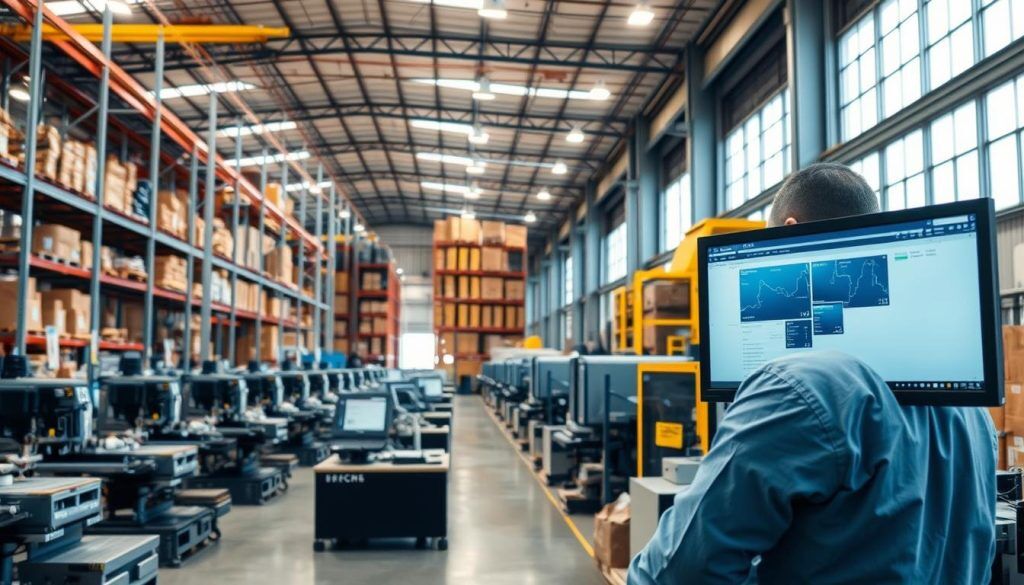
We understand the immense pressure to optimize operations and reduce errors in today’s fast-paced industrial landscape. Optical character recognition technology has emerged as a critical solution for achieving a competitive advantage. This guide explores how it transforms traditional processes.
By automatically converting printed or handwritten text from images into digital formats, this system eliminates the inefficiencies of manual entry. Our expertise shows it delivers measurable improvements in accuracy, quality control, and compliance. It significantly reduces operational costs compared to fully manual methods.
We help organizations capture critical information from various documents, turning unstructured data into actionable intelligence. This partnership accelerates your digital transformation journey and enables sustainable growth.
Physical documents containing vital operational information often create bottlenecks in manufacturing workflows. We recognize that converting printed text into digital formats represents a fundamental shift in how organizations handle critical data.
Optical character recognition technology automatically converts typed or handwritten text from images into machine-readable formats. This system has evolved from basic pattern-matching to sophisticated AI-powered computer vision.
Modern systems achieve remarkable accuracy rates approaching 99% even with challenging document conditions. The evolution represents significant breakthroughs in computer vision capabilities.
| Processing Stage | Key Functions | Primary Benefits |
|---|---|---|
| Image Preprocessing | Noise removal, skew correction, contrast enhancement | Improved document quality and readability |
| Text Localization | Detecting text regions, separating from non-text areas | Accurate text area identification |
| Character Recognition | Machine learning classification, contextual analysis | High-accuracy text extraction |
This technology eliminates the error-prone nature of manual document re-entry. Traditional methods suffer from high error rates due to human interpretation mistakes and fatigue.
By automating conversion of physical documents into structured digital data, character recognition dramatically improves data reliability. Critical business information remains consistent and accessible throughout operations.
Practical applications extend beyond simple text extraction to include barcode reading and label validation. Manufacturers experience transformative improvements in information flow accuracy and speed.
The transition from manual paperwork to automated data capture unlocks a new level of operational excellence on the production floor. We help businesses harness this power to achieve measurable improvements across their entire operation.
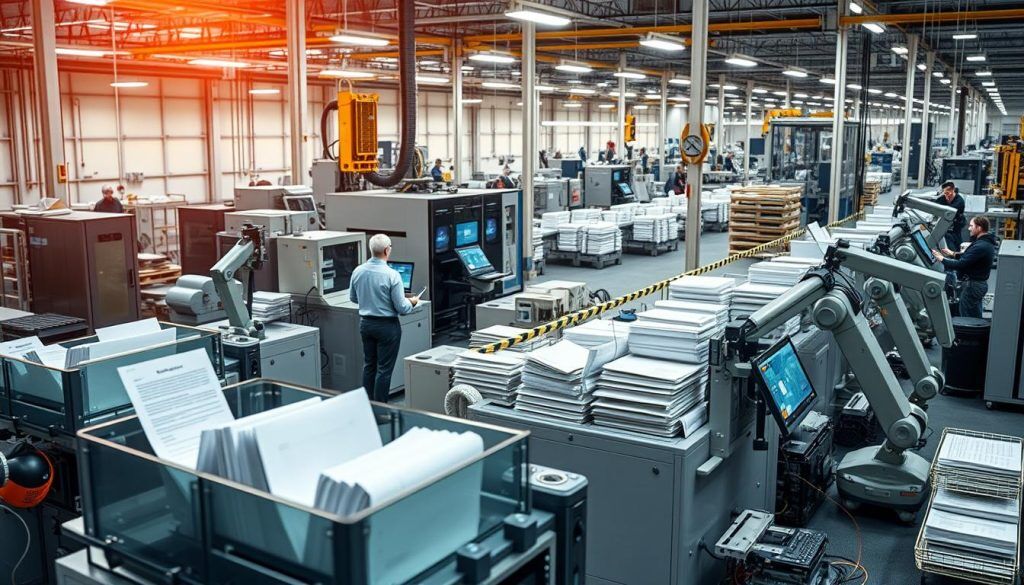
These advantages fundamentally change how companies manage information and drive value.
Automating document processing workflows delivers immediate efficiency gains. Staff members are freed from repetitive data entry tasks.
This allows them to focus on higher-value activities like analysis and process improvement. Leading research confirms cost reductions of over 80% compared to manual methods.
The table below highlights the stark contrast between traditional and modern approaches.
| Processing Aspect | Manual Method | Automated System |
|---|---|---|
| Speed | Slow, dependent on human speed | Rapid, near-instantaneous processing |
| Cost per Document | High, includes labor and error correction | Low, primarily system maintenance |
| Scalability | Limited by available staff | Effortlessly handles volume spikes |
| Data Accuracy | Prone to human errors | Consistently high,接近 99% |
Regulatory adherence becomes significantly simpler with digital audit trails. The system automatically logs every step, supporting standards like ISO and GDPR.
This technology is crucial for robust manufacturing quality control. It ensures accurate capture from inspection reports and certificates.
Eliminating transcription errors protects product integrity and prevents costly compliance violations. Reliable information directly supports better management decisions.
Document processing automation creates a continuous information stream that transforms how manufacturers manage their operations. We implement solutions that seamlessly convert physical paperwork into structured digital data, enabling real-time decision-making across the entire production lifecycle.
Our approach integrates optical character recognition technology directly with manufacturing execution platforms. This connection enables automatic routing of critical information from diverse document formats.
Production reports, quality checklists, and shipping manifests become instantly accessible digital assets. The system captures text from operator logbooks and machine counters with exceptional accuracy.
We’ve observed significant time savings in product tracking workflows. Label verification processes automatically confirm that all required text elements are present before items leave the facility.
This document management approach prevents costly errors in date verification and regulatory compliance. The technology extracts vital information from warranty forms and return slips, triggering appropriate actions without manual intervention.
Real-time data capture from analog meters and legacy blueprints further enhances operational visibility. This comprehensive processing system ensures information flows seamlessly between stakeholders and platforms.
The journey toward automated document processing begins with a critical choice between standardized and customized solutions. We guide organizations through this strategic decision-making process.
We recommend starting with pre-trained systems that handle common document types effectively. These ready-made solutions deploy rapidly with minimal coding requirements.
When standard models struggle with specialized typefaces or unusual layouts, custom development becomes necessary. This approach requires annotating representative images to train specialized recognition capabilities.
| Solution Type | Best Use Cases | Implementation Time | Accuracy Level |
|---|---|---|---|
| Out-of-the-Box | Standard documents, common fonts | Days to weeks | 90-95% |
| Custom Model | Specialized typefaces, poor quality | Weeks to months | 95-99% |
Successful implementation requires seamless workflow integration. We ensure digitized data flows directly into your enterprise platforms.
Our approach includes establishing standardized image capture protocols and connecting recognition engines through APIs. This creates a cohesive digital ecosystem.
We provide comprehensive support throughout the implementation journey. Our services include performance monitoring and continuous optimization.
The underlying technologies powering modern text recognition systems represent a convergence of artificial intelligence and scalable cloud infrastructure that drives unprecedented accuracy. We implement solutions that leverage these advanced capabilities to transform document processing workflows.
Artificial intelligence and machine learning technologies enable systems to automatically learn patterns from millions of text samples. This approach eliminates the need for manual feature engineering that characterized earlier systems.
Deep learning models demonstrate remarkable adaptability to document variations and font differences. They continuously improve through retraining on new data encountered in specific operational environments.
Cloud-based APIs provide enterprise-grade capabilities without significant capital investment. These services offer scalable processing capacity that adjusts to demand fluctuations.
We implement solutions using platforms like Google Cloud’s Document AI and Vision services. These tools provide comprehensive document understanding across multiple languages and formats.
| Technology Aspect | Traditional Approach | Modern AI-Powered System |
|---|---|---|
| Pattern Recognition | Rule-based templates | Neural network learning |
| Adaptation Capability | Limited to predefined formats | Continuous improvement |
| Processing Infrastructure | On-premise servers | Cloud-based scalability |
| Language Support | Limited multilingual | 200+ languages |
The technical architecture combines multiple components including image preprocessing, segmentation algorithms, and natural language processing. This integrated approach ensures reliable data extraction from diverse document types.
Optimizing automated text extraction requires a nuanced understanding of how different recognition technologies serve distinct operational needs. We help manufacturers navigate this complexity by matching specific character recognition capabilities to their unique document processing requirements.
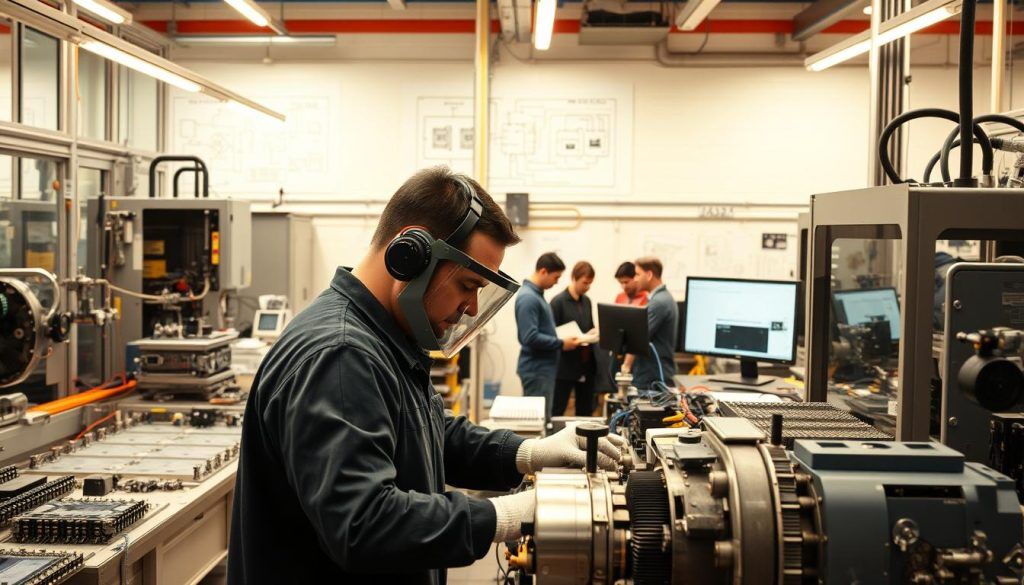
Manufacturing environments handle various document types, each demanding specialized approaches. Optical Mark Recognition excels with checkbox forms, while Intelligent Character Recognition handles handwritten notes effectively.
The selection process begins with assessing whether your primary needs involve printed or handwritten content. This fundamental distinction determines the most suitable technology for your operation.
Document quality significantly impacts solution design. High-quality laser prints need minimal preprocessing, while challenging materials require advanced algorithms.
Global operations demand multilingual support across 200+ languages. We ensure your system handles diverse character sets from Latin to Asian scripts.
Output requirements vary by use case. Some applications need simple text extraction, while others require structured data mapping for automated workflows.
Security considerations influence deployment choices between cloud APIs and on-premise solutions. We help balance implementation speed with data protection needs.
We stand at the precipice of a new era in automated data capture, driven by breakthroughs in generative AI. These innovations promise to transform how industrial operations handle document intelligence.
Generative AI technologies are revolutionizing traditional character recognition systems. These advanced platforms leverage foundational models to create custom extractors without extensive training.
This represents a paradigm shift from rigid recognition models to flexible, intelligent document understanding. Systems can now adapt to new document types and extract complex relationships between data elements.
We see this technology enabling rapid deployment of specialized parsers for unique industrial requirements. The need for massive data labeling efforts is significantly reduced.
Future developments will push accuracy levels beyond 99% toward human-equivalent performance. Challenging scenarios involving degraded documents and complex layouts will see remarkable improvements.
Processing speed enhancements will enable real-time analysis at production line velocities. Specialized AI hardware and optimized cloud infrastructure will eliminate processing bottlenecks.
These advancements will create comprehensive intelligent ecosystems that integrate with other AI capabilities. The result is a seamless workflow that delivers measurable competitive advantages.
Optical character recognition has evolved into a mission-critical capability for the modern industrial landscape. This powerful technology delivers transformative improvements in operational efficiency and data reliability.
We have demonstrated how implementing these solutions generates compelling business value. Organizations achieve dramatic cost reductions while enhancing product quality and compliance standards.
Successful implementation requires careful planning and expert partnership. We provide comprehensive support throughout your digital transformation journey.
Our commitment extends beyond initial deployment to continuous optimization and strategic guidance. We help align document intelligence capabilities with your broader business objectives.
Embrace this foundational technology to unlock sustainable growth and industry leadership.
Optical character recognition technology automates the extraction of text from images, such as serial numbers on components or labels on packaging. This direct capture into your management systems drastically reduces manual entry errors, ensuring data integrity and supporting real-time tracking for better decision-making.
Our systems are designed to handle a wide array of document types common in the industry. This includes bills of lading, quality control certificates, work orders, and compliance labels. Advanced machine learning models enable the software to adapt to various fonts, formats, and image qualities for reliable information extraction.
Absolutely. A key advantage of modern optical character recognition is its seamless integration capability. We provide robust APIs and support services to connect our text capture and processing tools directly with your current enterprise resource planning, manufacturing execution, and warehouse management systems, creating a unified information flow.
Standard, out-of-the-box solutions offer excellent efficiency for common text recognition tasks. However, for unique use cases involving specialized product codes, handwritten annotations, or low-quality images, a custom model trained on your specific data delivers superior accuracy. We help you evaluate the cost-benefit analysis to choose the optimal approach.
Machine learning is the core technology that enables continuous improvement. As our systems process more images and documents, the algorithms learn from corrections and new patterns. This ongoing learning process enhances character detection accuracy over time, adapts to changes in your documentation, and improves overall system resilience without significant manual intervention.
The field is rapidly advancing with generative AI and sophisticated custom extractors leading the way. We anticipate significant leaps in processing speed for real-time applications and enhanced accuracy for complex visual inspections. These advancements will further reduce operational costs and unlock new levels of automation in quality control and supply chain management.



Experience power, efficiency, and rapid scaling with Cloud Platforms!