

Understanding the Replatforming Review Guide: Your How-To Master
Embarking on a replatforming journey is a significant undertaking for any business, demanding careful planning and execution. A robust replatforming review guide serves as your essential roadmap, ensuring every step, from initial assessment to post-launch optimization, is meticulously managed. This guide will walk you through the comprehensive process, equipping you with the knowledge to navigate complex migrations successfully.
Effectively utilizing a replatforming review guide helps mitigate risks, optimize resource allocation, and ultimately achieve desired business outcomes. It transforms a daunting project into a structured, manageable sequence of activities. Understanding each phase is crucial for making informed decisions and fostering a smooth transition.
Why Replatform? Understanding the Drivers Behind Migration
Businesses undertake replatforming for a multitude of reasons, often driven by the need to overcome existing limitations or capitalize on new opportunities. Identifying these core drivers is the first step in formulating a successful platform migration strategy. These initiatives are often integral to broader digital transformation initiatives.
Common motivations include:
- Scalability limitations: Current platforms may struggle to handle increased traffic, data, or product catalogs, impeding growth.
- Outdated technology: Legacy systems can become difficult to maintain, lack modern features, and pose security risks.
- High operational costs: Excessive licensing fees, customization expenses, or infrastructure management can drain resources.
- Poor user experience (UX): A cumbersome backend or front-end experience can lead to inefficiencies for staff and dissatisfaction for customers.
- Lack of integration capabilities: Inability to connect with essential third-party tools like ERP, CRM, or marketing automation systems.
- Need for enhanced features: Desire for advanced functionalities such as AI-driven personalization, headless commerce, or improved analytics.
Understanding these pain points thoroughly helps define the scope and objectives for your new platform. This clarity ensures that the subsequent investment in replatforming yields tangible benefits. Clearly articulating these drivers forms the bedrock of your entire project.
Phase 1: Strategic Planning and Assessment
The initial phase is arguably the most critical, laying the groundwork for the entire replatforming project. This stage involves deep introspection into your current systems and a clear vision for your future state. A well-defined platform migration strategy is essential here.
Defining Objectives and Scope
Before any technical work begins, clearly articulate what success looks like for your replatforming initiative. What specific business problems are you trying to solve? How will you measure the ROI?
Key considerations include:
- Business Goals: Increase conversion rates, reduce operational costs, improve site performance, expand into new markets.
- Key Performance Indicators (KPIs): Define measurable metrics such as page load speed, bounce rate, average order value, or system uptime.
- Project Scope: Determine which systems will be migrated, what data will be transferred, and which new functionalities are essential. Avoid scope creep by maintaining a focused approach.
Current **Technology Stack Assessment**
Thoroughly analyze your existing platform and connected systems. Document every component, its functionality, and its dependencies. This comprehensive review helps identify potential roadblocks and integration challenges.
This assessment involves:
- Auditing existing infrastructure: Servers, databases, network architecture.
- Reviewing current software: CMS, CRM, ERP, payment gateways, marketing tools.
- Evaluating custom code and integrations: Understand what is unique to your current setup.
- Assessing data quality and volume: Prepare for data cleansing and migration requirements.
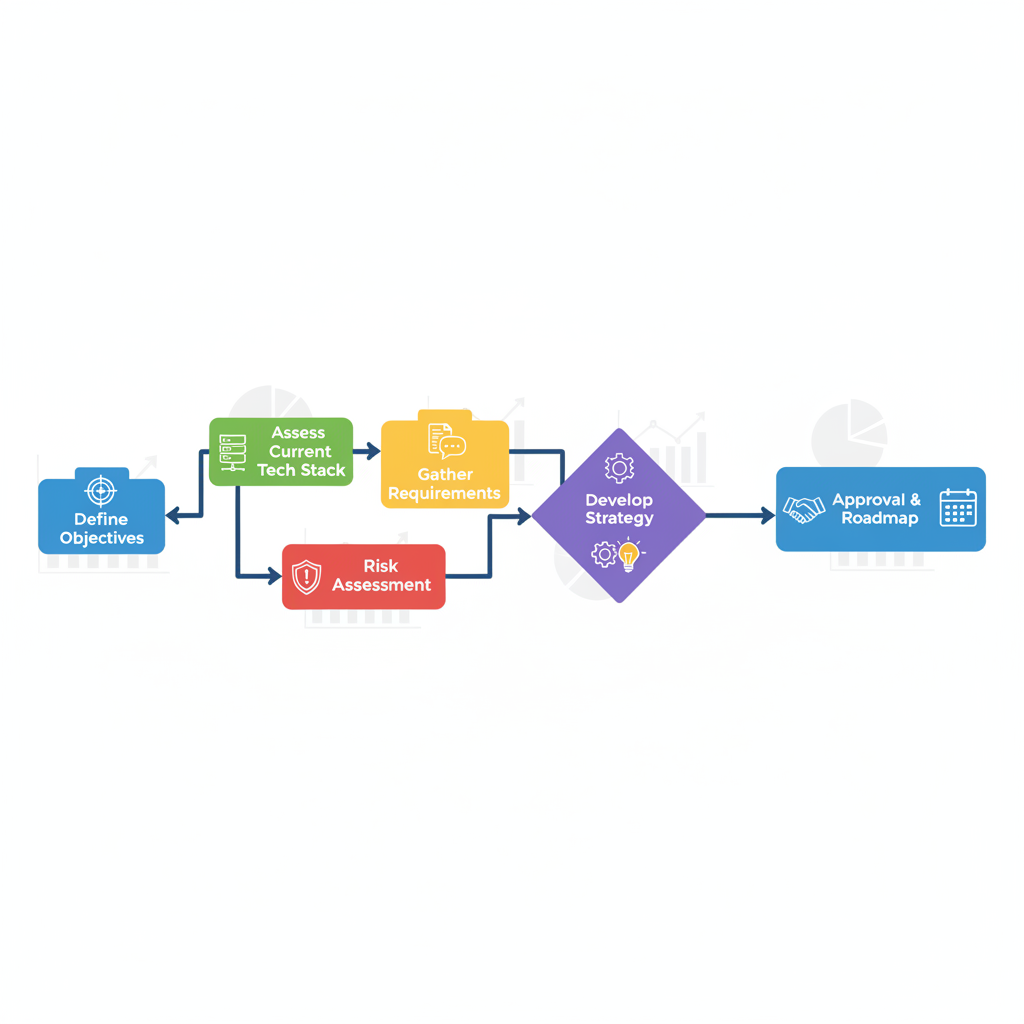
Gathering Requirements and Future State Vision
Based on your objectives and current system analysis, outline the functional and non-functional requirements for your new platform. This includes everything from specific features to performance expectations and security protocols. Engaging stakeholders from across the organization is vital here.
Considerations for requirements gathering:
- Functional requirements: Specific features the new platform must offer (e.g., product catalog management, customer accounts, checkout process).
- Non-functional requirements: Performance (speed, scalability), security, compliance, usability, maintainability.
- User stories: Describe how different user types (customers, administrators, marketers) will interact with the new system.
- Integration needs: List all third-party systems that must connect with the new platform.
Risk Assessment and Mitigation Planning
Every large-scale project carries risks. Identify potential issues early and develop strategies to mitigate them. This proactive approach can save significant time and resources down the line.
Common risks include:
- Data loss or corruption during migration.
- Unexpected system downtime.
- Budget overruns or schedule delays.
- Vendor lock-in or poor vendor support.
- Resistance to change from internal teams.
- Security vulnerabilities in the new platform.
Develop contingency plans for each identified risk, assigning responsibilities for their management. This forms a critical part of your overall replatforming project management.
STREAMLINE YOUR BUSINESS
Streamline your business operations. Share your unique requirements with Opsio today,
✓ Free consultation✓ No commitment required
✓ Trusted by experts
Phase 2: Vendor Selection and Due Diligence
Choosing the right platform and implementation partner is pivotal to the success of your replatforming project. This phase demands careful evaluation against your defined requirements and long-term vision. This is where your e-commerce replatforming checklist becomes indispensable.
Developing **Vendor Selection Criteria**
Establish clear criteria based on your strategic objectives, functional requirements, and budget. These criteria will guide your evaluation of potential platform solutions and service providers. A structured approach ensures objectivity.
Your criteria should cover:
- Platform capabilities: Does it meet all essential functional and non-functional requirements?
- Scalability and flexibility: Can it grow with your business and adapt to future needs?
- Integration ecosystem: How well does it connect with your existing or planned third-party systems?
- Total Cost of Ownership (TCO): Beyond licensing, consider implementation, customization, maintenance, and support costs.
- Security and compliance: Does it meet industry standards and regulatory requirements?
- Vendor reputation and support: Check client references, support models, and future roadmap.
Request for Proposal (RFP) and Evaluation
Issue a detailed RFP to shortlisted vendors, outlining your project goals, technical requirements, and desired outcomes. Their responses will form the basis of your initial evaluation. Be specific in your requests to receive comparable proposals.
During the evaluation process:
- Review proposals rigorously: Assess how each vendor addresses your requirements and challenges.
- Conduct demos and proof-of-concept: See the platform in action and test critical functionalities.
- Engage in technical deep-dives: Ensure the proposed solution aligns with your technical capabilities and future vision.
- Interview potential implementation partners: Evaluate their experience, methodology, and team structure.
For cloud replatforming considerations, specifically evaluate cloud vendor SLAs, data residency policies, and the availability of managed services. This directly impacts long-term operational efficiency.
Negotiation and Contracting
Once you've identified your preferred platform and partner, enter into detailed negotiations. Ensure contracts clearly define scope, deliverables, timelines, payment schedules, and service level agreements (SLAs). Legal review is essential here.
Key contractual elements:
- Detailed statement of work (SOW) for implementation.
- Clearly defined milestones and acceptance criteria.
- Support agreements, including response times and escalation procedures.
- Intellectual property rights and data ownership.
- Exit clauses and dispute resolution mechanisms.
Phase 3: Implementation and Data Migration
This phase involves the actual building, configuring, and populating of your new platform. Effective replatforming project management is crucial here, keeping the project on track and within budget. Adhering to system migration best practices will minimize disruptions.
Development and Configuration
Work closely with your implementation partner to build and configure the new platform according to your specifications. This includes front-end development, backend setup, and customization of core functionalities. Regular communication and progress reviews are vital.
Development activities typically include:
- Setting up the development, staging, and production environments.
- Configuring core platform features and modules.
- Developing custom functionalities or integrations.
- Designing and implementing the user interface (UI) and user experience (UX).
- Thorough unit testing and integration testing.
Data Migration Strategy and Execution
Data migration is often one of the most complex and risky parts of replatforming. Develop a meticulous plan to transfer all necessary data from your old system to the new one, ensuring data integrity and accuracy.
Steps for effective data migration: 1. Data audit and cleansing: Identify and rectify any inconsistencies, duplicates, or outdated information in your existing data. 2. Mapping: Define how data fields from the old system will map to fields in the new system. 3. Extraction: Extract data from the legacy platform. 4. Transformation: Reformat and enrich data to fit the new platform's structure. 5. Loading: Import the transformed data into the new system. 6. Verification: Conduct thorough checks to ensure all data has been accurately migrated. 7. Rollback plan: Have a strategy in place in case of migration failure.
Integrations and Testing
Integrate the new platform with all required third-party systems (e.g., ERP, CRM, payment gateways, shipping providers). Following this, perform extensive testing to ensure all functionalities work as expected and integrations are seamless.
Types of testing to conduct:
- Functional testing: Verify all features work according to requirements.
- Performance testing: Assess system speed, responsiveness, and stability under load.
- Security testing: Identify vulnerabilities and ensure data protection.
- User Acceptance Testing (UAT): Key business users test the system to confirm it meets their needs.
- Regression testing: Ensure new changes haven't negatively impacted existing functionalities.
Phase 4: Post-Launch Optimization and Review
Launching the new platform is a major milestone, but the journey doesn't end there. Post-launch activities are crucial for ensuring long-term success, continuous improvement, and realizing the full potential of your investment.
Go-Live and Monitoring
Carefully plan and execute the go-live process, coordinating all necessary teams and systems. Immediately after launch, monitor the platform closely for any issues or unexpected behaviors. A detailed cutover plan minimizes downtime.
Monitoring activities include:
- Real-time performance tracking (page load times, server response).
- Error logging and immediate incident response.
- Traffic and conversion rate monitoring.
- User feedback collection (surveys, direct communication).
Training and Support
Provide comprehensive training to all internal users who will interact with the new platform. Establish clear support channels and documentation to address user queries and technical issues effectively. User adoption is key to ROI.
Training should cover:
- New workflows and processes.
- Admin panel functionalities.
- Troubleshooting common issues.
- Accessing support resources.
Continuous Improvement and Optimization
Replatforming is not a one-time event; it's an ongoing process of optimization. Regularly review platform performance, gather user feedback, and identify areas for improvement. Leverage analytics to drive data-informed decisions.
Optimization strategies include:
- Performance tuning: Continuously refine server configurations, code, and database queries.
- Feature enhancements: Prioritize and implement new functionalities based on business needs and user feedback.
- Security updates: Keep the platform patched and protected against emerging threats.
- A/B testing: Experiment with different layouts, content, and features to improve user experience and conversion.
Common Challenges and How to Overcome Them
Despite meticulous planning, replatforming projects can encounter various challenges. Anticipating these issues and having strategies to address them is a hallmark of strong replatforming project management.
- Data Integrity Issues: Incorrect or incomplete data migration can cripple a new system. Overcome this by investing heavily in data cleansing, comprehensive mapping, and thorough validation before, during, and after migration. Automated tools can assist in this process.
- Scope Creep: Adding functionalities during the project can lead to delays and budget overruns. Overcome this by establishing a strict change management process. Any new request must be evaluated against its impact on cost, time, and resources, with formal approval required.
- Integration Complexities: Connecting the new platform to existing systems can be more challenging than anticipated. Overcome this by conducting a detailed technology stack assessment early on, prioritizing critical integrations, and developing robust APIs or middleware solutions.
- Budget Overruns: Unforeseen costs can quickly deplete project funds. Overcome this by building a contingency fund (typically 15-20% of the total budget), closely tracking expenses, and transparently communicating financial status with stakeholders.
- Internal Resistance: Team members may resist adopting new tools and workflows. Overcome this through effective change management, early stakeholder involvement, comprehensive training, and clear communication of the benefits the new platform will bring.
- Performance Bottlenecks: The new platform may not perform as expected under load. Overcome this by conducting rigorous performance and load testing well before launch, identifying potential bottlenecks, and optimizing infrastructure and code.
Frequently Asked Questions
Navigating a replatforming project often brings specific questions to the forefront. This section addresses common inquiries about the replatforming review guide process.
What is the primary purpose of a replatforming review guide?
The primary purpose of a replatforming review guide is to provide a structured, comprehensive framework for managing and executing a platform migration project. It ensures that all critical aspects, from strategic planning to post-launch optimization, are considered and addressed, thereby reducing risks and increasing the likelihood of project success.
How long does a typical replatforming project take?
The duration of a replatforming project varies significantly based on factors like the complexity of the existing system, the size of the data to be migrated, the number of integrations, and the chosen platform. Simple projects might take 6-9 months, while complex enterprise-level migrations can extend beyond 12-18 months.
What are the key elements of an effective **e-commerce replatforming checklist**?
An effective e-commerce replatforming checklist should cover strategic planning (goals, budget), platform and vendor selection (RFP, demos), technical requirements (integrations, data migration), testing procedures (UAT, performance), go-live strategy, and post-launch optimization. It ensures no critical step is overlooked.
When should a business consider a **cloud replatforming considerations**?
A business should consider cloud replatforming when seeking enhanced scalability, improved performance, reduced infrastructure management overhead, greater flexibility, and access to advanced cloud-native services. This move often aligns with broader digital transformation initiatives aimed at modernizing IT infrastructure.
What role does a **replatforming project management** play in success?
Replatforming project management is crucial for defining scope, allocating resources, managing timelines and budgets, coordinating teams, and mitigating risks. Effective project management ensures that all phases of the migration are executed efficiently, stakeholders are informed, and the project stays aligned with business objectives.
STREAMLINE YOUR BUSINESS
Streamline your business operations. Share your unique requirements with Opsio today,
✓ Free consultation✓ No commitment required
✓ Trusted by experts
Conclusion
Successfully navigating a replatforming journey is a monumental achievement that can redefine your business capabilities. By diligently following a well-structured replatforming review guide, you empower your organization to make informed decisions, minimize risks, and achieve a seamless transition. This comprehensive approach ensures that your new platform not only meets current needs but also provides a scalable, future-proof foundation for sustained growth. Embrace this guide to transform your digital landscape confidently.
Opsio provides managed services and cloud consulting to help organizations implement and manage their technology infrastructure effectively.