

Understanding Enterprise Cloud SLA Monitoring
In today's fast-paced digital landscape, enterprises increasingly rely on cloud services to power critical business operations. Managing these services effectively requires robust mechanisms to ensure performance and reliability. This is where enterprise Cloud SLA monitoring becomes indispensable for maintaining operational excellence and meeting customer expectations.
Enterprise Cloud SLA monitoring involves the systematic tracking, reporting, and management of Service Level Agreements (SLAs) for cloud-based services used by large organizations. It ensures that cloud providers deliver on their promised performance, availability, and security commitments. This comprehensive oversight is crucial for corporate SLA monitoring across diverse cloud environments.
This essential process extends beyond simple uptime checks. It encompasses a holistic view of large-scale cloud performance, including response times, throughput, error rates, and resource utilization. Effective monitoring provides the necessary insights to optimize cloud investments and prevent potential disruptions. It’s a foundational element for any organization leveraging the cloud.
The goal is to maintain business continuity and uphold organizational cloud service levels. By continuously verifying compliance with agreed-upon terms, businesses can proactively identify and address issues. This strategic approach minimizes downtime and safeguards against performance degradation, which can significantly impact revenue and customer trust.
Why Enterprise Cloud SLA Monitoring is Critical for Businesses
Effective enterprise Cloud SLA monitoring is not merely a technical exercise; it's a strategic imperative for any business operating in the cloud. It directly impacts an organization's bottom line, reputation, and ability to meet regulatory obligations. Without it, companies are essentially operating blind regarding their cloud service quality.
One primary reason is financial risk mitigation. Cloud outages or performance dips can lead to significant revenue losses, missed opportunities, and increased operational costs. Robust business SLA tracking helps quantify these risks and provides data to hold providers accountable, potentially leading to service credits or contract renegotiations.
Beyond finances, maintaining a strong brand reputation is paramount. Customers expect seamless experiences, and service disruptions can quickly erode trust and loyalty. Comprehensive company-wide cloud monitoring ensures that customer-facing applications and internal systems consistently meet high standards, thereby protecting the brand's image.
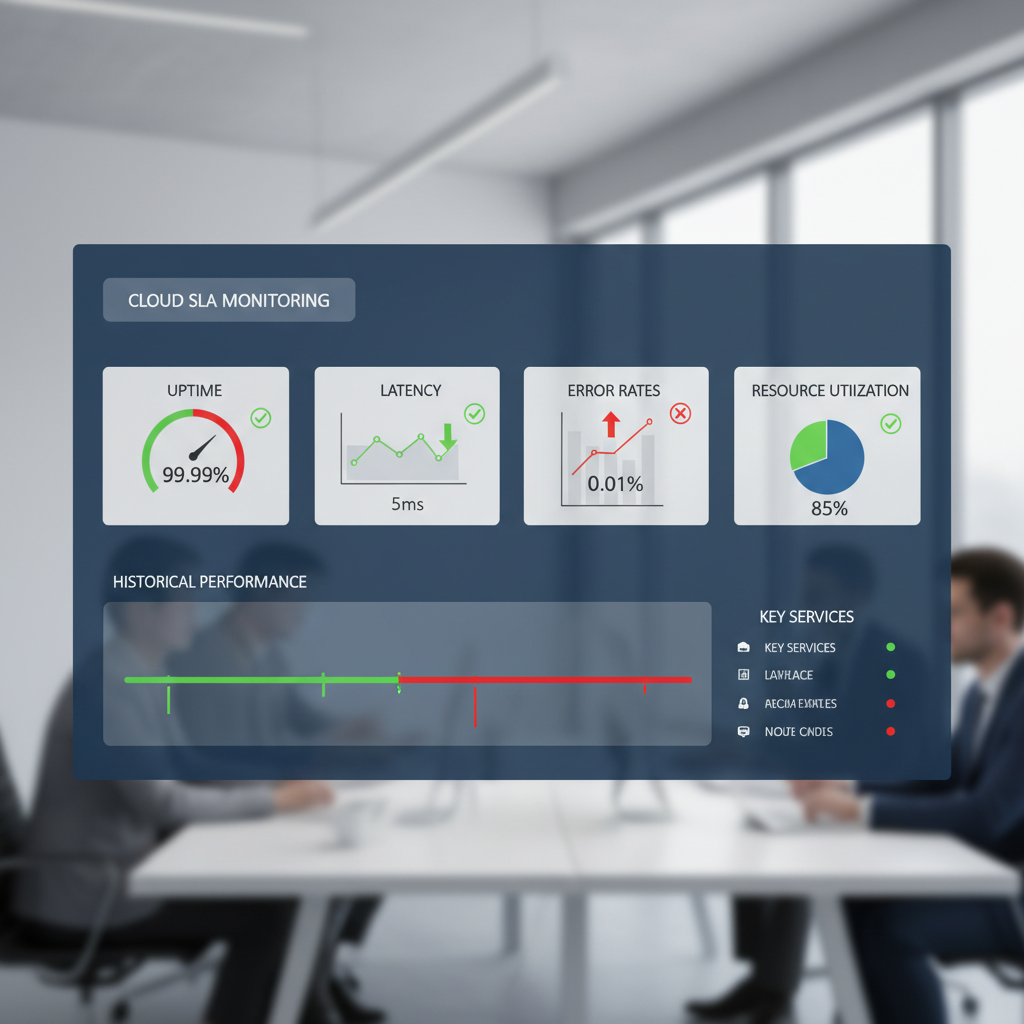
Furthermore, regulatory compliance is a growing concern for many enterprises. Industries like finance, healthcare, and government have strict requirements regarding data availability, security, and integrity. Enterprise Cloud SLA monitoring provides the auditable data necessary to demonstrate compliance with these complex regulations.
It also empowers better decision-making regarding cloud strategy and vendor selection. By understanding the true performance of existing services, businesses can make informed choices about scaling resources, adopting new cloud technologies, or switching providers. This data-driven approach is key to optimizing cloud expenditure and resource allocation.
Key Components of Effective Enterprise Cloud SLA Monitoring
Implementing effective enterprise Cloud SLA monitoring requires a structured approach, integrating several critical components. These elements work in concert to provide a complete picture of cloud service health and compliance. Understanding each component is vital for building a robust monitoring framework.
Defining Key Performance Indicators (KPIs) and Service Level Objectives (SLOs)
The first step in any monitoring strategy is to clearly define what success looks like. This involves identifying specific KPIs that directly relate to business outcomes, such as transaction success rates or application load times. These KPIs form the basis for your SLOs, which are internal targets for service performance.
Typical KPIs include uptime, latency, throughput, error rate, and response time for critical applications. For example, a banking application might have an SLO of 99.99% availability and a transaction processing time under 500ms. These specific metrics allow for precise measurement and reporting.
Centralized Monitoring Platforms
To handle the complexity of modern cloud environments, enterprises need centralized monitoring platforms. These platforms aggregate data from various cloud services, applications, and infrastructure components into a single pane of glass. This consolidation simplifies oversight and provides a unified view of overall service health.
These platforms often feature advanced analytics, customizable dashboards, and integration capabilities with other IT tools. They enable teams to correlate events across different layers of the cloud stack, facilitating faster root cause analysis and issue resolution. This holistic approach is fundamental to enterprise-grade SLA solutions.
Automated Alerting and Reporting
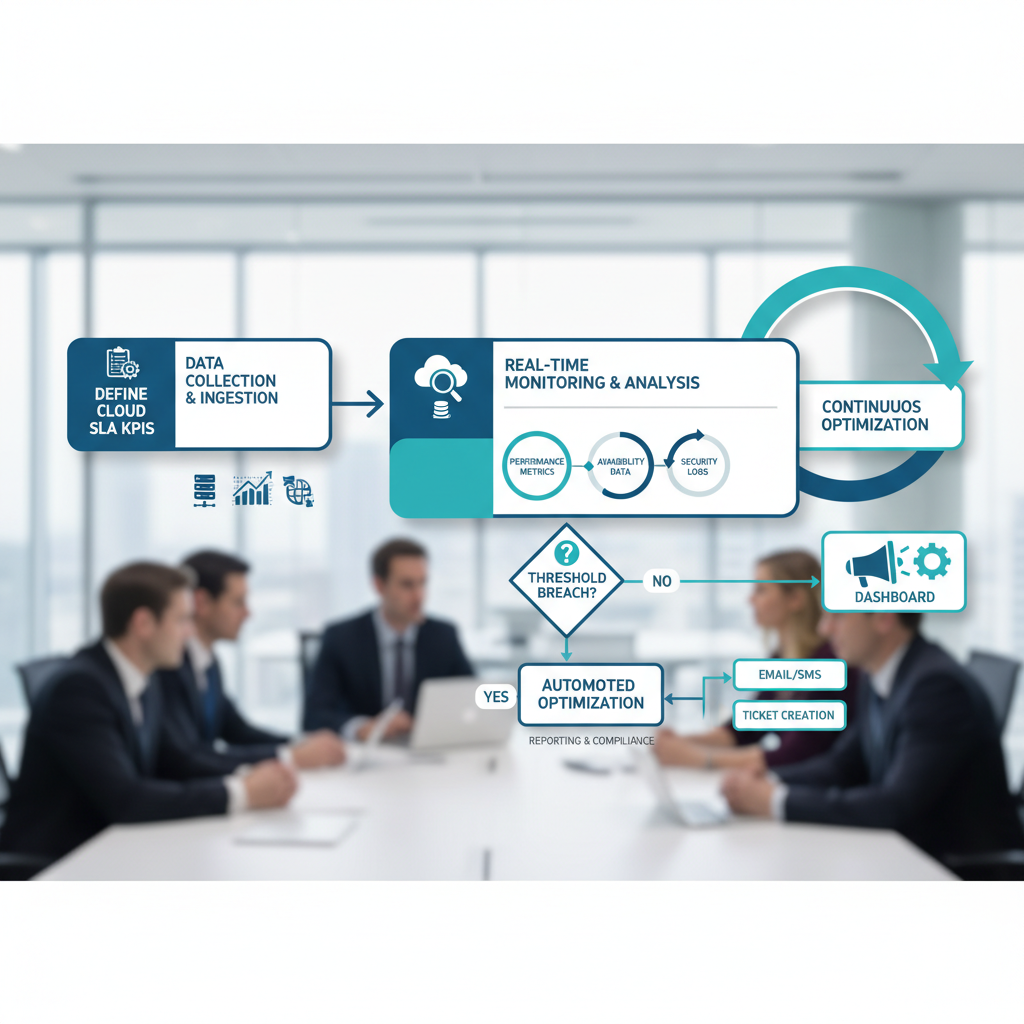
Proactive problem resolution relies heavily on timely alerts. An effective enterprise Cloud SLA monitoring system must feature configurable alerting mechanisms that notify relevant teams immediately when an SLO is breached or a critical threshold is exceeded. These alerts can be routed through various channels, like email, SMS, or incident management systems.
Beyond real-time alerts, comprehensive reporting is crucial for long-term analysis and accountability. Regular reports should detail SLA compliance, performance trends, and incident summaries. These reports support strategic planning, vendor reviews, and demonstrate compliance with business SLA tracking requirements.
Data Collection and Analysis
The foundation of robust monitoring is efficient data collection. This involves gathering metrics, logs, and traces from all relevant cloud resources, including virtual machines, containers, serverless functions, databases, and network components. The data must be collected continuously and at a granular level.
Once collected, powerful analytics capabilities are needed to process and interpret this vast amount of data. This includes trend analysis, anomaly detection, and correlation engines that can identify patterns and potential issues before they escalate. Such analysis provides actionable insights for optimizing cloud resources.
ENSURE UNINTERRUPTED SERVICE
Ensure uninterrupted service delivery and proactively prevent costly SLA breaches. Leverage our automated, real
✓ Free consultation✓ No commitment required
✓ Trusted by experts
Challenges in Enterprise Cloud SLA Monitoring
While indispensable, enterprise Cloud SLA monitoring presents several unique challenges that organizations must navigate. The dynamic and distributed nature of cloud environments adds layers of complexity that traditional on-premises monitoring solutions often struggle to address. Understanding these hurdles is the first step towards overcoming them.
One significant challenge stems from multi-cloud and hybrid cloud strategies. Enterprises often use services from multiple cloud providers (AWS, Azure, Google Cloud) simultaneously, alongside private cloud or on-premises infrastructure. This creates fragmented data sources and inconsistent monitoring tools, making unified corporate SLA monitoring difficult.
The sheer scale and dynamism of enterprise cloud deployments also pose challenges. Resources can spin up and down rapidly, making it hard to maintain a consistent view of the environment. Monitoring solutions must be elastic and capable of auto-discovering new resources to prevent blind spots in company-wide cloud monitoring.
Another hurdle is the complexity of cloud service dependencies. A single business application might rely on dozens of interconnected cloud services, each with its own SLA. Pinpointing the root cause of an issue amidst this web of dependencies requires sophisticated correlation and tracing capabilities, which many generic tools lack.
Data Volume and Signal-to-Noise Ratio
The volume of monitoring data generated by large-scale cloud performance environments can be overwhelming. Enterprises deal with petabytes of logs, metrics, and event data daily. Sifting through this noise to find meaningful signals – actual performance issues or SLA breaches – is a significant challenge.
This often leads to alert fatigue, where operations teams are bombarded with non-critical or false-positive alerts. Tuning monitoring thresholds and implementing intelligent anomaly detection are crucial for improving the signal-to-noise ratio and ensuring that important alerts receive immediate attention.
Vendor Lock-in and Tool Sprawl
Reliance on cloud provider-specific monitoring tools can lead to vendor lock-in, making it difficult to switch providers or integrate with other cloud platforms. Conversely, adopting too many specialized third-party tools can result in tool sprawl, increasing complexity and operational overhead. Finding the right balance is key for best enterprise Cloud SLA monitoring.
Integration challenges also arise when trying to unify data from disparate tools. Ensuring data consistency, establishing common metrics, and creating aggregated dashboards across diverse monitoring solutions require careful planning and often custom development. This highlights the need for flexible, open solutions.
Best Practices for Implementing Enterprise Cloud SLA Monitoring
To overcome the inherent challenges and maximize the value of enterprise Cloud SLA monitoring, organizations should adopt a set of established best practices. These guidelines help ensure a robust, scalable, and effective monitoring framework that truly supports business objectives. Following these tips can lead to significantly improved cloud operations.
1. Define Clear Business Context and Objectives: Before implementing any monitoring solution, clearly articulate what business goals it serves. Understand which cloud services are critical for specific business processes and what performance thresholds are acceptable. This ensures that monitoring efforts are aligned with strategic priorities.
2. Establish Comprehensive SLOs and SLAs: Go beyond basic uptime. Define specific, measurable, achievable, relevant, and time-bound (SMART) Service Level Objectives for every critical cloud service. Ensure your internal SLOs are more stringent than your provider's SLAs to provide a buffer against breaches. Regularly review and update these as business needs evolve.
3. Implement End-to-End Monitoring: Focus on monitoring the entire service delivery chain, from the end-user experience to the underlying infrastructure components. This includes application performance monitoring (APM), infrastructure monitoring, network monitoring, and synthetic transaction monitoring. A holistic view is crucial for effective organizational cloud service levels.
4. Leverage Automation for Alerting and Remediation: Automate as much of the alerting, notification, and initial remediation process as possible. Use runbooks for common issues to reduce manual intervention and speed up resolution. Integrate monitoring alerts directly into your incident management and ticketing systems.
5. Utilize Predictive Analytics and AI/ML: Move beyond reactive monitoring by incorporating predictive analytics and machine learning. These technologies can identify subtle anomalies and predict potential outages before they impact users. This proactive approach is a hallmark of advanced enterprise Cloud SLA monitoring guide principles.
6. Regularly Review and Optimize Monitoring Configurations: Cloud environments are constantly evolving, so your monitoring strategy must too. Periodically review your KPIs, SLOs, alert thresholds, and reporting formats. Remove outdated checks and add new ones as your cloud footprint changes. This continuous optimization ensures the monitoring system remains relevant and efficient.
Choosing the Right Enterprise Cloud SLA Monitoring Solution
Selecting the optimal enterprise-grade SLA solutions is a critical decision that impacts an organization's ability to manage its cloud services effectively. With a multitude of options available, a methodical approach is essential to find a solution that aligns with specific business needs and technical requirements. This choice should be viewed as a long-term investment.
When evaluating potential solutions, consider their ability to provide comprehensive coverage across your entire cloud ecosystem. This includes support for multi-cloud and hybrid environments, as well as a wide range of cloud services, from IaaS to PaaS and SaaS applications. A unified platform is generally preferable to disparate tools.
Key Evaluation Criteria
1. Scalability and Performance: The solution must be able to scale seamlessly with your growing cloud footprint and handle vast amounts of monitoring data without performance degradation. It should efficiently process metrics, logs, and traces from thousands of ephemeral resources.
2. Integration Capabilities: Assess how well the solution integrates with your existing IT ecosystem, including incident management, CI/CD pipelines, security tools, and business intelligence platforms. Robust APIs and pre-built connectors are vital for streamlined operations.
3. Customization and Flexibility: Look for a solution that offers flexible dashboards, custom reporting options, and configurable alert rules. The ability to tailor the monitoring experience to specific team roles and business requirements is highly beneficial for enterprise Cloud SLA monitoring.
4. Anomaly Detection and AI-driven Insights: Advanced solutions leverage AI and machine learning to detect anomalies, reduce alert noise, and provide actionable insights. These capabilities are crucial for proactive problem identification and improving the efficiency of operations teams.
5. Cost-Effectiveness and TCO: Evaluate not just the licensing cost, but also the total cost of ownership (TCO), including implementation, training, maintenance, and potential savings from improved efficiency and reduced downtime. Compare pricing models (e.g., per-host, per-metric, consumption-based) to find the best fit.
6. Vendor Support and Community: A strong vendor with excellent customer support, clear documentation, and an active user community can be invaluable. This ensures you have access to resources and expertise when implementing or troubleshooting the solution. Look for best enterprise Cloud SLA monitoring solutions with proven track records.
The Future of Enterprise Cloud SLA Monitoring
The landscape of enterprise Cloud SLA monitoring is continuously evolving, driven by advancements in technology and the increasing complexity of cloud environments. The future will see even greater reliance on intelligent automation and predictive capabilities to maintain high organizational cloud service levels. Organizations must stay abreast of these trends to optimize their monitoring strategies.
One major trend is the widespread adoption of Artificial Intelligence for IT Operations (AIOps). AIOps platforms leverage AI and machine learning to analyze vast amounts of operational data, correlate events, and identify patterns that human operators might miss. This significantly reduces alert fatigue and speeds up root cause analysis, embodying advanced enterprise Cloud SLA monitoring tips.
Predictive analytics will become even more sophisticated, enabling systems to forecast potential performance issues or SLA breaches before they occur. By analyzing historical data and real-time trends, these systems can trigger proactive measures, such as auto-scaling resources or initiating maintenance tasks, minimizing disruption to large-scale cloud performance.
Furthermore, continuous verification and autonomous remediation will gain prominence. Monitoring solutions will not only detect issues but also automatically trigger scripts or workflows to resolve common problems without human intervention. This shift towards self-healing systems will dramatically improve operational efficiency and reliability.
Enhanced Observability and Distributed Tracing
The future will also emphasize enhanced observability, moving beyond traditional metrics and logs to incorporate distributed tracing more comprehensively. This provides a deep, end-to-end view of requests as they flow through complex microservices architectures, making it easier to pinpoint latency issues or failures within distributed applications. This is key for future enterprise Cloud SLA monitoring examples.
Serverless and containerized environments will continue to grow, necessitating monitoring tools specifically designed for these ephemeral and dynamic architectures. These tools will need to offer granular insights into function invocations, container performance, and efficient resource utilization without adding significant overhead. The focus will remain on delivering precise, actionable data to maintain strict corporate SLA monitoring.
Frequently Asked Questions
What is enterprise Cloud SLA monitoring?
Enterprise Cloud SLA monitoring is the process of continually tracking, measuring, and reporting on the performance and availability of cloud services against predefined Service Level Agreements (SLAs) for large organizations. It ensures that cloud providers meet their contractual obligations and that business-critical applications perform as expected. This involves comprehensive oversight of various cloud metrics.
Why is enterprise Cloud SLA monitoring important?
It is crucial because it helps organizations mitigate financial risks from downtime, protect brand reputation, ensure regulatory compliance, and make informed decisions about cloud investments. Effective monitoring provides transparency into cloud service quality, enabling proactive issue resolution and maintaining operational stability. This directly impacts business continuity.
What are the key metrics for enterprise Cloud SLA monitoring?
Key metrics typically include uptime percentage, latency (response time), throughput, error rates, and resource utilization (CPU, memory, network I/O). These metrics are vital for assessing the performance and reliability of cloud services. The specific metrics chosen should align with the critical functions of each cloud-hosted application.
How does multi-cloud impact enterprise Cloud SLA monitoring?
Multi-cloud environments complicate monitoring by requiring integration with multiple cloud provider APIs and monitoring tools. This can lead to fragmented visibility and challenges in aggregating data. Solutions must offer unified dashboards and consistent metrics across diverse cloud platforms to provide a single pane of glass view for effective corporate SLA monitoring.
What are some best practices for enterprise Cloud SLA monitoring?
Best practices include defining clear business objectives, establishing comprehensive and stringent Service Level Objectives (SLOs), implementing end-to-end monitoring, leveraging automation for alerts and remediation, utilizing predictive analytics, and regularly reviewing and optimizing monitoring configurations. These steps ensure continuous improvement and relevance.
What role does AI play in the future of enterprise Cloud SLA monitoring?
AI and Machine Learning (ML) are increasingly used to enhance monitoring through AIOps platforms. They help analyze vast datasets, identify anomalies, predict potential outages, and automate remediation tasks. AI reduces alert fatigue and enables more proactive management of cloud performance, leading to more resilient and efficient operations.
ENSURE UNINTERRUPTED SERVICE
Ensure uninterrupted service delivery and proactively prevent costly SLA breaches. Leverage our automated, real
✓ Free consultation✓ No commitment required
✓ Trusted by experts
Conclusion
Enterprise Cloud SLA monitoring is an indispensable practice for any organization leveraging cloud services at scale. It transcends basic technical oversight, becoming a strategic imperative that directly influences financial health, brand reputation, and regulatory adherence. By meticulously tracking large-scale cloud performance against predefined Service Level Agreements, businesses can ensure continuity and optimize their extensive cloud investments.
Implementing effective company-wide cloud monitoring requires a thoughtful approach, focusing on clear objectives, comprehensive KPIs, and the strategic deployment of enterprise-grade SLA solutions. While challenges exist, embracing best practices and leveraging advanced tools for business SLA tracking can transform these hurdles into opportunities for greater operational resilience and efficiency. The ongoing evolution towards AI-driven, predictive, and self-healing systems underscores the critical importance of a proactive and intelligent approach to organizational cloud service levels.
Opsio provides cloud consulting and managed services to help organizations implement and manage their technology infrastructure effectively.