Did you know that connected devices now generate more data than the entire global internet did just a decade ago? This explosion of information represents a seismic shift in how companies operate, creating unprecedented opportunities for those who can harness it effectively.
We see organizations across every sector leveraging this data deluge to drive efficiency and create new revenue streams. The key lies in building the right expertise to transform raw data into actionable intelligence.
Our approach focuses on creating scalable, connected systems that empower businesses to automate processes and make smarter decisions. This transformation is not just about technology; it’s about fundamentally reshaping operations for a digital-first marketplace.
Companies that embrace these innovations gain a significant competitive edge. They achieve greater operational visibility, enhance customer experiences, and position themselves for sustainable growth in an increasingly interconnected world.
Key Takeaways
- Connected devices generate massive amounts of data that create new business opportunities.
- Proper expertise is essential for transforming data into actionable business intelligence.
- Scalable connected systems enable automation and smarter decision-making.
- Technology adoption fundamentally reshapes business operations for digital markets.
- Organizations that embrace innovation gain significant competitive advantages.
- Operational visibility and customer experience improvements drive sustainable growth.
Introduction to Cloud Innovation and IoT
The convergence of Internet of Things technology and cloud platforms creates unprecedented opportunities for operational transformation. This powerful combination enables organizations to connect billions of devices while processing massive data volumes in real-time.
The Intersection of IoT and Cloud Technology
Cloud innovation provides the scalable infrastructure necessary for connected ecosystems to function effectively. This seamless integration allows raw sensor information to transform into strategic business intelligence.
Enterprise spending on these technologies demonstrates accelerating adoption rates. Investments are expected to grow from $301 billion in 2024 to $690 billion by 2030.
Why Business Transformation Needs Innovation
Top use cases deliver measurable value across industries. Process automation, quality control, and real-time inventory management lead global adoption.
Current spending breakdown shows hardware accounts for 49% of investments. Services and software each represent 24%, while security comprises 2%.
Research confirms tangible business impact from this innovation. 63% of companies report revenue increases after implementation, while 57% gain competitive advantage.
Organizations that embrace these technologies achieve sustainable growth. They optimize operations while developing new products that meet evolving market demands.
Understanding IoT: From Embedded Systems to Internet Connectivity
Understanding the technical evolution that transforms basic electronic components into intelligent, connected assets is essential for strategic business planning. This progression represents a fundamental shift in how organizations approach technology infrastructure.
Defining IoT and Its Core Components
We define the Internet of Things as an expanding network of physical objects equipped with integrated software, sensors, and network connectivity. These components work together to create intelligent systems capable of autonomous operation.
The core elements include sensors that collect environmental data, microcontrollers that execute embedded software, and communication modules enabling connectivity. Cloud platforms then aggregate and analyze information from connected devices.
Evolution from Embedded Systems to Smart Devices
The journey begins with firmware—low-level software instructions written into specialized electronic device memory. These perform basic tasks like sensor signal conversion, typically coded in languages like C or assembler.
Embedded systems represent the next evolutionary step, utilizing high-level programming languages such as Java, C++, or Python. They perform more complex functions including data processing and inter-device communication.
The critical transformation occurs when embedded systems gain internet connectivity, converting them into IoT devices. This enables remote monitoring, control, and updates across distributed locations.
| Technology Stage |
Primary Function |
Programming Languages |
Connectivity Level |
| Firmware |
Basic signal conversion |
C, Assembler |
Standalone |
| Embedded Systems |
Data processing |
Java, C++, Python |
Local network |
| IoT Devices |
Remote management |
Multiple languages |
Internet-enabled |
This evolution demonstrates how technological advancement has expanded possibilities for business applications. Organizations can now deploy sophisticated smart devices capable of machine learning and predictive analytics.
Key Strategies for Building an Effective IoT Development Team
Strategic team composition directly determines the success of complex connected system implementations. We guide organizations in assembling specialists who understand every architecture layer, from device hardware to cloud integration.
Essential Roles in Connected Technology Projects
A well-structured unit requires diverse expertise across multiple domains. Business analysts translate requirements into technical specifications, while hardware designers create physical components.
Embedded firmware programmers handle device-level functionality, and wireless communications experts ensure reliable connectivity. Back-end builders construct server-side logic for seamless cloud integration.
| Specialist Role |
Primary Focus Area |
Key Deliverables |
| Business Analyst |
Requirement Translation |
Technical Specifications |
| Hardware Designer |
Physical Components |
Device Prototypes |
| Embedded Programmer |
Device Functionality |
Firmware Code |
| Cloud Engineer |
Server Infrastructure |
Scalable Architecture |
| Data Scientist |
Analytics & Insights |
Business Intelligence |
Task Distribution and Team Dynamics
Clear role definition enables efficient collaboration across hardware, software, and cloud components. Complex initiatives benefit from project management professionals who establish communication channels.
System architects design high-level frameworks ensuring seamless integration. Effective coordination prevents bottlenecks and maintains alignment with business objectives throughout implementation.
“The right combination of technical specialists transforms ambitious concepts into operational solutions that drive measurable business value.”
Essential Skills for an IoT Development Team
Technical excellence in connected solutions emerges from a balanced integration of hardware, software, and security competencies. We identify the specific proficiencies that distinguish exceptional specialists in this field.
Technical Proficiency: Programming, Hardware Integration, and Firmware
Mastery of multiple programming languages forms the foundation of effective system creation. Developers require expertise in C and C++ for direct hardware interaction, Java for platform-independent applications, and Python for rapid prototyping.
Comprehensive networking knowledge ensures reliable data transmission across distributed ecosystems. Specialists must understand device-to-gateway protocols like Zigbee and Bluetooth, plus device-to-cloud protocols including MQTT and HTTP.
Cloud computing skills enable real-time analytics and large-scale system management. Experience with major platforms like AWS or Azure supports seamless deployment and advanced technology integration.
- Embedded software programming for resource-optimized firmware
- Hardware interface knowledge including GPIO, SPI, and I2C
- Data analytics proficiency for processing vast information volumes
Soft Skills: Project Management and Cybersecurity Awareness
Beyond technical capabilities, successful initiatives require strong coordination and security mindsets. Project management skills help navigate complex, multi-disciplinary efforts effectively.
Cybersecurity awareness must permeate all design decisions, especially in regulated sectors. Quality assurance approaches maintain high standards throughout the entire lifecycle.
We emphasize that the ideal skillset balances immediate project needs with long-term strategic requirements. Cross-functional expertise allows specialists to cover multiple roles, optimizing team composition and preventing skill gaps.
Leveraging Cloud Innovation for Scalable IoT Solutions
Modern business scalability hinges on the seamless fusion of physical devices with powerful cloud computing resources. This integration forms the backbone of effective connected systems, enabling organizations to manage massive data flows from countless endpoints.
We design architectures that connect devices to leading platforms like AWS, Azure, and Google Cloud. This approach ensures reliability and performance across global deployments.
Benefits of Cloud Integration
Cloud-enabled solutions offer substantial advantages. They provide elastic scalability to accommodate growing device populations effortlessly.
Centralized data storage simplifies management and backup processes. Powerful processing capabilities enable real-time analytics and complex data manipulations.
These systems also deliver cost efficiency through pay-as-you-go models. This eliminates expensive upfront investments in on-premises infrastructure.
Best Practices for Secure and Scalable Cloud Architectures
Implementing robust security is paramount for any connected project. We recommend encrypting data both in transit and at rest.
Identity and access management controls restrict system access to authorized users. Network segmentation isolates components for enhanced protection.
For scalability, architectures should leverage microservices and containerization. This ensures solutions can grow from pilot projects to enterprise deployments.
| Architecture Component |
Primary Function |
Key Benefit |
| Data Ingestion Pipeline |
Collects device information |
Real-time processing |
| Time-Series Database |
Stores sensor readings |
Optimized for analytics |
| AI/ML Analytics Engine |
Generates insights |
Predictive capabilities |
| Device Management Portal |
Controls connected assets |
Centralized oversight |
This structured approach allows organizations to harness advanced data management. It transforms raw sensor information into actionable business intelligence.
Integrating Hardware, Firmware, and Software in IoT Projects
The true challenge in creating effective connected solutions lies in harmonizing hardware capabilities with software requirements. We approach this integration as a coordinated dance between physical components, embedded programming, and user interfaces.

Physical device integration begins with configuring sensors and microcontrollers that serve as the system’s foundation. These components collect accurate information and respond to commands through carefully designed communication pathways.
Interoperability and Device Connectivity
Firmware development requires optimizing embedded code for precise control and efficient data collection. This low-level programming manages power consumption and ensures reliable operation in resource-constrained environments.
Network connectivity establishes stable communication between devices and cloud services. We select appropriate protocols that maintain system integrity under challenging conditions.
Application development creates intuitive interfaces for device management and data visualization. Mobile apps and web dashboards present actionable insights to end users.
| Integration Layer |
Primary Function |
Key Challenge |
Solution Approach |
| Hardware Components |
Data collection & physical response |
Component compatibility |
Standardized communication modules |
| Firmware Programming |
Device control & optimization |
Power management |
Efficient embedded code design |
| Software Applications |
User interface & analytics |
Data visualization |
Intuitive dashboard development |
| Communication Protocols |
Secure data transmission |
Network stability |
Appropriate protocol selection |
Successful integration creates solutions greater than the sum of their parts. Proper synchronization delivers reliable operation and accelerates project timelines while minimizing risks.
Hiring and Augmenting Your IoT Development Team
Organizations face a critical decision when building technical capabilities for connected systems: whether to cultivate internal talent or leverage external expertise. This choice significantly impacts project timelines, costs, and ultimate success.
In-House vs. Outsourced IoT Development
Microsoft research reveals that 47% of companies lack sufficient skilled engineers for implementation. This talent gap explains why strategic team augmentation has become essential for maintaining competitive advantage.
Half of organizations build solutions internally, while the other half engage third-party providers. The optimal approach depends on existing technical capabilities, project complexity, and budget constraints.
Outsourcing Benefits: Cost, Talent Access, and Speed to Market
Cost comparisons show compelling advantages. Hiring developers in the United States averages $102,000 annually excluding taxes. Engaging partners in Romania or Ukraine costs $40,000-52,000 including all fees.
This represents potential savings of 50-60% without sacrificing quality. Domestic hiring processes often take 35 days to 6 months, while outsourcing providers can assemble dedicated teams within weeks.
Various engagement models offer flexibility. Extended Team augmentation maintains your project control while adding specialists. Managed Team options handle complete team management for you.
Nearshoring to Latin American or European countries provides convenient time zones and cultural compatibility. This facilitates effective communication and partnership throughout the project lifecycle.
Managing Security and Compliance in IoT Initiatives
Every connected device in a business ecosystem represents a potential vulnerability that requires comprehensive protection strategies. We approach security as an integrated component throughout the entire development process, not as an afterthought.
Connected environments face multiple threats including unauthorized access, data interception, and firmware vulnerabilities. Each smart device expands the attack surface, demanding robust protection measures.
Cybersecurity Risks and Best Practices
We implement layered security approaches that address vulnerabilities at every level. Encryption protects information both during transmission and storage, while authentication mechanisms control access.
Regular vulnerability assessments identify potential weaknesses before exploitation. Our teams conduct penetration testing to simulate real-world attack scenarios.
Security best practices include:
- Implementing end-to-end encryption for all data flows
- Establishing strong identity and access management controls
- Maintaining regular firmware update capabilities
- Conducting continuous security monitoring
Regulatory Standards and Industry Certifications
Compliance requirements vary significantly across industries and regions. Healthcare applications must adhere to HIPAA standards, while European operations require GDPR compliance.
We maintain certifications including ISO 27001 for information security management and SOC 2 for service organizations. These frameworks ensure our solutions meet rigorous quality and security standards.
Proper security integration from project inception prevents costly retrofitting later. Building protection into the initial architecture reduces risks while ensuring regulatory compliance across different markets.
Real-World Examples and Case Studies of Successful IoT Projects
Concrete implementations across diverse industries demonstrate the tangible value that connected technologies deliver to forward-thinking organizations. We have delivered over 60 successful implementations to businesses spanning multiple sectors.
Industry leaders including Weinman, Cardo Systems, Anoto, and Locinox have enhanced their operations through strategic technology adoption. These companies improved device performance while gaining valuable analytics.
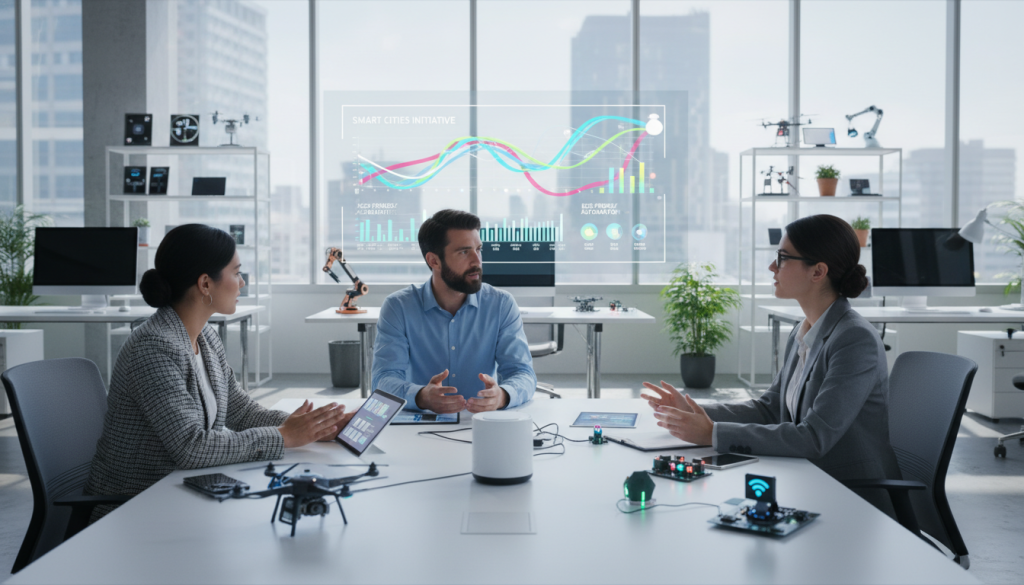
Insights from Industry Leaders
Our experience reveals consistent patterns across successful implementations. Manufacturing companies achieve predictive maintenance capabilities through connected systems.
Healthcare providers implement remote patient monitoring solutions that transform care delivery. These systems enable continuous health tracking through wearable devices.
Logistics organizations optimize inventory management with real-time tracking solutions. Smart agriculture platforms help farmers make data-driven decisions about irrigation and harvesting.
| Industry Sector |
Solution Type |
Key Benefit |
Implementation Example |
| Manufacturing |
Inventory Tracking |
Real-time Visibility |
20-ton steel sheet monitoring |
| Healthcare |
Remote Monitoring |
Proactive Care |
Wearable vital signs tracking |
| Agriculture |
Precision Farming |
Resource Optimization |
Soil condition monitoring |
| Smart Cities |
Traffic Management |
Congestion Reduction |
Adaptive traffic light systems |
| Retail |
Customer Analytics |
Experience Enhancement |
Behavior tracking solutions |
These examples share common success factors. Clear business objectives guide technology selection while experienced engineers ensure robust implementation.
Scalable architectures accommodate growth while maintaining solution quality. This approach delivers lasting value across diverse business environments.
Conclusion
The journey toward digital transformation culminates in strategic partnerships that amplify technological capabilities. Building or augmenting specialized expertise represents a critical step for organizations seeking competitive differentiation through connected systems.
We help businesses navigate the complex landscape of hardware integration, cloud platforms, and data analytics. Our approach combines technical excellence with practical business focus, reducing operational burden while enabling growth.
Partnering with experienced providers offers immediate access to global talent pools and proven methodologies. This collaboration accelerates time to market and delivers measurable returns across financial and operational dimensions.
The rapidly evolving market creates urgency for establishing robust capabilities. Forward-thinking companies that act now will capture emerging opportunities before competitors.
We invite organizations to explore how our comprehensive service offerings can address specific challenges. Together, we can transform raw information into strategic insights that drive sustainable business growth.
FAQ
What are the primary advantages of integrating cloud technology with our Internet of Things initiative?
Cloud integration offers unparalleled scalability for handling data from numerous sensors and devices. It enables real-time analytics, provides robust data storage solutions, and facilitates remote management. This combination reduces infrastructure costs and accelerates time-to-market for your product by leveraging existing, secure cloud platforms.
How do you approach security for connected devices and the entire system?
Our approach to cybersecurity is comprehensive, spanning from the device firmware to the mobile app and cloud communication. We implement encryption protocols, secure boot processes, and regular vulnerability assessments. Adhering to industry standards, we ensure data protection and compliance throughout the product lifecycle to safeguard your business and users.
What is the typical composition of a team for an Internet of Things project?
A successful team combines expertise in hardware engineering, firmware development, software creation, and quality assurance. This includes specialists for embedded systems, backend and mobile app development, UX/UI design, and data analytics. Effective collaboration between these roles is crucial for seamless integration and a high-quality solution.
Should we build an in-house team or partner with an external company for development?
The decision depends on your core business, timeline, and budget. Partnering with an experienced company provides immediate access to a full spectrum of experts, reduces recruitment costs, and speeds up the development process. This model is often more efficient, allowing your internal team to focus on strategic business goals.
What key factors influence the overall costs of an Internet of Things solution?
Several factors impact costs, including the complexity of the hardware and sensors, the sophistication of the firmware and software, cloud service usage, and the scope of integration with existing systems. A clear project definition and a phased development process help manage the budget effectively while ensuring the final product meets quality expectations.
Author
Johan Carlsson - Country Manager
Johan Carlsson is a cloud architecture specialist and frequent speaker focused on scalable workloads, AI/ML, and IoT innovation. At Opsio, he helps organizations harness cutting-edge technology, automation, and purpose-built services to drive efficiency and achieve sustainable growth. Johan is known for enabling enterprises to gain a competitive advantage by transforming complex technical challenges into powerful, future-ready cloud solutions.