Key Takeaways
- DevSecOps embeds security into every phase of the software development lifecycle, replacing the outdated approach of bolting on security after code is written.
- Organizations that adopt DevSecOps reduce vulnerability remediation costs by up to 30x compared to finding issues in production.
- A successful DevSecOps pipeline relies on automated SAST, DAST, SCA, and IaC scanning tools integrated directly into CI/CD workflows.
- Cultural change matters as much as tooling: shared ownership of security across dev, ops, and security teams is the foundation of DevSecOps.
- This guide covers the full DevSecOps framework, from definition and benefits through tool selection, common challenges, and a step-by-step implementation roadmap.
In today's threat landscape, security cannot be a final checkpoint before deployment. Cyber attacks grow more frequent and more sophisticated every quarter, while development teams ship code faster than ever through CI/CD pipelines. DevSecOps closes that gap by making security a continuous, automated, and shared responsibility from the first line of code to production monitoring.
For many organizations, adopting DevSecOps means rethinking how development, operations, and security teams collaborate. This guide explains what DevSecOps is, why it is essential in 2026, and how to implement it step by step.

What Is DevSecOps? Definition and Core Principles
DevSecOps stands for Development, Security, and Operations. It extends the DevOps philosophy by treating security as a first-class concern woven into every stage of the software development lifecycle (SDLC) rather than a gate at the end. The DevSecOps meaning is straightforward: every person who touches the code shares responsibility for its security.
The "Shift Left" Principle
The core idea behind DevSecOps is shifting security left, which means moving security checks earlier in the development process. When developers receive security feedback while they are still writing code, they fix vulnerabilities in minutes instead of weeks. Industry data shows that addressing a vulnerability during the coding phase costs roughly 30 times less than patching the same issue in production.
Key Pillars of a DevSecOps Framework
- Automation: Security testing is automated and embedded directly into CI/CD pipelines so it never blocks releases unnecessarily.
- Collaboration: Development, security, and operations teams plan, build, and review together from sprint zero.
- Continuous Security: Scanning, monitoring, and compliance checks run at every stage, not just before deployment.
- Shared Responsibility: Security is everyone's job. Developers write secure code, ops hardens infrastructure, and security engineers set policy and review findings.
DevSecOps vs DevOps: What Is the Difference?
DevOps breaks down silos between development and operations to ship software faster. DevSecOps extends that same philosophy to security. The table below highlights where they diverge.
| Aspect | Traditional DevOps | DevSecOps |
|---|
| Security Integration | Security applied at the end of the pipeline | Security embedded at every stage of the SDLC |
| Responsibility | Security owned by a dedicated team | Security is a shared responsibility across all teams |
| Testing Approach | Manual security testing performed late | Automated SAST, DAST, and SCA in CI/CD |
| Speed vs Security | Tends to prioritize speed | Treats speed and security as equal priorities |
| Culture | Collaboration between dev and ops | Collaboration between dev, ops, and security |

Why Is DevSecOps Important in 2026?
Three converging trends make DevSecOps essential for any organization building software today.
Rising Threat Volume and Sophistication
Cyber attacks are growing in both frequency and complexity. Supply-chain attacks, zero-day exploits, and AI-assisted phishing campaigns target vulnerabilities that traditional end-of-pipeline security reviews miss. DevSecOps catches these issues earlier, before they reach production.
Faster Development Cycles Demand Faster Security
Agile methodologies and CI/CD pipelines have compressed release cycles from months to hours. Manual security reviews at the end of a sprint become bottlenecks. Automated DevSecOps tools run in parallel with builds, keeping pace with modern delivery speeds.
Regulatory Compliance as Code
Regulations like GDPR, SOC 2, HIPAA, and PCI DSS require organizations to demonstrate continuous security controls. DevSecOps automates compliance checks and generates audit-ready evidence as a byproduct of normal development work, turning compliance from a quarterly scramble into a continuous process.
Benefits of Adopting a DevSecOps Approach
Organizations that implement DevSecOps gain advantages that extend well beyond improved security posture.
- Earlier Vulnerability Detection: Issues found during coding are cheaper and faster to fix than production hotfixes.
- Faster Time to Market: Security no longer creates release bottlenecks when it runs automatically inside the pipeline.
- Lower Remediation Costs: Fixing defects in development costs a fraction of post-deployment patching.
- Continuous Compliance: Automated policy checks satisfy regulatory requirements without manual audits.
- Stronger Cross-Team Collaboration: Shared security goals break down silos between development, operations, and security.
- Reduced Alert Fatigue: Prioritized, contextual findings replace noisy security scans.
- Continuous Improvement: Feedback loops from monitoring feed back into development, raising the security bar over time.

How the DevSecOps Pipeline Works
A DevSecOps pipeline integrates security checks at every phase of the SDLC. Below is a breakdown of what happens at each stage.
Plan
- Threat modeling to identify attack surfaces before writing code
- Security requirements defined alongside functional requirements
- Risk assessment and compliance planning
Code
- Secure coding standards and peer code reviews
- Static Application Security Testing (SAST) scans source code for vulnerabilities
- Software Composition Analysis (SCA) checks open-source dependencies for known CVEs
Build
- Container image scanning for misconfigurations and vulnerable base images
- Infrastructure as Code (IaC) security validation with tools like Checkov or tfsec
- Dependency verification and artifact signing
Test
- Dynamic Application Security Testing (DAST) probes running applications for runtime vulnerabilities
- Interactive Application Security Testing (IAST) combines SAST and DAST approaches
- Penetration testing on staging environments
Deploy
- Secure configuration validation against hardening benchmarks (CIS, NIST)
- Secret management through vaults (HashiCorp Vault, AWS Secrets Manager)
- Automated rollback on security policy violations
Operate and Monitor
- Runtime Application Self-Protection (RASP) for live threat blocking
- Continuous vulnerability scanning in production
- Incident response automation and security event correlation
Essential DevSecOps Tools and Platforms
Choosing the right DevSecOps tools depends on your technology stack, but several categories are non-negotiable for a mature pipeline.
Static Analysis (SAST)
SAST tools like SonarQube, Checkmarx, and Semgrep analyze source code without executing it. They catch injection flaws, hardcoded secrets, and insecure patterns during the coding phase.
Dynamic Analysis (DAST)
DAST tools such as OWASP ZAP, Burp Suite, and Invicti test running applications by simulating real attacks. They identify vulnerabilities like cross-site scripting (XSS), SQL injection, and authentication flaws that only appear at runtime.
Software Composition Analysis (SCA)
SCA tools including Snyk, Mend (formerly WhiteSource), and Dependabot monitor open-source dependencies for known vulnerabilities and license compliance risks.
Infrastructure as Code Security
Tools like Checkov, tfsec, and Bridgecrew scan Terraform, CloudFormation, and Kubernetes manifests for security misconfigurations before provisioning infrastructure.
Container and Kubernetes Security
Trivy, Aqua Security, and Prisma Cloud scan container images and enforce runtime policies in Kubernetes environments.
Secret Management
HashiCorp Vault, AWS Secrets Manager, and Azure Key Vault centralize credential storage and eliminate hardcoded secrets from codebases.

Common DevSecOps Challenges and How to Overcome Them
Implementing DevSecOps is rarely a smooth process. Here are the most common obstacles and practical solutions.
Cultural Resistance
Developers may view security checks as friction. Solution: Start with developer-friendly tools that provide fix suggestions alongside findings. Run security champions programs where volunteers from each team become security advocates.
Tool Integration Complexity
Stitching together SAST, DAST, SCA, and IaC scanners into a single pipeline can be complicated. Solution: Use a DevSecOps platform like GitLab Ultimate or GitHub Advanced Security that consolidates multiple scanning types. Alternatively, adopt an orchestration layer such as DefectDojo to unify findings.
Alert Fatigue
Too many low-severity findings drown out critical vulnerabilities. Solution: Tune scanners to focus on high and critical severity issues first. Use risk-based prioritization that considers exploitability, reachability, and business impact.
Skill Gaps
Not every developer has a security background. Solution: Invest in security training and certifications. DevSecOps certifications from organizations like Practical DevSecOps and SANS help upskill teams.
Balancing Speed and Thoroughness
Exhaustive scans can slow pipelines. Solution: Run fast incremental SAST scans on every commit and reserve full deep scans for nightly builds or pull request merges.

DevSecOps Best Practices for 2026
Follow these proven practices to build a mature DevSecOps program.
- Automate Everything Repeatable: Manual security checks do not scale. Automate SAST, DAST, SCA, IaC scanning, and compliance checks inside your CI/CD pipeline.
- Treat Security Policies as Code: Define security policies in version-controlled files (Open Policy Agent, Sentinel) so they are reviewable, testable, and auditable.
- Implement Security Gates, Not Walls: Set automated pass/fail criteria at each pipeline stage. Block deployments that introduce critical vulnerabilities while allowing lower-severity issues to proceed with tracking.
- Run a Security Champions Program: Designate one developer per team as a security champion who receives advanced training and acts as the first point of contact for security questions.
- Measure and Report: Track mean time to remediation (MTTR), vulnerability escape rate, and security debt. Share dashboards with leadership to maintain organizational support.
- Adopt a Zero Trust Approach: Apply least-privilege access to CI/CD systems, artifact repositories, and deployment targets. Verify every identity and every action.
- Continuously Improve Through Feedback: Run post-incident reviews and feed lessons learned back into threat models, scanner rules, and training programs.
Step-by-Step DevSecOps Implementation Roadmap
Use this phased approach to introduce DevSecOps into your organization without disrupting delivery velocity.
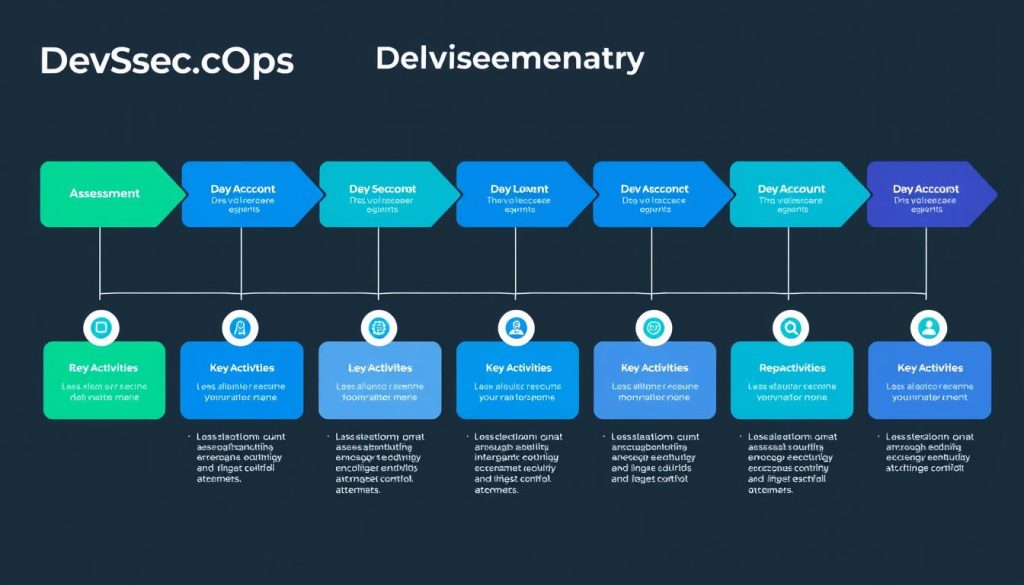
Phase 1: Assess and Plan (Weeks 1-2)
- Audit your current CI/CD pipeline for security gaps
- Identify critical applications and high-risk code repositories
- Define security requirements and compliance obligations
- Select initial DevSecOps tools based on your technology stack
Phase 2: Integrate Core Scanning (Weeks 3-6)
- Add SAST scanning to your CI pipeline for every commit
- Implement SCA to monitor open-source dependency vulnerabilities
- Configure secret scanning to prevent credential leaks
- Set baseline severity thresholds (block critical, warn on high)
Phase 3: Expand Coverage (Weeks 7-12)
- Add DAST scanning against staging environments
- Implement IaC scanning for Terraform, CloudFormation, or Kubernetes manifests
- Deploy container image scanning in your build pipeline
- Launch a security champions program across development teams
Phase 4: Mature and Optimize (Ongoing)
- Tune scanner rules to reduce false positives
- Implement risk-based prioritization using exploitability data
- Add runtime protection (RASP) in production
- Build security dashboards tracking MTTR, vulnerability trends, and security debt
- Conduct regular threat modeling sessions for new features

Frequently Asked Questions
What does DevSecOps stand for?
DevSecOps stands for Development, Security, and Operations. It is an approach that integrates security practices into every phase of the DevOps software development lifecycle, making security a shared responsibility rather than a final-stage gate.
How is DevSecOps different from DevOps?
DevOps focuses on collaboration between development and operations teams to deliver software faster. DevSecOps adds security as a third pillar, embedding automated security testing and compliance checks throughout the CI/CD pipeline instead of treating security as a separate phase.
What are the most important DevSecOps tools?
The essential DevSecOps tool categories are SAST (static code analysis), DAST (dynamic runtime testing), SCA (open-source dependency scanning), IaC security scanners, container security tools, and secret management vaults. Popular choices include SonarQube, OWASP ZAP, Snyk, Checkov, Trivy, and HashiCorp Vault.
How long does it take to implement DevSecOps?
Most organizations can integrate core DevSecOps scanning into their CI/CD pipeline within 4 to 6 weeks. Reaching full maturity with runtime protection, risk-based prioritization, and security champion programs typically takes 3 to 6 months of iterative improvement.
What is a DevSecOps pipeline?
A DevSecOps pipeline is a CI/CD workflow with automated security checks embedded at every stage: code scanning during development, dependency analysis during build, dynamic testing in staging, configuration validation before deployment, and continuous monitoring in production.