Boost Performance with ITSM Cloud SLA Monitoring Best Practices
March 6, 2026|2:57 PM
Unlock Your Digital Potential
Whether it’s IT operations, cloud migration, or AI-driven innovation – let’s explore how we can support your success.
Home /
Work /
Blogs /
Boost Performance with ITSM Cloud SLA Monitoring Best Practices
Understanding ITSM Cloud SLA Monitoring: An Essential Guide
In today’s fast-paced digital landscape, IT service reliability is paramount. Businesses increasingly rely on cloud services to deliver critical applications and infrastructure, making effective management crucial. This comprehensive guide will delve into itsm Cloud sla monitoring, an indispensable practice for ensuring optimal performance and service delivery.
itsm Cloud sla monitoring involves tracking, analyzing, and reporting on the performance of cloud services against predefined service level agreements. It’s a critical component of a robust IT service management (ITSM) framework, ensuring that cloud providers meet their commitments and user expectations are consistently satisfied. Understanding this process is vital for any organization leveraging cloud technology.
What is ITSM Cloud SLA Monitoring?
ITSM Cloud SLA monitoring is the systematic process of overseeing and evaluating the performance of cloud-based services against established Service Level Agreements (SLAs). These agreements define the minimum level of service a provider is committed to delivering, covering aspects like uptime, response times, and security. Effective monitoring ensures these contractual obligations are met.
This proactive approach helps organizations verify that their cloud infrastructure and applications are performing as expected. It integrates traditional ITSM principles with the dynamic nature of cloud environments, providing visibility into critical service metrics. Ultimately, itsm Cloud sla monitoring helps maintain business continuity and user satisfaction by identifying and addressing service deviations promptly.
Why is itsm Cloud sla monitoring Critical?
The shift to cloud computing introduces new complexities and dependencies. Organizations delegate significant control over their IT infrastructure to third-party providers, making rigorous oversight essential. Without proper itsm Cloud sla monitoring, businesses operate with reduced visibility, increasing their exposure to service disruptions and compliance risks.
Effective monitoring empowers organizations to hold cloud providers accountable for their contractual obligations. It enables proactive identification of performance degradation, allowing for swift intervention before issues impact end-users or business operations. This continuous vigilance safeguards service quality, optimizes resource utilization, and protects the financial investment in cloud solutions.
Core Concepts of ITSM SLA Monitoring
To fully grasp the intricacies of itsm Cloud sla monitoring, it’s important to understand the fundamental concepts that underpin it. This includes recognizing the unique characteristics of cloud SLAs and the key elements that constitute a comprehensive monitoring strategy within an ITSM framework.
Understanding SLAs in a Cloud Context
Service Level Agreements (SLAs) are formal contracts between a service provider and a customer, outlining the expected level of service. In a cloud context, these agreements are often more complex, encompassing shared responsibility models and dynamic infrastructure. A cloud SLA for IT operations typically details metrics for availability, performance, security, and support.
Unlike on-premise setups, cloud SLAs involve services delivered over the internet, introducing variables like network latency and multi-tenancy. Organizations must carefully review and negotiate these terms, ensuring they align with business needs and compliance requirements. Monitoring these cloud-specific parameters is essential for successful IT service management SLA.
Key Components of ITSM SLA Monitoring
Effective ITSM SLA monitoring relies on several interconnected components working in harmony. These elements provide a holistic view of service performance and facilitate informed decision-making. Each component plays a crucial role in maintaining service quality and accountability.
Key components typically include:
Metric Definition: Clearly defined metrics and Key Performance Indicators (KPIs) such as uptime, response time, error rates, and throughput.
Data Collection: Automated systems to gather performance data from various cloud services and infrastructure components.
Baseline Establishment: Setting performance baselines to identify normal operating conditions and detect deviations.
Thresholds and Alerts: Defining acceptable performance thresholds and configuring alerts for when these thresholds are breached.
Reporting and Analytics: Generating regular reports on SLA adherence, identifying trends, and providing insights for continuous improvement.
Process Integration: Seamlessly integrating monitoring data with the broader ITSM framework, including incident, problem, and change management.
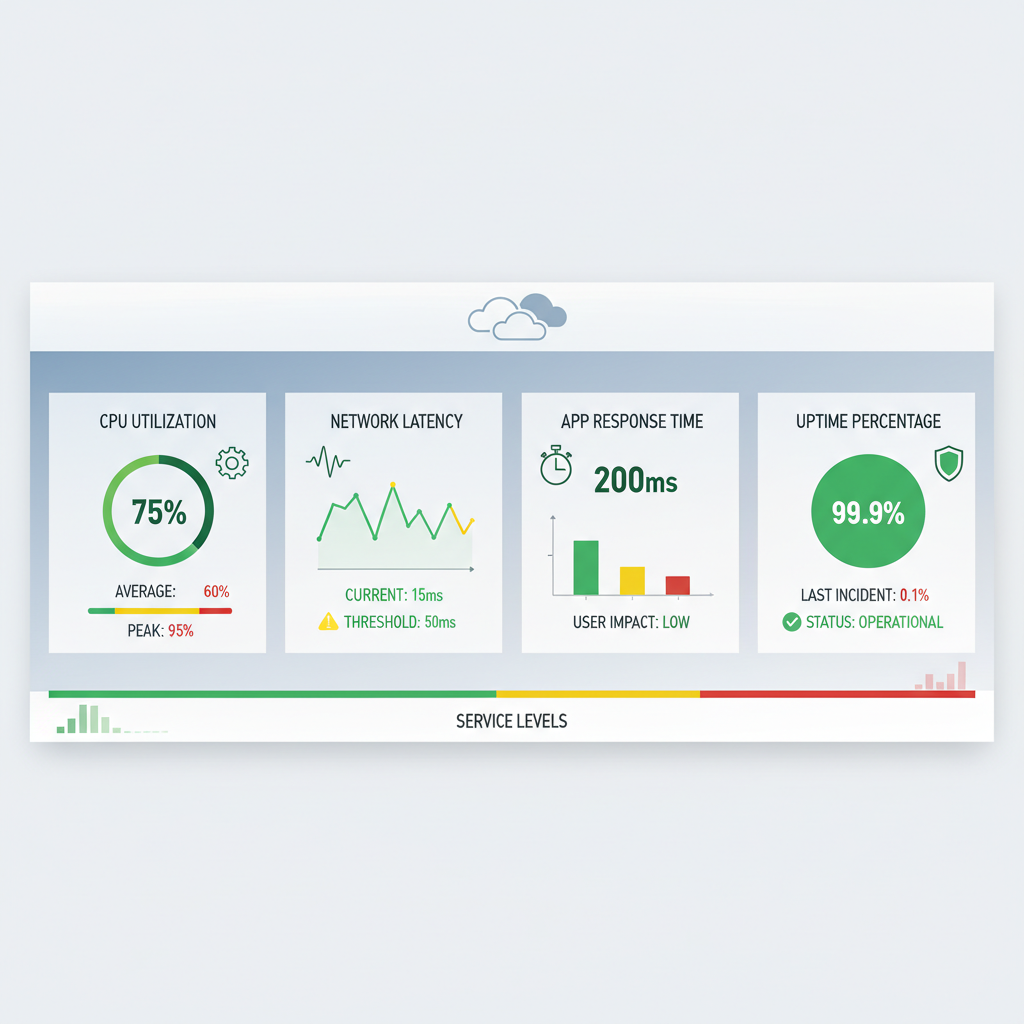
A dashboard showing various cloud service performance metrics like CPU utilization, network latency, application response time, and uptime percentage, with green, yellow, and red indicators for different service levels.
Challenges and Best Practices for itsm Cloud sla monitoring
While the benefits of itsm Cloud sla monitoring are clear, implementing and maintaining an effective system comes with its own set of challenges. Addressing these hurdles requires strategic planning and adherence to best practices. This section will explore common obstacles and offer actionable advice for overcoming them.
Common Challenges in Cloud SLA Monitoring
The dynamic and distributed nature of cloud environments presents unique challenges for itsm Cloud sla monitoring. Unlike traditional on-premise systems, cloud services can scale rapidly, be deployed across multiple regions, and involve complex dependencies. These factors make comprehensive monitoring a sophisticated endeavor.
Some common challenges include:
Data Silos: Performance data scattered across various cloud providers, services, and monitoring tools, making a unified view difficult.
Dynamic Environments: The ephemeral nature of cloud resources (e.g., auto-scaling instances) complicates consistent data collection and baseline establishment.
Lack of Visibility: Limited insights into the underlying infrastructure managed by cloud providers, especially in PaaS or SaaS models.
Complex SLAs: Negotiating and interpreting intricate cloud SLAs that may differ significantly between providers and service tiers.
Alert Fatigue: Overwhelming numbers of alerts due to poorly defined thresholds or insufficient correlation, leading to missed critical issues.
Integration Issues: Difficulty integrating cloud monitoring tools with existing IT service management SLA platforms.
Best Practices for Effective ITSM Cloud SLA Monitoring
Overcoming these challenges requires a strategic approach grounded in best practices. Implementing these guidelines will significantly enhance the effectiveness of your itsm Cloud sla monitoring efforts, leading to improved service quality and operational efficiency. Organizations seeking the best itsm Cloud sla monitoring solutions will find these tips invaluable.
#### Defining Clear Metrics and KPIs
The foundation of effective monitoring is having precise and relevant metrics. You must define what truly matters for your business operations and align these with your cloud service objectives. This clarity ensures that your monitoring efforts are focused and meaningful.
Align with Business Objectives: Ensure your chosen metrics directly support critical business processes and end-user experience.
Specificity: Define metrics like “application response time” with specific thresholds, e.g., “95% of transactions under 2 seconds.”
Quantitative and Measurable: All metrics must be quantifiable and readily measurable from your cloud environment.
Include Operational Metrics: Beyond availability, monitor performance indicators like CPU utilization, memory usage, network latency, and database query times.
Regular Review: Periodically review and update metrics and KPIs to reflect changes in business needs or cloud service offerings.
#### Implementing Robust Monitoring Tools
Choosing and configuring the right monitoring tools is crucial for capturing accurate and timely performance data. These tools should offer deep visibility into your cloud environment and integrate seamlessly with your existing ITSM framework. The capabilities of your monitoring tools directly impact the quality of your itsm Cloud sla monitoring.
Cloud-Native Integration: Select tools that natively integrate with your specific cloud provider (e.g., AWS CloudWatch, Azure Monitor, Google Cloud Monitoring).
End-to-End Visibility: Choose solutions that can monitor not just infrastructure, but also applications, databases, and user experience.
Scalability: Ensure your monitoring solution can scale alongside your cloud infrastructure as your needs evolve.
Customizable Dashboards: Look for tools that offer customizable dashboards to provide a consolidated, real-time view of all relevant metrics.
#### Automating Alerting and Reporting
Manual monitoring and reporting are unsustainable in dynamic cloud environments. Automation is key to ensuring timely detection of issues and efficient communication of performance data. This is a crucial element for optimizing your service desk SLA monitoring.
Smart Alerting: Implement intelligent alerting systems with tiered notifications based on the severity and impact of an incident.
Threshold-Based Alerts: Configure alerts to trigger when performance metrics exceed predefined thresholds.
Integration with ITSM: Integrate monitoring alerts directly with your ITSM platform to automatically create incidents, reducing manual effort.
Automated Reports: Schedule automated reports on SLA adherence, performance trends, and incident resolution times for stakeholders.
#### Regularly Reviewing and Adapting SLAs
SLAs are not static documents; they need to evolve with your business and the services you consume. Regular review and adaptation are critical to maintaining their relevance and effectiveness within your SLA in ITSM framework. This is a key itsm Cloud sla monitoring tip for long-term success.
Scheduled Reviews: Conduct periodic reviews of your cloud SLAs, ideally annually or whenever there are significant changes to services or business requirements.
Performance Data Driven: Use historical performance data from your monitoring system to inform SLA revisions, identifying areas where terms may need adjustment.
Negotiate with Providers: Be prepared to renegotiate SLA terms with your cloud providers based on performance trends and evolving business needs.
Internal Alignment: Ensure internal stakeholders (business units, IT operations, legal) are aligned with any proposed SLA changes.
ENSURE UNINTERRUPTED SERVICE
Ensure uninterrupted service delivery and proactively prevent costly SLA breaches. Leverage our automated, real
✓ Free consultation ✓ No commitment required ✓ Trusted by experts
Tools and Technologies for itsm Cloud sla monitoring
Selecting the appropriate tools and technologies is fundamental to establishing effective itsm Cloud sla monitoring. The right solutions can provide comprehensive visibility, automate critical tasks, and integrate seamlessly with your existing IT service management infrastructure. Understanding their capabilities is key to successful ITSM cloud performance.
Essential Features of Cloud SLA Monitoring Tools
Modern cloud SLA monitoring tools offer a wide array of features designed to address the complexities of cloud environments. When evaluating solutions, consider capabilities that enhance visibility, automation, and reporting for your specific needs. The best itsm Cloud sla monitoring tools combine robust data collection with actionable insights.
Look for tools that provide:
Multi-Cloud/Hybrid Cloud Support: Ability to monitor services across different cloud providers and on-premise environments for a unified view.
Real-time Data Collection: Continuous capture of performance metrics, logs, and events from various cloud resources.
AI/ML-Powered Analytics: Advanced analytics to detect anomalies, predict potential issues, and reduce alert noise.
Customizable Dashboards and Reporting: Flexible visualization options to create tailored views for different stakeholders and generate compliance reports.
Integration Capabilities: Seamless integration with ITSM platforms, incident management tools, and other operational systems.
Synthetics and Real User Monitoring (RUM): Tools that simulate user interactions or monitor actual user experiences to gauge service quality from an end-user perspective.
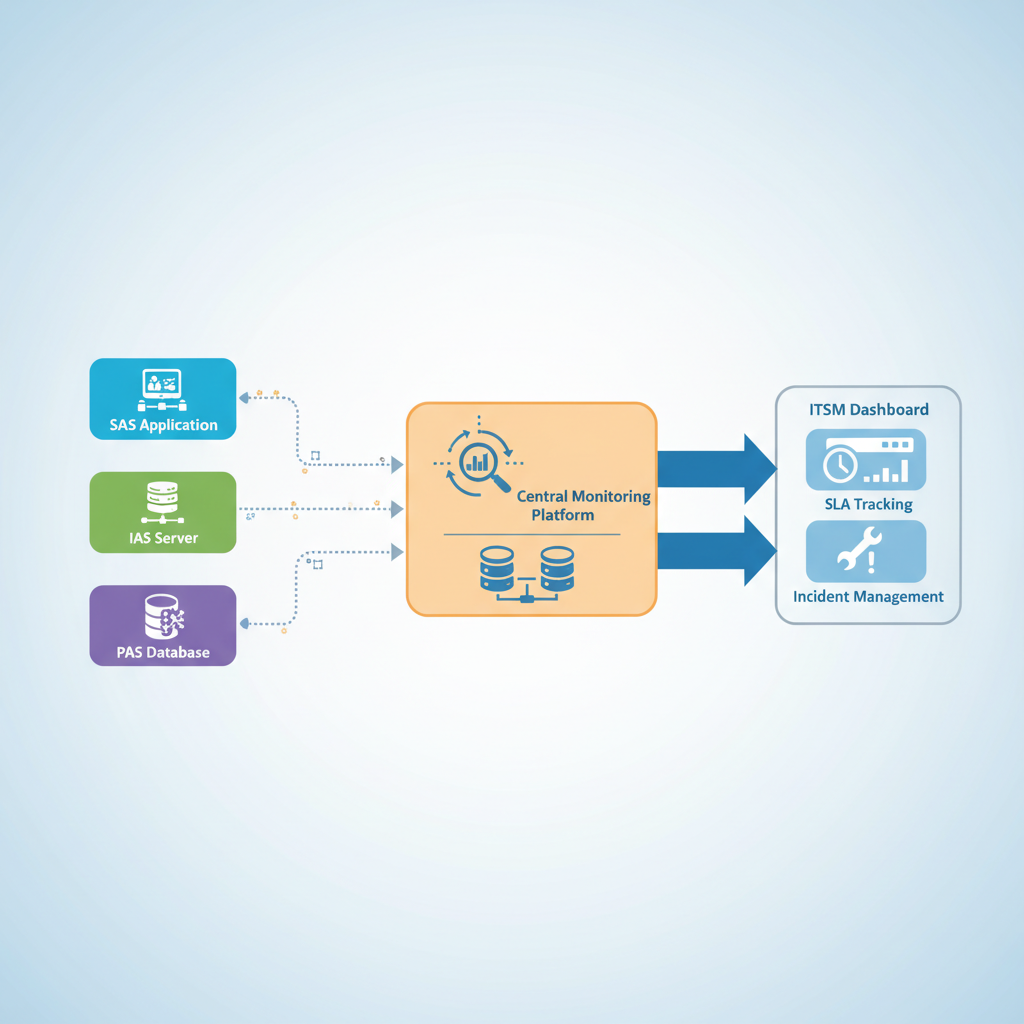
A diagram illustrating the flow of data from various cloud services (e.g., SaaS application, IaaS server, PaaS database) through a central monitoring platform, which then feeds into an ITSM dashboard for SLA tracking and incident management.
Integrating with Your ITSM Framework
The true power of itsm Cloud sla monitoring is realized when it’s tightly integrated with your broader ITSM framework. This ensures that monitoring insights translate directly into actionable processes for incident, problem, and change management. A well-integrated system streamlines operations and improves overall service delivery.
Integration typically involves:
Automated Incident Creation: Monitoring tools automatically generate incidents in your ITSM platform when SLA thresholds are breached.
Enriched Incident Data: Incidents are populated with relevant context, such as affected services, metrics, and historical data, aiding faster diagnosis.
Problem Management Linkage: Persistent or recurring SLA breaches can automatically trigger problem management processes for root cause analysis.
Change Management Impact Analysis: Performance data can inform change management, helping to assess the impact of proposed changes on SLA adherence.
Configuration Management Database (CMDB) Updates: Monitoring tools can feed configuration item data into your CMDB, ensuring accurate mapping of services to infrastructure.
Implementing itsm Cloud SLA Monitoring: A Step-by-Step Approach
Implementing an effective itsm Cloud sla monitoring system requires a structured and methodical approach. By following these steps, organizations can establish robust monitoring capabilities that ensure cloud service reliability and align with business objectives. This step-by-step guide offers practical itsm Cloud sla monitoring examples for implementation.
1. Define Your Service Level Objectives (SLOs)
Begin by clearly outlining what “good service” means for your cloud-based applications and infrastructure. These SLOs are the measurable targets that underpin your formal SLAs and should reflect business criticalities.
Identify Critical Services: Pinpoint which cloud services are essential for core business operations and end-user satisfaction.
Quantify Expectations: For each critical service, define specific, measurable, achievable, relevant, and time-bound (SMART) objectives. For example, “99.9% API uptime” or “average user login time under 3 seconds.”
Stakeholder Collaboration: Engage business owners, IT operations, and end-users to ensure SLOs accurately reflect their needs and expectations.
Establish Baselines: Gather initial performance data to understand current service levels, which will help set realistic and achievable SLOs.
2. Select the Right Monitoring Tools
Choosing the appropriate monitoring solution is a pivotal decision that will impact the effectiveness and efficiency of your itsm Cloud sla monitoring efforts. Consider your existing infrastructure, cloud providers, and specific monitoring requirements.
Assess Cloud Provider Offerings: Utilize native monitoring tools provided by your cloud vendor (e.g., AWS CloudWatch, Azure Monitor) as a baseline.
Evaluate Third-Party Solutions: Explore specialized tools that offer multi-cloud visibility, advanced analytics, and deeper application-level insights.
Integration Capabilities: Prioritize tools that seamlessly integrate with your existing ITSM platform and other operational systems.
Cost and Scalability: Consider the pricing model, scalability, and ease of deployment to ensure the solution aligns with your budget and growth projections.
3. Configure Monitoring and Alerting
Once tools are selected, the next crucial step is to configure them to collect relevant data and generate meaningful alerts. This ensures that performance deviations are detected and escalated promptly.
Instrument Your Cloud Resources: Deploy agents, configure APIs, or set up log forwarding to collect metrics, logs, and traces from all relevant cloud components.
Set Up Thresholds: Define appropriate thresholds for each SLO. For instance, an alert might trigger if API uptime drops below 99.8% or if response time exceeds 2 seconds for a sustained period.
Configure Alerting Rules: Establish rules for notifications, specifying who receives alerts, through what channels (email, SMS, ITSM tickets), and under what conditions.
Prioritize Alerts: Implement a severity matrix to categorize alerts based on their potential impact on services and business operations, preventing alert fatigue.
4. Establish Reporting and Review Processes
Regular reporting and reviews are essential for assessing SLA adherence, identifying trends, and driving continuous improvement. This ensures accountability and provides insights for strategic decision-making.
Automate Report Generation: Configure your monitoring tools to automatically generate periodic reports on SLA performance, incident trends, and resource utilization.
Create Customizable Dashboards: Develop dashboards tailored to different audiences (e.g., executive summaries, operational details for IT teams).
Schedule Regular Reviews: Conduct weekly or monthly meetings with relevant stakeholders to review SLA performance, discuss major incidents, and address underlying issues.
Document Findings and Actions: Maintain clear records of review outcomes, agreed-upon actions, and assigned responsibilities for follow-up.
5. Continuously Optimize
ITSM Cloud SLA monitoring is not a one-time setup; it’s an ongoing process of refinement and improvement. The cloud environment is dynamic, and your monitoring strategy must evolve with it.
Feedback Loop: Implement a feedback mechanism from incident and problem management to refine SLOs, thresholds, and alerting rules.
Performance Baselines: Continuously update performance baselines to reflect changes in workload, application versions, or cloud configurations.
Stay Updated: Keep abreast of new features and capabilities offered by your cloud providers and monitoring tool vendors.
Conduct Post-Incident Reviews: Use post-incident analysis to identify gaps in monitoring coverage or alerting effectiveness and implement corrective actions.
Benefits of Effective itsm Cloud sla monitoring
Implementing a robust itsm Cloud sla monitoring system yields numerous benefits that extend beyond simply meeting contractual obligations. These advantages contribute significantly to operational efficiency, financial stability, and overall business success in a cloud-centric world.
Firstly, enhanced accountability is a primary benefit. Organizations gain the necessary data to verify that cloud providers deliver on their promises, fostering trust and ensuring service quality. This transparency empowers businesses to effectively manage provider relationships and negotiate terms based on actual performance.
Secondly, proactive issue resolution becomes standard practice. By continuously monitoring key metrics, teams can detect performance deviations and potential outages before they impact end-users. This enables swifter responses, minimizing downtime and reducing the financial and reputational damage of service disruptions.
Furthermore, effective monitoring provides invaluable insights for resource optimization. By understanding how cloud resources are consumed in relation to service levels, organizations can make informed decisions about scaling, cost management, and capacity planning. This leads to more efficient use of cloud spend and improved ITSM cloud performance.
Finally, compliance and governance are significantly strengthened. Businesses can demonstrate adherence to regulatory requirements and internal policies by maintaining comprehensive records of service performance. This robust audit trail is essential for meeting compliance standards and mitigating risks associated with data sovereignty and security in the cloud.
Frequently Asked Questions (FAQ)
This section addresses common questions regarding itsm Cloud sla monitoring, providing clear and concise answers to help clarify key concepts and practices.
What exactly is itsm Cloud sla monitoring?
ITSM Cloud SLA monitoring is the practice of continuously observing and analyzing the performance of cloud services against predefined Service Level Agreements (SLAs). It involves collecting data on metrics like uptime, response times, and error rates to ensure that cloud providers meet their contractual obligations and that business-critical services remain operational. This process is a core element of effective IT service management.
Why is itsm Cloud sla monitoring important for cloud services?
itsm Cloud sla monitoring is crucial for cloud services because it provides visibility and accountability in environments where infrastructure is often managed by third parties. It helps businesses ensure they receive the service levels they pay for, proactively identify and resolve performance issues, minimize downtime, and manage the financial implications of service disruptions. It ultimately safeguards business continuity and user experience.
What are typical metrics monitored in cloud SLAs?
Typical metrics monitored in cloud SLAs often include availability (e.g., 99.9% uptime), performance (e.g., average response time under 200ms, transaction success rates), error rates, and resource utilization (e.g., CPU, memory, network I/O). Additionally, metrics related to data backup and recovery times (RTO/RPO), security incident response, and customer support response times are also common.
How does itsm Cloud sla monitoring differ from traditional SLA monitoring?
itsm Cloud sla monitoring differs from traditional SLA monitoring primarily due to the dynamic, distributed, and often opaque nature of cloud environments. Traditional monitoring focuses on on-premise infrastructure where organizations have full control. Cloud monitoring must account for shared responsibility models, multi-tenancy, rapid scalability, and the need to integrate with diverse cloud provider APIs, introducing complexities not present in traditional setups.
What role does automation play in itsm Cloud sla monitoring?
Automation plays a critical role in itsm Cloud sla monitoring by enabling real-time data collection, automated alert generation, and streamlined reporting. It minimizes manual effort, reduces the risk of human error, and ensures that performance deviations are detected and escalated immediately. Automation also facilitates the creation of incidents in ITSM tools, speeding up resolution processes and enhancing overall operational efficiency.
ENSURE UNINTERRUPTED SERVICE
Ensure uninterrupted service delivery and proactively prevent costly SLA breaches. Leverage our automated, real
✓ Free consultation ✓ No commitment required ✓ Trusted by experts
Conclusion
itsm Cloud sla monitoring is an indispensable practice for any organization leveraging cloud services. It forms the bedrock of reliable IT service delivery, ensuring that cloud environments meet the stringent demands of modern business operations. By adopting a strategic approach, employing best practices, and utilizing robust tools, businesses can proactively manage service quality and uphold their commitments to end-users.
Investing in comprehensive itsm Cloud sla monitoring not only provides crucial oversight but also fosters accountability, optimizes resource utilization, and strengthens compliance. Embrace these principles to navigate the complexities of the cloud with confidence and secure the operational excellence your business demands.
Jacob Stålbro is a seasoned digitalization and transformation leader with over 20 years of experience, specializing in AI-driven innovation. As Head of Innovation and Co-Founder at Opsio, he drives the development of advanced AI, ML, and IoT solutions. Jacob is a sought-after speaker and webinar host known for translating emerging technologies into real business value and future-ready strategies.