Whether it’s IT operations, cloud migration, or AI-driven innovation – let’s explore how we can support your success.
Home /
Work /
Blogs /
Effective Cloud SLA Monitoring: Ensure Uptime & Performance
Unlocking Reliability: Your Cloud SLA Monitoring Guide
In today’s fast-paced digital landscape, businesses increasingly rely on cloud services for critical operations. Ensuring these services consistently meet agreed-upon performance standards is paramount for business continuity and customer satisfaction. This comprehensive cloud SLA monitoring guide will explore the essential aspects of overseeing your cloud service performance effectively. We will delve into strategies for optimizing cloud performance management and ensuring robust service uptime tracking.
Effective cloud SLA monitoring provides the necessary insights to verify that your cloud providers deliver on their promises. It involves continuous observation and analysis of various metrics defined within a Service Level Agreement (SLA). This proactive approach helps organizations maintain operational integrity and avoid potential disruptions. Understanding and implementing a strong monitoring framework is crucial for any cloud-centric enterprise.
What is cloud SLA monitoring?
Cloud SLA monitoring is the systematic process of observing, measuring, and analyzing the performance and availability of cloud services against predefined Service Level Agreements. It involves utilizing specialized tools and methodologies to track key performance indicators (KPIs) and verify that cloud providers meet their contractual obligations. This proactive approach ensures operational transparency and accountability.
This process extends beyond simple uptime checks, encompassing a wide array of performance metrics. It provides a detailed view of cloud service health, allowing organizations to detect and address potential issues before they impact end-users. Robust monitoring is fundamental to maintaining a high quality of service from external cloud providers.
Why is cloud SLA monitoring crucial?
Cloud SLA monitoring is crucial because it directly impacts business continuity, user experience, and financial efficiency. Without it, organizations operate blindly, unaware if their cloud infrastructure is performing optimally or experiencing hidden issues. This lack of visibility can lead to costly downtime and lost revenue.
Furthermore, proper monitoring helps enforce SLA compliance, ensuring that providers meet the performance guarantees outlined in their contracts. It provides objective data for discussions with vendors regarding service credits or necessary improvements. Ultimately, it safeguards an organization’s investment in cloud services and maintains trust with its customers.
Key Components of Cloud SLA Monitoring
Effective cloud SLA monitoring relies on understanding and defining several foundational components. These elements form the backbone of any robust monitoring strategy, ensuring that all critical aspects of cloud service delivery are accurately tracked. Without these clearly defined parameters, evaluating provider performance becomes subjective and ineffective.
Organizations must collaborate closely with their cloud providers to establish realistic and measurable terms within their agreements. This collaborative approach fosters transparency and sets clear expectations for both parties. A well-structured SLA with defined monitoring components is a powerful tool for governance.
Defining Service Level Agreements (SLA)
A Service Level Agreement (SLA) is a contract between a service provider and a customer, outlining the level of service expected. It clearly defines specific metrics, responsibilities, and remedies or penalties for non-compliance. These agreements are the bedrock for any cloud sla monitoring effort.
SLAs for cloud services typically cover various performance aspects, including availability, response times, and support. Both parties must thoroughly understand and agree upon these terms before service commencement. Robust service level agreement tracking begins with a clear and comprehensive SLA.
Understanding Key Performance Indicators (KPIs)
Key Performance Indicators (KPIs) are measurable values that demonstrate how effectively a company is achieving key business objectives. In cloud SLA monitoring, KPIs are specific metrics used to assess the performance of cloud services against the agreed-upon SLAs. Selecting the right KPIs is vital for effective service uptime tracking and overall cloud performance management.
Different types of cloud services necessitate different KPIs for accurate monitoring. Organizations must identify the most relevant metrics that reflect their unique operational needs and user expectations. This targeted approach ensures that monitoring efforts yield actionable insights.
#### Availability and Uptime
Availability and uptime are perhaps the most fundamental KPIs in any cloud SLA. They measure the percentage of time a service is operational and accessible to users. High availability is critical for business continuity and uninterrupted service delivery.
Typically expressed as “nines” (e.g., 99.9%, 99.999%), these metrics define acceptable levels of downtime. Ensure your SLA explicitly defines how uptime is calculated and what constitutes an outage. Clear definitions prevent disputes and ensure consistent service level agreement tracking.
#### Performance and Latency
Performance KPIs evaluate the speed and responsiveness of cloud services. These often include metrics like response time, latency, and throughput. Slow performance can be as detrimental as complete unavailability for user experience.
Monitoring these aspects helps identify bottlenecks and ensure applications deliver a smooth experience. Latency, in particular, is crucial for geographically dispersed users or applications requiring real-time interactions. It’s a key aspect of comprehensive cloud performance management.
#### Data Durability and Security
Data durability refers to the long-term integrity and accessibility of stored data, often measured by the probability of data loss. Security KPIs, on the other hand, monitor the effectiveness of protective measures against unauthorized access or breaches. These are critical, though often less directly ‘performance’-oriented, metrics.
While not always tied to real-time performance, these metrics are vital for trust and compliance. SLAs should specify data backup frequency, recovery point objectives (RPOs), recovery time objectives (RTOs), and security incident response times. This forms an essential part of monitoring cloud agreements.
#### Support Response Times
Support response times measure how quickly a cloud provider addresses and resolves issues reported by customers. This includes initial acknowledgment time, time to resolution, and severity-based escalation procedures. Efficient support is crucial when problems arise.
Monitoring these metrics helps ensure that any service disruptions are handled promptly, minimizing their impact. Clear communication and adherence to these support SLAs are essential for maintaining a positive customer-provider relationship.
The Process of Effective Cloud SLA Monitoring
Establishing an effective cloud SLA monitoring process requires careful planning and continuous execution. It involves a systematic approach to data collection, analysis, reporting, and proactive response. A well-defined process ensures that organizations can consistently verify provider performance and maintain high service levels.
This structured methodology transforms raw performance data into actionable insights, enabling informed decision-making. By following these steps, businesses can move beyond reactive problem-solving to a more proactive and strategic management of their cloud environments.
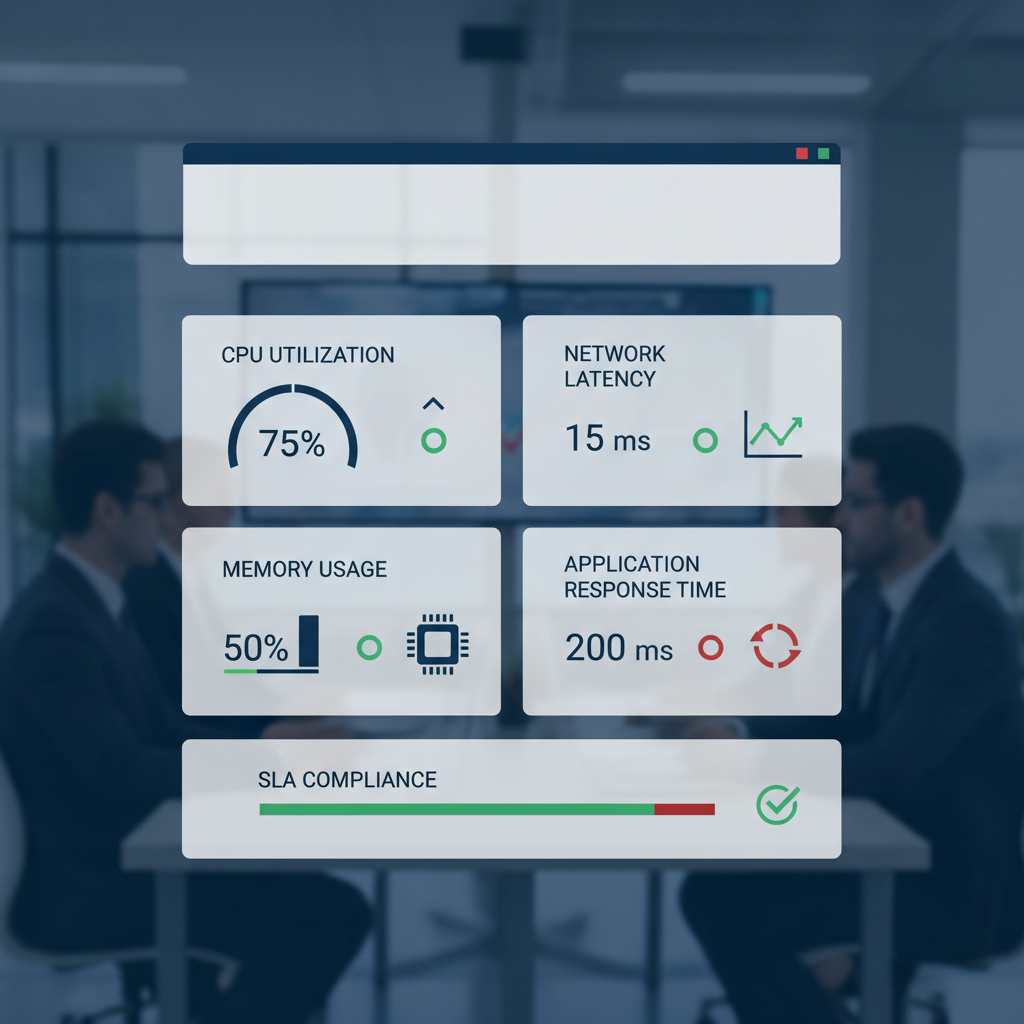
A dashboard showing various cloud performance metrics like CPU utilization, network latency, memory usage, and application response times, with green/red indicators for SLA compliance.
Setting up Monitoring Tools
The first step in effective cloud SLA monitoring is selecting and configuring appropriate monitoring tools. These tools automate the collection of performance data from various cloud services. They must be capable of integrating with your cloud provider’s APIs and your internal systems.
Consider tools that offer comprehensive dashboards, customizable alerts, and historical data retention for trending. Choose tools that provide visibility across your entire cloud footprint, especially in multi-cloud or hybrid environments. This ensures a unified view of your cloud service health.
Continuous Data Collection and Analysis
Once tools are in place, the process moves to continuous data collection. This involves systematically gathering metrics related to availability, performance, and other defined KPIs. The data must be collected regularly and in real-time where possible, to reflect current service conditions accurately.
Subsequent analysis of this data is critical to identify trends, anomalies, and potential SLA breaches. Automated analytics can highlight deviations from baseline performance, signaling issues that require immediate attention. This continuous feedback loop is essential for service level agreement tracking.
Reporting and Alerting Mechanisms
Effective cloud SLA monitoring relies heavily on robust reporting and alerting. Monitoring tools should generate clear, concise reports that summarize performance against SLA targets. These reports are invaluable for regular reviews with cloud providers.
Alerting mechanisms are equally important, providing immediate notification when critical thresholds are crossed or an SLA is at risk. Alerts should be configurable, routed to the appropriate personnel, and provide sufficient context to facilitate rapid response. This is a core aspect of monitoring cloud agreements.
Remediation and Optimization
The final step in the monitoring process involves acting on the insights gained. When an SLA breach or performance degradation is detected, prompt remediation is necessary. This may involve escalating issues to the cloud provider, adjusting resource allocation, or modifying application configurations.
Beyond immediate fixes, the data collected through monitoring should inform ongoing optimization efforts. Analyzing long-term trends can reveal areas for proactive improvement, helping to prevent future issues and enhance overall cloud performance management. This continuous improvement cycle is key.
Benefits of Robust Cloud SLA Monitoring
Implementing robust cloud SLA monitoring offers numerous tangible benefits that extend beyond simply checking boxes on a contract. It empowers organizations with data-driven insights, leading to improved operational efficiency, enhanced financial control, and stronger relationships with cloud providers. These advantages contribute significantly to overall business success and resilience.
By proactively managing cloud service performance, businesses can maintain a competitive edge and build greater trust with their end-users. The strategic value derived from comprehensive monitoring transforms it from a mere technical task into a critical business enabler.
Ensuring SLA Compliance and Accountability
One of the primary benefits is the ability to rigorously ensure SLA compliance. Monitoring provides objective, verifiable evidence of whether a cloud provider is meeting its contractual obligations. This eliminates guesswork and establishes clear accountability for service delivery.
In cases of non-compliance, this data serves as leverage for discussions, enabling organizations to claim service credits or demand corrective actions. It transforms vague promises into measurable outcomes, ensuring you get the service you pay for. This is fundamental to effective service level agreement tracking.
Optimizing Cloud Performance and Resource Utilization
Robust cloud SLA monitoring allows for continuous optimization of cloud resources. By closely tracking performance metrics, organizations can identify underperforming services or over-provisioned resources. This insight supports intelligent scaling decisions.
Optimizing resource utilization not only improves application performance but also leads to significant cost savings. It ensures that cloud expenditures align directly with actual performance needs, preventing wasteful spending. This proactive approach elevates cloud performance management.
Enhancing Customer Trust and Satisfaction
Consistent and reliable cloud service delivery directly translates into enhanced customer trust and satisfaction. When services perform as expected, users have a positive experience, reinforcing their confidence in your business. This loyalty is invaluable in competitive markets.
Cloud SLA monitoring helps minimize downtime and performance issues, which are major drivers of customer frustration. By maintaining high service uptime tracking, businesses demonstrate their commitment to quality and reliability. It contributes directly to a strong brand reputation.
Mitigating Risks and Costs
Proactive cloud SLA monitoring plays a vital role in mitigating operational risks and unforeseen costs. Early detection of performance degradation or potential outages allows organizations to intervene before minor issues escalate into major disruptions. This preventive posture is economically sound.
Furthermore, by verifying compliance and optimizing resource usage, businesses avoid penalties, unexpected charges, and the indirect costs associated with downtime. It transforms potential liabilities into managed variables, safeguarding financial stability.
ENSURE UNINTERRUPTED SERVICE
Ensure uninterrupted service delivery and proactively prevent costly SLA breaches. Leverage our automated, real
✓ Free consultation ✓ No commitment required ✓ Trusted by experts
Challenges in Cloud SLA Monitoring
Despite its clear benefits, implementing and maintaining effective cloud SLA monitoring is not without its challenges. The dynamic and distributed nature of cloud environments introduces complexities that traditional monitoring approaches often struggle to address. Organizations must be aware of these hurdles to develop robust and resilient monitoring strategies.
Overcoming these challenges requires a combination of sophisticated tools, technical expertise, and a clear understanding of cloud architectures. Addressing these complexities head-on ensures that monitoring efforts remain effective and scalable.
Complexity of Multi-Cloud Environments
Many organizations utilize multi-cloud or hybrid cloud strategies, leveraging services from multiple providers simultaneously. This introduces significant complexity to cloud SLA monitoring, as each provider may have different monitoring tools, APIs, and SLA definitions. Consolidating this data into a unified view is a major challenge.
Integrating disparate monitoring systems and correlating performance data across different cloud platforms requires sophisticated solutions. It makes consistent service level agreement tracking more intricate, demanding careful planning and specialized tooling.
Data Granularity and Interpretation
Cloud services generate vast amounts of performance data, often at very fine granularities. While this volume can be beneficial, it also poses challenges in terms of storage, processing, and interpretation. Differentiating meaningful signals from noise becomes a complex task.
Understanding what data points are truly indicative of SLA compliance versus normal fluctuations requires deep expertise and intelligent analytics. Overwhelming data can lead to alert fatigue or, conversely, missed critical events. This impacts the precision of monitoring cloud agreements.
Tool Integration and Standardization
A common challenge is the integration of various monitoring tools and the standardization of metrics across different cloud services and internal systems. Without proper integration, organizations can end up with fragmented visibility and manual data correlation efforts. This can hinder comprehensive cloud performance management.
Achieving a standardized approach to monitoring across diverse environments is essential for consistent cloud service health assessment. It requires careful selection of tools that support open standards and robust integration capabilities.
Best Practices for Cloud SLA Monitoring
To overcome the challenges and fully leverage the benefits of cloud SLA monitoring, organizations should adopt a set of best practices. These guidelines help establish a robust, efficient, and scalable monitoring framework. Implementing these practices will ensure consistent SLA compliance and optimal cloud performance.
These recommendations draw upon industry experience and technical expertise, offering actionable steps for improving your monitoring strategy. Following these tips will enhance your ability to maintain high service levels and proactively manage your cloud infrastructure.
Clear Definition of Metrics and Baselines
Ensure all metrics within your SLA are clearly defined, unambiguous, and measurable. Establish performance baselines for your applications and infrastructure before deployment. These baselines provide a reference point against which actual performance can be compared, making it easier to detect anomalies. This precise approach is a key part of cloud sla monitoring tips.
Leveraging Automated Tools
Implement automated cloud SLA monitoring tools. Manual monitoring is impractical and prone to human error in dynamic cloud environments. Automated solutions can continuously collect data, analyze performance against KPIs, and generate alerts without constant human intervention. Automation is fundamental to efficient service uptime tracking.
Regular Review and Adjustment of SLAs
Cloud environments and business needs evolve rapidly. Therefore, regularly review your existing SLAs with your providers and adjust them as necessary. Ensure that the agreements remain relevant to your current operational requirements and technological landscape. This continuous refinement is vital for effective service level agreement tracking.
Establishing Clear Communication Channels
Establish clear and formal communication channels with your cloud providers. Define escalation paths and contact points for critical incidents and performance issues. Prompt and effective communication is paramount for swift resolution of any SLA breaches or performance concerns. This strengthens the foundation for monitoring cloud agreements.
Conducting Periodic Audits and Drills
Periodically conduct audits of your monitoring setup and perform drills to test your incident response procedures. Verify that your monitoring tools are functioning correctly and that your team is prepared to respond to alerts. These proactive checks are invaluable for maintaining a high level of cloud service health.
Cloud SLA Monitoring Examples
Understanding cloud SLA monitoring in theory is important, but seeing practical examples can clarify its application. These scenarios illustrate how different organizations leverage monitoring to ensure their cloud services meet specific performance and availability criteria. They showcase the diverse range of applications for this critical practice.
These examples highlight how cloud sla monitoring is tailored to different service models and business needs. They demonstrate the versatility and indispensable nature of robust monitoring strategies across various cloud deployments.
Example 1: SaaS Application Monitoring
A company relying on a third-party SaaS customer relationship management (CRM) application needs to ensure its availability and responsiveness for sales teams. Their SLA with the SaaS provider guarantees 99.9% uptime and a maximum response time of 500ms for key transactions.
Their cloud sla monitoring setup continuously pings the CRM application’s login page and critical API endpoints. It tracks response times and logs any periods of unavailability. If the uptime drops below 99.9% over a month or response times consistently exceed 500ms, an alert is triggered, providing concrete data for discussions with the SaaS vendor. This is a common scenario in cloud sla monitoring examples.
Example 2: Infrastructure as a Service (IaaS) Performance
A retail business hosts its e-commerce website on an IaaS platform, requiring high performance during peak shopping seasons. Their SLA with the IaaS provider stipulates specific CPU utilization limits, network ingress/egress speeds, and disk I/O performance.
The company uses an IaaS-specific cloud sla monitoring tool to collect metrics directly from their virtual machines. They monitor CPU load, memory usage, network throughput, and disk latency in real-time. Alerts are configured to notify the operations team if any resource consistently approaches its SLA limit, allowing them to scale resources proactively or address potential bottlenecks before an actual SLA breach impacts customers. This proactive cloud performance management is crucial for the business.
Choosing the Best Cloud SLA Monitoring Solution
Selecting the best cloud SLA monitoring solution is a critical decision that impacts the effectiveness of your entire cloud strategy. With numerous tools available, it’s essential to identify one that aligns with your specific needs, infrastructure, and budget. A thoughtful selection process ensures comprehensive coverage and actionable insights.
The right monitoring solution can transform how you manage your cloud resources and interact with your providers. It empowers you to maintain high service levels and optimize your cloud investment efficiently.
Key Features to Look For
When evaluating cloud sla monitoring solutions, several key features stand out. These functionalities are crucial for comprehensive coverage and effective management. Prioritize tools that offer real-time monitoring, customizable dashboards, and robust alerting capabilities. Look for features that provide historical data analysis and trending.
Furthermore, consider solutions that offer anomaly detection, root cause analysis, and predictive analytics. These advanced capabilities move beyond basic monitoring to provide deeper insights and proactive issue prevention, aligning with best cloud sla monitoring practices.
Integration Capabilities
A crucial aspect is the solution’s ability to integrate with your existing cloud platforms, third-party services, and internal IT tools. Ensure the monitoring tool can seamlessly connect to your cloud providers’ APIs (e.g., AWS CloudWatch, Azure Monitor, Google Cloud Monitoring). Compatibility with incident management systems and notification platforms is also vital.
Strong integration capabilities simplify data collection and streamline your operational workflows. They prevent data silos and provide a unified view of your cloud service health across your entire ecosystem.
Scalability and Future-Proofing
Your chosen cloud sla monitoring solution must be scalable to grow with your cloud environment. As your business expands and adopts more cloud services, the monitoring tool should effortlessly handle increased data volumes and complexity. Opt for solutions that are designed for elasticity and can adapt to evolving cloud technologies.
Future-proofing ensures your investment remains valuable over time, avoiding the need for frequent and costly migrations to new monitoring platforms. This long-term perspective is essential for sustainable cloud performance management.
Frequently Asked Questions (FAQ)
Here are some common questions regarding cloud SLA monitoring.
What is the primary purpose of cloud SLA monitoring?
The primary purpose of cloud SLA monitoring is to continuously verify that cloud service providers are meeting the performance, availability, and security commitments outlined in their Service Level Agreements. It ensures accountability and helps maintain expected service quality.
How often should I review my cloud service agreements?
You should review your cloud service agreements at least annually, or whenever there are significant changes to your business operations, cloud architecture, or provider contracts. Regular reviews ensure the SLAs remain relevant to your current needs.
Can cloud SLA monitoring prevent outages?
While cloud SLA monitoring cannot prevent all outages, it can significantly reduce their impact and frequency. By detecting performance degradations and anomalies early, it allows for proactive intervention, potentially preventing minor issues from escalating into major service disruptions.
What are common metrics tracked in cloud SLA monitoring?
Common metrics include service availability (uptime), latency, response times, throughput, error rates, resource utilization (CPU, memory), and data durability. Security and support response times are also critical components.
Is cloud SLA monitoring different for PaaS vs. IaaS?
Yes, cloud SLA monitoring differs based on the cloud service model. For IaaS, you monitor underlying infrastructure like VMs and networks. For PaaS, monitoring focuses on the application platform’s performance and availability, with less emphasis on the underlying OS or hardware, as those are managed by the provider.
What are the benefits of automated service level agreement tracking?
Automated service level agreement tracking provides continuous, objective data collection and analysis, reduces manual effort, and enables real-time alerting for potential breaches. This leads to faster issue resolution, improved accountability, and better overall cloud performance management.
ENSURE UNINTERRUPTED SERVICE
Ensure uninterrupted service delivery and proactively prevent costly SLA breaches. Leverage our automated, real
✓ Free consultation ✓ No commitment required ✓ Trusted by experts
Conclusion
Cloud SLA monitoring is not merely a technical checkbox; it is a strategic imperative for any organization leveraging cloud services. By systematically tracking performance against defined Service Level Agreements, businesses gain critical visibility and control over their cloud environments. This comprehensive approach ensures that cloud providers deliver on their promises, fostering trust and operational excellence.
Implementing robust cloud SLA monitoring provides numerous benefits, from ensuring SLA compliance and optimizing resource utilization to enhancing customer satisfaction and mitigating risks. While challenges exist, adopting best practices and choosing the right tools empowers organizations to navigate the complexities of modern cloud infrastructure effectively. Embrace proactive monitoring to unlock the full potential and reliability of your cloud investments, ensuring consistent cloud service health for sustained business success.
Jacob Stålbro is a seasoned digitalization and transformation leader with over 20 years of experience, specializing in AI-driven innovation. As Head of Innovation and Co-Founder at Opsio, he drives the development of advanced AI, ML, and IoT solutions. Jacob is a sought-after speaker and webinar host known for translating emerging technologies into real business value and future-ready strategies.