Whether it’s IT operations, cloud migration, or AI-driven innovation – let’s explore how we can support your success.
Home /
Work /
Blogs /
Expert Cloud SLA Monitoring Online: Enhance Uptime & Performance
Understanding Cloud SLA Monitoring Online
In today’s fast-paced digital landscape, businesses increasingly rely on cloud services to power their operations. Ensuring these services meet agreed-upon performance standards is paramount, making Cloud sla monitoring online an indispensable practice. This guide delves into the nuances of online SLA tracking, offering insights into its benefits, key features, and best practices for implementation.
Cloud sla monitoring online provides a continuous, real-time overview of your cloud service performance against pre-defined Service Level Agreements (SLAs). It encompasses a range of tools and methodologies designed to ensure that cloud providers deliver on their promises. Effective monitoring helps maintain critical business functions and client trust.
Why Cloud SLA Monitoring Online is Essential for Modern Businesses
For any organization leveraging cloud infrastructure, the reliability and performance of those services directly impact business continuity and customer satisfaction. Cloud sla monitoring online is not merely a technical requirement; it is a strategic imperative. It empowers businesses to proactively address issues before they escalate into major disruptions.
Robust online SLA tracking ensures that your cloud resources operate optimally, minimizing downtime and performance bottlenecks. By continuously scrutinizing key metrics, businesses can quickly identify deviations from expected service levels. This vigilance is crucial for maintaining competitive advantage and operational efficiency in a cloud-centric world.
Ensuring Performance and Reliability
Performance and reliability are the cornerstones of any successful cloud deployment. Cloud sla monitoring online solutions provide the visibility needed to confirm that applications and services are consistently available and responsive. This proactive approach helps to prevent service degradations that could impact end-users.
With web-based cloud SLA monitoring, organizations can track uptime, latency, throughput, and error rates across various cloud components. This detailed oversight allows for immediate detection of anomalies, enabling prompt intervention. Ultimately, it builds confidence in your cloud infrastructure.
Maintaining Compliance and Trust
Many industries are subject to strict regulatory requirements that mandate specific levels of service availability and data protection. Cloud sla monitoring online plays a vital role in demonstrating compliance with these standards. It provides an auditable trail of performance data.
Beyond compliance, consistent service delivery fostered by effective monitoring builds and sustains customer trust. When users experience reliable, high-performing services, their confidence in your brand grows. This trust is invaluable in fostering long-term customer relationships and business success.
Key Components of Effective Cloud SLA Monitoring Online
To truly master cloud service performance, a robust Cloud sla monitoring online system must integrate several crucial components. These elements work in concert to provide comprehensive oversight and actionable insights. Without these, organizations might only get a partial picture of their cloud health.
A well-rounded solution ensures that all facets of service delivery are transparent and measurable. This proactive approach is fundamental for maintaining optimal operational efficiency. It supports quick issue resolution and sustained service excellence.
Real-time Performance Metrics
The ability to collect and analyze real-time performance metrics is fundamental to effective online SLA tracking. These metrics include critical data points such as CPU utilization, memory consumption, network latency, and disk I/O. Continuous data streams allow for immediate insight into system behavior.
Real-time monitoring empowers administrators to spot potential bottlenecks or failures as they occur, rather than after they have impacted users. This immediate feedback loop is essential for maintaining the high availability and responsiveness expected from cloud services. It forms the backbone of any robust monitoring strategy.
Alerting and Notification Systems
Even the most sophisticated monitoring system is only as effective as its ability to communicate issues promptly. Advanced alerting and notification systems are therefore critical components of Cloud sla monitoring online. They ensure that relevant personnel are informed the moment an SLA is breached or threatened.
These systems can be configured to trigger alerts via various channels, including email, SMS, or integrated messaging platforms. Intelligent alerting helps to minimize alert fatigue by providing contextual information and escalating notifications based on the severity of the issue. This ensures that critical problems receive immediate attention.
Reporting and Analytics Capabilities
Beyond real-time alerts, comprehensive reporting and analytics capabilities are vital for understanding long-term trends and identifying recurring issues. Cloud sla monitoring online tools offer dashboards, historical data analysis, and customizable reports. These features provide a holistic view of performance over time.
These insights are invaluable for capacity planning, performance optimization, and demonstrating SLA adherence to stakeholders. Robust reporting helps identify patterns, predict future demands, and make data-driven decisions. This strategic advantage optimizes cloud resource utilization.
Integration with Existing Tools
Modern IT environments rarely operate in silos, making integration a key feature for any cloud-based SLA solution. Effective Cloud sla monitoring online platforms should seamlessly integrate with existing ITSM tools, incident management systems, and other operational platforms. This fosters a unified operational view.
Such integrations streamline workflows, automate incident creation, and enrich problem resolution processes. They prevent data fragmentation and ensure that monitoring data contributes to a broader understanding of the IT ecosystem. This interconnectedness is crucial for efficient operations.
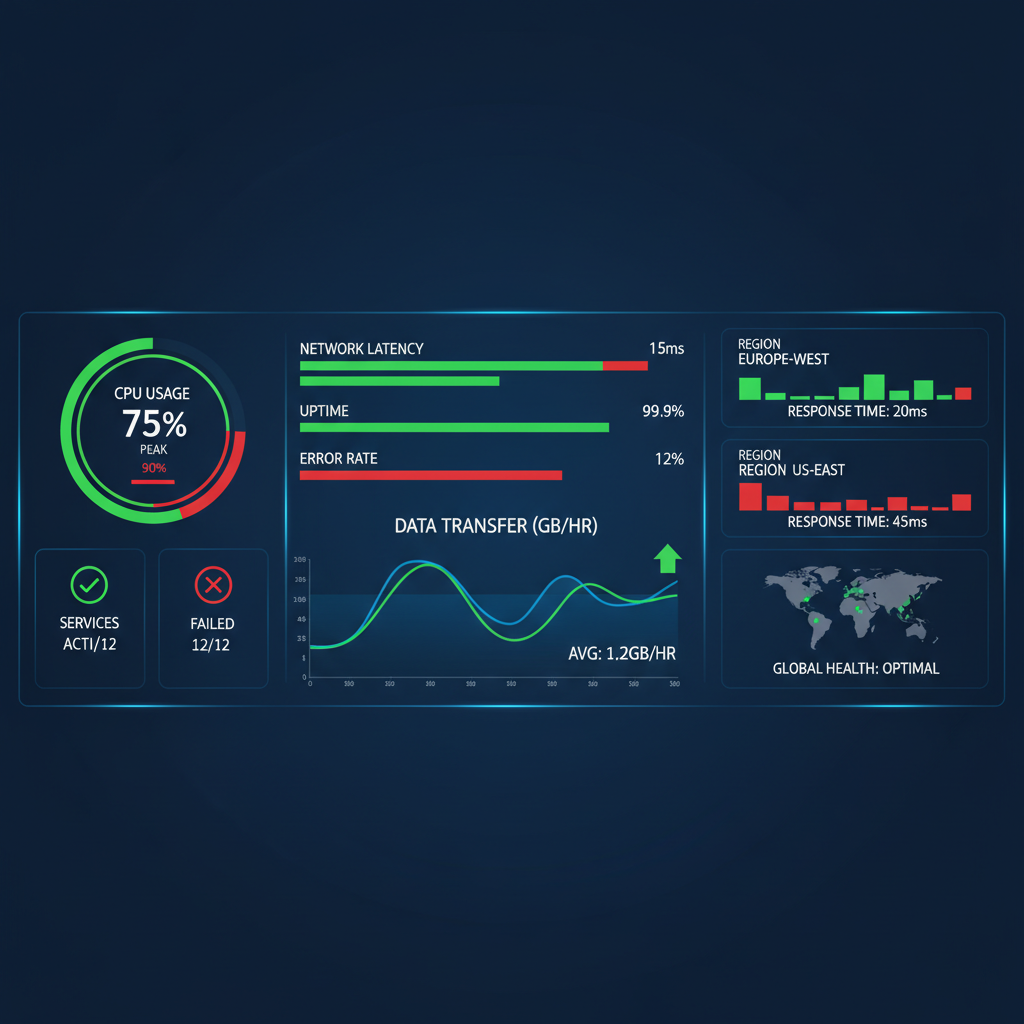
A dashboard displaying various real-time cloud performance metrics like CPU usage, network latency, and uptime percentages with green and red indicators.
Types of Cloud SLA Monitoring Online Solutions
The market offers a diverse range of solutions for Cloud sla monitoring online, each with its unique strengths and approaches. Understanding these different types helps organizations choose the best fit for their specific operational needs and infrastructure. From dedicated platforms to integrated services, options abound.
Selecting the right solution involves considering factors like the complexity of your cloud environment, budget, and the level of customization required. Each type offers distinct advantages, catering to different scales and service requirements. This varied landscape ensures flexibility for businesses.
Web-Based Cloud SLA Monitoring Platforms
Web-based cloud SLA monitoring platforms offer the convenience of accessibility from anywhere with an internet connection. These solutions are typically delivered as a service, requiring no on-premise installation or complex infrastructure setup. They are known for their ease of deployment.
Users can access comprehensive dashboards, configure alerts, and view reports directly through a web browser. This accessibility makes them ideal for distributed teams and organizations with limited IT resources. These platforms often provide intuitive interfaces, simplifying the monitoring process.
SaaS SLA Monitoring Tools
SaaS SLA monitoring tools represent a specific category within web-based solutions, emphasizing a subscription-based, fully managed service model. With SaaS SLA monitoring, the provider handles all underlying infrastructure, maintenance, and updates. This offloads significant operational burden.
These tools are designed for rapid deployment and scalability, making them attractive to businesses of all sizes, particularly those without extensive in-house monitoring expertise. They often come with pre-built integrations and best practices embedded. Many of the best Cloud sla monitoring online solutions fall into this category.
Remote Cloud Performance Monitoring Services
Remote cloud performance monitoring services take a different approach, often involving agents deployed within your cloud environment or external probes that simulate user interactions. These services focus on gathering deep performance data from various vantage points. They provide a comprehensive view of service delivery.
This method allows for detailed tracking of application response times, database performance, and network health, irrespective of the underlying cloud provider. Internet-based SLA checks are a common feature, simulating end-user experiences from multiple global locations. This is crucial for understanding real-world performance.
Open-Source vs. Commercial Solutions
When considering Cloud sla monitoring online options, businesses face the choice between open-source and commercial solutions. Open-source tools like Prometheus or Zabbix offer flexibility and no licensing fees, but require significant in-house expertise for setup, configuration, and maintenance. They allow for deep customization.
Commercial solutions, on the other hand, typically provide out-of-the-box functionality, dedicated support, and more user-friendly interfaces, though they come with subscription costs. Many offer cloud-based SLA solutions that simplify deployment and management. The decision often hinges on balancing cost, control, and internal capabilities.
ENSURE UNINTERRUPTED SERVICE
Ensure uninterrupted service delivery and proactively prevent costly SLA breaches. Leverage our automated, real
✓ Free consultation ✓ No commitment required ✓ Trusted by experts
Implementing Cloud SLA Monitoring Online: A Step-by-Step Guide
Successfully implementing Cloud sla monitoring online requires a structured approach to ensure all critical aspects of your cloud services are covered. This methodical process helps to establish a robust monitoring framework that delivers actionable insights. Following these steps will help maximize the effectiveness of your solution.
A well-planned implementation minimizes potential pitfalls and ensures that your monitoring efforts align with business objectives. It sets the foundation for continuous improvement in cloud service delivery. This guide provides Cloud sla monitoring online tips for a smooth rollout.
Step 1: Define Your SLAs and KPIs
The first crucial step is to clearly define your Service Level Agreements (SLAs) with your cloud provider and internally establish key performance indicators (KPIs). These agreements should detail expected uptime, performance thresholds, response times, and incident resolution targets. Without clear definitions, effective monitoring is impossible.
Translate these SLAs into measurable KPIs that your monitoring solution can track, such as availability percentage, average response time, or error rate. This foundational work ensures that your monitoring efforts are aligned with your business commitments. It forms the benchmark for all future assessments.
Step 2: Choose the Right Monitoring Solution
With your SLAs and KPIs clearly defined, the next step is to select a Cloud sla monitoring online solution that aligns with your specific requirements. Consider factors like scalability, integration capabilities, ease of use, and reporting features. Evaluate various web-based cloud SLA monitoring and SaaS SLA monitoring options.
Look for tools that offer comprehensive coverage for your specific cloud environment, whether it’s AWS, Azure, Google Cloud, or a multi-cloud setup. The best Cloud sla monitoring online tool will offer flexibility and deep insights. A thorough evaluation will prevent future compatibility issues.
Step 3: Configure Your Monitoring Environment
Once a solution is chosen, you must configure it to monitor your cloud resources effectively. This involves deploying agents (if required), setting up API integrations with your cloud provider, and defining specific metrics to track. Ensure that all critical services and applications are included in the monitoring scope.
Proper configuration is key to gathering accurate and relevant data. This might include defining custom checks or scripts to monitor unique aspects of your application. Detailed configuration ensures that no critical blind spots remain.
Step 4: Establish Alerting and Reporting Workflows
Configure your alerting system based on the defined KPIs and SLA thresholds. Determine who should receive alerts for different types and severities of incidents. Integrate with your incident management system for automated ticket creation.
Additionally, set up automated reports to regularly review performance trends and SLA compliance. These reports should be tailored for different audiences, from technical teams to executive stakeholders. This step is vital for operational responsiveness and strategic oversight.
Step 5: Regularly Review and Optimize
Cloud environments are dynamic, so your monitoring strategy should be too. Regularly review your monitoring configuration, SLA definitions, and KPIs to ensure they remain relevant. Adjust thresholds as your applications evolve or as performance baselines change.
Analyze your historical data to identify recurring issues or areas for improvement. Use these insights to optimize your cloud infrastructure and fine-tune your monitoring setup. Continuous optimization is key to maintaining peak performance and efficient resource utilization.
Best Practices for Cloud SLA Monitoring Online
Maximizing the effectiveness of your Cloud sla monitoring online efforts goes beyond simply deploying tools. Adhering to best practices ensures that your monitoring solution provides actionable insights and genuinely supports your operational goals. These practices contribute to a robust and resilient cloud environment.
Implementing these strategies will help you move from reactive problem-solving to proactive performance management. They are essential for any organization committed to high-quality cloud service delivery. These Cloud sla monitoring online tips will strengthen your strategy.
Proactive Monitoring Strategies
Shift your focus from reactive troubleshooting to proactive problem prevention. Implement predictive analytics where possible to foresee potential issues before they impact services. This involves analyzing trends and anomaly detection to flag impending problems.
Proactive monitoring also includes synthetic transactions and end-user experience monitoring. These methods simulate user behavior to identify performance degradations from the user’s perspective, often before real users notice. This provides early warning signals that allow for preventative action.
Baselines and Benchmarking
Establishing performance baselines is critical for meaningful Cloud sla monitoring online. A baseline defines what “normal” performance looks like for your applications and infrastructure. Without a baseline, it’s difficult to distinguish normal fluctuations from actual performance issues.
Regularly benchmark your current performance against these baselines and industry standards. This provides context for your metrics and helps identify areas where improvements are needed. It allows for objective evaluation of service health.
Automated Remediation
For common, well-understood issues, consider implementing automated remediation steps within your monitoring framework. When an SLA breach is detected, an automated script or workflow can be triggered to resolve the problem without human intervention. This could involve restarting a service or scaling up resources.
Automated remediation significantly reduces response times and minimizes downtime for recurring issues. It frees up human operators to focus on more complex, novel problems. This boosts operational efficiency and service continuity.
Data Security and Privacy
Given the sensitive nature of performance data, ensure that your Cloud sla monitoring online solution adheres to stringent data security and privacy standards. Data should be encrypted both in transit and at rest, and access controls should be robust. Compliance with regulations like GDPR or HIPAA is non-negotiable.
Choose providers that demonstrate a strong commitment to security and offer features like audit trails and role-based access control. Protecting monitoring data is as important as protecting operational data. This safeguards sensitive information and maintains trust.
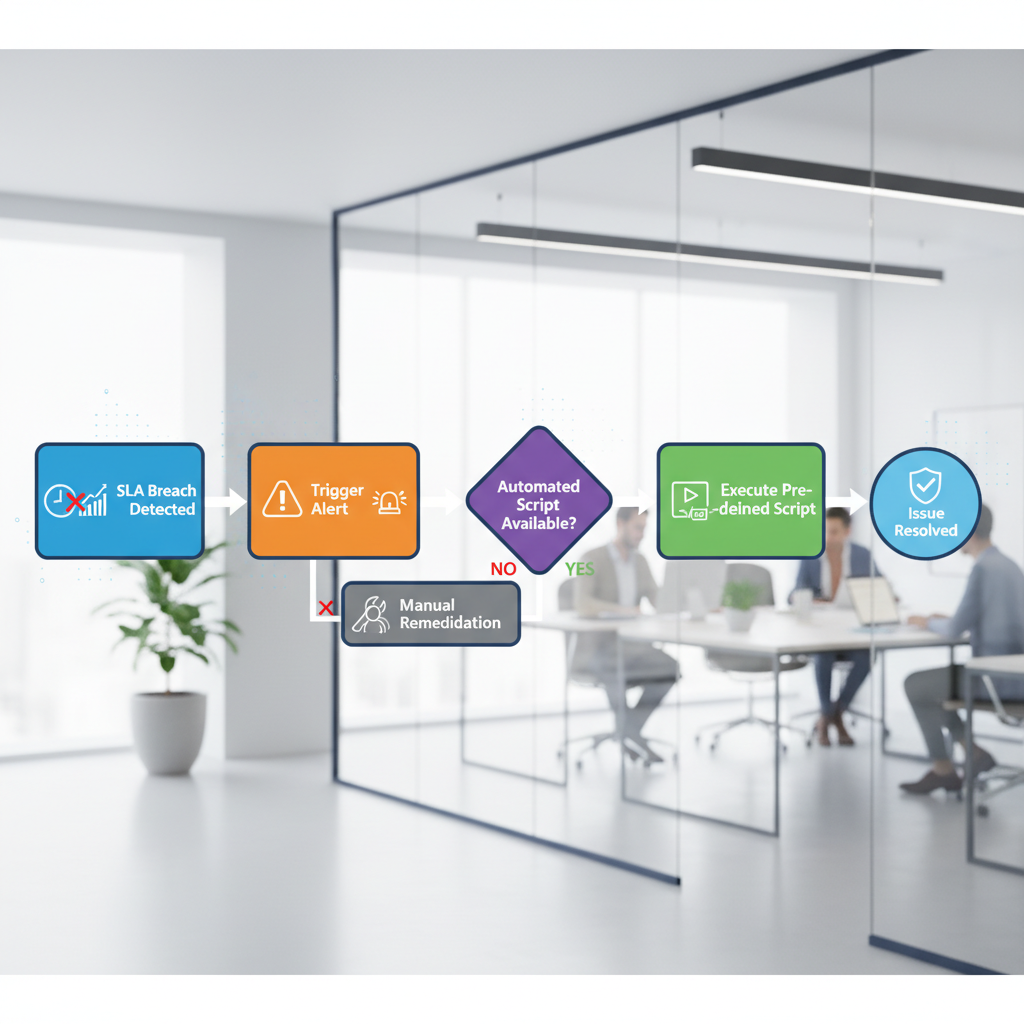
A flowchart illustrating the process of an automated remediation system, showing detection of an SLA breach, triggering an alert, and then executing a pre-defined script to resolve the issue automatically.
Challenges in Cloud SLA Monitoring Online
While the benefits of Cloud sla monitoring online are undeniable, organizations often encounter various challenges during implementation and ongoing management. Understanding these obstacles is the first step toward overcoming them. Proactive planning can mitigate many common issues.
Addressing these challenges effectively requires a combination of technical solutions, strategic planning, and continuous process refinement. It ensures that monitoring efforts remain efficient and yield valuable insights.
Complexity of Cloud Environments
Cloud environments, especially multi-cloud or hybrid setups, are inherently complex and dynamic. Resources can be spun up and down rapidly, and interdependencies between services can be intricate. This dynamism makes comprehensive online SLA tracking particularly challenging.
Monitoring tools must be able to adapt to these changes, discover new resources, and accurately map service dependencies. The sheer volume and variety of metrics can also be overwhelming without proper aggregation and filtering. Managing this complexity requires sophisticated solutions.
False Positives and Alert Fatigue
A common problem in monitoring is the generation of too many alerts, many of which may be false positives or low-priority issues. This “alert fatigue” can cause teams to miss critical warnings. It reduces the overall effectiveness of the alerting system.
Fine-tuning alert thresholds, implementing intelligent suppression rules, and focusing on actionable alerts are essential strategies. Prioritizing alerts based on business impact helps ensure that only truly critical issues demand immediate attention.
Cost Management
Implementing and maintaining robust Cloud sla monitoring online solutions can incur significant costs, especially for large-scale deployments or specialized services. These costs can include licensing fees, data storage, and the operational overhead of managing the monitoring infrastructure.
Organizations need to carefully evaluate the cost-benefit ratio of different solutions and optimize their monitoring footprint. Focus on monitoring critical metrics efficiently rather than collecting every possible data point. Cost-effective strategies are crucial for sustainability.
Vendor Lock-in Concerns
When adopting cloud-based SLA solutions, particularly those offered by cloud providers themselves, there’s a risk of vendor lock-in. Switching providers later can be complex and costly if your monitoring solution is deeply integrated with a specific ecosystem.
To mitigate this, consider solutions that offer broad compatibility across multiple cloud platforms or are vendor-agnostic. This flexibility provides more control and reduces future migration headaches. It safeguards against reliance on a single provider.
Choosing the Best Cloud SLA Monitoring Online Provider
Selecting the right provider for Cloud sla monitoring online is a critical decision that impacts your operational efficiency and service reliability. A thorough evaluation process ensures you partner with a solution that best fits your organizational needs. Consider various factors beyond just cost.
The best Cloud sla monitoring online solution will not only meet your current requirements but also scale with your future growth. It should offer a balance of features, support, and usability. This strategic choice underpins your cloud success.
Scalability and Flexibility
Your chosen monitoring solution must be scalable to grow with your cloud infrastructure. As your services expand or contract, the monitoring system should effortlessly adapt without requiring major overhauls. This ensures continuous coverage.
Flexibility in monitoring various types of cloud services, applications, and even hybrid environments is also crucial. A versatile platform can provide consistent online SLA tracking across your entire digital footprint. This adaptability is vital in dynamic cloud landscapes.
Support and Documentation
Even the most intuitive tools require good support and comprehensive documentation. Evaluate the quality of customer support offered by potential providers, including their response times and availability. Strong support is invaluable during setup and troubleshooting.
Thorough documentation, tutorials, and a vibrant community forum can significantly aid in self-service and problem-solving. This ensures that your team can effectively utilize the tool and resolve issues independently.
Pricing Models
Different Cloud sla monitoring online providers offer various pricing models, often based on metrics collected, hosts monitored, or data volume. Understand these models thoroughly to avoid unexpected costs. Compare them against your anticipated usage.
Look for transparent pricing and consider the total cost of ownership, including setup, maintenance, and potential add-ons. A clear understanding of the pricing structure helps in budgeting and cost control.
User Experience and Interface
An intuitive and user-friendly interface is paramount for efficient Cloud sla monitoring online. Dashboards should be clear, customizable, and provide quick access to critical information. An overly complex interface can lead to inefficient use and overlooked issues.
Ease of configuration, setting up alerts, and generating reports significantly impacts the operational burden on your team. A seamless user experience fosters adoption and maximizes the value of the monitoring tool.
Frequently Asked Questions About Cloud SLA Monitoring Online
What is Cloud sla monitoring online?
Cloud sla monitoring online refers to the continuous, real-time tracking and analysis of cloud service performance against predefined Service Level Agreements (SLAs). It involves using specialized tools and platforms to observe metrics like uptime, response times, and resource utilization. This practice ensures that cloud providers meet their contractual obligations and that services remain reliable for end-users.
Why is online SLA tracking important for cloud services?
Online SLA tracking is crucial for cloud services because it helps businesses ensure performance, reliability, and compliance. It allows organizations to detect and respond to performance issues proactively, minimizing downtime and negative impacts on users. Furthermore, it provides the necessary data to verify that cloud providers are upholding their promised service levels and regulatory requirements.
How do I choose the best Cloud sla monitoring online tool?
To choose the best Cloud sla monitoring online tool, start by defining your specific SLAs and KPIs. Then, evaluate solutions based on scalability, integration capabilities with your existing systems, real-time metrics, robust alerting, and comprehensive reporting features. Consider the vendor’s support, documentation, pricing model, and the tool’s overall user experience.
Can Cloud sla monitoring online prevent downtime?
While Cloud sla monitoring online cannot prevent all downtime, it significantly reduces its likelihood and impact. By providing real-time alerts and insights into potential issues, it enables teams to identify and address problems before they escalate into full outages. Proactive monitoring, combined with automated remediation strategies, helps in preventing many forms of service disruption.
What are the benefits of remote cloud performance monitoring?
Remote cloud performance monitoring offers several benefits, including insights into end-user experience from various geographic locations. It helps identify latency issues specific to certain regions and validates global service delivery. This method ensures that services are performing optimally for all users, regardless of their location, and provides a true external perspective on cloud service health.
ENSURE UNINTERRUPTED SERVICE
Ensure uninterrupted service delivery and proactively prevent costly SLA breaches. Leverage our automated, real
✓ Free consultation ✓ No commitment required ✓ Trusted by experts
Conclusion
Effective Cloud sla monitoring online is no longer a luxury but a fundamental necessity for any business operating in the cloud. It provides the crucial visibility and control needed to ensure service reliability, maintain compliance, and foster customer trust. By understanding the types of solutions available and adhering to best practices, organizations can build robust monitoring frameworks.
The journey to optimal cloud performance is continuous, requiring ongoing review and optimization of your monitoring strategy. Investing in the right Cloud sla monitoring online tools and processes will empower your business to thrive in the dynamic world of cloud computing. This guide serves as a comprehensive resource to navigate your options and make informed decisions for your cloud infrastructure.
Jacob Stålbro is a seasoned digitalization and transformation leader with over 20 years of experience, specializing in AI-driven innovation. As Head of Innovation and Co-Founder at Opsio, he drives the development of advanced AI, ML, and IoT solutions. Jacob is a sought-after speaker and webinar host known for translating emerging technologies into real business value and future-ready strategies.