Whether it’s IT operations, cloud migration, or AI-driven innovation – let’s explore how we can support your success.
Home /
Work /
Blogs /
Expert MSP Cloud SLA Monitoring: Ensure Uptime & Performance
Understanding MSP Cloud SLA Monitoring
In today’s fast-paced digital landscape, cloud services are indispensable for businesses of all sizes. Managed Service Providers (MSPs) play a critical role in managing these complex environments for their clients. A cornerstone of this management is robust msp Cloud sla monitoring, ensuring that agreed-upon performance standards are consistently met. This practice is vital for maintaining client trust and delivering reliable service.
Effective msp Cloud sla monitoring goes beyond simple uptime checks, encompassing a holistic view of cloud service performance. It involves dedicated systems and processes to track, measure, and report on various metrics defined within a Service Level Agreement (SLA). For MSPs, this specialized monitoring ensures accountability and operational excellence in cloud service delivery.
What is msp Cloud sla monitoring?
msp Cloud sla monitoring refers to the continuous process of observing, measuring, and reporting on the performance of cloud services managed by an MSP against predefined Service Level Agreements (SLAs). These SLAs are contractual agreements between an MSP and its client, outlining the minimum acceptable level of service quality. It ensures that the outsourced SLA monitoring truly reflects the client’s needs.
This comprehensive approach involves utilizing specialized tools and methodologies to track critical metrics such as uptime, latency, data throughput, and incident response times. The goal is to proactively identify issues, ensure compliance with contractual obligations, and provide transparency to clients regarding their cloud infrastructure’s performance. It forms the backbone of managed service provider SLA monitoring.
Defining Service Level Agreements in the Cloud Context
An SLA for managed services clearly articulates the service parameters that an MSP commits to deliver. In the cloud context, these agreements are particularly complex due to the shared responsibility model and the dynamic nature of cloud environments. They cover various aspects of service availability and performance.
Typical cloud SLAs include specifics on server uptime, network availability, data backup and recovery objectives, and security incident response times. For an MSP, establishing realistic and measurable cloud service levels is fundamental. These detailed agreements form the basis against which all msp Cloud sla monitoring activities are conducted.
Why is msp Cloud sla monitoring Crucial for MSPs?
msp Cloud sla monitoring is not merely a technical task; it’s a strategic imperative for MSPs. It directly impacts client satisfaction, operational efficiency, and the MSP’s reputation in a competitive market. Without it, MSPs risk service degradation and potential client churn.
This disciplined approach helps MSPs uphold their commitments, demonstrate value, and build long-lasting client relationships. It provides the necessary data to prove compliance and justify service charges. The ability to show tangible results from MSP cloud performance tracking differentiates leading service providers.
Ensuring Client Satisfaction and Retention
Clients entrust their critical IT operations to MSPs, expecting consistent and reliable service. Robust msp Cloud sla monitoring provides irrefutable proof that an MSP is meeting its commitments, fostering trust and confidence. This transparency is crucial for maintaining strong client relationships and reducing churn.
When clients can see their cloud services consistently performing as promised, their satisfaction levels remain high. Proactive identification and resolution of potential SLA breaches also prevent issues from escalating, further cementing client loyalty. Effective monitoring is a key driver for long-term client retention.
Driving Operational Efficiency and Proactive Problem Solving
Consistent msp Cloud sla monitoring allows MSPs to move from reactive troubleshooting to proactive problem-solving. By continuously tracking performance metrics, MSPs can detect anomalies and potential issues before they impact end-users. This predictive capability significantly improves operational efficiency.
Early warnings enable MSP teams to address root causes, optimize configurations, and prevent downtime. This reduces the number of urgent support tickets and frees up valuable resources. It’s a cornerstone of effective MSP cloud performance tracking and management.
Upholding Compliance and Regulatory Requirements
Many industries are subject to stringent regulatory compliance standards that dictate specific requirements for data handling, availability, and security. MSPs managing client data in the cloud must ensure these standards are met. msp Cloud sla monitoring provides the audit trails needed for compliance.
Documentation of consistent SLA adherence can be critical during audits, proving due diligence and preventing costly penalties. For example, specific uptime guarantees might be necessary for healthcare or financial services clients. Reliable monitoring ensures that these compliance benchmarks are consistently maintained.
Financial Implications and Accountability
SLA breaches often come with financial penalties, such as service credits or direct reimbursements to clients. Diligent msp Cloud sla monitoring helps MSPs avoid these costly consequences by preventing breaches in the first place. It is a direct measure of an MSP’s accountability.
Conversely, consistently exceeding SLA targets can strengthen an MSP’s negotiation position for contract renewals and expansions. It demonstrates a commitment to quality that justifies premium services. Precise monitoring provides the data needed to manage financial risk and maximize service value.
Key Components of an Effective msp Cloud sla monitoring Strategy
Developing a robust msp Cloud sla monitoring strategy involves several interconnected components. It requires more than just tools; it demands a clear understanding of objectives, metrics, and reporting mechanisms. A comprehensive strategy ensures all aspects of outsourced SLA monitoring are covered.
An effective strategy must align with both the MSP’s capabilities and the client’s business needs. This involves careful planning and continuous refinement to adapt to evolving cloud environments and client expectations. It underpins all successful third-party SLA management.
Robust Monitoring Tools and Platforms
The foundation of any msp Cloud sla monitoring strategy lies in sophisticated monitoring tools and platforms. These solutions collect vast amounts of data from various cloud services and infrastructure components. They provide real-time insights into performance and availability.
Modern tools offer capabilities like unified dashboards, customizable alerts, and integration with ticketing systems. Selecting the right platform that can handle multi-cloud environments is crucial for comprehensive MSP cloud service levels monitoring. These tools are indispensable for tracking “SLA for managed services”.
Defining Clear Metrics and KPIs
Effective msp Cloud sla monitoring relies on clearly defined metrics and Key Performance Indicators (KPIs). These must be specific, measurable, achievable, relevant, and time-bound (SMART). Vague metrics lead to confusion and ineffective monitoring.
Typical KPIs include:
Uptime/Availability: Percentage of time a service is operational.
Latency: Time delay for data transfer or response.
Throughput: Volume of data processed over time.
Error Rate: Frequency of service failures or incorrect responses.
Response Time: Time taken to acknowledge and resolve an incident.
Establishing Reporting and Alerting Mechanisms
Timely reporting and alerting are critical for proactive msp Cloud sla monitoring. Reporting provides transparency to clients, detailing performance over specific periods. Automated alerts, on the other hand, notify MSP teams instantly when performance deviates from SLA thresholds.
These mechanisms ensure that both clients and MSPs are always informed about service status and potential issues. Customizable dashboards allow clients to view performance data relevant to their specific services. This constant communication builds trust and allows for rapid response.
A dashboard displaying various cloud service performance metrics like CPU usage, network latency, storage I/O, and uptime percentages, with green, yellow, and red indicators for SLA compliance. The dashboard should look modern and professional, illustrating real-time data tracking for an MSP.
Regular Review and Optimization Processes
An effective msp Cloud sla monitoring strategy is not static; it requires continuous review and optimization. Regular meetings with clients to discuss performance reports, gather feedback, and adjust SLAs are essential. The cloud landscape is dynamic, so agreements must evolve.
These reviews help identify trends, pinpoint recurring issues, and fine-tune monitoring parameters for better accuracy. Optimization ensures that the monitoring strategy remains relevant and effective in supporting current business needs. It is key to enhancing MSP cloud service levels.
ENSURE UNINTERRUPTED SERVICE
Ensure uninterrupted service delivery and proactively prevent costly SLA breaches. Leverage our automated, real
✓ Free consultation ✓ No commitment required ✓ Trusted by experts
Challenges in msp Cloud sla monitoring
Despite its critical importance, implementing and maintaining robust msp Cloud sla monitoring presents several challenges. The dynamic and distributed nature of cloud environments often complicates traditional monitoring approaches. MSPs must navigate these complexities skillfully.
Understanding these challenges is the first step towards developing resilient and adaptive monitoring solutions. Addressing these hurdles ensures that the monitoring efforts yield meaningful and actionable insights. This often requires deep expertise in third-party SLA management.
Complexity of Multi-Cloud Environments
Many organizations utilize a multi-cloud strategy, leveraging services from different providers like AWS, Azure, and Google Cloud. Monitoring across these disparate environments, each with its own APIs, metrics, and dashboards, adds significant complexity. Integrating these systems is a major challenge.
Ensuring consistent SLA enforcement and reporting across diverse platforms requires sophisticated tools and integration strategies. MSPs must develop unified monitoring solutions that can aggregate data from multiple sources seamlessly. This is a common hurdle in effective third-party SLA management.
Data Volume and Interpretation
Cloud environments generate an enormous volume of performance data, from network traffic logs to application metrics. Sifting through this deluge of information to identify relevant signals and potential SLA breaches can be overwhelming. Raw data alone is not useful without proper interpretation.
MSPs need advanced analytics capabilities and intelligent alerting systems to cut through the noise. The challenge lies in transforming raw data into actionable insights that can inform decision-making and proactive interventions. This is where expertise in MSP cloud performance tracking becomes crucial.
Defining Realistic SLAs
Establishing realistic and achievable SLAs can be surprisingly difficult. Overly ambitious SLAs can lead to frequent breaches and client dissatisfaction, while overly conservative ones may not reflect the true capabilities of cloud services. It’s a delicate balance.
MSPs must have a deep understanding of their cloud infrastructure, vendor commitments, and client expectations to define appropriate service levels. Open and transparent communication with clients during the SLA definition phase is vital to set proper expectations. This guides the entire msp Cloud sla monitoring guide.
Integration with Existing Tools
MSPs typically use a suite of tools for various operational tasks, including ticketing, billing, and remote management. Integrating msp Cloud sla monitoring solutions with these existing tools can be complex. Seamless integration is essential for workflow efficiency.
Without proper integration, data silos emerge, leading to manual data transfers, errors, and delayed responses. A well-integrated ecosystem ensures that performance data flows efficiently to relevant systems, enabling faster incident resolution and reporting. This is key for unified managed service provider SLA monitoring.
Best Practices for msp Cloud sla monitoring
Implementing best practices is essential for an MSP to achieve optimal msp Cloud sla monitoring. These strategies help overcome common challenges, enhance service quality, and strengthen client relationships. Adopting these approaches ensures consistent and reliable performance.
Following these guidelines will enable MSPs to maximize the effectiveness of their monitoring efforts. They also contribute to demonstrating expertise and reliability in service delivery. These are some of the best msp Cloud sla monitoring tips for the industry.
1. Automate Monitoring Processes
Manual monitoring of cloud services is impractical and prone to error given the scale and dynamism of cloud environments. Automating data collection, analysis, and alerting processes is paramount. Automation ensures continuous, real-time oversight.
Automated tools can track hundreds of metrics simultaneously, identify deviations from baselines, and trigger alerts without human intervention. This frees up MSP staff to focus on higher-value tasks, like problem resolution and strategic planning. Invest in a comprehensive automation platform.
2. Define Granular and Actionable Metrics
Beyond general uptime, define granular metrics that provide specific insights into service health and user experience. For example, measure API response times for critical applications, database query latency, or specific network path performance. These details are vital for effective MSP cloud performance tracking.
Actionable metrics allow MSPs to pinpoint the exact source of an issue and take targeted corrective action. General metrics might indicate a problem, but granular data helps in quick diagnosis. This precision is a hallmark of best msp Cloud sla monitoring.
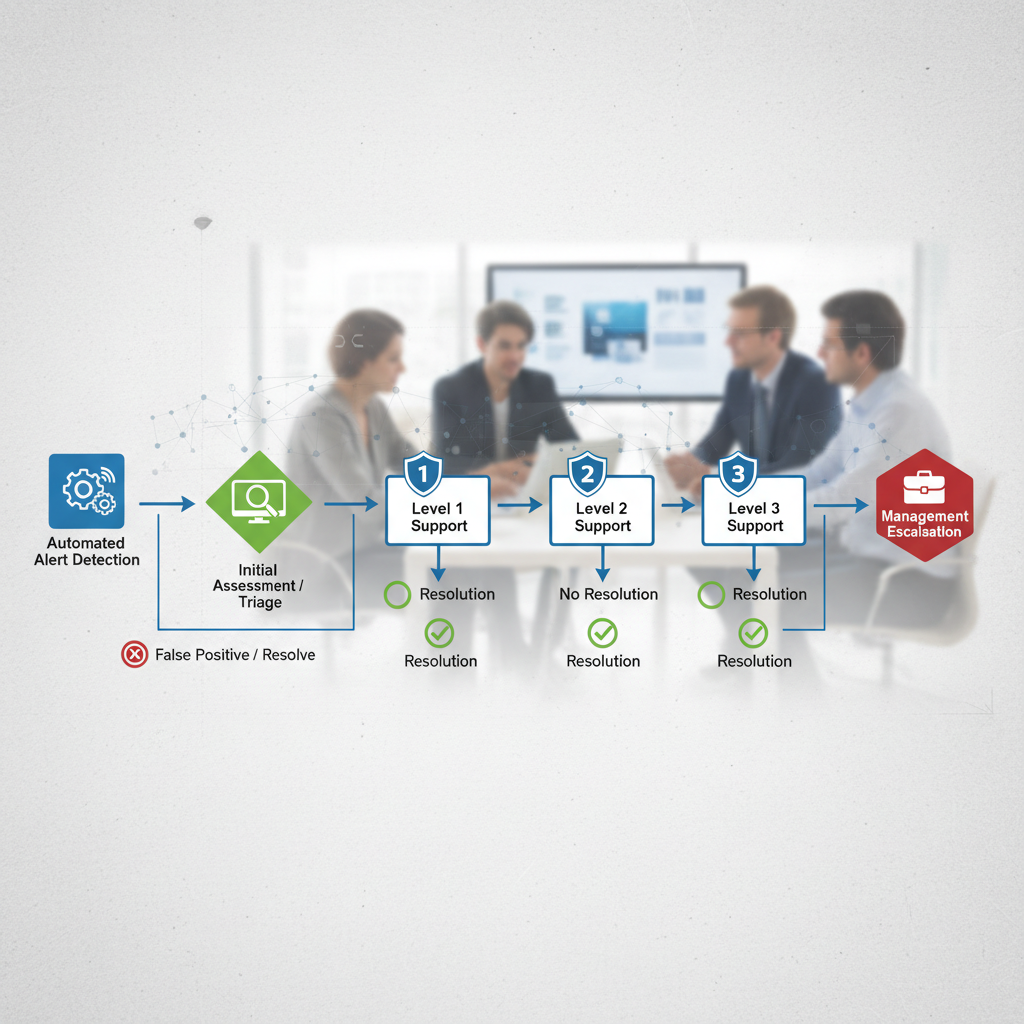
3. Establish Clear Escalation Paths
Develop clear and documented escalation paths for when SLA thresholds are approached or breached. Define who gets notified, through what channels, and what immediate actions need to be taken. Rapid response is crucial to minimize impact.
This ensures that critical issues are addressed promptly by the appropriate personnel. A well-defined escalation matrix prevents delays and confusion, ensuring efficient incident management. It forms an integral part of any robust msp Cloud sla monitoring guide.
A flowchart illustrating an IT incident escalation process, starting from automated alert detection, through level 1, level 2, and level 3 support teams, finally reaching management if the issue remains unresolved. Arrows and decision points should clearly show the flow.
4. Conduct Periodic SLA Reviews with Clients
Regularly review SLAs with clients to ensure they remain relevant and aligned with their evolving business needs and the capabilities of cloud services. Technology advances, and business requirements change, necessitating adjustments to agreements. This is a critical msp Cloud sla monitoring tip.
These reviews provide an opportunity for feedback, discussion of performance trends, and proactive adjustments. It fosters a collaborative partnership and ensures the MSP continues to meet client expectations. Schedule quarterly or bi-annual SLA review meetings.
5. Leverage Advanced Analytics for Predictive Insights
Move beyond reactive monitoring by leveraging advanced analytics, including Artificial Intelligence (AI) and Machine Learning (ML). These technologies can analyze historical data to identify patterns, predict potential outages, and anticipate performance degradation. Predictive analytics transform MSP cloud performance tracking.
Predictive capabilities allow MSPs to take preventive measures, such as scaling resources or optimizing configurations, before an SLA breach occurs. This proactive stance significantly enhances service reliability and operational efficiency. This is considered among the best msp Cloud sla monitoring practices.
Choosing the Right Tools for msp Cloud sla monitoring
Selecting the appropriate tools is paramount for successful msp Cloud sla monitoring. The right platform can streamline operations, provide deep insights, and support complex multi-cloud environments. The choice depends on several factors specific to the MSP’s operations and client base.
Investing in robust and scalable monitoring tools is a strategic decision that impacts an MSP’s ability to deliver high-quality cloud services. Evaluating various options carefully is crucial to ensure long-term success. Consider these aspects when seeking msp Cloud sla monitoring examples.
Key Features to Look For
When evaluating msp Cloud sla monitoring tools, several features stand out as essential. These capabilities ensure comprehensive coverage and efficient management of cloud service levels.
Real-time Data Collection: The ability to gather and display performance metrics in real-time is non-negotiable for immediate issue detection.
Customizable Dashboards: MSPs need flexibility to create dashboards tailored to specific clients or services, showing relevant KPIs at a glance.
Intelligent Alerting: Tools should offer granular control over alert thresholds, notification methods (email, SMS, slack), and escalation rules.
Multi-Cloud Support: Essential for MSPs managing diverse client infrastructures across various cloud providers.
Reporting and Analytics: Robust reporting features that provide historical data, trend analysis, and customizable reports for clients.
Integration Capabilities: Seamless integration with existing PSA (Professional Services Automation), RMM (Remote Monitoring and Management), and ticketing systems.
Scalability and Vendor Support
The chosen monitoring tool must be scalable to grow with the MSP’s client base and the increasing complexity of cloud environments. A solution that struggles to handle expanding data volumes or new services will quickly become a bottleneck. Scalability is key to future-proofing investments.
Furthermore, reliable vendor support and a strong community are invaluable. Timely technical assistance, regular updates, and access to training resources ensure that the MSP can maximize its investment in the tool. Strong vendor partnership is a critical msp Cloud sla monitoring tip.
Future Trends in msp Cloud sla monitoring
The landscape of cloud computing is constantly evolving, and msp Cloud sla monitoring must adapt to these changes. Emerging technologies and shifting client expectations are shaping the future of how MSPs manage service levels. Staying abreast of these trends is crucial for competitive advantage.
Anticipating these developments allows MSPs to proactively refine their strategies and tools. This forward-thinking approach ensures that their monitoring capabilities remain cutting-edge and effective. This is an important part of any msp Cloud sla monitoring guide.
AI and Machine Learning for Predictive Analytics
The integration of Artificial Intelligence and Machine Learning will become even more pervasive in msp Cloud sla monitoring. AI/ML algorithms can process vast amounts of data to detect subtle anomalies, predict potential failures, and identify performance bottlenecks before they manifest as critical issues. This will revolutionize MSP cloud performance tracking.
This shift from reactive to truly predictive monitoring will enable MSPs to prevent outages more effectively, optimize resource utilization, and deliver an even higher quality of service. It represents a significant leap in proactive service management.
Increased Focus on Security SLAs
As cybersecurity threats continue to escalate, security will become an even more prominent component of cloud SLAs. MSPs will need to offer granular security SLAs that cover aspects like incident response times, vulnerability management, and compliance with data protection regulations. The best msp Cloud sla monitoring will include robust security aspects.
Monitoring security-related SLAs will require specialized tools and expertise to track security events, assess postures, and ensure compliance. This heightened focus will reinforce the importance of comprehensive security monitoring alongside performance monitoring.
Automation of Remediation Actions
Beyond automated alerting, the future will see increased automation of remediation actions. When an SLA threshold is breached, AI-driven systems may automatically trigger pre-defined scripts or workflows to resolve common issues, such as scaling up resources or restarting services.
This capability will drastically reduce mean time to resolution (MTTR) and further enhance the efficiency of MSP operations. Human intervention will then be reserved for more complex or novel incidents. This is a powerful application of msp Cloud sla monitoring tips.
Greater Transparency and Real-time Reporting
Clients will increasingly demand greater transparency and real-time access to their service performance data. MSPs will need to provide highly customizable client portals and dashboards that offer immediate, granular insights into SLA compliance and operational health.
This level of transparency builds deeper trust and allows clients to have a clearer understanding of the value their MSP provides. It moves away from static reports to dynamic, on-demand performance views. This is an excellent example of msp Cloud sla monitoring examples in practice.
Frequently Asked Questions
Understanding msp Cloud sla monitoring can raise several questions for MSPs and their clients. This section addresses some of the most common inquiries, providing clear and concise answers to common points of confusion.
What is the primary purpose of msp Cloud sla monitoring?
The primary purpose of msp Cloud sla monitoring is to ensure that cloud services delivered by a Managed Service Provider consistently meet the performance and availability standards outlined in a Service Level Agreement (SLA). It provides transparency, accountability, and the data necessary for continuous service improvement. By tracking key metrics, MSPs can proactively address issues and prevent costly service disruptions.
How often should an MSP review its client SLAs?
An MSP should review its client SLAs periodically, ideally on a quarterly or bi-annual basis, depending on the client’s business dynamics and the pace of technological change. Regular reviews ensure that the SLAs remain relevant, reflect current service capabilities, and align with the client’s evolving business needs. This also provides an opportunity to gather feedback and adjust terms as necessary.
What are common metrics included in cloud SLAs?
Common metrics included in cloud SLAs typically encompass service availability (uptime percentage), network latency, data throughput, error rates, and incident response/resolution times. For specific services, metrics might also include database transaction speeds, API response times, or backup success rates. These metrics are crucial for quantifying and verifying the quality of service delivery.
How does msp Cloud sla monitoring benefit client relationships?
msp Cloud sla monitoring significantly benefits client relationships by fostering trust and transparency. By providing clear, data-driven reports on service performance and SLA adherence, MSPs demonstrate accountability and commitment to quality. Proactive problem-solving, enabled by effective monitoring, minimizes service disruptions, leading to higher client satisfaction and stronger, long-term partnerships.
Can msp Cloud sla monitoring prevent security breaches?
While msp Cloud sla monitoring primarily focuses on performance and availability, it can indirectly contribute to preventing security breaches by monitoring security-related aspects of an SLA. This might include tracking vulnerability scanning completion, security patch deployment, and incident response times. Dedicated security monitoring tools, often integrated with SLA monitoring, are essential for comprehensive cybersecurity defense, but SLA monitoring ensures agreed-upon security practices are followed.
What is the difference between reactive and proactive monitoring?
Reactive monitoring involves responding to issues only after they have already occurred and impacted service. In contrast, proactive monitoring uses continuous data analysis, often with advanced analytics like AI/ML, to detect anomalies, predict potential problems, and address them before they lead to service degradation or an SLA breach. msp Cloud sla monitoring aims to be as proactive as possible to minimize service impact.
ENSURE UNINTERRUPTED SERVICE
Ensure uninterrupted service delivery and proactively prevent costly SLA breaches. Leverage our automated, real
✓ Free consultation ✓ No commitment required ✓ Trusted by experts
Conclusion
Robust msp Cloud sla monitoring is not just a technical requirement but a strategic necessity for any Managed Service Provider in the modern cloud era. It forms the bedrock of client trust, operational efficiency, and sustained business growth. By meticulously defining, tracking, and reporting on Service Level Agreements, MSPs demonstrate their commitment to excellence and accountability.
Embracing best practices, leveraging advanced monitoring tools, and staying ahead of future trends will empower MSPs to deliver unparalleled cloud service levels. Ultimately, a strong msp Cloud sla monitoring strategy ensures that clients receive consistent, reliable, and high-performing cloud services, solidifying the MSP’s position as a trusted and invaluable partner.
Jacob Stålbro is a seasoned digitalization and transformation leader with over 20 years of experience, specializing in AI-driven innovation. As Head of Innovation and Co-Founder at Opsio, he drives the development of advanced AI, ML, and IoT solutions. Jacob is a sought-after speaker and webinar host known for translating emerging technologies into real business value and future-ready strategies.