Prepare for Cloud SLA Monitoring in 2026: Trends & Insights
March 6, 2026|2:50 PM
Unlock Your Digital Potential
Whether it’s IT operations, cloud migration, or AI-driven innovation – let’s explore how we can support your success.
Home /
Work /
Blogs /
Prepare for Cloud SLA Monitoring in 2026: Trends & Insights
The Evolving Landscape of Cloud SLA Monitoring
The reliance on cloud services has dramatically increased across all industries, making robust service level agreement (SLA) monitoring an absolute necessity. As organizations continue to migrate critical workloads to the cloud, understanding and verifying provider performance against agreed-upon terms becomes paramount. This comprehensive guide delves into the nuances of Cloud sla monitoring 2026, exploring its future, trends, and best practices.
Effective cloud SLA monitoring ensures that the services delivered consistently meet the expectations set out in contracts. It provides the crucial visibility needed to manage vendor relationships, mitigate risks, and maintain operational stability. This proactive approach helps businesses avoid costly downtime and reputational damage.
Why Cloud SLA Monitoring is More Critical Than Ever
In today’s fast-paced digital economy, business continuity hinges on the reliable performance of cloud infrastructure and applications. Cloud SLA monitoring serves as the watchdog, ensuring that cloud providers uphold their commitments. Without it, organizations operate with significant blind spots regarding service quality.
SLA breaches can have severe financial implications, from contractual penalties to lost revenue due to service disruptions. Beyond monetary costs, prolonged outages can erode customer trust and significantly damage a company’s brand reputation. Therefore, diligent monitoring is a cornerstone of responsible cloud governance.
Maintaining operational resilience requires constant vigilance over cloud performance metrics, including uptime, latency, and error rates. By proactively tracking these indicators, businesses can identify potential issues before they escalate into major incidents. This approach aligns cloud service delivery with overarching business objectives.
Current Challenges in Cloud SLA Monitoring
Despite its criticality, implementing effective cloud SLA monitoring presents several complex challenges for organizations. The distributed nature of cloud environments, often spanning multiple providers and hybrid setups, complicates unified visibility. This fragmentation makes it difficult to gain a holistic view of service performance.
One significant hurdle is the lack of standardized metrics and reporting formats across different cloud providers. Each vendor may define uptime, latency, or availability slightly differently, leading to inconsistencies when trying to compare or aggregate performance data. This complexity demands flexible monitoring solutions.
Organizations frequently encounter visibility gaps, especially within serverless architectures or highly dynamic microservices environments. Data silos between various monitoring tools also prevent a comprehensive understanding of an application’s end-to-end performance. The inherent elasticity of cloud resources further complicates baseline establishment.
ENSURE UNINTERRUPTED SERVICE
Ensure uninterrupted service delivery and proactively prevent costly SLA breaches. Leverage our automated, real
✓ Free consultation ✓ No commitment required ✓ Trusted by experts
Key Trends Shaping Cloud SLA Monitoring
The future of cloud SLA monitoring is rapidly evolving, driven by advancements in technology and changing business demands. SLA monitoring trends 2026 indicate a strong move towards more intelligent, proactive, and user-centric approaches. These shifts are redefining how organizations ensure cloud service quality.
Predictive analytics, powered by artificial intelligence and machine learning, will play a central role in transforming monitoring capabilities. This shift from reactive issue resolution to proactive problem prevention is a defining characteristic of cloud performance monitoring predictions. It enables organizations to anticipate and mitigate potential service degradations before they impact users.
The move towards Experience-Level Agreements (XLAs) is another significant trend, emphasizing actual user experience over technical metrics alone. This broader focus ensures that while infrastructure is performing, the end-user perception of service quality is also high. Understanding the holistic user journey becomes paramount.
Predictive Analytics and AI-Driven Insights
AI and machine learning algorithms are revolutionizing how performance data is analyzed and interpreted. These sophisticated systems can identify subtle patterns and anomalies that human operators might miss, offering deeper insights into potential issues. This intelligence is crucial for the future of cloud SLA monitoring.
By analyzing historical data and real-time streams, AI can forecast potential bottlenecks or service degradations. This proactive capability allows teams to intervene before an SLA breach occurs, significantly improving reliability. Such intelligent automation will be a hallmark of upcoming SLA monitoring technologies.
Shift to Experience-Level Agreements (XLAs)
While traditional SLAs focus on technical metrics like uptime and latency, XLAs extend this to cover the entire user journey and satisfaction. This user-centric approach ensures that technical performance directly translates into a positive experience for customers. It offers a more holistic view of service quality.
Monitoring user sentiment, application responsiveness from their perspective, and overall satisfaction are key components of XLAs. This shift requires sophisticated real-user monitoring (RUM) and synthetic transaction monitoring tools. The cloud SLA monitoring outlook heavily emphasizes this user-centric perspective.
Integration with FinOps and Cost Management
As cloud costs continue to rise, integrating SLA monitoring with FinOps practices becomes crucial. Understanding the cost implications of performance levels allows businesses to optimize resources without compromising service quality. This combined approach ensures both efficiency and reliability.
By correlating performance data with expenditure, organizations can make informed decisions about resource allocation and scaling strategies. This helps avoid over-provisioning while still meeting service level objectives. Such integration is vital for achieving the best Cloud sla monitoring 2026 outcomes.
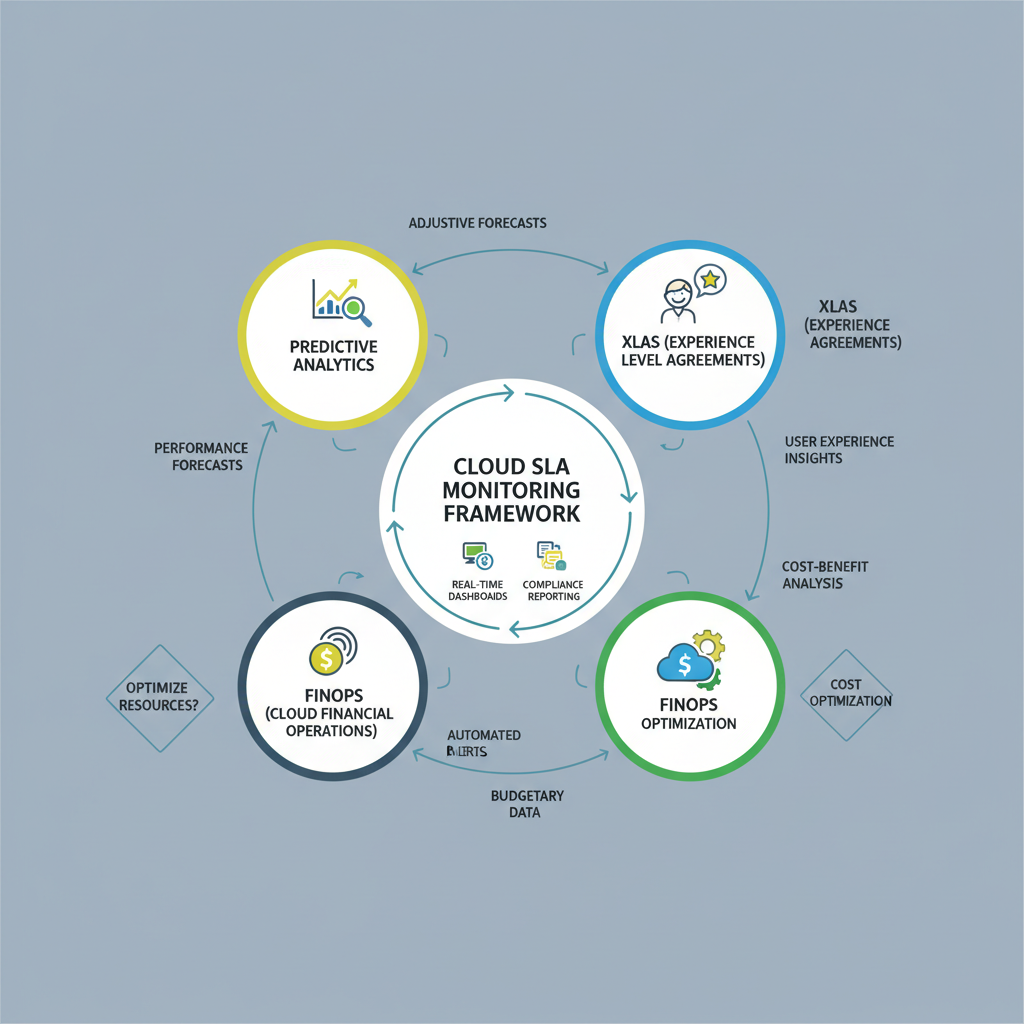
An infographic illustrating the interconnectedness of predictive analytics, XLAs, and FinOps within a modern cloud SLA monitoring framework, showing data flows and decision points.
Innovation in cloud technology is constantly introducing new tools and methodologies for effective SLA monitoring. The landscape is moving towards more integrated, intelligent, and automated solutions. These advancements are critical for keeping pace with the dynamic nature of cloud environments.
Observability platforms are gaining prominence, offering a unified view across logs, metrics, and traces to provide deep insights into system behavior. Serverless computing presents unique monitoring challenges, driving the development of specialized, event-driven monitoring tools. These upcoming SLA monitoring technologies are designed to handle distributed architectures.
Enhanced Real User Monitoring (RUM) and synthetic monitoring are becoming more sophisticated, accurately simulating user journeys and tracking actual user experiences. Emerging concepts like blockchain could also offer tamper-proof record-keeping for SLA adherence, increasing trust and transparency. These advancements are shaping the cloud SLA monitoring outlook.
Advanced Observability Platforms
Modern observability platforms move beyond traditional monitoring by consolidating data from diverse sources into a single pane of glass. This allows for comprehensive analysis of system health and performance, providing granular insights into every component. Such platforms are essential for complex cloud deployments.
By integrating logs, metrics, and traces, these platforms enable faster root cause analysis and proactive issue identification. They offer an end-to-end view of application performance, critical for understanding how individual services contribute to overall SLA compliance. This holistic approach supports the future of cloud SLA monitoring.
Serverless-Native Monitoring Solutions
Serverless architectures introduce ephemeral resources and event-driven functions, posing unique challenges for traditional monitoring tools. New serverless-native solutions are emerging that provide granular visibility into function invocations, execution times, and error rates. These tools are designed to handle the stateless and distributed nature of serverless.
These specialized monitoring platforms offer insights into cold starts, concurrency issues, and integration points between different serverless components. They are crucial for maintaining SLAs in highly dynamic, event-driven environments. Their development is a key part of upcoming SLA monitoring technologies.
AI/ML for Anomaly Detection and Root Cause Analysis
The sheer volume of data generated by cloud environments makes manual analysis impossible. AI and ML algorithms are indispensable for automatically detecting anomalies and pinpointing their root causes. This capability significantly reduces mean time to resolution (MTTR).
These intelligent systems can learn normal operational patterns and alert teams to deviations that might indicate an impending issue or SLA breach. They help prioritize alerts and guide engineers directly to the source of a problem. This enhanced intelligence is central to cloud performance monitoring predictions.
Best Practices for Effective Cloud SLA Monitoring
Establishing a robust cloud SLA monitoring strategy requires adherence to several best practices that go beyond simply installing tools. Organizations must define clear objectives, automate processes, and foster a culture of continuous improvement. These Cloud sla monitoring 2026 tips ensure maximum effectiveness.
Firstly, defining clear, measurable, and achievable service level objectives (SLOs) is foundational. Without precise benchmarks, it’s impossible to accurately measure compliance or identify deviations. These objectives should be aligned with business impact and user expectations.
Automating monitoring processes minimizes human error and ensures continuous vigilance across all cloud services. Regular review and adaptation of SLAs are also crucial, as cloud environments and business needs evolve rapidly. Transparent communication with both internal stakeholders and cloud providers builds trust and facilitates collaboration.
Defining Measurable Service Level Objectives
SLOs are specific, quantifiable targets within an SLA, such as 99.9% uptime or less than 100ms latency for critical transactions. These objectives must be clearly articulated and agreed upon by all parties. They serve as the direct measures for monitoring success.
It is vital to prioritize SLOs based on their impact on business operations and customer experience. Focusing monitoring efforts on the most critical services ensures that resources are allocated effectively. This clarity forms the basis of effective Cloud sla monitoring 2026.
Leveraging Automation for Continuous Monitoring
Manual monitoring is unsustainable in dynamic cloud environments. Implementing automated tools for data collection, analysis, and alerting ensures constant vigilance without overwhelming human operators. Automation is key to achieving consistent and reliable monitoring.
These automated systems should be configured to trigger alerts when thresholds are breached, enabling rapid response to potential issues. Integration with incident management systems further streamlines the remediation process. This proactive automation is a core component of the best Cloud sla monitoring 2026 approaches.
Regular Review and Adaptation of SLAs
Cloud services, business requirements, and user expectations are not static; they evolve over time. Therefore, SLAs and their associated SLOs must be regularly reviewed and updated to remain relevant and effective. An outdated SLA can lead to misaligned expectations or inadequate protection.
This iterative process ensures that monitoring efforts continue to address the most critical aspects of cloud service delivery. It also provides an opportunity to negotiate terms with providers based on observed performance and changing needs. This adaptability is critical for the future of cloud SLA monitoring.
Implementing a Robust Cloud SLA Monitoring Strategy
Developing an effective cloud SLA monitoring strategy involves several key steps, from tool selection to team collaboration. A well-structured implementation ensures that an organization can reliably track and enforce its service agreements. This comprehensive Cloud sla monitoring 2026 guide outlines the essential components.
Begin by performing a thorough assessment of your existing cloud architecture, identifying all critical services and their dependencies. This inventory will inform which metrics are most important to monitor. Subsequently, select monitoring tools that offer the necessary capabilities for your specific cloud environment.
Establishing clear baselines for normal performance is crucial for accurate anomaly detection and alerting. Training your teams on the monitoring tools and the importance of SLA compliance fosters a culture of accountability. Continuous improvement cycles ensure the strategy remains effective and adapts to new challenges.
Choosing the Right Monitoring Tools
Selecting the appropriate tools is foundational for any successful monitoring strategy. Consider solutions that offer end-to-end visibility, support multi-cloud or hybrid environments, and integrate with your existing operational tools. Scalability and ease of use are also important factors.
Look for features such as real-time dashboards, customizable alerts, historical data analysis, and predictive capabilities. Cloud sla monitoring 2026 examples often highlight integrated platforms that combine infrastructure, application, and network monitoring. The right tools provide actionable insights.
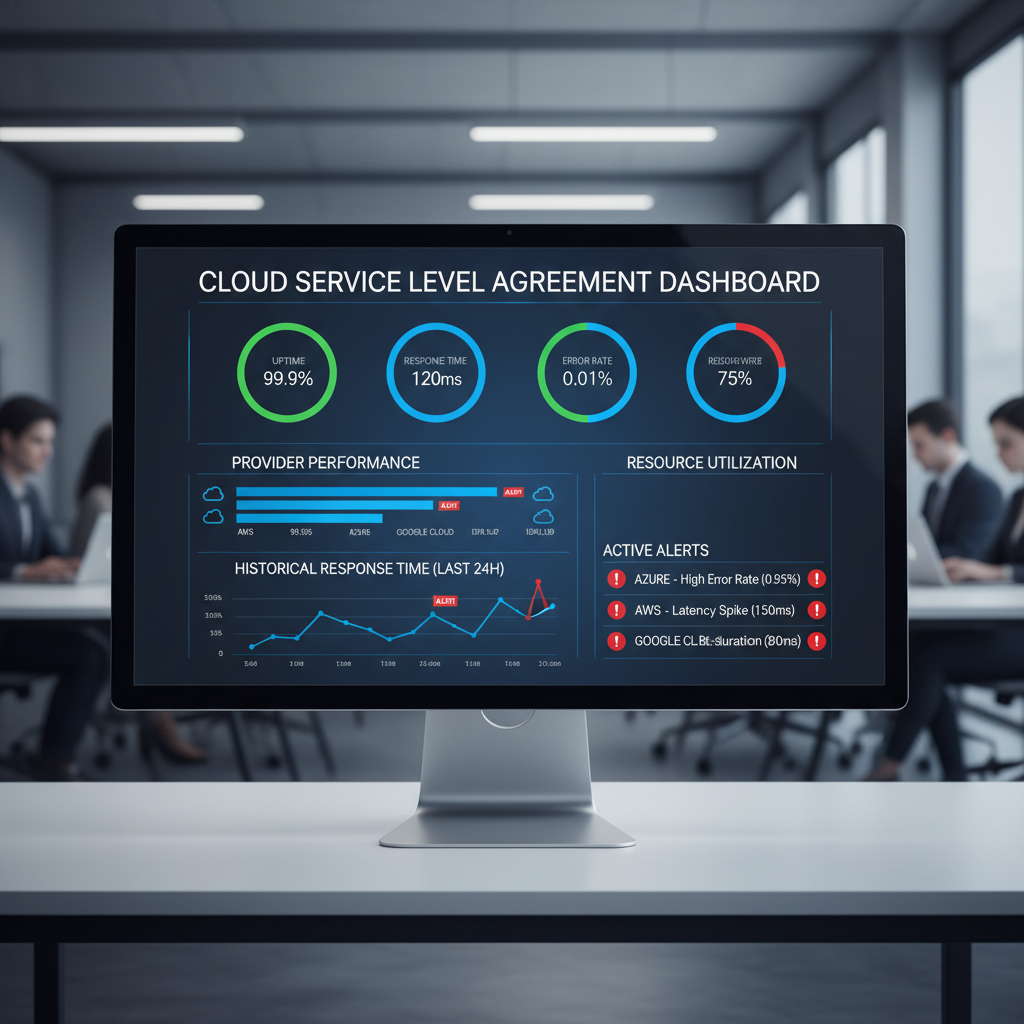
A dashboard displaying various cloud SLA monitoring metrics like uptime percentage, response times, error rates, and resource utilization across different cloud providers, with alerts highlighted.
Establishing Baselines and Alerting Thresholds
Before you can detect anomalies, you need to understand what constitutes normal performance for each service. Establishing historical baselines provides a crucial reference point for comparing current performance. This data-driven approach ensures alerts are meaningful.
Once baselines are set, define clear alerting thresholds that indicate a potential SLA breach or a degradation in service quality. These thresholds should be carefully calibrated to avoid alert fatigue while ensuring timely notification of critical issues. Effective thresholds are a key Cloud sla monitoring 2026 tip.
Fostering a Culture of Accountability
Successful SLA monitoring is not just about tools; it’s about people and processes. Educate all relevant teams—from development and operations to business stakeholders—on the importance of SLAs and their role in upholding them. This shared understanding promotes proactive engagement.
Encourage collaboration between teams and cloud providers, fostering open communication channels for performance reviews and issue resolution. Regular reporting on SLA adherence keeps everyone informed and accountable for service quality. This collective responsibility enhances the cloud SLA monitoring outlook.
Frequently Asked Questions About Cloud SLA Monitoring
What is Cloud SLA monitoring 2026?
Cloud SLA monitoring 2026 refers to the evolving practices and technologies used to continuously track, measure, and verify that cloud services meet the performance and availability commitments outlined in Service Level Agreements (SLAs) with providers. It encompasses current trends and future predictions in cloud performance assurance.
Why is proactive Cloud SLA monitoring crucial for businesses?
Proactive Cloud SLA monitoring is crucial because it allows businesses to detect and address potential service degradations or breaches before they impact end-users or violate contractual terms. This helps prevent costly downtime, maintain customer trust, avoid financial penalties, and ensure business continuity in cloud environments.
What are the main challenges in implementing Cloud SLA monitoring?
Key challenges include the complexity of multi-cloud and hybrid environments, the lack of standardized metrics across different providers, achieving comprehensive visibility into dynamic cloud resources, and managing vast amounts of performance data. These issues require sophisticated and integrated monitoring solutions.
How do AI and Machine Learning contribute to future SLA monitoring?
AI and Machine Learning will contribute significantly by enabling predictive analytics, which can anticipate potential service issues before they occur, and by automating anomaly detection. They can process vast datasets to identify subtle patterns, reduce false positives, and speed up root cause analysis, enhancing the proactive nature of SLA monitoring.
What is the difference between SLAs and XLAs in the context of cloud monitoring?
SLAs (Service Level Agreements) typically focus on technical metrics like uptime, latency, and error rates. XLAs (Experience Level Agreements), on the other hand, broaden this focus to include the actual end-user experience and satisfaction, measuring factors that directly impact how users perceive service quality, beyond just technical performance.
What are some examples of effective Cloud sla monitoring 2026 strategies?
Effective Cloud sla monitoring 2026 strategies involve leveraging unified observability platforms for end-to-end visibility, implementing AI-driven predictive analytics for proactive issue detection, adopting serverless-native monitoring for ephemeral workloads, and integrating FinOps practices to balance performance with cost efficiency. They also emphasize continuous review and adaptation of SLAs.
ENSURE UNINTERRUPTED SERVICE
Ensure uninterrupted service delivery and proactively prevent costly SLA breaches. Leverage our automated, real
✓ Free consultation ✓ No commitment required ✓ Trusted by experts
Conclusion
The journey into the future of cloud SLA monitoring highlights a landscape of increasing complexity and innovation. As organizations deepen their reliance on cloud services, the need for sophisticated, intelligent, and proactive monitoring becomes undeniable. By embracing the SLA monitoring trends 2026, leveraging upcoming SLA monitoring technologies, and adopting robust best practices, businesses can ensure optimal cloud performance and maintain unwavering trust with their customers and partners.
A well-implemented cloud SLA monitoring strategy is more than just a technical requirement; it is a critical business enabler. It provides the assurance that cloud investments are delivering expected value, safeguarding operations, and driving growth. Prepare your organization for the advancements in cloud performance monitoring predictions to secure a resilient and high-performing cloud future.
Jacob Stålbro is a seasoned digitalization and transformation leader with over 20 years of experience, specializing in AI-driven innovation. As Head of Innovation and Co-Founder at Opsio, he drives the development of advanced AI, ML, and IoT solutions. Jacob is a sought-after speaker and webinar host known for translating emerging technologies into real business value and future-ready strategies.