Top Cloud SLA Monitoring Providers: Ensure Uptime & Performance
March 6, 2026|2:50 PM
Unlock Your Digital Potential
Whether it’s IT operations, cloud migration, or AI-driven innovation – let’s explore how we can support your success.
Home /
Work /
Blogs /
Top Cloud SLA Monitoring Providers: Ensure Uptime & Performance
Understanding Cloud SLA Monitoring Providers
In the rapidly expanding world of cloud computing, managing expectations and ensuring service quality is paramount. Service Level Agreements (SLAs) are formal contracts outlining the minimum performance and availability standards a cloud service provider guarantees to its customers. Effectively tracking these commitments is where Cloud sla monitoring providers become indispensable partners for businesses.
These specialized entities offer robust solutions designed to continuously oversee, measure, and report on the performance of cloud services against predefined SLA metrics. They ensure transparency and accountability, providing critical insights into whether cloud environments are meeting their agreed-upon performance thresholds. Without dedicated monitoring, identifying and addressing potential service degradations promptly becomes a significant challenge for any organization relying on cloud infrastructure.
What Are SLAs in the Cloud Context?
Service Level Agreements in the cloud define the specific operational parameters that a cloud provider promises to deliver. These agreements cover various aspects, from network uptime and data availability to response times for support tickets. They are crucial for both providers and consumers, establishing clear expectations and responsibilities.
Typical metrics include uptime percentages, latency, data backup frequency, disaster recovery capabilities, and the speed of problem resolution. An SLA ensures that customers receive the service quality they pay for, protecting their operations from unexpected outages or performance issues. Understanding these contractual commitments forms the foundation for effective cloud performance monitoring companies to operate.
Key Components of Cloud SLAs
Cloud SLAs are often multifaceted, encompassing several critical components that dictate service delivery. Each component addresses a specific area of performance or availability. Monitoring these aspects thoroughly is essential for maintaining operational integrity and customer satisfaction.
Here are some standard components you’ll find in most cloud SLAs:
Availability: This specifies the percentage of time a service will be operational and accessible. For example, 99.9% uptime means very little downtime annually.
Performance: Metrics like response time, throughput, and latency are defined here. These measure how quickly and efficiently the service operates.
Data Durability and Backup: Guarantees regarding data persistence, backup frequency, and recovery point objectives (RPOs) are included. This ensures data integrity and recoverability.
Security: Outlines measures taken to protect data and infrastructure, though often security responsibilities are shared between provider and customer.
Support: Defines response times for incidents, problem resolution times, and available support channels. Timely support is vital for business continuity.
Why is SLA Monitoring Crucial for Cloud Services?
Effective SLA monitoring is not merely a technical exercise; it’s a strategic imperative for businesses utilizing cloud services. It directly impacts operational efficiency, customer satisfaction, and financial outcomes. Neglecting proper SLA tracking can lead to severe consequences, including significant financial losses and reputational damage.
The dynamic nature of cloud environments, with their distributed architectures and shared resources, makes continuous oversight even more critical. SLA tracking service providers offer the tools and expertise to navigate this complexity. They transform raw performance data into actionable insights, enabling proactive management and informed decision-making.
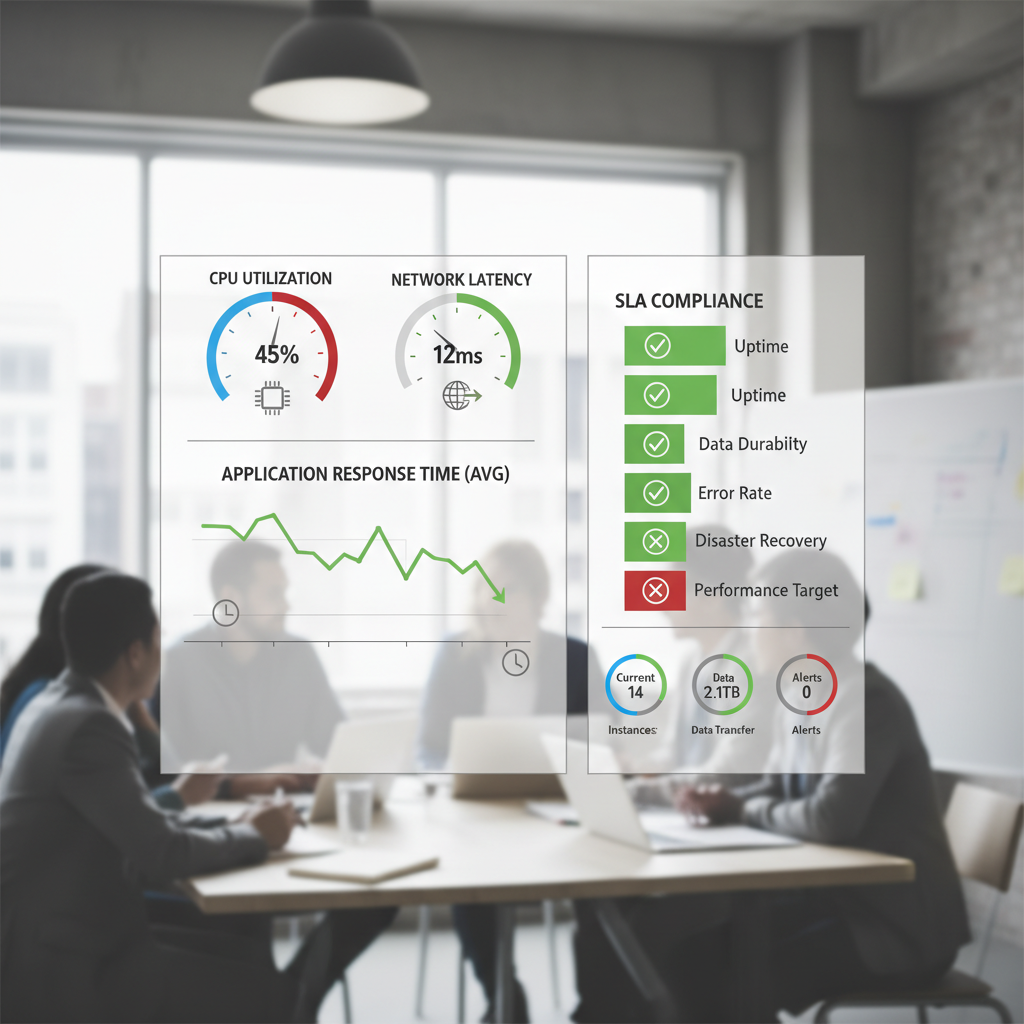
A dashboard displaying various cloud service metrics like CPU utilization, network latency, application response times, and an SLA compliance meter, with green indicators for met SLAs and red for breaches.
Protecting Business Operations
Monitoring ensures that your critical business applications and data remain available and performant. Downtime or slow performance can directly translate into lost revenue, decreased productivity, and damaged customer trust. Cloud service level management providers help mitigate these risks by continuously verifying service adherence.
When an SLA breach occurs, proactive alerting allows businesses to respond swiftly, minimizing the impact. This protective layer ensures business continuity, safeguarding against disruptions that could cripple operations. It empowers organizations to hold their cloud providers accountable for the services rendered.
Ensuring Cost-Effectiveness
While cloud services offer scalability and cost savings, without proper monitoring, you might be paying for services that don’t meet your operational needs. SLA monitoring firms help validate that you are getting the expected value from your cloud investments. They reveal discrepancies between promised and actual service levels.
By identifying underperforming services, organizations can negotiate credits for breaches or explore alternative providers. This data-driven approach optimizes cloud spending and ensures that resources are allocated efficiently. It provides the leverage needed to engage with providers effectively.
Enhancing Compliance and Governance
Many industries operate under strict regulatory compliance frameworks that demand specific levels of data availability, security, and performance. SLA monitoring provides the audit trails and evidence required to demonstrate compliance with these regulations. It offers transparent reporting on service performance.
This is particularly relevant for sectors like healthcare, finance, and government, where data integrity and accessibility are non-negotiable. Top SLA solution providers deliver reporting capabilities that simplify compliance audits. They help build a robust governance framework around cloud service consumption.
Key Features to Look for in Cloud SLA Monitoring Providers
When evaluating potential Cloud sla monitoring providers, it’s essential to consider a range of features that align with your organization’s specific needs. Not all solutions are created equal, and the best fit will depend on your cloud architecture, compliance requirements, and operational objectives. A comprehensive Cloud sla monitoring providers guide often emphasizes these functionalities.
Look for solutions that offer more than just basic uptime checks; they should provide deep insights and actionable intelligence. The right provider will act as an extension of your operations team, delivering clarity and control over your cloud environment. This strategic partnership is vital for long-term success.
Comprehensive Performance Metrics
A robust monitoring solution should track a wide array of metrics beyond simple availability. This includes CPU utilization, memory usage, network latency, disk I/O, and application-specific performance indicators. Detailed metrics allow for precise identification of performance bottlenecks and potential SLA breaches.
It is crucial to monitor both infrastructure and application performance. This holistic view ensures that all layers of your cloud stack are performing as expected. The best Cloud sla monitoring providers offer customizable dashboards to visualize these metrics effectively.
Real-time Alerting and Notifications
Timely alerts are critical for immediate incident response. The monitoring solution should offer customizable alerting mechanisms, notifying relevant teams via various channels like email, SMS, Slack, or ticketing systems. This ensures that potential issues are addressed before they escalate.
Configurable alert thresholds and escalation policies are also important. This allows for differentiated responses based on the severity of the issue and ensures that the right personnel are engaged. Effective alerting is a cornerstone of proactive cloud management.
Customizable Reporting and Dashboards
The ability to generate comprehensive reports and build custom dashboards is vital for stakeholder communication and compliance purposes. Reports should detail SLA compliance, incident history, and performance trends over time. This data supports informed decision-making.
Customizable dashboards allow teams to visualize the most relevant metrics at a glance. They provide a consolidated view of your cloud environment’s health and performance. This transparency helps in demonstrating value and accountability.
Multi-Cloud and Hybrid Cloud Support
Many organizations operate in multi-cloud or hybrid cloud environments, utilizing services from different providers. The ideal Cloud sla monitoring providers should offer unified monitoring capabilities across these diverse platforms. This consolidates data and simplifies management.
A single pane of glass for all your cloud services greatly reduces complexity and operational overhead. It ensures consistent SLA enforcement regardless of where your workloads reside. This flexibility is increasingly important in modern IT landscapes.
Integration Capabilities
Seamless integration with existing IT tools, such as incident management systems, configuration management databases (CMDBs), and DevOps pipelines, is a significant advantage. This streamlines workflows and enhances operational efficiency. Integrations reduce manual effort and improve data consistency.
APIs and pre-built connectors allow for automated data exchange and process automation. This enables a more cohesive and automated approach to cloud operations. Strong integration capabilities are a hallmark of advanced monitoring solutions.
ENSURE UNINTERRUPTED SERVICE
Ensure uninterrupted service delivery and proactively prevent costly SLA breaches. Leverage our automated, real
✓ Free consultation ✓ No commitment required ✓ Trusted by experts
Choosing the Right Cloud SLA Monitoring Providers
Selecting the best Cloud sla monitoring providers requires careful consideration of several factors beyond just features. It involves evaluating vendor reputation, support quality, pricing models, and how well their solution aligns with your strategic goals. Making an informed decision is paramount for long-term success.
This Cloud sla monitoring providers guide emphasizes due diligence to ensure you partner with a provider that truly meets your needs. Look for examples of successful implementations and case studies relevant to your industry. A thorough evaluation process will yield the most suitable outcome.
Vendor Reputation and Experience
Research the provider’s track record, customer reviews, and industry standing. A vendor with extensive experience in cloud monitoring and a strong reputation for reliability is often a safer choice. Their expertise translates into more robust and effective solutions.
Look for providers with a proven history of innovation and adaptability in the fast-evolving cloud landscape. Engaging with established SLA monitoring vendors can provide peace of mind. Their long-term commitment to the space is a valuable asset.
Scalability and Flexibility
Ensure the monitoring solution can scale with your evolving cloud infrastructure and accommodate future growth. It should be flexible enough to adapt to changes in your service architecture and monitoring requirements. Scalability is a key advantage of cloud services themselves.
The solution should support increasing volumes of data and a growing number of monitored endpoints without performance degradation. This ensures that your monitoring capabilities remain robust as your cloud footprint expands. Flexibility allows for customized monitoring strategies.
Pricing Structure and TCO
Understand the pricing model thoroughly, including any hidden costs for data ingestion, alerting, or advanced features. Compare the total cost of ownership (TCO) across different providers, considering licensing fees, implementation costs, and ongoing operational expenses. A transparent pricing model is crucial.
Consider if the pricing aligns with your budget and usage patterns. Some providers offer pay-as-you-go models, while others have tiered subscriptions. The most cost-effective solution will be one that scales with your needs without breaking the bank.
Support and Service Level Agreements
Evaluate the support offered by the Cloud sla monitoring providers themselves. What are their response times for critical issues? What support channels are available? Good technical support can be invaluable, especially during unexpected incidents.
Review their own internal SLAs for support and customer service. This gives an indication of their commitment to service quality. Reliable support is a critical factor in maintaining operational continuity when using external tools.
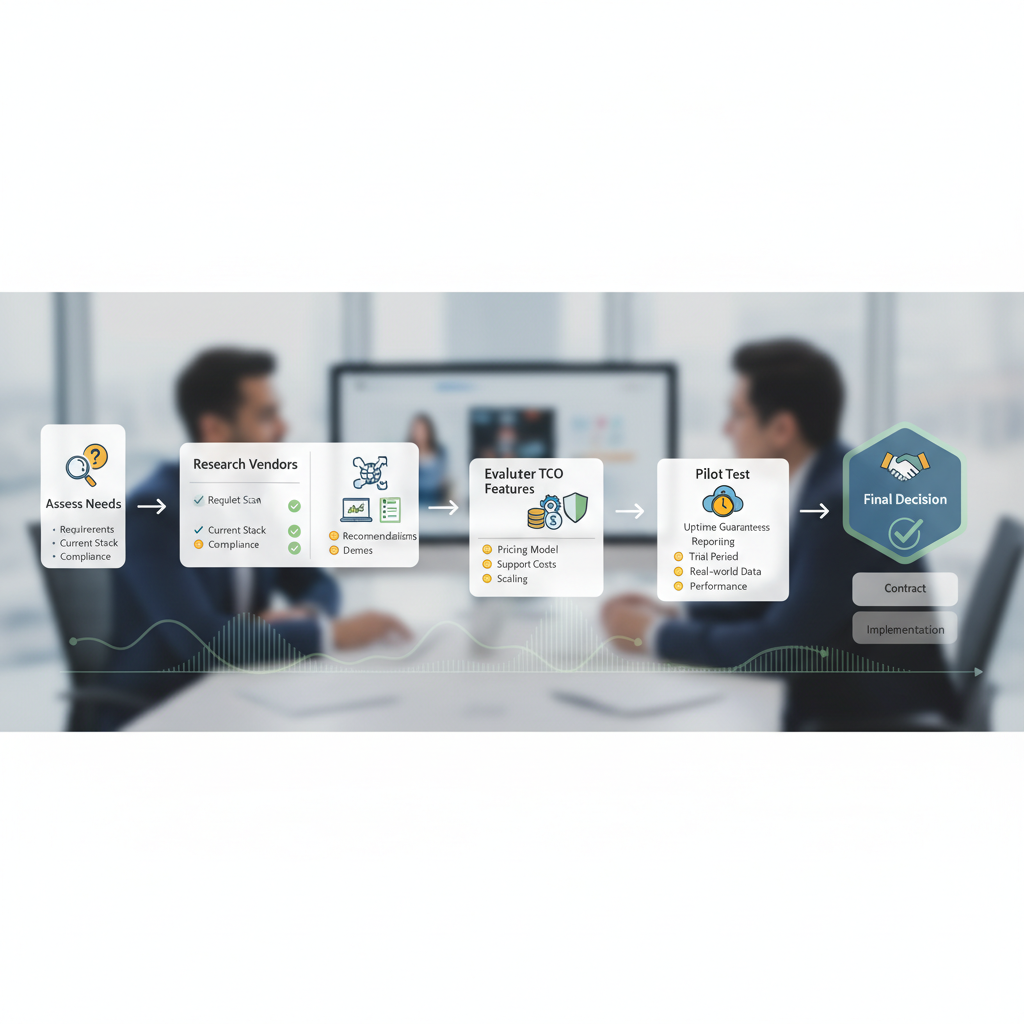
A flowchart illustrating the process of selecting a cloud SLA monitoring provider, with steps like “Assess Needs,” “Research Vendors,” “Evaluate Features,” “Consider TCO,” “Pilot Test,” and “Final Decision.”
Benefits of Partnering with Top Cloud SLA Monitoring Providers
Engaging with leading Cloud sla monitoring providers offers numerous strategic and operational advantages that extend beyond mere technical oversight. These partnerships empower organizations to optimize their cloud investments, enhance operational resilience, and maintain a competitive edge. The best Cloud sla monitoring providers deliver significant value.
They bring specialized expertise, cutting-edge technology, and a deep understanding of cloud ecosystems to the table. This allows businesses to focus on their core competencies while relying on experts to safeguard their cloud service quality. The strategic benefits are substantial.
Proactive Problem Resolution
Top monitoring providers enable businesses to identify and address potential performance issues or SLA breaches before they impact end-users. Their advanced analytics and alerting systems facilitate proactive intervention. This minimizes downtime and maintains service quality.
By predicting potential failures, teams can implement preventative measures, ensuring continuous service delivery. This shift from reactive firefighting to proactive management is a hallmark of mature cloud operations. Proactive resolution boosts customer satisfaction and trust.
Improved Vendor Accountability
With clear, objective data on SLA performance, organizations can hold their cloud service providers accountable for their contractual obligations. This data provides leverage in discussions regarding service credits or performance improvements. It fosters a relationship built on transparency.
This objective evidence ensures that agreements are honored, and service quality remains consistent. Improved accountability leads to better service from your cloud vendors. It’s an essential aspect of managing external dependencies effectively.
Enhanced Resource Optimization
Detailed performance data helps in understanding resource utilization patterns and identifying inefficiencies. Organizations can optimize their cloud resource allocation, ensuring that services are adequately provisioned without overspending. This fine-tuning enhances cost-effectiveness.
By identifying underutilized resources or performance bottlenecks, businesses can make informed decisions about scaling up or down. This leads to more efficient use of cloud infrastructure. Optimized resource management is crucial for sustainable cloud operations.
How Cloud SLA Monitoring Providers Work
Cloud sla monitoring providers leverage a combination of agents, APIs, and network probes to collect vast amounts of data from your cloud environment. This data is then processed, analyzed, and presented through intuitive dashboards and reports. Their methodologies ensure comprehensive coverage and deep insights.
The entire process is designed to be continuous and automated, providing real-time visibility into the health and performance of your cloud services. Understanding these operational mechanisms helps in appreciating the value these firms bring. It showcases the technical sophistication behind their offerings.
Data Collection Mechanisms
Monitoring solutions typically deploy lightweight agents on virtual machines or containers, or they integrate directly with cloud provider APIs (e.g., AWS CloudWatch, Azure Monitor). These mechanisms gather metrics on infrastructure performance, application response times, and network traffic. External probes may simulate user interactions to measure end-user experience.
This multi-faceted approach ensures comprehensive data collection from various layers of the cloud stack. The choice of mechanism often depends on the specific service being monitored and the level of detail required. Robust data collection is the foundation of effective monitoring.
Data Analysis and Interpretation
Once collected, the raw data undergoes sophisticated analysis. This involves applying machine learning algorithms and rule-based engines to identify patterns, anomalies, and potential SLA breaches. The data is then correlated across different metrics to pinpoint root causes of issues.
Advanced analytics can predict future performance degradations, enabling proactive intervention. The interpretation phase transforms raw numbers into actionable insights. This empowers teams to make informed decisions quickly.
Reporting and Visualization
The analyzed data is then presented through customizable dashboards, real-time alerts, and historical reports. These visualizations allow users to quickly grasp the current state of their cloud services and track long-term performance trends. Clear presentation is key for usability.
Reports often include compliance summaries, incident logs, and detailed performance metrics, providing a comprehensive overview for both technical teams and business stakeholders. This transparent reporting fosters trust and accountability. It also supports compliance efforts effectively.
Future Trends in Cloud SLA Monitoring
The landscape of cloud computing is constantly evolving, and with it, the approaches to SLA monitoring are advancing rapidly. Future trends in Cloud sla monitoring providers will focus on greater automation, deeper integration with AI, and a more user-centric perspective. These innovations will further enhance the precision and efficiency of monitoring solutions.
Organizations should look towards providers that are embracing these emerging technologies to future-proof their cloud operations. Staying ahead of these trends will ensure that monitoring capabilities remain robust and relevant. The evolution of monitoring will mirror the evolution of cloud services themselves.
AI and Machine Learning Integration
Artificial intelligence and machine learning are increasingly being integrated into monitoring solutions to enhance anomaly detection, predict outages, and automate root cause analysis. AI-driven insights reduce manual effort and improve the accuracy of problem identification. This automation is a game-changer.
These technologies enable monitoring systems to learn normal behavior patterns and flag deviations with greater precision, reducing false positives. Predictive analytics empower proactive problem resolution like never before. AI will make monitoring smarter and more efficient.
AIOps for Automated Remediation
AIOps platforms combine AI/ML with IT operations data to automate many aspects of IT management, including intelligent alerting and automated remediation. Future Cloud sla monitoring providers will integrate more deeply with AIOps to trigger automated actions in response to detected SLA breaches. This moves beyond just alerting.
This could involve auto-scaling resources, rerouting traffic, or initiating recovery procedures without human intervention. Automated remediation reduces mean time to resolution (MTTR) and minimizes the impact of incidents. AIOps promises a truly self-healing cloud environment.
Focus on Business-Level SLAs
While technical metrics remain crucial, there’s a growing emphasis on monitoring business-level SLAs that directly impact customer experience and revenue. This involves tracking metrics like transaction completion rates, login success rates, and customer journey performance. A holistic view is emerging.
Monitoring solutions will evolve to provide richer insights into how technical performance translates into business outcomes. This shift ensures that monitoring efforts are aligned with strategic business objectives. It bridges the gap between IT and the business.
Frequently Asked Questions
What exactly do Cloud sla monitoring providers do?
Cloud sla monitoring providers offer specialized tools and services to continuously track and verify that cloud services meet the performance, availability, and security standards outlined in Service Level Agreements (SLAs). They collect data, analyze it for compliance, and provide alerts and reports. Their primary role is to ensure accountability and transparency between cloud users and providers.
Why is it important to use SLA tracking service providers?
It’s crucial to use SLA tracking service providers to safeguard your business operations. They help prevent unexpected downtime, ensure you’re getting the service quality you pay for, and provide evidence for compliance and regulatory requirements. Without them, identifying and addressing performance issues in complex cloud environments becomes difficult and reactive.
How do cloud service level management providers ensure E-E-A-T?
Cloud service level management providers demonstrate E-E-A-T through several means: by employing expert engineers and data scientists, offering robust and reliable monitoring solutions, publishing transparent performance reports, and maintaining strong customer support. Their long-standing presence, certifications, and positive client testimonials also contribute to their authority and trustworthiness in the field.
Can Cloud sla monitoring providers work across different cloud platforms?
Yes, many modern Cloud sla monitoring providers offer multi-cloud and hybrid cloud support. They are designed to integrate with various cloud platforms like AWS, Azure, Google Cloud, and on-premises infrastructure. This capability provides a unified view of your entire distributed environment, ensuring consistent SLA compliance across all your services.
What are common metrics monitored by SLA monitoring firms?
SLA monitoring firms commonly track metrics such as uptime percentage, network latency, application response times, data durability (e.g., successful backups), throughput, and error rates. They also often monitor resource utilization (CPU, memory, disk I/O) and specific service health indicators relevant to the cloud services in use.
ENSURE UNINTERRUPTED SERVICE
Ensure uninterrupted service delivery and proactively prevent costly SLA breaches. Leverage our automated, real
✓ Free consultation ✓ No commitment required ✓ Trusted by experts
Conclusion
The reliance on cloud services continues to grow exponentially, making robust SLA monitoring an absolute necessity for businesses of all sizes. Cloud sla monitoring providers offer critical tools and expertise to ensure that cloud environments consistently meet agreed-upon performance and availability standards. By leveraging these specialized solutions, organizations gain transparency, enhance accountability, and protect their operational integrity.
Choosing the best Cloud sla monitoring providers involves a careful evaluation of features, vendor reputation, and how well their offerings align with your unique cloud strategy. As the cloud landscape evolves, the integration of AI, AIOps, and a focus on business-level SLAs will further refine these monitoring capabilities, solidifying their role as indispensable partners in the digital age.
Jacob Stålbro is a seasoned digitalization and transformation leader with over 20 years of experience, specializing in AI-driven innovation. As Head of Innovation and Co-Founder at Opsio, he drives the development of advanced AI, ML, and IoT solutions. Jacob is a sought-after speaker and webinar host known for translating emerging technologies into real business value and future-ready strategies.