Expert Cloud Managed Provider Services for Your Business Growth
March 5, 2026|1:04 PM
Unlock Your Digital Potential
Whether it’s IT operations, cloud migration, or AI-driven innovation – let’s explore how we can support your success.
Home /
Insights /
Expert Cloud Managed Provider Services for Your Business Growth
Understanding the Evolving Landscape of cloud managed provider in 2026
The realm of cloud computing continues its rapid expansion, becoming an indispensable backbone for businesses globally. As organizations increasingly migrate critical operations to the cloud, the complexity of managing these environments also escalates. This is precisely where a cloud managed provider steps in, offering specialized services to navigate these intricate digital waters.
By 2026, the demand for sophisticated cloud management solutions will have reached new heights. Businesses require more than just hosting; they need proactive monitoring, robust security, and optimized performance. A reliable cloud managed provider delivers comprehensive support, ensuring cloud infrastructure operates seamlessly and efficiently.
This guide will serve as your definitive resource for understanding, evaluating, and ultimately choosing the best cloud managed provider for your organization in the current competitive landscape. We will delve into the critical aspects of managed cloud services, offering insights and practical tips to empower your decision-making process.
Why Partner with a cloud managed provider? Benefits and Advantages
Engaging with a specialized cloud managed provider brings a multitude of strategic advantages to businesses of all sizes. These partnerships extend beyond simple technical support, evolving into a critical component of modern IT strategy. Understanding these benefits is the first step in leveraging managed cloud services effectively.
One primary benefit is access to deep cloud expertise that might be costly or difficult to maintain in-house. A managed service provider (MSP) specializing in cloud environments employs certified professionals who possess extensive knowledge across various cloud platforms. This expertise ensures that your cloud infrastructure is designed, implemented, and optimized according to best practices.
Furthermore, partnering with a third-party provider allows your internal IT teams to refocus on core business initiatives rather than day-to-day operational tasks. The cloud managed provider takes responsibility for routine maintenance, patching, backups, and performance tuning. This shift in focus can significantly enhance productivity and foster innovation within your organization.
Cost efficiency is another compelling advantage. While an initial investment is required, outsourcing managed IT services often proves more economical than building and maintaining an in-house team with equivalent skill sets and tools. Providers typically offer scalable service models, allowing you to pay only for the resources and support you need. They help optimize cloud spending, preventing costly over-provisioning and identifying efficiencies.
Reliability and uptime are paramount in today’s always-on business environment. A dedicated cloud managed provider offers 24/7 monitoring and rapid response to incidents, minimizing downtime and ensuring business continuity. Their robust infrastructure and proactive approach help prevent issues before they impact operations.
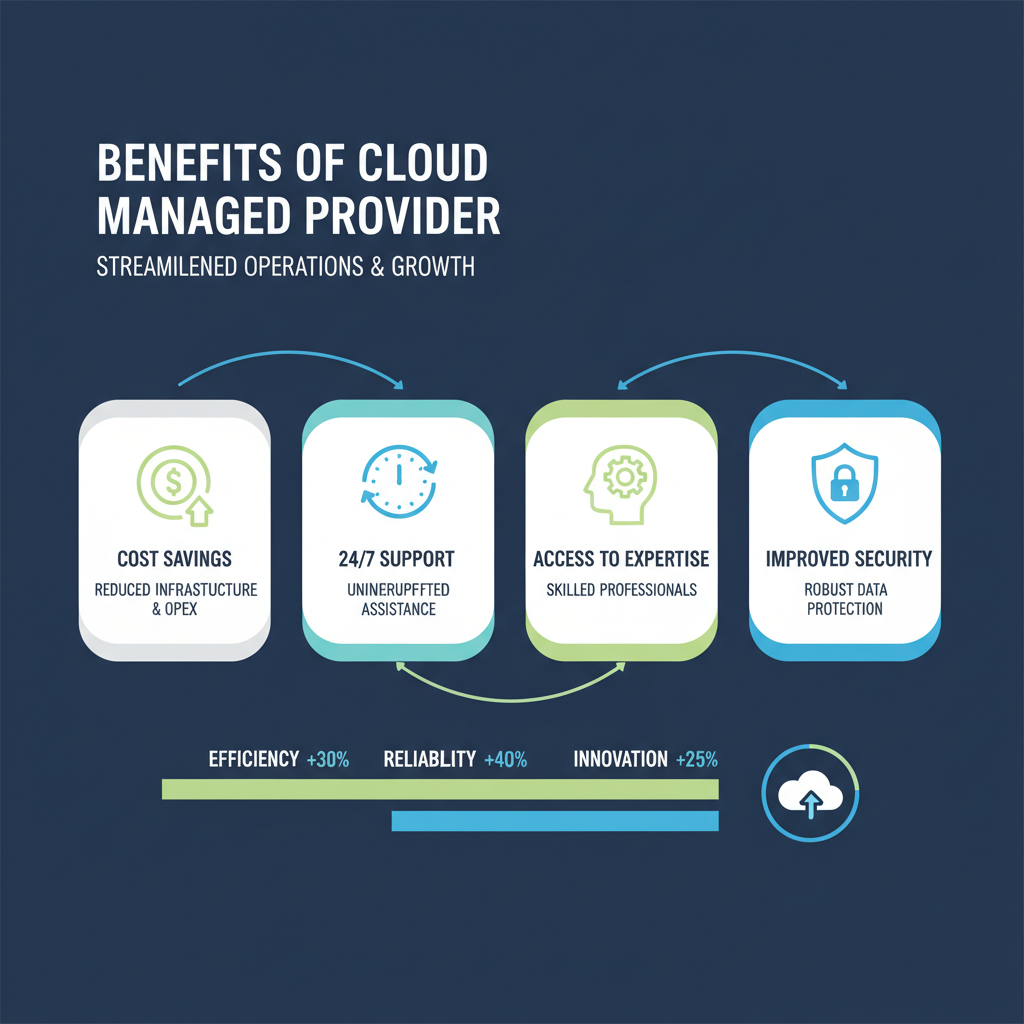
A detailed infographic showing different benefits of using a cloud managed provider, such as cost savings, 24/7 support, access to expertise, and improved security, depicted with relevant icons.
Finally, enhanced security and compliance are critical benefits that a specialized provider brings. They implement advanced security protocols, conduct regular audits, and help businesses adhere to industry-specific regulatory requirements. This proactive security posture is invaluable in protecting sensitive data and maintaining trust.
Key Considerations When Selecting a cloud managed provider
Choosing the right cloud managed provider is a strategic decision that can significantly impact your business’s operational efficiency, security, and growth trajectory. It’s crucial to evaluate potential partners based on several key criteria. A thorough assessment will ensure you select a provider that aligns perfectly with your specific needs and long-term objectives.
This section outlines the essential factors to consider during your selection process. Each aspect plays a vital role in determining the overall quality and suitability of a potential cloud vendor. By carefully reviewing these areas, you can make an informed choice that supports your cloud journey.
Assessing Technical Expertise and Specializations
The technical proficiency of a cloud managed provider is arguably its most critical attribute. You need a partner with proven cloud expertise across the platforms you utilize or plan to use. Verify their certifications and experience with major cloud vendors such as AWS, Azure, or Google Cloud.
Look for providers that demonstrate deep knowledge in specific areas relevant to your business, like data analytics, AI/ML integration, or serverless computing. Their ability to understand your unique technological landscape is paramount. Inquire about their track record with similar projects or industries.
Experience with various operating systems, databases, and application stacks is also essential. A versatile provider can offer more comprehensive solutions and adapt to your evolving technological needs. Their technical support teams should be well-versed in troubleshooting a wide range of issues.
Evaluating Service Level Agreements (SLAs) and Support Models
A robust service level agreement (SLA) is the cornerstone of any successful partnership with a managed service provider (MSP). The SLA outlines the specific services provided, performance metrics, availability guarantees, and response times. Carefully review these terms to ensure they meet your operational requirements.
Key components of an SLA include uptime guarantees, incident response and resolution times, and parameters for performance monitoring. Understand the penalties or remedies specified if the provider fails to meet these agreed-upon levels. A clear and comprehensive SLA protects both parties.
Consider the support models offered, such as 24/7 technical support, dedicated account managers, and tiered support structures. Evaluate how easily you can communicate with their teams and what channels are available for support requests. Proactive communication and transparent reporting are signs of a strong provider.
Understanding Security and Compliance Posture
In an era of escalating cyber threats, the security posture of your cloud managed provider is non-negotiable. They must demonstrate a robust approach to securing your data and infrastructure. Inquire about their security certifications, such as ISO 27001, SOC 2, or relevant industry-specific standards.
Ask about their data encryption practices, access control mechanisms, and disaster recovery plans. A good provider will have comprehensive strategies for threat detection, prevention, and incident response. They should also perform regular security audits and vulnerability assessments.
For businesses operating in regulated industries, compliance with standards like HIPAA, GDPR, or NIS2 is critical. Verify that the cloud vendor has experience and established processes to help you meet these regulatory obligations. Their commitment to compliance is a direct reflection of their trustworthiness.
Cost Structure and Value Proposition
While cost should not be the sole determining factor, understanding the pricing model and overall value proposition is crucial. Managed cloud services can vary significantly in pricing, from fixed monthly fees to usage-based models. Ensure transparency in their billing and a clear breakdown of services included.
Compare pricing across multiple potential providers, but always consider the value received beyond just the dollar amount. A slightly more expensive provider might offer superior service, advanced features, or specialized cloud expertise that justifies the higher cost. Look for a cloud managed provider that offers scalability in their pricing.
Understand how they help optimize your cloud spending over time. A good managed service provider can provide cost-saving recommendations and implement strategies to prevent cloud waste. They should be seen as a strategic partner in managing your total cost of ownership (TCO) for cloud resources.
MAXIMIZE YOUR CLOUDS
Maximize your cloud’s potential with expert management. Discover custom cloud solutions
✓ Free consultation ✓ No commitment required ✓ Trusted by experts
The Step-by-Step Process to Choose Your Ideal cloud managed provider
Selecting the best cloud managed provider involves a structured and methodical approach. This process ensures that you thoroughly evaluate all options and make a decision that aligns with your organization’s strategic goals. Following these steps will help you navigate the complexities of provider selection with confidence.
These cloud managed provider tips are designed to simplify your search and ensure you ask the right questions at each stage. By committing to a detailed selection process, you increase the likelihood of forging a successful, long-term partnership that truly benefits your business.
Step 1: Define Your Cloud Needs and Goals
Before approaching any potential provider, clearly articulate your current cloud environment, future aspirations, and specific challenges. Identify which aspects of cloud management you need assistance with, whether it’s migration, optimization, security, or ongoing operational support.
Document your technical requirements, performance expectations, and any compliance obligations. Consider your budget constraints and the desired timeline for implementation. A clear internal understanding of your needs will enable you to effectively communicate with prospective providers.
Step 2: Research and Shortlist Potential Providers
Begin by researching reputable managed service provider (MSP) companies known for their cloud expertise. Look for providers with a strong industry reputation, positive client testimonials, and a proven track record. Industry reports and peer recommendations can be valuable resources at this stage.
Create a preliminary shortlist of 5-10 providers that appear to meet your initial criteria. Focus on those with demonstrated experience in your industry or with technologies relevant to your business. This initial research will streamline the subsequent due diligence.
Step 3: Conduct Due Diligence and Request Proposals
Reach out to your shortlisted providers to request detailed information and proposals. Provide them with a comprehensive Request for Proposal (RFP) that outlines your specific needs, technical requirements, desired service levels, and budget considerations. This ensures you receive comparable responses.
During this phase, assess each cloud vendor’s organizational structure, client references, and financial stability. Look for transparency in their offerings and a willingness to tailor solutions to your unique situation. A good cloud managed provider guide will emphasize this step.
Step 4: Evaluate Proposals and Interview Candidates
Carefully review each submitted proposal, comparing them against your predefined criteria. Pay close attention to the proposed solutions, pricing models, service level agreements (SLAs), and security measures. Look for clarity, comprehensiveness, and alignment with your business goals.
Schedule interviews with the top 2-3 candidates. Use these meetings to delve deeper into their technical capabilities, team structure, and customer support philosophy. Ask probing questions about their problem-solving methodologies and how they handle client communication.
Step 5: Negotiate Contracts and Onboarding
Once you have identified your preferred cloud managed provider, thoroughly review and negotiate the contract terms. Ensure that all aspects of the service, including pricing, support, security, and performance guarantees, are explicitly detailed in the service level agreement (SLA).
Clarify the onboarding process, including timelines, responsibilities, and key milestones. A well-defined onboarding plan is crucial for a smooth transition. Establish clear communication channels and performance review schedules to ensure ongoing success.
Common Challenges and How to Overcome Them with a cloud managed provider
Even with the best planning, transitioning to or managing cloud infrastructure can present various challenges. A proficient cloud managed provider is equipped to help businesses anticipate and mitigate these common hurdles, transforming potential obstacles into opportunities for streamlined operations.
One frequent challenge is managing escalating cloud costs due to inefficient resource allocation or lack of visibility. A dedicated cloud managed provider can implement robust cost optimization strategies. They use specialized tools and expertise to monitor usage, identify idle resources, and recommend more cost-effective configurations, helping you avoid unnecessary expenses.
Security concerns remain a top priority for organizations migrating to the cloud. Many businesses struggle with implementing comprehensive security frameworks and staying compliant with evolving regulations. A reputable cloud vendor offers advanced security services, including threat detection, vulnerability management, and compliance auditing. They ensure your cloud environment meets stringent security standards like NIS2.
Another significant hurdle is the complexity of managing multi-cloud or hybrid cloud environments. Integrating different platforms and ensuring seamless data flow requires specialized skills. A cloud managed provider with broad cloud expertise can design and implement unified management strategies, simplifying operations across diverse environments. They provide a single pane of glass for monitoring and control.
Finally, a lack of internal cloud expertise can hinder a company’s ability to fully leverage cloud benefits. Recruitment and retention of skilled cloud professionals are challenging and expensive. By partnering with a third-party provider, businesses gain immediate access to a team of certified experts. This alleviates the pressure on internal teams and ensures optimal cloud performance.
Future Trends: What to Expect from cloud managed provider Services by 2026
The landscape of cloud managed services is continuously evolving, driven by technological advancements and shifting business needs. By 2026, several key trends will define the offerings and capabilities of a leading cloud managed provider. Understanding these trends will help businesses plan for the future.
One significant trend is the increased adoption of Artificial Intelligence (AI) and Machine Learning (ML) for enhanced cloud management. AI-powered tools will offer more predictive analytics, automating incident response and optimizing resource allocation with greater precision. This will lead to even more efficient and proactive managed IT services.
Furthermore, the focus on FinOps (Cloud Financial Operations) will intensify. cloud managed provider offerings will incorporate sophisticated cost management and optimization platforms. These platforms will provide real-time insights into cloud spending, helping organizations make data-driven decisions to control budgets and maximize ROI.
A modern, futuristic office worker interacting with a holographic interface displaying cloud performance metrics and security dashboards, symbolizing advanced cloud managed services in 2026.
Security services provided by a managed service provider will become even more specialized and proactive. Expect advanced threat intelligence integration, automated compliance checks, and a greater emphasis on zero-trust architectures. Providers will also focus heavily on data sovereignty and complex regulatory adherence, particularly for global enterprises.
Lastly, the rise of serverless computing and containerization will necessitate a new generation of managed services. cloud managed provider firms will offer specialized expertise in managing these dynamic, event-driven architectures. This will include optimizing performance, scaling resources, and ensuring security for highly distributed applications.
Frequently Asked Questions about cloud managed provider
Navigating the world of managed cloud services can raise many questions. This section addresses some of the most common inquiries businesses have about selecting and working with a cloud managed provider. These answers provide further clarity and help solidify your understanding.
What exactly is a cloud managed provider?
A cloud managed provider is a third-party company that specializes in managing and maintaining a business’s cloud infrastructure and services. They offer a range of managed IT services, including monitoring, security, optimization, and technical support, often for platforms like AWS, Azure, or Google Cloud. Their primary role is to ensure the cloud environment runs efficiently, securely, and cost-effectively.
How does a cloud managed provider differ from a traditional MSP?
While a traditional managed service provider (MSP) might manage on-premise IT infrastructure, a cloud managed provider focuses specifically on cloud-based environments. They possess deep cloud expertise and specialized tools to handle the unique complexities of cloud platforms. Their services are tailored to cloud security, scalability, and cost optimization.
What are the key benefits of using a cloud managed provider?
Key benefits include access to specialized cloud expertise, 24/7 technical support, enhanced security and compliance, improved operational efficiency, and significant cost savings through optimization. Partnering with a cloud managed provider allows internal teams to focus on core business activities while offloading complex cloud management tasks to experts.
How do I ensure data security with a third-party provider?
Ensuring data security involves carefully vetting the provider’s security practices, certifications (e.g., ISO 27001, SOC 2), and compliance with relevant regulations like GDPR or HIPAA. A strong service level agreement (SLA) should detail their security measures, incident response plans, and data handling protocols. Regular audits and transparent reporting are also crucial.
What should I look for in a service level agreement (SLA)?
A comprehensive SLA should clearly define performance metrics, uptime guarantees, incident response and resolution times, and the scope of services. It should also outline penalties for non-compliance and communication protocols. Ensure the SLA aligns with your business’s operational needs and expectations for reliability.
Can a cloud managed provider help with cost optimization?
Absolutely. A good cloud managed provider offers significant value in cost optimization. They utilize specialized tools and cloud expertise to monitor resource usage, identify inefficiencies, recommend rightsizing of instances, and implement strategies like reserved instances or spot instances. This proactive management helps reduce cloud spending and maximizes your return on investment.
MAXIMIZE YOUR CLOUDS
Maximize your cloud’s potential with expert management. Discover custom cloud solutions
✓ Free consultation ✓ No commitment required ✓ Trusted by experts
Conclusion: Making an Informed Decision for Your Cloud Journey
Choosing the right cloud managed provider is a pivotal decision for any organization leveraging cloud technology in 2026. This comprehensive cloud managed provider guide has outlined the essential factors, from assessing technical expertise to understanding future trends. By meticulously evaluating potential partners based on their cloud expertise, security posture, SLA commitments, and value proposition, you can make an informed decision that drives your business forward.
A strategic partnership with a reputable managed service provider can unlock unparalleled benefits, including enhanced security, optimized performance, and significant cost efficiencies. The best cloud managed provider will act as a true extension of your team, providing the specialized knowledge and continuous support needed to navigate the complexities of modern cloud environments. Invest wisely in your cloud managed provider to ensure a resilient, scalable, and secure future for your digital operations.