Best Cloud Cost Optimization Tools: A How-To Guide
March 3, 2026|10:26 AM
Unlock Your Digital Potential
Whether it’s IT operations, cloud migration, or AI-driven innovation – let’s explore how we can support your success.
Home /
Work /
Blogs /
Best Cloud Cost Optimization Tools: A How-To Guide
The rapid adoption of cloud computing has transformed how businesses operate, offering unparalleled scalability, flexibility, and innovation. However, this transformative power comes with a critical challenge: managing escalating cloud expenses. Without proper oversight, cloud costs can quickly spiral out of control, eroding profitability and hindering strategic investments. This is where cloud cost optimization tools become indispensable.
This comprehensive cloud cost optimization tools guide is designed to help you navigate the complexities of cloud spending. We will explore how these essential tools empower organizations to gain visibility, control, and efficiency over their cloud environments. Understanding and implementing the best cloud cost optimization tools is no longer optional; it’s a strategic imperative for sustainable growth.
Understanding Cloud Cost Optimization: Why It Matters
Cloud cost optimization refers to the process of reducing your overall cloud spending by identifying mismanaged resources, eliminating waste, and allocating costs efficiently. It’s not about cutting necessary services, but rather ensuring that every dollar spent in the cloud delivers maximum value. This proactive approach is vital for maintaining financial health.
Many organizations migrate to the cloud for agility but soon face sticker shock due to unexpected bills. Factors like idle instances, over-provisioned resources, and neglected old deployments contribute significantly to unnecessary expenditure. Effective cloud cost management software addresses these issues head-on.
The benefits of diligent optimization extend far beyond simple cost reduction. It frees up budget for innovation, improves operational efficiency, and enhances resource utilization across your infrastructure. Ultimately, it fosters a more strategic approach to cloud adoption, moving beyond mere migration to thoughtful, value-driven deployment.
The Core Principles of Effective Cloud Cost Management
Effective cloud cost management is built upon several foundational principles that work in concert to drive efficiency. Implementing these principles, often with the aid of robust optimization platforms, transforms how organizations perceive and control their cloud expenditure. Each element contributes to a holistic strategy for financial governance in the cloud.
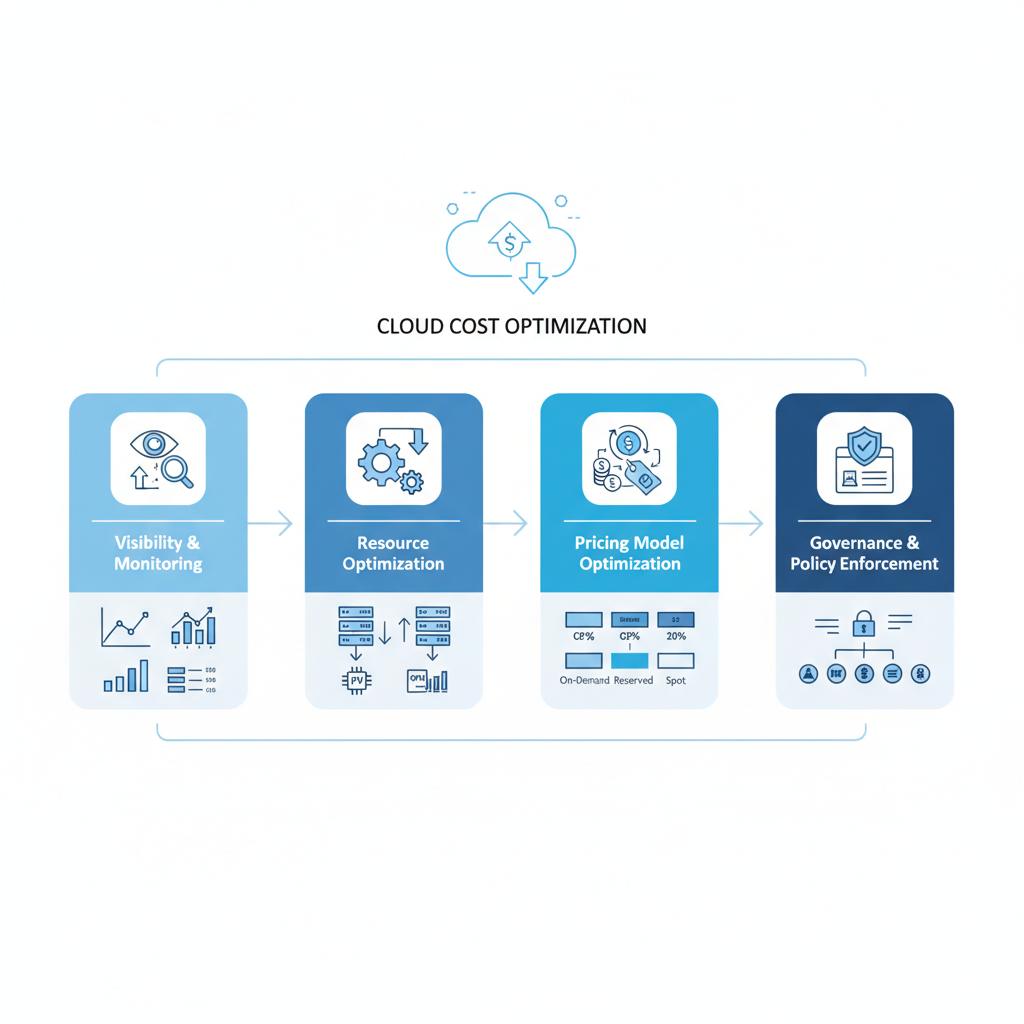
Visibility and Monitoring
The first step in controlling costs is understanding where your money is going. Comprehensive visibility provides a clear picture of your cloud spend across all accounts, services, and regions. Spend tracking tools aggregate billing data, allowing you to see granular breakdowns by project, team, or application.
Resource monitoring solutions offer real-time insights into resource utilization, helping identify idle or underutilized assets. Without this initial transparency, any attempts at optimization are merely guesswork. It forms the bedrock for informed decision-making.
Resource Optimization
Once you have visibility, the next principle involves actively optimizing your cloud resources. This means ensuring that you provision resources that exactly match your workload requirements, avoiding both over-provisioning and under-provisioning. Smart optimization can significantly impact your bottom line.
Key strategies include rightsizing instances, which involves adjusting compute and memory to suit actual usage patterns. Deleting idle resources, such as unattached storage volumes or unused snapshots, also yields immediate savings. Furthermore, scheduling resources to power off during non-business hours for development or staging environments can drastically reduce costs.
Pricing Model Optimization
Leveraging the various pricing models offered by cloud providers is another crucial principle. Cloud providers offer discounts for commitments, and understanding these options can unlock substantial savings. This requires careful planning and analysis.
Reserved Instances (RIs) and Savings Plans allow you to commit to a certain amount of usage over a period (e.g., 1-3 years) in exchange for a significant discount. Spot Instances offer even greater savings for fault-tolerant workloads that can tolerate interruptions. Cost analysis tools can help determine the optimal mix of these models for your specific needs.
Governance and Policy Enforcement
Establishing clear policies and governance structures is essential for long-term cost control. This involves defining rules around resource provisioning, tagging, and usage. Automation plays a critical role in enforcing these policies consistently.
Well-defined governance prevents cloud sprawl and ensures that resources are always provisioned and managed according to best practices. Automation tools for cloud can automatically enforce these policies, ensuring that resources are tagged correctly, rightsized, or shut down when no longer needed. This proactive approach sustains optimization efforts over time.
A detailed infographic illustrating the four core principles of cloud cost optimization: Visibility & Monitoring, Resource Optimization, Pricing Model Optimization, and Governance & Policy Enforcement, with icons representing each concept.
✓ Free consultation ✓ No commitment required ✓ Trusted by experts
Key Features to Look for in cloud cost optimization tools
Choosing the best cloud cost optimization tools requires evaluating a suite of features that align with your organizational needs and cloud strategy. Modern optimization platforms go beyond simple reporting, offering sophisticated capabilities designed to maximize efficiency. Consider these essential features when selecting your cloud cost management software.
Comprehensive cost visibility is paramount, offering interactive dashboards and customizable reports that break down spending by service, region, account, and custom tags. This allows teams to quickly pinpoint cost drivers and areas for improvement. Granular data is crucial for effective decision-making.
Anomaly detection provides alerts for unexpected spikes in spending, allowing immediate investigation and action before costs get out of hand. These proactive notifications prevent costly surprises. Such alerts are often powered by machine learning algorithms that learn historical spending patterns.
Resource rightsizing recommendations, often AI-driven, suggest optimal instance types and sizes based on actual usage data. This eliminates guesswork and ensures you’re not paying for over-provisioned resources. These recommendations are a cornerstone of efficiency software.
Reserved Instance (RI) and Savings Plan management capabilities analyze your historical usage to recommend optimal purchase strategies. They help you buy and manage commitments effectively, ensuring you get the best discounts without over-committing. These features are critical for long-term savings.
Budgeting and forecasting tools allow you to set financial limits and predict future cloud spend based on current trends. This empowers teams to stay within budget and plan for future resource needs. Accurate forecasting is a key benefit of advanced cost analysis tools.
Tagging and allocation features facilitate granular cost allocation by department, project, or cost center. Proper tagging is fundamental for chargeback and showback models, fostering accountability across teams. These capabilities transform raw spending data into actionable financial insights.
Automation capabilities are increasingly vital, enabling automatic shutdown of idle resources, enforcement of tagging policies, and even automated adjustments based on usage. Automation tools for cloud free up valuable engineering time and ensure continuous optimization. This removes manual effort and ensures consistency.
Multi-cloud support is essential for organizations leveraging multiple cloud providers or hybrid environments. A unified view across all your cloud platforms simplifies management and provides a holistic optimization strategy. This prevents blind spots in your spend analysis.
Seamless integration with existing ITSM, FinOps, and billing systems ensures data consistency and streamlines workflows. APIs and connectors simplify the integration process, making the optimization platform a central part of your cloud ecosystem. Strong integrations enhance the utility of any cloud cost optimization tools.
Robust reporting and analytics provide deep insights into cost trends, waste areas, and optimization opportunities. These cost analysis tools offer visual data exploration, custom reports, and export options for further analysis. They help transform raw data into a clear cloud cost optimization tools guide for ongoing improvement.
Types of cloud cost optimization tools
The market for cloud cost optimization tools offers a diverse range of solutions, each with distinct advantages and use cases. Understanding these categories helps in selecting the best cloud cost optimization tools for your specific environment and business objectives. From native offerings to specialized platforms, choices abound.
Native cloud provider tools, such as AWS Cost Explorer, Azure Cost Management, and Google Cloud Cost Management, are often the first stop for many organizations. They offer deep integration with their respective cloud services and are typically free or included with your cloud subscription. These tools provide fundamental visibility and basic recommendations within a single cloud environment.
While effective for initial insights, their primary limitation is a lack of multi-cloud visibility and sometimes less advanced features compared to dedicated third-party solutions. They are excellent for understanding individual cloud spend but may fall short for complex multi-cloud strategies. They are foundational cloud cost management software.
Third-party commercial optimization platforms, often referred to as FinOps platforms, offer comprehensive, multi-cloud capabilities. Examples include dedicated optimization platforms that provide advanced analytics, cross-cloud visibility, sophisticated automation tools for cloud, and detailed cost analysis tools. These platforms are designed to tackle the complexities of large-scale, multi-provider environments.
These solutions typically come with a cost, but they deliver significant ROI through enhanced features like predictive analytics, anomaly detection, and advanced governance. They often provide extensive support and a more mature feature set, making them invaluable efficiency software for enterprises. For those seeking the best cloud cost optimization tools, these platforms are often top contenders.
Open-source tools represent another category, though less common for comprehensive cloud cost optimization. Projects like Kubecost for Kubernetes environments or various scripts and dashboards built on cloud APIs can offer flexibility and customization. They are ideal for specific optimization tasks or for organizations with strong in-house technical expertise.
The main advantages are typically cost-effectiveness and adaptability, while potential drawbacks include a greater need for maintenance, less comprehensive feature sets, and a reliance on community support. These tools often serve as valuable components within a broader cloud cost optimization tools guide strategy, addressing niche requirements.
Implementing and Maximizing Your Optimization Platform
Successfully implementing and maximizing the value of your chosen cloud cost optimization tools requires a structured approach. It’s not just about installing software; it’s about integrating the platform into your organizational workflows and culture. This process transforms how your teams manage cloud resources.
Phase 1: Assessment and Baseline
Begin by conducting a thorough assessment of your current cloud environment and spending patterns. Identify your biggest cost drivers, areas of waste, and immediate quick wins. This baseline understanding is crucial for measuring the success of your optimization efforts. Engage stakeholders to understand their needs and challenges.
Phase 2: Tool Selection
Based on your assessment, organizational needs, and multi-cloud strategy, select the best cloud cost optimization tools. Consider factors like multi-cloud support, automation capabilities, reporting features, and integration with your existing infrastructure. This critical choice impacts the effectiveness of your entire strategy.
Phase 3: Integration and Configuration
Once selected, integrate the optimization platform with your cloud accounts and other relevant systems. Configure dashboards, set up alerts, and define reporting parameters tailored to your organizational structure. Ensure all relevant data sources are connected to provide a complete picture.
Phase 4: Optimization Strategy Development
Develop a comprehensive optimization strategy that leverages the features of your new cloud cost management software. This includes defining policies for resource rightsizing, purchasing Reserved Instances or Savings Plans, and implementing scheduling for non-production environments. Clearly communicate these policies across teams.
Phase 5: Continuous Monitoring and Refinement
Cloud cost optimization is an ongoing process, not a one-time event. Continuously monitor your cloud spend and resource utilization using the tool’s analytics. Regularly review reports, identify new optimization opportunities, and refine your strategies based on evolving business needs and cloud provider offerings. This is where consistent application of cloud cost optimization tools tips truly pays off.
A step-by-step flowchart illustrating the implementation process of cloud cost optimization tools, starting from “Assess Current Spend” and progressing through “Select Tool,” “Integrate & Configure,” “Develop Strategy,” and “Continuous Monitoring.”
Common Challenges and How to Overcome Them
Implementing and maintaining effective cloud cost optimization can present several challenges. Organizations often face hurdles that can impede their progress, even with the most sophisticated optimization platforms. Recognizing and addressing these issues is key to sustained success.
One common challenge is the lack of organizational buy-in, particularly from engineering teams who prioritize speed over cost. Overcome this by educating stakeholders on the ROI of optimization, demonstrating how freed-up budget can fuel innovation and improve resource availability. Frame optimization as a shared responsibility rather than a burden.
The inherent complexity of cloud environments, with countless services and pricing models, can lead to data overload. Utilize the dashboards and custom reports provided by spend tracking tools to simplify information. Focus on high-impact areas first, breaking down the optimization journey into manageable sprints. This approach prevents teams from feeling overwhelmed.
Resistance to change is another significant hurdle. Teams might be hesitant to adopt new processes or relinquish control over resource provisioning. Emphasize the long-term benefits for them, such as more stable budgets, clearer visibility into their own spend, and better resource allocation that supports their project goals. Highlighting these positive outcomes encourages adoption.
Concerns about vendor lock-in can also arise, especially when relying heavily on a single optimization platform. Mitigate this by choosing multi-cloud optimization platforms that offer flexibility and compatibility across different providers. Ensure your chosen solution enhances, rather than restricts, your strategic cloud choices. This foresight is crucial for long-term adaptability.
Finally, ensuring continuous optimization requires ongoing effort and diligence. It’s not a set-it-and-forget-it task. Implement regular reviews, integrate optimization into DevOps pipelines, and leverage automation tools for cloud to enforce policies consistently. Effective resource monitoring solutions are vital for sustained efficiency, acting as an early warning system for new inefficiencies.
Future Trends in Cloud Financial Management
The landscape of cloud cost optimization tools is continuously evolving, driven by innovation and the increasing maturity of cloud adoption. Staying abreast of these future trends is crucial for any organization looking to maintain a competitive edge and maximize their cloud investments. The best cloud cost optimization tools will embrace these advancements.
Artificial Intelligence (AI) and Machine Learning (ML) are becoming central to cloud cost optimization. These technologies enable smarter recommendations, predictive analytics for future spend, and more accurate anomaly detection. AI-driven systems can automatically identify complex patterns of waste and suggest the most efficient resource configurations.
The FinOps maturity model is gaining widespread adoption, emphasizing a cultural shift towards collaborative cloud financial management. It integrates finance, technology, and business teams to drive cost-conscious decisions throughout the cloud lifecycle. This holistic approach leverages cloud cost management software as a central pillar for organizational alignment.
Automated governance is another significant trend, moving beyond simple alerts to proactive, self-healing systems. More sophisticated automation tools for cloud will automatically adjust resources, enforce tagging policies, and even implement cost-saving actions without manual intervention. This reduces human error and ensures policies are consistently applied.
Furthermore, sustainability is emerging as a critical factor in cloud optimization. Organizations are increasingly looking to optimize not just for cost but also for environmental impact. Future efficiency software will provide insights into the carbon footprint of cloud resources, allowing businesses to make greener choices while also saving money. This aligns financial goals with environmental responsibility.
The continuous evolution of cloud cost optimization tools will ensure they remain vital for businesses navigating their cloud journeys. As cloud environments grow in complexity, these advanced platforms will be indispensable for maintaining control, driving efficiency, and achieving strategic financial goals.
✓ Free consultation ✓ No commitment required ✓ Trusted by experts
Conclusion
Mastering cloud costs is no longer just a technical challenge; it’s a strategic business imperative. Cloud cost optimization tools empower organizations to gain essential visibility, implement effective controls, and drive continuous efficiency across their cloud estates. By embracing the principles outlined in this cloud cost optimization tools guide, you can transform your cloud spending from an uncontrolled expense into a strategic advantage.
Investing in the best cloud cost optimization tools allows you to proactively manage resources, leverage optimal pricing models, and enforce robust governance policies. This not only reduces waste but also frees up valuable budget for innovation and growth. A well-optimized cloud environment is more resilient, more agile, and ultimately, more profitable. Take control of your cloud spend today and unlock the full potential of your digital transformation.
Johan Carlsson is a cloud architecture specialist and frequent speaker focused on scalable workloads, AI/ML, and IoT innovation. At Opsio, he helps organizations harness cutting-edge technology, automation, and purpose-built services to drive efficiency and achieve sustainable growth. Johan is known for enabling enterprises to gain a competitive advantage by transforming complex technical challenges into powerful, future-ready cloud solutions.